
Photochemical efficiency and variation in photosynthetic pigments in Nothofagus pumilio seedlings growing under light intensity and soil moisture gradients
iForest - Biogeosciences and Forestry, Volume 19, Issue 4, Pages 311-320 (2026)
doi: https://doi.org/10.3832/ifor5020-019
Published: Aug 19, 2026 - Copyright © 2026 SISEF
Research Articles
Abstract
Regeneration dynamics in forest ecosystems depend on seedlings’ ability to persist in shaded understories and, following canopy opening, to rapidly adjust physiologically to new, contrasting light and soil moisture conditions. In this study, we examined the real-time efficiency of the photosynthetic apparatus and the short- to intermediate-term acclimatory response of photosynthetic pigments on Nothofagus pumilio seedlings exposed to different light and soil moisture levels. We evaluated phenology, chlorophyll fluorescence and pigment content in leaves, on 2-3 years-old seedlings in a controlled greenhouse experiment with three levels of light intensity (low = 4%, medium = 26%, high = 64% of the natural incident irradiance) and two levels of soil moisture (optimal = 40-60%, excess = 80-100% of soil field capacity). We measured six samples per treatment (light intensity × soil moisture levels) monthly during one growing season (n = 216). Data were analyzed by multiple ANOVAs. Although maximum quantum yield remained stable (> 0.80) across treatments, seedlings exhibited differential eco-physiological responses primarily driven by light availability. Structural investment was synergistic and negatively affected by the light × soil moisture interaction, resulting in reduced leaf production, chlorophyll, and carotenoids during peak season under the high-light and excess-soil-moisture treatment. Seedlings under medium light showed optimal performance, with maximum pigment accumulation and high PSII efficiency without signs of chronic photoinhibition. N. pumilio seedlings decouple short-term functional photochemical efficiency from their structural investment strategy (pigment content), a mechanism that ensures survival under variable canopy cover but results in reduced growth under sub-optimal conditions.
Keywords
Acclimation, Chlorophyll Fluorescence, Photoprotection, Phenotypic Plasticity, Nothofagus pumilio
Introduction
Understanding forest regeneration dynamics is essential for ensuring their conservation and predicting their responses to natural and anthropogenic disturbances. Nothofagus pumilio (Poepp. et Endl.) Krasser is a native tree species of high ecological and economic importance, widely distributed across Chilean and Argentine Patagonia ([9]). In these forests, tree regeneration commonly persists in the shaded understory for extended periods ([44], [45]). This leads to the formation of a seedling bank ([7]) that responds to canopy gaps caused by windstorms, logging, exotic beaver activity, or avalanches ([15], [17], [31]). As regeneration in southern temperate forests is largely driven by gap dynamics, current silvicultural prescriptions for N. pumilio forests in Tierra del Fuego focus on creating canopy openings to promote natural regeneration ([5]). These management approaches are implemented through harvesting systems such as shelterwood cuts ([27]) and variable-retention harvesting ([13]), which modify canopy structure and resource availability. Light and soil moisture are among the most critical factors affecting the growth and survival of understory seedlings in austral forests ([16], [29], [45]). As a mid-tolerant to shade species, N. pumilio responds positively to moderate light intensity ([30]). Although low soil water availability is a known limiting factor, excessive soil moisture can also negatively affect seedling performance, particularly in mesic forest species ([18]). For example, in N. pumilio forests, site quality decreases when soil moisture exceeds around 60% of field capacity ([28]), as reduced soil aeration and altered nutrient dynamics constrain root functioning and resource uptake ([41], [58]). Although several studies evaluated N. pumilio seedlings under extreme conditions, the eco-physiological mechanisms underlying their responses to sudden changes in light and soil resources remain poorly understood ([41]).
Following tree logging, seedling survival and rapid growth depend on their ability to adjust to new microclimatic conditions ([51], [52], [35]).
While previous studies have characterized the growth and gas exchange patterns of N. pumilio under different regimes ([23], [30]), the underlying photochemical mechanism remains unexplored. Understanding the interaction between light and water availability helps explain how soil moisture stress significantly modulates a plant’s ability to process light energy ([20]). When soil moisture is excessive, metabolic limitations and reduced nutrient uptake often decrease CO2 assimilation rates, creating a “sink limitation”. In these conditions, absorbed light energy exceeds the processing capacity of the photosynthetic apparatus, potentially intensifying photo-oxidative stress under the high irradiance levels typical of canopy gaps ([37]).
To evaluate these complex responses, we combined chlorophyll fluorescence and pigment analysis. Both approaches provide complementary information about plants’ eco-physiological adaptation capacity. Chlorophyll fluorescence reveals the real-time operational efficiency of the photosynthetic apparatus, whereas pigment content reflects dynamic acclimatory responses over short- to intermediate-timescales. Specifically, adjustments in light-harvesting pigments (chlorophyll a and b) and photoprotective pigments (carotenoids) involve structural and biochemical regulation in response to specific environmental conditions. Assessing these factors is essential to distinguish between short-term functional resilience and structural impairment under environmental stress. In this context, evaluating physiological traits can provide valuable insights into stress levels, light-use efficiency, and the growth potential of tree seedlings under different understory conditions.
To analyze the effects of light and soil moisture on N. pumilio seedling physiology, we conducted a controlled greenhouse experiment. This setup simulated different harvesting scenarios, such as those resulting from canopy openings created by variable retention and shelterwood cuts in Tierra del Fuego ([28], [29], [30], [21]). The objective was to estimate the real-time efficiency of the photosynthetic apparatus and the short- to intermediate-term acclimatory response of photosynthetic pigments in N. pumilio seedlings exposed to different light intensities and soil moisture levels. We assessed this by measuring chlorophyll fluorescence and photosynthetic pigment content in leaves over a six-month growing season. We hypothesized that light intensity and soil moisture interact synergistically to determine the physiological performance of N. pumilio seedlings, such that extreme combinations (high light and excess soil moisture) reduce photochemical efficiency (ΦPSII, qP) and increase photoprotective responses (NPQ and carotenoids). In contrast, intermediate light conditions and optimal soil moisture promote higher chlorophyll content and maintain photochemical performance, resulting in a unimodal physiological response across the light gradient modulated by soil moisture availability. This approach allows understanding of how N. pumilio natural regeneration responds to contrasting environments in terms of photosynthetic function and acclimation to light and water availability.
Materials and methods
Plant material and microclimate growing conditions
Seedlings of N. pumilio, 2-3 years old, measuring 6-7 cm in height, were obtained from the understory of mature forests (54° 06′ S, 68° 37′ W). Seedlings were collected in September, at the beginning of the spring season in the Southern Hemisphere, before budburst, from stands with high canopy cover (94 ± 5%). Seedlings were transplanted into plastic pots (14 cm diameter and 15 cm height) filled with a substrate of peat/sand/forest soil (1:1:1). The substrate corresponded to a clay loam soil (sand-silt-clay, 36-24-40%) with 7% organic matter, pH 4.99, and soil field capacity of 81% ([28]).
Incident solar radiation during the growing season (October to March) averaged 2085 ± 534 µmol m-2 s-1, with a maximum absolute value of 2702 µmol m-2 s-1. Plants were grown in a greenhouse in Ushuaia city (Tierra del Fuego - 54° 46′ S, 68° 12′ W) during one growing season, under a 100 µm commercial nylon cover to prevent natural rainfall. Three light intensity treatments were established using zero, one, or two layers of commercial black shade cloth: high (1334.4 ± 235.82 µmol m-2 s-1, i.e., 64% of natural irradiance), medium (542.1 ± 74.65 µmol m-2 s-1, 26%), and low (83.4 ± 61.97 µmol m-2 s-1, 4%). The low-light-intensity treatment simulated the light conditions typically found in primary forests, while the medium- and high-intensity treatments represented conditions typical of harvested stands with varying canopy opening (see [30] for more details).
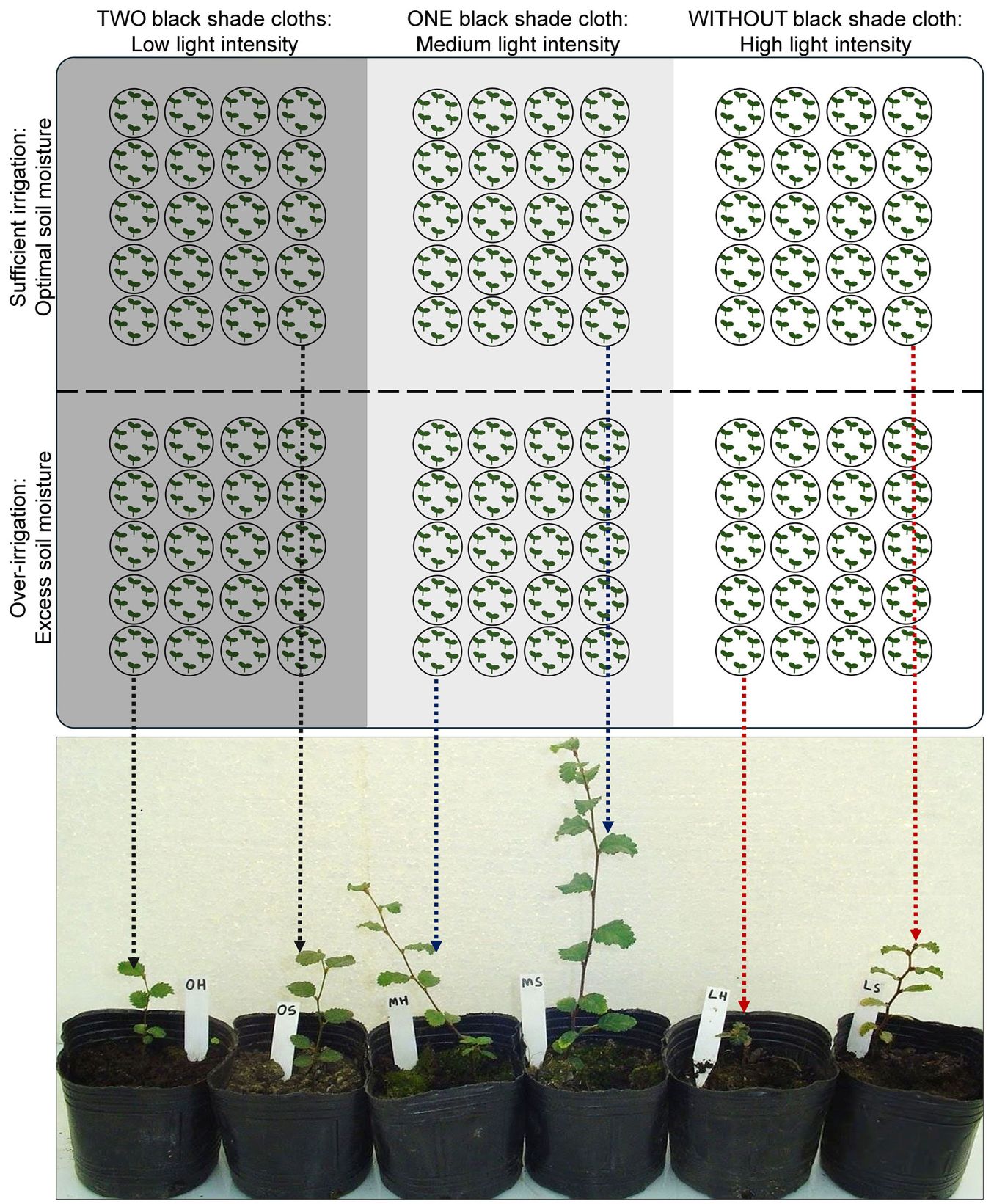
Temperature was controlled via forced ventilation to ensure that canopy-level temperature did not exceed 24 °C. Air humidity, as well as air and soil temperatures, was continuously monitored in each light-intensity treatment using data loggers throughout the study period (Fig. S1 in Supplementary material). Soil water content was actively managed through manual irrigation to maintain two distinct treatment levels: half of the plants were kept at 40-60% of soil field capacity (optimal soil moisture), while the other half were maintained at 80-100% (excess soil moisture), representing a potential stress condition. For each combination of light level and soil moisture, six blocks of 40 plastic pots were allocated in distinct positions within the greenhouse (Fig. 1). Irrigation in the greenhouse varied according to the combination of light and soil moisture treatments (six treatments in total) and was controlled gravimetrically every 3 days throughout the growing season in response to seasonal changes in temperature and evaporative demand. Pot weight was monitored, and when pots approached the lower threshold of each soil moisture treatment (40% for optimal moisture and 80% for excess moisture), they were irrigated up to the upper limit of the corresponding range. Treatments under low and medium light levels required lower irrigation frequency, with 13 to 23 irrigation events applied throughout the growing season, whereas treatments under high light intensity required more frequent irrigation to keep pots within the target soil moisture range (36 to 45 irrigation events). Most of the seedlings survived transplanting, with a mortality rate of 0.5% to 2.4% in spring. During the first week of each month of the growing season (October to March), six plastic pots per block per treatment were randomly chosen for measurements (6 seedlings × 6 treatments × 6 months, n = 216).
Fig. 1 - Conceptual diagram of the arrangement of Nothofagus pumilio seedlings within the greenhouse, along with a comparative photo of seedlings for each treatment taken at the end of the growing season (March). Six blocks were established for each combination of soil moisture treatments (optimal soil moisture; excess soil moisture) and light intensity treatments (low light intensity; medium light intensity; high light intensity).
Sampling and measurements
Phenological status was monitored monthly from the beginning of spring (September) to the beginning of autumn (March). Each month, 30 plants were randomly selected from each treatment, and their phenological stages were recorded, including budburst, leaf unfolding, full leaf expansion, appearance of first red leaves, red leaves, and complete leaf fall. We also recorded the number of leaves per plant as a proxy for vegetative growth. This metric has been used as an indicator of seedling vigor and meristematic activity in response to environmental stress ([40]).
For chlorophyll fluorescence measurements, randomly selected pots were moved to controlled laboratory conditions (12-14 °C in complete darkness) for an 8-hour acclimation period before measurements. Chlorophyll fluorescence was assessed in the first fully expanded, intact leaf that remained attached to the stem. Measurements were taken on one leaf per plant, with six plants per treatment (n = 6 leaves per treatment), using a Chlorophyll fluorometer (Model S151, Qubit Systems, Kingston, Ontario, Canada). This instrument uses a pulsed LED light source (peak wavelength 660 nm, 50 Hz) to excite chlorophyll fluorescence without inducing photosynthesis. Emitted fluorescence is detected through a long-pass filter (>700 nm), ensuring that only the fluorescence emitted by the leaf in response to the pulsed LED is measured. This setup enables precise detection across a wide range of irradiance levels, from complete darkness to saturated light conditions. Each leaf was exposed to a saturation pulse of high light intensity (2250 µmol m-2 s-1) for five seconds to determine the following fluorescence variables: fluorescence in the absence of photosynthetic light (F0), which occurs when all PSII reaction centres are open; maximum fluorescence level (Fm), which occurs when all reaction centres are closed; variable fluorescence (Fv), that is the difference between F0 and Fm; maximum fluorescence under illuminated conditions (F′m); steady-state yield of fluorescence in the light (Ft); and zero level fluorescence in the light (F′0). From chlorophyll fluorescence parameters, the following coefficients were calculated: the effective quantum yield of PSII photochemistry (ΦPSII = [F′m-Ft]/ F′m - [33]); photochemical quenching (qP = [F′m-Ft]/[F′m-F′0] - [12]); maximum quantum yield of PSII in dark-adapted leaves (Fv/Fm - [3]); and non-photochemical quenching (NPQ = [Fm/F′m]-1 - [2]). These standard parameters are widely used to assess photosynthetic responses, such as diurnal photoinhibition and water stress ([6]), and to model light-response curves of ΦPSII ([56]).
Complementarily, chlorophyll and carotenoid contents were determined by a spectrophotometric method applied in Lichtenthaler & Babani ([26]). Fresh leaf discs (0.5 cm2) were obtained from the first fully expanded leaf of the same plants where chlorophyll fluorescence was measured, and processed immediately after collection. Each leaf disc was placed in 2 ml of an aqueous acetone-Tris buffer solution (80% v/v, pH 7.8). This solution was centrifuged at 1610 × g for 10 minutes at 20 °C. The supernatant was used to determine absorbance at 470, 537, 647 and 663 nm with a spectrophotometer to quantify pigment concentrations and contents according to Sims & Gamon ([47]), including chlorophyll a (ChlA, mmol m-2), chlorophyll b (ChlB, mmol m-2), total chlorophyll (ChlT, mmol m-2), ratio between chlorophyll a and b (ChlA/ChlB), carotenoids (Car, mmol m-2), and ratio between total chlorophyll and carotenoids (ChlT/Car).
Statistical analyses
For each response variable (number of leaves, fluorescence and pigment variables), a three-way analysis of variance (ANOVA) was performed, with month (October to March), light intensity (4%, 26%, and 64% of the natural incident irradiance) and soil moisture (40-60%, and 80-100% soil field capacity) as fixed factors, including all possible interactions among factors. Because most variables showed significant interactions, we analyzed simple effects by performing post hoc comparisons for each factor at each level of the interacting factor (e.g., light intensity within each month) using Tukey’s multiple range test (α = 0.05). Statistical analyses were performed in R ([43]).
Correlation analyses were conducted among the response variables to evaluate their relationships. Principal Component Analyses (PCA) were performed on a matrix of 36 rows and 7 columns to rank and visualize multivariate responses of plants by integrating pigment-related variables with chlorophyll fluorescence parameters across treatments at three representative periods of the growing season: early spring (October), mid-summer (January), and late summer/early autumn (March). A subset of eco-physiological variables was selected for the PCA analyses to reduce redundancy among correlated traits, prioritizing variables with stronger contributions to the principal components and clearer treatment-related responses. Correlation analyses and PCAs were performed using the “vegan” package ([39]) in R ([43]).
Results
Phenology and leaf production
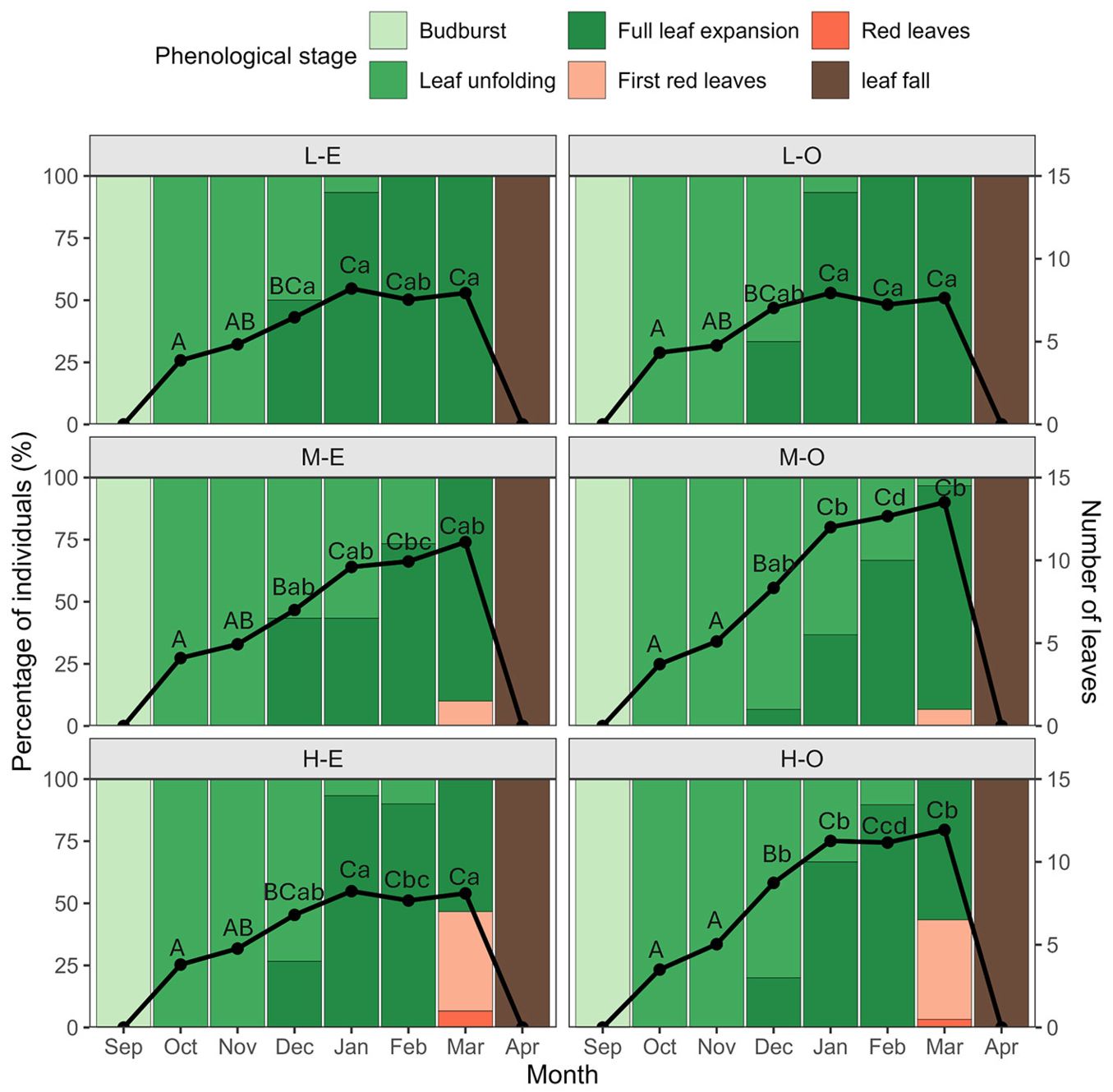
The phenological status of the seedlings defined the study period, which extended from October to March (Fig. 2). At the beginning of spring (September), all seedlings were at the budburst stage, followed by leaf unfolding during October and November. From December onwards, distinct patterns emerged in both the rate of leaf development and the total number of leaves. Seedlings reached an early plateau in leaf number by early December across three treatments (the two low-light conditions and the high-light-excess-soil-moisture treatment). Consequently, in these treatments, the highest proportion of leaves was fully expanded in January, and leaf number remained stable up to the end of the growing season (Tab. 1, Fig. 2). In contrast, leaf number continued to increase significantly after December in the other treatments, resulting in a higher proportion of plants still bearing expanding leaves during this period. Red leaves appeared early under medium and high light intensities (March), with the highest proportion in the high-light treatments. The final leaf number was significantly higher under medium and high light with optimal soil moisture (Tab. 1, Fig. 2). By April, all treatments showed complete leaf loss.
Fig. 2 - Seasonal progression of phenological stages (stacked bars, left Y-Axis) and leaf number (black line and points, right Y-Axis) in Nothofagus pumilio seedlings under the six studied treatments (combinations of light intensity and soil moisture), representing the interactions shown in Tab. 1. Different capital letters indicate significant differences among months within treatments, whereas lowercase letters indicate significant differences among treatments within each month (Tukey test, p < 0.05). (L-E): low light intensity × excess soil moisture; (L-O): low light intensity × optimal soil moisture; (M-E): medium light intensity × excess soil moisture; (M-O): medium light intensity × optimal soil moisture; (H-E): high light intensity × excess soil moisture; (H-O): high light intensity × optimal soil moisture.
Tab. 1 - ANOVA results for the number of leaves in Nothofagus pumilio seedlings along the growing season, considering month, light intensity, and soil moisture levels as factors and their interactions. (df): Degrees of freedom.
| Effects | df | Number of leaves | |
|---|---|---|---|
| F statistics | p-value | ||
| Month | 5 | 126.48 | <0.001 |
| Light | 2 | 38.21 | <0.001 |
| Moisture | 1 | 38.28 | <0.001 |
| Month: Light | 10 | 6.33 | <0.001 |
| Month: Moisture | 5 | 3.97 | 0.002 |
| Light: Moisture | 2 | 10.14 | <0.001 |
| Month: Light: Moisture | 10 | 1.78 | 0.067 |
Chlorophyll fluorescence
All raw fluorescence parameters (F0, Fm, F′m, Ft, and F′0) were significantly affected by the three main factors studied, with multiple significant interactions (Tab. S1 in Supplementary material), indicating a complex response at the signal level. In contrast, the derived physiological coefficients (ΦPSII, qP, Fv/Fm, and NPQ) were driven by simpler dynamics, primarily affected by seasonal variation and light intensity, whereas soil moisture had no significant effect on the main physiological coefficients (Tab. 2). Light intensity modulated the temporal dynamics of three coefficients (ΦPSII, qP, and NPQ), generating distinct seasonal patterns (Tab. 2, Fig. 3). Fv/Fm was the most stable parameter to the influence of light and soil moisture, varying only across the season (p<0.01).
Tab. 2 - ANOVA results of fluorescence coefficients in Nothofagus pumilio seedlings along the growing season, considering month, light intensity, and soil moisture levels as factors and their interactions. (ΦPSII): PSII photochemical efficiency; (qP): photochemical quenching; (Fv/Fm): maximum quantum yield of PSII; (NPQ): non-photochemical quenching; (df): degrees of freedom; (F-stat): F statistics.
| Effects | df | ΦPSII | qP | Fv/Fm | NPQ | ||||
|---|---|---|---|---|---|---|---|---|---|
| F-stat | p-value | F-stat | p-value | F-stat | p-value | F-stat | p-value | ||
| Month | 5 | 56.6 | <0.001 | 50.1 | <0.001 | 5.8 | <0.001 | 18.9 | <0.001 |
| Light | 2 | 1.7 | 0.193 | 0.9 | 0.415 | 0.7 | 0.488 | 5.9 | 0.003 |
| Moisture | 1 | 2.9 | 0.091 | 3.8 | 0.052 | 0.2 | 0.628 | 0.2 | 0.628 |
| Month × Light | 10 | 2.1 | 0.029 | 2.4 | 0.01 | 1.0 | 0.413 | 3.9 | <0.001 |
| Month × Moisture | 5 | 0.6 | 0.722 | 0.8 | 0.553 | 0.7 | 0.592 | 1.8 | 0.119 |
| Light × Moisture | 2 | 0.9 | 0.394 | 0.5 | 0.615 | 1.6 | 0.205 | 0.2 | 0.795 |
| Month × Light × Moisture | 10 | 0.6 | 0.831 | 0.5 | 0.871 | 1.1 | 0.357 | 1.4 | 0.178 |
Fig. 3 - Fluorescence coefficients in Nothofagus pumilio across months for the three light intensity treatments, representing the interactions shown in Tab. 2. The data average the values of the two soil moisture treatments because soil moisture does not interact with the other two factors. (ΦPSII): efficiency of PSII photochemistry; (qP): photochemical quenching; (Fv/Fm): maximum quantum yield of PSII; (NPQ): non-photochemical quenching. Error bars represent the standard error. Values followed by different capital letters represent significant differences (p <0.05) among months for each light intensity treatment, while lower-case letters represent significant differences (p <0.05) among light intensity levels for each month, according to the Tukey test. Underlined capital letters indicate significant differences (p <0.05) among months when light treatments are pooled, i.e., when no interaction between month and light was detected.
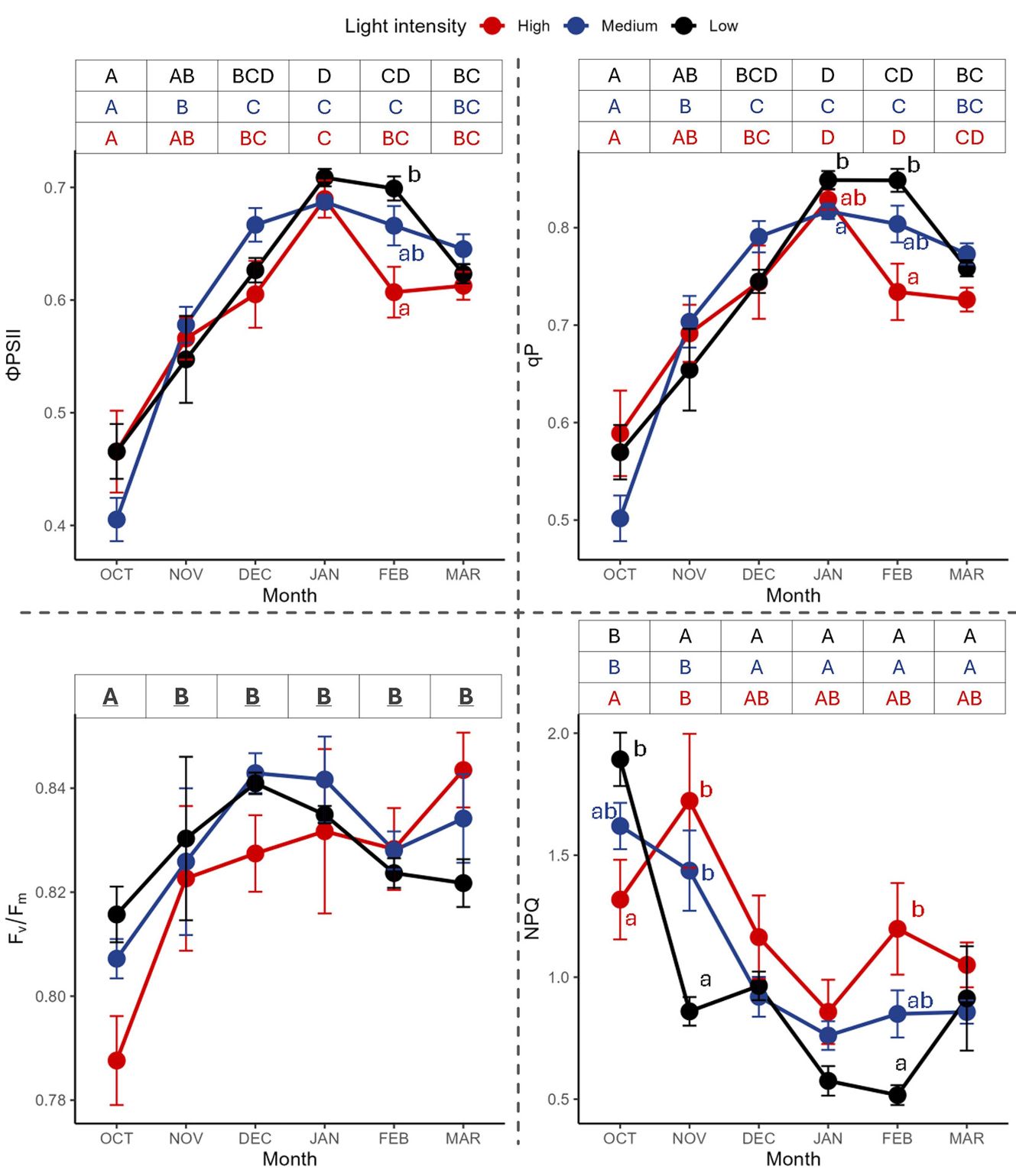
The efficiency of PSII photochemistry (ΦPSII) and photochemical quenching (qP) showed a consistent seasonal pattern, with low values at the beginning of the growing season, a peak during mid-season, and a decline towards the end of the growing season. This reflects the seasonal trajectory of photosynthetic capacity, from initial development through peak performance to senescence. Light intensity modulated the temporal trend, reducing photochemical efficiency in late summer via photoinhibition or greater reliance on photoprotective mechanisms under high irradiance (Fig. 3). Non-photochemical quenching (NPQ) showed contrasting responses depending on light conditions, reflecting shifts in photoprotective strategies. Under low light, NPQ was higher at the beginning of the season, whereas under high light, it increased during mid- to late season, indicating enhanced energy dissipation at higher irradiance (Fig. 3).
Photosynthetic pigments content
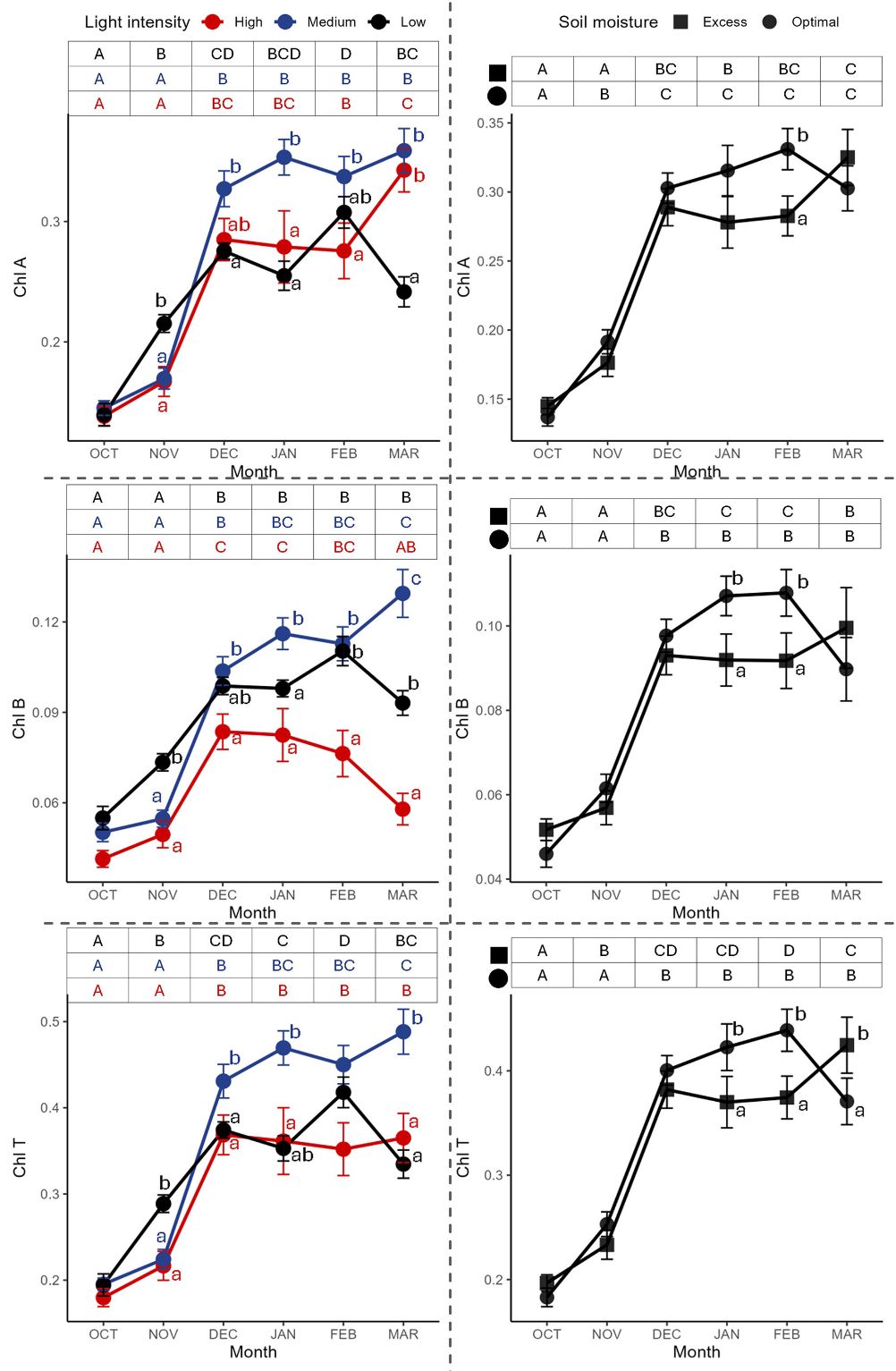
Photosynthetic pigment content in Nothofagus pumilio seedlings exhibited clear acclimation to light levels throughout the growing season, while also being influenced by soil moisture (Tab. 3). Chlorophyll a (ChlA), chlorophyll b (ChlB), and total chlorophyll (ChlT) were strongly and positively correlated with each other (Tab. S3 in Supplementary material) and varied according to the interactions between month × light intensity and between month × soil moisture. Treatment effects on pigment concentrations were not evident at the onset of the growing season. However, as the season progressed, clear differences emerged across light treatments. Seedlings under low light initially accumulated higher chlorophyll concentrations, whereas from mid-season onwards, those under medium light consistently exhibited the highest values, reaching peak levels towards the end of the growing season (Fig. 4). Differences in pigment composition were also observed, with higher ChlB under low light compared to high light, while ChlA showed less consistent variation among treatments (Fig. 4). With respect to soil moisture treatment across the growing season, a similar pattern was observed for all three variables. Differences emerged in mid-summer, when seedlings under optimal soil moisture exhibited higher chlorophyll concentrations, whereas in March this trend was reversed only for ChlT (Fig. 4).
Tab. 3 - ANOVA results of pigment content variables in Nothofagus pumilio seedlings along the growing season, considering month, light intensity, and soil moisture levels as factors and their interactions. (ChlA): chlorophyll a (mmol m-2); (ChlB): chlorophyll b (mmol m-2); (ChlT): total chlorophyll (mmol m-2); (ChlA/ChlB): ratio between chlorophyll a and b; (Car): carotenoids (mmol m-2); (ChlT/Car): ratio between total chlorophyll and carotenoids; (df): degrees of freedom; (F-stat): F statistics.
| Effect | df | ChlA | ChlB | ChlT | Car | ChlA/ChlB | ChlT/Car | ||||||
|---|---|---|---|---|---|---|---|---|---|---|---|---|---|
| F-stat | p-value | F-stat | p-value | F-stat | p-value | F-stat | p-value | F-stat | p-value | F-stat | p-value | ||
| Month | 5 | 81.3 | <0.001 | 65.2 | <0.001 | 75.1 | <0.001 | 34.8 | <0.001 | 83.8 | <0.001 | 14.2 | <0.001 |
| Light | 2 | 14.8 | 0.000 | 58.7 | <0.001 | 20.0 | <0.001 | 261.4 | <0.001 | 18.6 | <0.001 | 94.7 | <0.001 |
| Moisture | 1 | 4.3 | 0.040 | 3.8 | 0.052 | 2.7 | 0.101 | 0.1 | 0.760 | 0.4 | 0.513 | 5.8 | 0.017 |
| Month: Light | 10 | 5.9 | <0.001 | 7.3 | <0.001 | 4.7 | <0.001 | 52.0 | <0.001 | 4.0 | <0.001 | 5.0 | <0.001 |
| Month: Moisture | 5 | 2.7 | 0.022 | 3.1 | 0.010 | 3.8 | 0.002 | 1.3 | 0.250 | 3.1 | 0.010 | 3.2 | 0.008 |
| Light: Moisture | 2 | 1.1 | 0.347 | 0.5 | 0.631 | 0.4 | 0.685 | 2.6 | 0.08 | 1.4 | 0.254 | 0.9 | 0.428 |
| Month: Light: Moisture | 10 | 1.3 | 0.210 | 1.4 | 0.194 | 1.5 | 0.143 | 2.0 | 0.040 | 2.4 | 0.010 | 3.5 | <0.001 |
Fig. 4 - Leaf tissue pigment content of chlorophyll a (ChlA), chlorophyll b (ChlB), and total chlorophyll (ChlT) in Nothofagus pumilio seedlings over the period studied and in three light intensity and two soil moisture treatments, representing the interactions shown in Tab. 3. When light intensity × month is shown, the data are averages of the two soil moisture treatments. When soil moisture × month is shown, the data are averages of the three light treatments. Error bars represent the standard error. Values followed by different capital letters represent significant differences (p <0.05) among months for each light intensity (or soil moisture) treatment, while lower-case letters represent significant differences among light intensity (or soil moisture) levels for each month, according to the Tukey test.
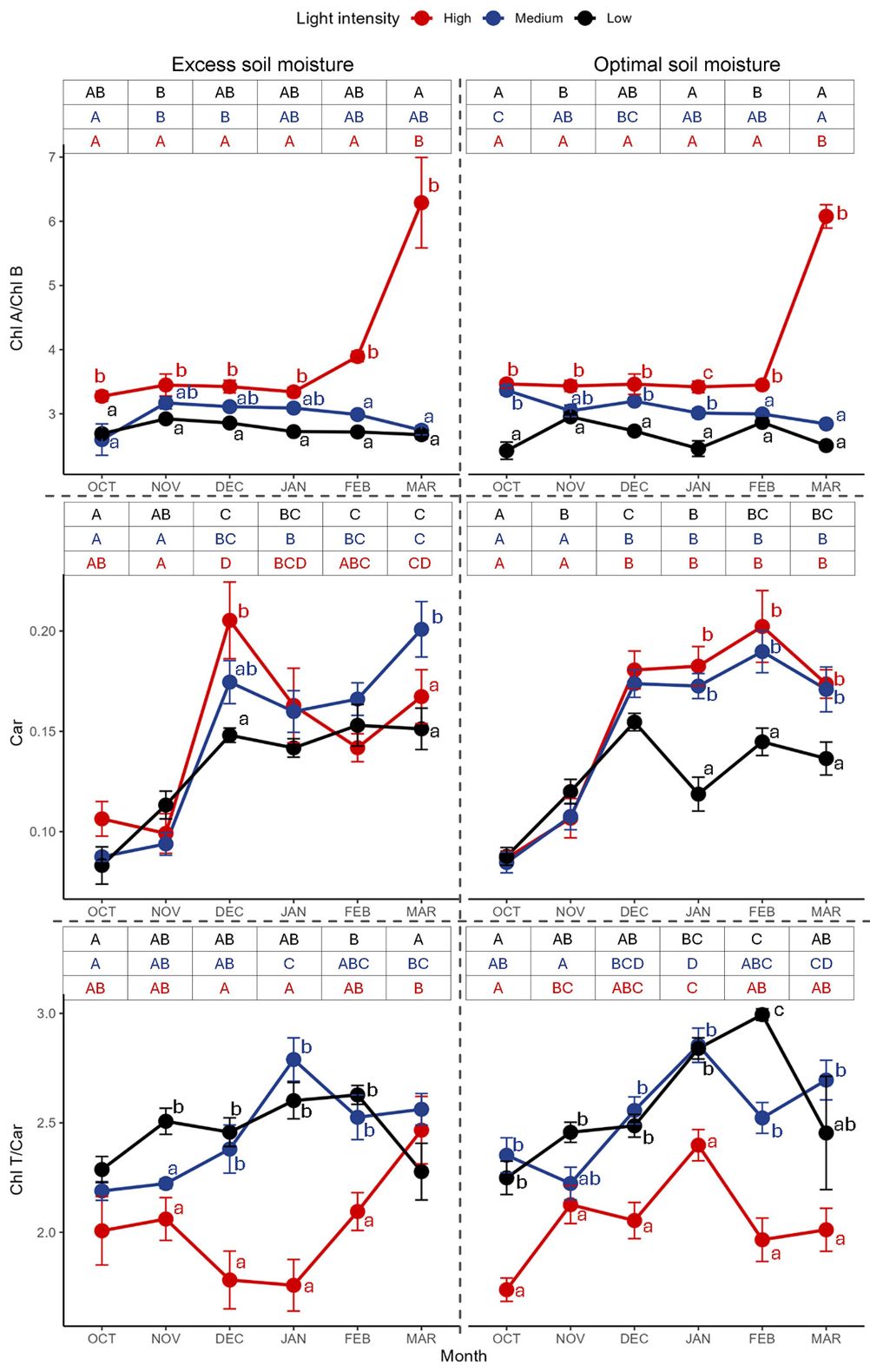
Regarding the ChlA/ChlB ratio, values were consistently higher under high light intensity, peaking in March under both soil moisture treatments (Fig. 5), and differences between high and low light intensities were evident for most of the growing season. Under optimal soil moisture, differentiation across light treatments was more pronounced, with clear contrasts also emerging between medium and low light, whereas under excess soil moisture, differences were mainly restricted to high versus low light conditions. Carotenoid content was primarily driven by light intensity, with higher values under medium and high light compared to low light conditions, particularly under optimal soil moisture (Fig. 5). Under excess soil moisture, this pattern was less consistent, indicating a weaker differentiation among light treatments. The total chlorophyll-to-carotenoid ratio (ChlT/Car) showed the opposite trend, with higher values at low and medium light intensities than at high light across both soil moisture conditions. This pattern reflects the combined effect of reduced carotenoid content under low light and increased chlorophyll content under intermediate light (Fig. 4, Fig. 5). Together, these patterns indicate coordinated adjustments in pigment composition, with increasing light intensity promoting a shift from light-harvesting investment (higher chlorophyll content and lower ChlA/ChlB ratio) towards enhanced photoprotection (higher carotenoid content and lower ChlT/Car ratio). In turn, soil moisture modulated this response, with optimal soil moisture enhancing pigment accumulation and photoprotective adjustments.
Fig. 5 - Ratio between chlorophyll a and b (ChlA/ChlB), carotenoids (Car, mmol m-2), and total chlorophyll-to-carotenoid ratio (ChlT/Car) in Nothofagus pumilio seedlings over the study period under three light intensity treatments and two soil moisture levels. Panels represent the triple interactions shown in Tab. 3, separated by soil moisture treatment. Values followed by different capital letters represent significant differences (p <0.05) among months for each light intensity and soil moisture treatment, while lower-case letters represent significant differences (p <0.05) among light intensity levels for each month and soil moisture treatment, according to the Tukey test.
Covariation between chlorophyll fluorescence and photosynthetic pigments
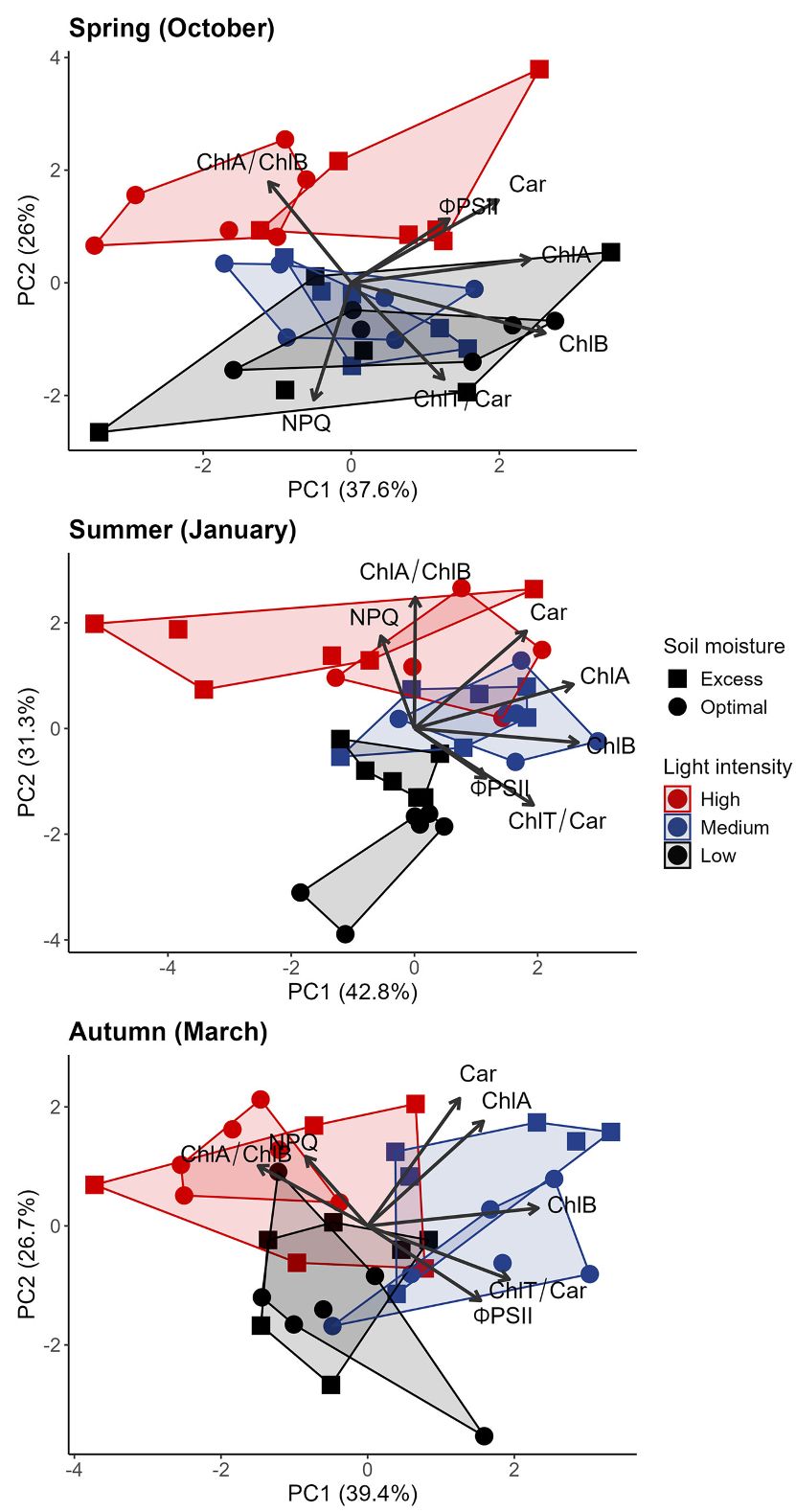
Chlorophyll fluorescence-based photosynthetic performance was moderately associated with pigment content (Fig. S2 in Supplementary material). NPQ was negatively correlated with pigment content, whereas ΦPSII and qP showed positive relationships, particularly with total chlorophyll content (ChlT). This relationship reflects the multivariate association patterns of seedlings across different treatments and key moments of the growing season (Fig. 6). PCA ordinations integrated physiological and biochemical traits into coordinated patterns of trait covariation, revealing a consistent multivariate structure of the photosynthetic apparatus. PC1 (37-42% of explained variance) was predominantly associated with chlorophyll content, with ChlA and ChlB contributing most (Tab. S2). PC2 (26-31%) captured a secondary gradient of variation related to pigment ratios (ChlA/ChlB and ChlT/Car), carotenoid content, and NPQ, and showed greater temporal variability. Across seasons, treatment separation was primarily driven by light availability: high-light conditions were clearly separated across the three periods, whereas medium and low light were also distinguishable but showed greater overlap at the beginning of the season. In contrast, soil moisture had a weaker effect, with differences occurring mainly within each light treatment rather than generating a distinct overall separation pattern. This pattern was most pronounced in mid-summer, when treatment groups were clearly differentiated. By March, treatment effects were still apparent but less distinct, with increased overlap among groups, particularly between soil moisture levels within the same light treatments. This suggests a seasonal convergence in seedling physiological responses towards the end of the growing season, while the main gradients associated with light and pigment composition remain detectable.
Fig. 6 - Principal component analyses (PCA) integrating chlorophyll fluorescence parameters and photosynthetic pigment contents of Nothofagus pumilio seedlings at three representative periods of the growing season: early spring (October), mid-summer (January), and early autumn (March). Each PCA represents the multivariate response of seedlings under the different combinations of light intensity and soil moisture treatments. Points correspond to individual plants.
Discussion
Seasonal phenology and adjustment of the photosynthetic machinery
The leaf phenology of N. pumilio seedlings under greenhouse conditions was largely consistent with the natural growth patterns described for the species, although leaf formation in natural forests typically peaks in early summer ([42], [36]). The early plateau in leaf number observed under excess soil moisture and high irradiance reflects a developmental constraint, likely due to environmental stress (either deep shade or soil saturation) that accelerates the leaf phenological cycle at the expense of total structural growth, mirroring the reduced biomass reported by Lencinas et al. ([23]).
The transition from the shaded understory to the high-irradiance environment of canopy gaps represents a critical bottleneck for Nothofagus pumilio regeneration ([52]). Our results reveal that seedlings navigate this transition through a differential allocation strategy, prioritizing the maintenance of photosynthetic function over structural investment. While light intensity dictated the metabolic “pathway” (photoprotection vs. light-harvesting), high soil moisture significantly constrained the magnitude of this investment, as shown by the observed interactions (Fig. 3, Fig. 4, Fig. 5). At the same time, PCA ordinations (Fig. 6) reinforced the central role of light availability as the main driver of seedling eco-physiological differentiation throughout the growing season. This is consistent with our hypothesis that physiological performance in N. pumilio seedlings follows a light-dependent response modulated by soil moisture availability. While a generalized synergistic effect was expected, the analysis indicates that this interaction is trait-dependent: synergistic negative effects occur between high light and excess soil moisture, primarily expressed in structural traits, whereas functional responses remain comparatively stable. This partial decoupling allowed seedlings to remain physiologically operational even when structural development (leaf number and pigment synthesis) was impaired by excess soil moisture or low light intensity, highlighting the prioritization of functional integrity under stress conditions.
PSII efficiency and energy dissipation mechanisms (quenching)
The actual efficiency of PSII photochemistry (ΦPSII) is modulated by the balance between energy capture and metabolic utilization ([37]). The results show that ΦPSII remained stable across treatments until late in the growing season, with declines under high light conditions, consistent with previous evidence that, under stress, ΦPSII decreases more rapidly as light intensity increases ([57]). A similar response for photochemical quenching (qP) reflects the proportion of open PSII reaction centers. The reduction in qP under medium and high light conditions indicates limited use of absorbed energy, likely associated with light saturation ([38]).
The sustained high Fv/Fm values (about 0.80) indicate no irreversible damage to PSII ([34], [22]). The significant decrease in both ΦPSII and qP in the high-light treatment indicates photochemical downregulation, a state known as dynamic photoinhibition ([38]). The stability of Fv/Fm therefore demonstrates the efficacy of photoprotective mechanisms, primarily high NPQ, in safely dissipating this excess energy. This prevented acute downregulation from escalating into chronic, damaging photoinhibition ([49]). Our results for N. pumilio were similar to those reported for Fagus by Cascio et al. ([4]) and Desotgiu et al. ([8]), which also showed no significant differences in Fv/Fm across different light conditions.
High NPQ under elevated irradiance indicates a shift toward dissipating thermal energy when light supply exceeds photosynthetic capacity, serving as a key photoprotective mechanism against excess light ([32]). The higher NPQ activity in expanding leaves at the beginning of the season could be related to leaf youth (ontogeny), as developing chloroplasts and lower photosynthetic capacity require greater thermal dissipation to avoid photo-oxidative stress ([19], [1]). While we detected a positive correlation between photochemical efficiency (ΦPSII, qP, Fv/Fm) and pigment content (Fig. S2 in Supplementary material), it was not as strong as correlations reported in other studies ([53]). Our results for photochemical parameters did not support the hypothesis of a synergistic interaction between stressors, as photochemical performance was primarily driven by light intensity rather than soil moisture, allowing seedlings to maintain functional stability across the two soil moisture levels analyzed.
Photosynthetic pigment content adjustments
Consistent with the literature, pigment content acclimation to light levels in N. pumilio followed predictable patterns: photodegradation explains the reduction in total chlorophyll under high irradiance ([50]), whereas the lower chlorophyll a/b ratio under shade represents an optimization of light harvesting ([48]). Thus, intermediate light conditions represent an optimal balance for pigment accumulation in this species, avoiding both light limitation under shade and photodegradation under high irradiance.
Reduced pigment concentrations under saturated soil conditions during peak growth reflect root-level stress, given that excess soil moisture has been shown to impair root development in N. pumilio ([23], [30]). Such soil saturation hinders nutrient uptake and, consequently, pigment synthesis ([55]), particularly in species such as N. pumilio, which is adapted to well-drained, poorly developed soils ([54], [35]). Moreover, Peri et al. ([41]) reported that N. pumilio rapidly reduces its normalized net photosynthetic rate under waterlogging conditions, further supporting the species’ sensitivity to soil saturation. Furthermore, high irradiance intensifies pigment destruction because the plant cannot synthesize new photosynthetic and photoprotective compounds (e.g., carotenoids) quickly enough ([10]). Carotenoids play a dual role, acting as accessory pigments in light harvesting and as protectors against photooxidative damage, protecting chlorophylls from destructive reactions ([24], [25], [46]).
Our results reveal a clear distinction between the temporal dynamics of functional and structural traits. Photosynthetic function followed a seasonal divergence-convergence pattern, peaking in January and February before converging in March. This discrepancy reinforces the decoupling between function and structure: while photochemical efficiency is an immediate response that declines during senescence, pigment profiles represent a more permanent strategic investment. The persistence of treatment-specific pigment ratios (ChlA/ChlB) towards the end of the growing season indicates that structural adjustments outlast photochemical responses, reflecting a lasting imprint of the environmental conditions experienced by seedlings. This appears to reflect a strategic acclimation, a structural adjustment that integrates resource availability with the plant’s broader phenological context.
Phenotypic plasticity: management implications and research perspectives
The mechanisms described above exemplify the high phenotypic plasticity of N. pumilio, which may contribute to its ability to cope with disturbed environments. Overall, this study demonstrates a clear acclimation of N. pumilio seedlings to light treatments influenced by soil moisture throughout the growing season. Plants preconditioned under a closed canopy rapidly adjusted their photosynthetic physiology (chlorophyll fluorescence and pigment content) in response to the new light regimes and soil moisture conditions. This acclimatization capacity is essential for regeneration survival after canopy opening by silvicultural cutting. Our study suggests that while seedlings can tolerate high irradiance through efficient photoprotective mechanisms (as evidenced by high NPQ and carotenoid accumulation), medium-light conditions appear most favorable for plants during their first years of life. Under moderate light levels, seedlings maximized chlorophyll content while maintaining PSII integrity. These findings align with previous reports of N. pumilio seedling plasticity in physiological variables such as photosynthetic rates ([28]) and morphological traits ([23], [30]). However, these findings should be contextualized. While this study evaluated the plant response over a single growing season, plasticity is a gradual process that develops over multiple seasons ([11]), and its adaptive advantages are also shaped by ecological context and competition with other colonizing species. Furthermore, the optimal soil moisture conditions in this study (well-drained, 50-60% field capacity) reflect the high-quality sites of primary forests ([28]). In contrast, the excess moisture treatment reflects the post-harvesting edaphic conditions in low-lying areas near wet meadows and peatlands, where drainage is naturally restricted ([14]), or the novelty created by the expansion of the invasive beaver (Castor canadensis - [17]). Therefore, to gain a comprehensive understanding, it is necessary to contrast these results with other potential environmental scenarios, such as rising temperatures and reduced soil moisture, across a comparable canopy-cover gradient to that analyzed in this study. Evaluating seedling responses under different scenarios, particularly in the context of climate change, would help determine whether the observed plasticity is sufficient to buffer the effects of a more extreme climate, a critical consideration for the long-term conservation and management of these forests.
Conclusions
Nothofagus pumilio seedlings show high phenotypic plasticity, enabling to adjust their photosynthetic apparatus during a single growing season in response to changes in light and soil moisture, conditions that often occur after timber harvesting. Seedling development early in the season is optimal under intermediate light conditions. Although seedlings can tolerate high irradiance through photoprotective mechanisms, partial canopy cover allows them to maximize photosynthetic performance without suffering chronic stress. This acclimation strategy could be supported by a differential physiological response, in which seedlings rely on rapid, short-term functional regulation (photochemical efficiency) to cope with light fluctuations, while their structural adjustment investment (pigment synthesis) reflects a strategic adjustment that integrates more complex, chronic environmental stress factors, including soil moisture. This physiological explanation supports the recommendation to adopt silvicultural practices that maintain partial canopy cover to promote successful regeneration. By promoting stable, intermediate light conditions, the establishment and survival of seedlings with a resilient physiological state is encouraged, which is key to ensuring the persistence of forests in the face of increasing climate variability.
List of abbreviations
The following abbreviations have been used throughout the paper:
- F0: Fluorescence in the absence of photosynthetic light;
- Fm: Maximum fluorescence level;
- Fv: variable fluorescence;
- F′m: Maximum fluorescence in the light;
- Ft: Steady-state yield of fluorescence in the light;
- F′0: Zero-level fluorescence in the light;
- ΦPSII: Efficiency of PSII photochemistry;
- qP: Photochemical quenching;
- Fv/Fm: Maximum quantum yield of PSII;
- NPQ: Non-photochemical quenching;
- ChlA: Chlorophyll a;
- ChlB: Chlorophyll b;
- ChlT: Total chlorophyll;
- ChlA/ChlB: Ratio between chlorophyll a and b;
- Car: Carotenoids;
- ChlT/Car: Ratio between total chlorophyll and carotenoids.
Acknowledgments
The authors gratefully acknowledge Emilce Gallo and Enrique Barrio for their collaboration during data collection and sampling processing.
Funding Declaration
This work was partly supported by PAE2004 22428 (ANPCyT, Argentina) and BOSAMCA MIA (CATIE, Costa Rica).
References
Gscholar
CrossRef | Gscholar
CrossRef | Gscholar
CrossRef | Gscholar
Gscholar
CrossRef | Gscholar
CrossRef | Gscholar
Gscholar
CrossRef | Gscholar
CrossRef | Gscholar
Gscholar
CrossRef | Gscholar

Authors’ Info
Authors’ Affiliation
María Vanessa Lencinas 0000-0002-2123-3976
Guillermo Martínez Pastur 0000-0003-2614-5403
Laboratorio de Recursos Agroforestales, Centro Austral de Investigaciones Científicas - CADIC, Consejo Nacional de Investigaciones Científicas y Técnicas - CONICET, cc 92, 9410 Ushuaia, Tierra del Fuego (Argentina)
Instituto Nacional de Tecnología Agropecuaria - INTA, Universidad Nacional de La Patagonia Austral - UNPA, Consejo Nacional de Investigaciones Científicas y Técnicas - CONICET, cc 332, 9400, Río Gallegos, Santa Cruz (Argentina)
CONICET - Laboratorio de Fisiología Vegetal, Instituto de Ciencias de la Vida, SeCyT - Rectorado, Universidad de Morón, Machado 914, B1708EOH, Morón, Buenos Aires (Argentina)
Corresponding author
Paper Info
Citation
Bottan L, Lencinas MV, Peri PL, Arena M, Martínez Pastur G (2026). Photochemical efficiency and variation in photosynthetic pigments in Nothofagus pumilio seedlings growing under light intensity and soil moisture gradients. iForest 19: 311-320. - doi: 10.3832/ifor5020-019
Academic Editor
Luigi Saulino
Paper history
Received: Oct 24, 2025
Accepted: Jun 22, 2026
First online: Aug 19, 2026
Publication Date: Aug 31, 2026
Publication Time: 1.93 months
Copyright Information
© SISEF - The Italian Society of Silviculture and Forest Ecology 2026
Open Access
This article is distributed under the terms of the Creative Commons Attribution-Non Commercial 4.0 International (https://creativecommons.org/licenses/by-nc/4.0/), which permits unrestricted use, distribution, and reproduction in any medium, provided you give appropriate credit to the original author(s) and the source, provide a link to the Creative Commons license, and indicate if changes were made.

Web Metrics
Breakdown by View Type
Article Usage
Total Article Views: 1290
(from publication date up to now)
Breakdown by View Type
HTML Page Views: 327
Abstract Page Views: 563
PDF Downloads: 348
Citation/Reference Downloads: 0
XML Downloads: 52
Web Metrics
Days since publication: 51
Overall contacts: 1290
Avg. contacts per week: 177.06
Article Citations
Article citations are based on data periodically collected from the Clarivate Web of Science web site
(last update: Jul 2026)
(No citations were found up to date. Please come back later)
Publication Metrics
by Dimensions ©
Articles citing this article
List of the papers citing this article based on CrossRef Cited-by.
Related Contents
iForest Similar Articles
Research Articles
Light acclimation of leaf gas exchange in two Tunisian cork oak populations from contrasting environmental conditions
vol. 8, pp. 700-706 (online: 08 January 2015)
Short Communications
Effect of four levels of shade on survival, morphology and chlorophyll fluorescence of Nothofagus alessandrii container-grown seedlings
vol. 8, pp. 638-641 (online: 08 January 2015)
Research Articles
Tracing the acclimation of European beech (Fagus sylvatica L.) populations to climatic stress by analyzing the antioxidant system
vol. 14, pp. 95-103 (online: 01 March 2021)
Research Articles
Wintertime photosynthesis and spring recovery of Ilex aquifolium L.
vol. 12, pp. 389-396 (online: 31 July 2019)
Research Articles
Relationships between leaf physiognomy and sensitivity of photosynthetic processes to freezing for subtropical evergreen woody plants
vol. 12, pp. 551-557 (online: 17 December 2019)
Research Articles
Calibration of a multi-species model for chlorophyll estimation in seedlings of Neotropical tree species using hand-held leaf absorbance meters and spectral reflectance
vol. 9, pp. 829-834 (online: 17 May 2016)
Research Articles
Magnolia grandiflora L. shows better responses to drought than Magnolia × soulangeana in urban environment
vol. 13, pp. 575-583 (online: 07 December 2020)
Research Articles
Needle traits of understory Silver fir, Norway spruce, and Scots pine in response to increased canopy openness in a birch-dominated stand
vol. 18, pp. 273-282 (online: 14 October 2025)
Research Articles
Response of juvenile progeny of seven forest tree species and their populations to simulated climate change-related stressors, heat, elevated humidity and drought
vol. 11, pp. 374-388 (online: 15 May 2018)
Research Articles
Adaptive variation in physiological traits of beech provenances in Central Europe
vol. 11, pp. 24-31 (online: 09 January 2018)
iForest Database Search
Search By Author
Search By Keyword
Google Scholar Search
Citing Articles
Search By Author
Search By Keywords
PubMed Search
Search By Author
Search By Keyword