
Mechanical stability of Scots pine across soil conditions and regeneration practices in hemiboreal forests
iForest - Biogeosciences and Forestry, Volume 19, Issue 3, Pages 226-236 (2026)
doi: https://doi.org/10.3832/ifor5131-019
Published: Jun 14, 2026 - Copyright © 2026 SISEF
Research Articles
Abstract
The intensification of wind disturbances increases the importance of maintaining tree mechanical stability in Northern European forests. Soil preparation during forest regeneration may influence long-term stability by modifying rooting conditions. We assessed the effects of site conditions, defined as combinations of soil type (e.g., freely draining mineral, waterlogged mineral, and drained peat soils) and site-specific soil preparation methods (disc trenching and mounding), on the mechanical stability of mid-aged Scots pine (Pinus sylvestris L.) stands in hemiboreal forests of northeastern Europe (Latvia). A static tree-pulling test was used to quantify resistance to primary and secondary failure, as well as the post-primary-failure stability margin. Trees growing on unprepared freely draining mineral soils exhibited the highest resistance to both primary and secondary failure, whereas trees on waterlogged mineral and peat soils showed reduced stability and a predominance of uprooting. Mounding on waterlogged sites did not consistently enhance long-term mechanical stability. Overall, soil physical properties and their interaction with tree size outweighed the long-term effects of soil preparation alone, highlighting the need for site-specific, climate-smart forest management strategies to enhance wind resistance in hemiboreal forests.
Keywords
Wind Disturbance, Scots Pine, Hemiboreal Forests, Static Tree-pulling Test, Soil Preparation
Introduction
In Northern Europe, forests are increasingly exposed to a range of intensifying climate-driven disturbances, which often interact, leading to long-lasting negative legacy effects ([16], [2], [4]). They might trigger a negative feedback loop, as, for example, wind-weakened trees can become prone to droughts and thus to secondary biotic agents ([52]), which subsequently reduces mechanical stability, serving as the weak spot in the stand for the next wind disturbance ([2], [13], [4]). During the late autumn-early spring season ([12]), when Northern Europe, including the Eastern Baltic region, experiences most of the annual cyclones ([49]), the likelihood of such effects increases due to insufficient soil frost, as both the duration and frequency of soil freezing in the region decrease ([19]). Under non-frozen, highly water-saturated soil conditions, the strength of tree soil-root anchorage is reduced ([43], [39]), making trees more prone to uprooting ([11]). The amplified impacts of natural disturbances, along with the increase in the total growing stock of forests ([50], [15], [52]) intensify the socio-economic and ecological impacts ([16], [52]). To sustain the resilience of future forest stands, such effects can be moderated through adaptive (climate-smart) forest management approaches ([36]).
In this regard, one approach could be the restoration of forest stands using material suited to landscape-specific conditions ([18]). Trees growing on periodically waterlogged soils can be more prone to windthrow due to shallow rooting systems and reduced strength of root-soil anchorage ([38], [39], [27]), especially under non-frozen soil conditions ([56], [27], [57]). Hence, matching the site factors (e.g., soil fertility, moisture regime) and the ecological requirements of tree species ([59]) is becoming increasingly important ([32], [31], [55]). In the Eastern Baltic region, stands of species with greater morphological plasticity ([5], [58], [33]), such as Scots pine (Pinus sylvestris L.), are found on soils ranging from freely draining mineral to constantly waterlogged organic ([20], [53]). This species can adapt mechanically to different wind climates, yet the risk of wind damage increases when grown under inappropriate soil conditions ([53]). For instance, under conditions of constantly high groundwater levels, pine cannot develop a deep root system to ensure mechanical stability ([39]), increasing the risk of wind damage ([14]).
The coupling of site factors with forest regeneration material can be further enhanced through soil preparation ([40]). Under the periodically waterlogged conditions, the restoration of forest stands on the mounding can enhance root distribution ([3], [9]), hence the strength of soil-root anchorage for both the individual trees and the stand could be increased accordingly ([8], [38], [47]). However, quantitative information on the long-term effects of forest restoration through mounding on the mechanical stability of trees in periodically waterlogged sites is not available ([9]).
Tree mechanical stability can be effectively characterized by the static tree-pulling test, which provides reliable information on the maximum resistive turning moment, indicating the susceptibility of trees to uprooting or stem breakage, depending on which component (root anchorage or stem integrity) is the weakest ([43], [39]). Thus, under sufficient soil-root anchorage, tree mechanical stability is determined by stem strength; however, in either mode of failure, the fatal collapse of a tree occurs in two distinct phases ([6]). The initial phase is a primary failure (PF), when internal wood damage occurs ([6]). PF is an early, hidden structural failure that is not visible during stem bending; when the tree’s hydraulic system is disrupted, it can trigger physiological drought stress and long-term legacy effects for windthrow survivors ([34]). The final stage of tree collapse is the secondary failure (SF), which occurs at peak loading and results in either uprooting or stem breakage ([43]).
The aim of this study was to assess how the mechanical stability (loading resistance) of mid-aged Scots pine varies across contrasting site conditions, defined as combinations of soil type (e.g., freely draining mineral, waterlogged mineral, and drained peat soils) and site-specific soil preparation methods (disc trenching and mounding), in the hemiboreal forests of the Eastern Baltic region in Latvia. Accordingly, two research questions were addressed: (1) How does the mechanical stability of mid-aged Scots pine vary across contrasting site conditions? (2) How do the characteristics of primary (PF) and secondary failure (SF), as well as the post-failure stability margin, differ among these conditions? We hypothesize that: (i) tree stability is higher on freely draining mineral soils due to stronger soil-root anchorage; and (ii) mounding improves mechanical stability in waterlogged conditions compared to unprepared sites. This study advances current knowledge by evaluating the mechanical stability of trees across contrasting soil conditions and site-specific soil preparation approaches in mid-aged Scots pine stands. Integrating primary and secondary failure (PF/SF) metrics with stability margin enables a more comprehensive assessment of both internal damage and fatal failure, providing new insights into the mechanisms governing tree stability under different site conditions.
Materials and methods
Study area
The study area is in the hemiboreal forest zone in Latvia, where approximately 51% of the territory is covered by forests ([37]). About 25% of these forests consist of pine-dominated stands ([37]). Across all forests, approximately 12%, 2%, and 3% of pine-dominated stands are situated on freely draining mineral soils, periodically waterlogged mineral soils, and drained peat soils, respectively, with corresponding total growing stocks of 115, 20, and 29 million cubic meters ([37]). The climate in Latvia is largely influenced by westerlies from the North Atlantic, with local conditions varying with distance from the Baltic Sea ([21]). This corresponds to an eastward increase in continentality ([21]), resulting in local differences in air temperature and precipitation ([28]). The mean annual precipitation in Latvia is 685 mm, with the highest mean monthly total (76 mm) occurring in August ([28]). The warmest month is July (+17.8 °C) while the coldest is February (-3.1 °C). Mean annual air temperature and wind speed are higher in western and central parts of Latvia, reaching +8.0 °C (in Riga) and 4.3 m s-1 (Ventspils; coastal area), respectively, while in the uplands eastwards, those values are reduced to +5.7 °C (Aluksne) and 2.5 m s-1 (Aluksne), respectively ([28]).
Study sites and sample trees
The study was conducted in forest stands managed by the Forest Research Stations near Jelgava (56° 44′ 24″ N, 23° 44′ 32″ E) and Kalsnava (56° 40′ 48″ N, 25° 54′ 43″ E), and by Riga Forests Ltd. (Daugava Forest District) near Ogre (56° 53′ 14″ N, 24° 40′ 27″ E), respectively. The studied 40-50-year-old pine stands were situated on flat terrain under lowland conditions, with elevations ranging from 5 m (Jelgava) to 45 m (Ogre) and 90 m (Kalsnava) a.s.l. The studied stands represented freely draining and waterlogged mineral soils (fine sand) and drained deep peat soils (organic - Tab. 1). On freely draining mineral soils, stands without initial soil preparation (Control) and stands established after disc trenching (Trench) were studied. On waterlogged mineral soils, undrained stands were sampled with (Mounding) and without initial soil preparation (Wet). For comparison, similarly aged Scots pine stands established after drainage on organic soils without initial preparation, namely drained deep peat (Peat), were also included (Tab. 1). The studied stands have been managed conventionally according to the forestry guidelines of the time (1970s-1980s), assuming initial planting densities and promoting natural regeneration, with 5.000 Scots pine saplings per hectare on dry mineral soils and 4.000 saplings per hectare on drained deep peat and waterlogged mineral soils. At that time, pre-commercial thinning was not prescribed, and the first commercial thinning for the studied stands was carried out at ages 20-30 years. None of the selected stands exhibited recorded windthrow damage or any biotic or fire disturbance prior to sampling.
Tab. 1 - The number of studied stands and sampled trees, and mean (± 95% confidence interval) stand age, stem diameter at breast height (DBH), total height (H), stemwood volume (V), gravimetric moisture content (θg), soil bulk density (ρSoil), and stand basal area (G) of each studied type of soil preparation of Scots pine stands. Control - stands on dry mineral soils without initial preparation; Trench - stands on dry mineral soils established after disc trenching; Mounding - stands on waterlogged mineral soils with mounding; Wet - stands on waterlogged mineral soils without initial soil preparation; Peat - drained deep peat (organic) soils without initial preparation.
| Sample group |
Stand (n) |
Tree (n) |
Stand age (years) |
DBH (cm) |
H (m) |
V (m3) |
θg (%) |
ρSoil (kg m-3) |
G (m2 ha-1) |
|---|---|---|---|---|---|---|---|---|---|
| Control | 4 | 20 | 45.7 ± 11.9 | 24.7 ± 1.9 | 23.5 ± 1.3 | 0.55 ± 0.11 | 13.9 ± 2.1 | 1198 ± 56 | 21.51 ± 2.17 |
| Mounding | 6 | 36 | 42.4 ± 7.4 | 20.4 ± 1.1 | 17.8 ± 0.6 | 0.29 ± 0.04 | 33.3 ± 2.2 | 1012 ± 45 | 24.94 ± 1.07 |
| Peat | 9 | 33 | 54.2 ± 7.7 | 26.1 ± 1.4 | 23.2 ± 0.8 | 0.59 ± 0.07 | 70.2 ± 3.3 | 364 ± 61 | 24.70 ± 2.41 |
| Trench | 4 | 23 | 38.5 ± 8.1 | 22.7 ± 1.6 | 19.3 ± 0.5 | 0.38 ± 0.06 | 26.8 ± 4.2 | 1108 ± 65 | 26.43 ± 2.01 |
| Wet | 7 | 46 | 39.2 ± 6.4 | 20.5 ± 1.1 | 17.8 ± 0.6 | 0.30 ± 0.04 | 37.5 ± 1.9 | 990 ± 39 | 25.46 ± 0.96 |
For testing, the main selection criteria were that trees were co-dominant and had no visible signs of pathogen infection, pest damage, stem defects, or mechanical injuries. Furthermore, the selected trees had to represent the stand’s mean diameter at breast height (DBH), which was measured with a manual caliper. The distance between the sample tree and neighboring trees corresponded to the mean stand spacing, and closely spaced trees were avoided to minimize the potential effects of increased root contacts. Stands were further screened to ensure the possibility of clearing a ≥25° pulling sector toward the anchor tree at a distance at least equal to the height of the sample tree. To characterize the microsite growing conditions of the sample tree (stand basal area, G), all trees ≥6 cm DBH within a radius of 12.62 m around each sample tree were measured for DBH (Tab. 1).
Static pulling test protocol
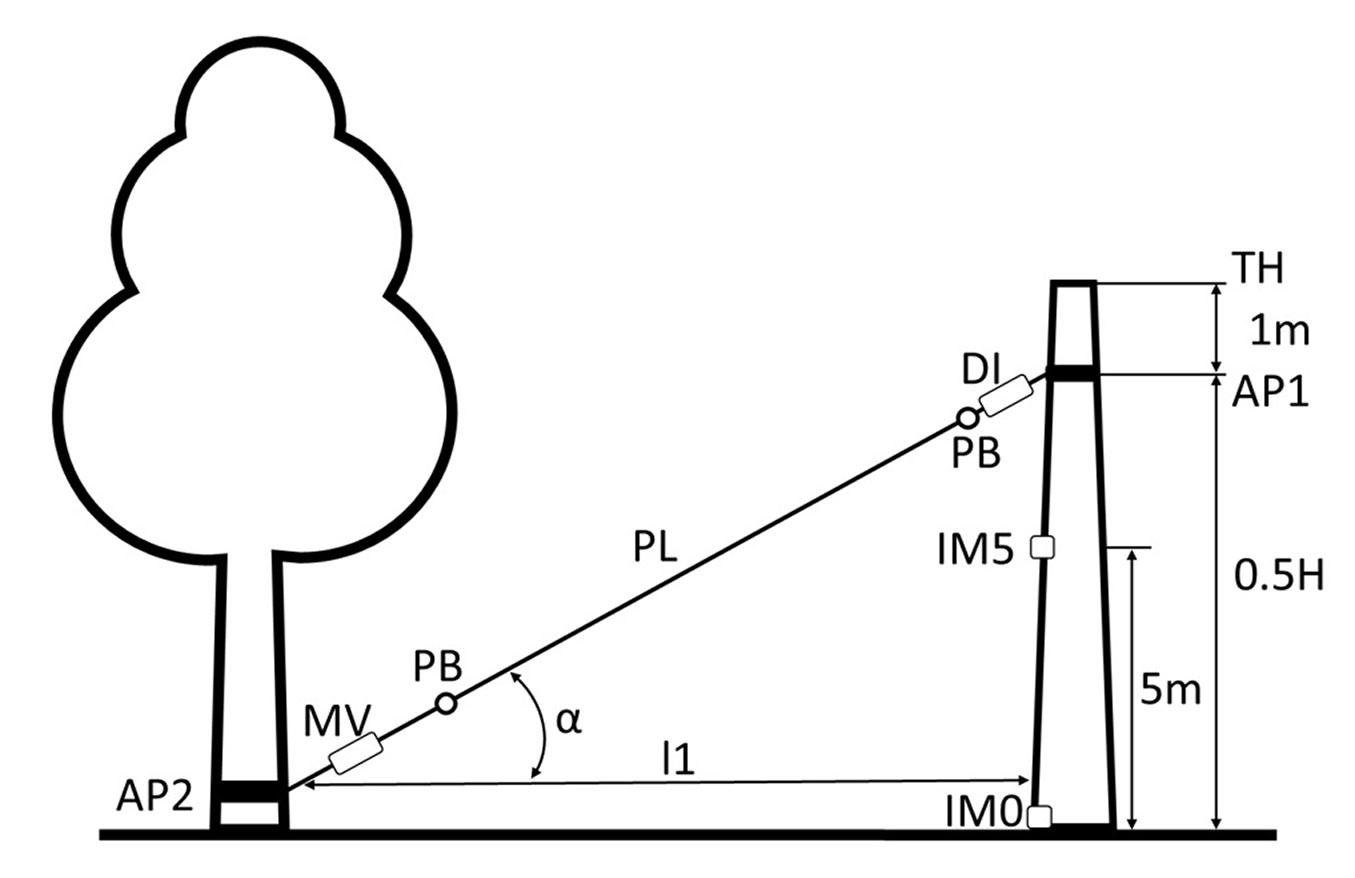
Tree pulling was conducted during frost-free periods without precipitation and under calm or comparably light wind conditions across the tested stands. Prior to testing, all sample trees were topped to minimize the effects of wind and crown mass on force measurements (Fig. 1). Pulling was performed by applying continuous loading using a 2-stroke motorised winch (1800 Capstan Cable Winch, Nordforest, Germany) positioned at 30-40 m from the sample tree and fixed to the secondary anchor point (tree) (AP2 - Fig. 1). A pulley-block system (PB - Fig. 1), made of two double pulleys and an 11-mm polyester rope as the pulling line (PL - Fig. 1), was installed between the winch and the sample tree. The attachment point of the pulling line on the sample tree (AP1 - Fig. 1) was set at half of its original height (Fig. 1). To prevent the slippage of the attachment, point during loading, the topping height of the trees was 1 m above the original height (TH - Fig. 1). Trees were pulled until they either uprooted or broke at the stem. The parameters of mechanical stability were measured and recorded using the TreeQinetic® system (Argus Electronic GmbH, Rostock, Germany). A dynamometer (DI - Fig. 1) positioned between the pulley system and the sample tree measured pulling force and the angle between the pulley line and the air-line linking the sample and anchor tree (α - Fig. 1). Stem inclination was measured at the base (IM0 - Fig. 1) and at 5 m height (IM5 - Fig. 1) using inclinometers.
Fig. 1 - Scheme of the destructive static pulling test setup. AP1 and AP2 anchor points; PB - pulley block; PL - pulling line; DI - dynamometer; α - the slope angle of the pulling line; l1 - the distance between the sample tree and the anchoring tree; IM0 and IM5 - inclinometers at the height of 0 and 5 m, respectively; H - tree height; TH - topping height; MV - motor winch.
Soil-root plate measurements, soil sampling, and laboratory analyses
For uprooted trees, the maximum depth of the soil-root plate was measured by inserting a steel rod near the stem base, and five radii (at 0°, 45°, 90°, 135°, and 180°) of the soil-root plate surface were assessed to calculate the relative soil-root plate depth (RPD, m m-3) and width (RPW, m m-3) in relation to stem volume. Following each static pulling test, pits were excavated at each sample tree. Soil samples were extracted from pit walls at depths of 0-10, 10-20, 20-40, and 40-80 cm using a 100 ml core sampler. Samples were sealed in airtight bags and transported to the Forest Environment Laboratory of the Latvian State Forest Research Institute “Silava”. Soil bulk density (ρSoil, kg m-3) and gravimetric moisture content (θg, %) were determined for the samples after oven drying at 105 °C for 48 h, and the mean value across all sampled depths was calculated for each tree (Tab. 1).
Calculations of indicators of mechanical stability
The bending moment at the stem base (BM, kNm) for each sample tree was calculated following Krišans ([24] - eqn. 1):
where F is the pulling force (kN), hAP1 is the attachment height of the pulling line at half of tree height (m), and Meα is the median of the angle between the pulling line and the air-line between the sample and anchor tree (°).
Stem curvature (NΔ, °) was expressed as the difference between simultaneous tilt measurements at the base and at the height of 5 m on the stem (eqn. 2):
where NΔ and N5m are inclinations at the stem base and at 5 m height, respectively. An increase in NΔ with a proportional rise in BM indicates elastic deformation, whereas a sudden increase in NΔ without a corresponding increase in BM implies structural failure of wood fibers, such as the PF ([6]). Under continued loading, trees ultimately experience SF either as uprooting or as stem breakage, indicating the maximum load resistance or the limit of mechanical stability ([7]). The difference (BMDIF) between the bending moment at SF (BMSF) and PF (BMPF) indicates the remaining stability margin after initial damage.
Tree volume estimation
To account for loading resistance relative to tree size, stemwood volume (V, m3), an integrative parameter of tree growth success ([61]), was used as a tree-size covariate. V is a robust proxy for overall tree size, as indicated by Peltola et al. ([44]), Krišans et al. ([24]), Seipulis et al. ([53]), and others. V was calculated using a locally developed volume equation after Liepa ([30] - eqn. 3):
where DBH is the stem diameter at the height of 1.3 m (cm), and H is the tree height (m).
Statistical analysis
Prior to the statistical analysis, the normality of the data was assessed diagnostically using histograms, which indicated that the data were normally distributed. The effects of soil preparation and SF mode (uprooting or stem breakage) on BMPF, BMSF, and BMDIF, as well as the differences in soil parameters (θg and ρSoil) and RPD and RPW of the sampled trees, were evaluated using a zero-intercept linear mixed-effects model fitted in R v. 4.5.2 ([48]), using the package “lme4” ([1] - eqn. 4):
where Vij is the tree stem volume; sci represents the site conditions; Vij : sci is the interaction. To account for the unequal sample sizes and potential intercorrelation among the trees, the studied stand was included as the random slope (Vij : standj) in the model. A zero-intercept model was applied to reflect the biological constraint that the response variable equals zero when the predictor is zero, thereby ensuring biological realism and preventing implausible predictions. Fixed-effect significance was evaluated using Wald’s χ2 test. Several alternative combinations of fixed effects and their interactions were tested for each response variable; however, only the final models selected through model comparison, which retain the maximum number of statistically significant fixed effects, are presented. Post-hoc pairwise comparisons among significant factor levels were conducted using Tukey’s honestly significant difference (HSD) test. Multiple comparisons were controlled using Tukey-adjusted family-wise error rate correction, as implemented in the “emmeans” package in R ([29]). The normality of the analyzed data was assessed diagnostically using histograms, which indicated that the data were normally distributed.
Results
Stand and soil characteristics
The analyzed dataset represents Scots pine stands established under different site conditions, among which the variations in the size of stems and roots of sampled trees, soil physical properties, and stand structure were observed (Tab. 1, Tab. 2, Tab. 3, Tab. 4). Site conditions created clear gradients in soil moisture and tree size, from dry mineral to waterlogged and Peat soils, with the largest trees in Peat and the smallest in Mounded and Wet sites. The number of studied stands ranged from four to nine per site conditions, with 20 to 46 trees sampled per group (Tab. 1). Larger trees by DBH and V were observed in Peat stands, while their height was similar to that of trees in Control (Tab. 1, Tab. 2). Smaller trees in terms of DBH and height were tested in Mounding, Trench, and Wet stands (Tab. 1, Tab. 2). Despite variations in tree size, G did not differ significantly (p > 0.05) among site conditions (Tab. 1, Tab. 2). This indicates that variation in tree dimensions was largely offset by changes in stand density.
Tab. 2 - Estimated marginal means (EMM), their standard error (SE), degrees of freedom (df), lower and upper levels of 0.95% confidence interval (CI) of the stand basal area (G, m2 ha-1) gravimetric moisture content (θg, %), soil bulk density (ρSoil, kg m-3), stem diameter at breast height (DBH, cm), total height (H, m), and the stemwood volume (V, m3) for each studied type of soil preparation of Scots pine stands. Grouping (common letters) indicates results of Tukey’s HSD post-hoc test, where identical letters denote no significant differences among treatments. Control - stands on dry mineral soils without initial preparation; Trench - stands on dry mineral soils established after disc trenching; Mounding - stands on waterlogged mineral soils with mounding; Wet - stands on waterlogged mineral soils without initial soil preparation; Peat - drained deep peat (organic) soils without initial preparation.
| Parameter | Soil | EMM | SE | df | Lower CI | Upper CI | Group |
|---|---|---|---|---|---|---|---|
| G | Control | 24.30 | 1.91 | 52.5 | 20.50 | 28.10 | a |
| Mounding | 24.90 | 2.03 | 23.8 | 20.70 | 29.10 | a | |
| Peat | 25.60 | 1.69 | 25.4 | 22.10 | 29.10 | a | |
| Trench | 25.50 | 1.49 | 30.6 | 22.50 | 28.60 | a | |
| Wet | 25.90 | 1.68 | 41.9 | 22.50 | 29.20 | a | |
| θg | Control | 14.4 | 6.55 | 16.4 | 0.541 | 28.3 | a |
| Mounding | 34.7 | 2.01 | 35.6 | 30.641 | 38.8 | ab | |
| Peat | 74 | 6.69 | 21.8 | 60.119 | 87.9 | c | |
| Trench | 28.2 | 2.47 | 71.6 | 23.252 | 33.1 | a | |
| Wet | 36.4 | 1.75 | 45.6 | 32.848 | 39.9 | b | |
| ρSoil | Control | 1179 | 116.1 | 16.1 | 932.9 | 1425 | b |
| Mounding | 1002 | 36 | 34 | 929.1 | 1076 | b | |
| Peat | 301 | 119.2 | 21.8 | 53.7 | 548 | a | |
| Trench | 1096 | 44.8 | 67.8 | 1007 | 1186 | b | |
| Wet | 1005 | 31.6 | 44.2 | 940.9 | 1068 | b | |
| DBH | Control | 12.8 | 0.498 | 127 | 11.8 | 13.7 | ab |
| Mounding | 11.6 | 0.378 | 128 | 10.9 | 12.4 | a | |
| Peat | 13.6 | 0.561 | 129 | 12.5 | 14.8 | b | |
| Trench | 12.2 | 0.361 | 126 | 11.5 | 12.9 | ab | |
| Wet | 12.4 | 0.288 | 128 | 11.9 | 13 | ab | |
| H | Control | 20.5 | 0.640 | 151 | 19.2 | 21.7 | b |
| Mounding | 15.3 | 0.458 | 148 | 14.4 | 16.2 | a | |
| Peat | 20.5 | 0.666 | 143 | 19.2 | 21.9 | b | |
| Trench | 16.7 | 0.468 | 148 | 15.7 | 17.6 | a | |
| Wet | 16.4 | 0.356 | 152 | 15.7 | 17.1 | a | |
| V | Control | 0.51 | 0.06 | 34.9 | 0.38 | 0.64 | ab |
| Mounding | 0.29 | 0.05 | 21.1 | 0.19 | 0.39 | a | |
| Peat | 0.59 | 0.04 | 28.7 | 0.51 | 0.68 | b | |
| Trench | 0.38 | 0.05 | 38.2 | 0.27 | 0.49 | a | |
| Wet | 0.31 | 0.04 | 29.1 | 0.22 | 0.40 | a |
Tab. 3 - The frequency of stem breakage and the mean (±95% confidence interval) bending moment at the stem base, expressed per stemwood volume, at both primary (BMPF) and secondary failures (BMSF), as well as the difference between them (BMDIF), together with the depth (RPD) and width (RPW) of the soil root plate attributed to stem volume for each studied type of soil preparation of Scots pine stands. Control - stands on dry mineral soils without initial preparation; Trench - stands on dry mineral soils established after disc trenching; Mounding - stands on waterlogged mineral soils with mounding; Wet - stands on waterlogged mineral soils without initial soil preparation; Peat - drained deep peat (organic) soils without initial preparation.
| Sample group |
Stem breakage (%) | BMPF (kNm m-3) |
BMSF (kNm m-3) |
BMDIF (%) |
RPD (m m-3) |
RPW (m m-3) |
|---|---|---|---|---|---|---|
| Control | 35 | 74.75 ± 7.44 | 101.78 ± 9.70 | 26.5 ± 3.0 | 0.68 ± 0.15 | 0.51 ± 0.07 |
| Mounding | 44 | 63.23 ± 3.52 | 97.79 ± 5.03 | 34.7 ± 3.4 | 0.52 ± 0.15 | 0.26 ± 0.04 |
| Peat | 42 | 65.58 ± 3.69 | 94.85 ± 4.19 | 30.9 ± 2.2 | 0.66 ± 0.09 | 0.28 ± 0.04 |
| Trench | 52 | 67.20 ± 5.87 | 96.31 ± 7.70 | 30.1 ± 3.1 | 0.71 ± 0.13 | 0.33 ± 0.04 |
| Wet | 26 | 66.28 ± 3.85 | 85.17 ± 3.72 | 22.4 ± 2.5 | 0.45 ± 0.05 | 0.24 ± 0.03 |
Tab. 4 - Estimated mean trends (EMT), their standard error (SE), degrees of freedom (df), lower and upper levels of 0.95% confidence interval (CI) of the depth (RPD, m m-3) and width (RPW, m m-3) of the soil root plate, expressed per stemwood volume for each studied type of soil preparation of Scots pine stands. Grouping (common letters) indicates results of Tukey’s HSD post-hoc test, where identical letters denote no significant differences among treatments. Control - stands on dry mineral soils without initial preparation; Trench - stands on dry mineral soils established after disc trenching; Mounding - stands on waterlogged mineral soils with mounding; Wet - stands on waterlogged mineral soils without initial soil preparation; Peat - drained deep peat (organic) soils without initial preparation.
| Parameter | Soil | EMT | SE | df | Lower CI |
Upper CI |
Group |
|---|---|---|---|---|---|---|---|
| RPD | Control | 1.24 | 0.32 | 61.6 | 0.59 | 1.88 | a |
| Mounding | -0.28 | 0.51 | 86.7 | -1.29 | 0.74 | a | |
| Peat | 0.26 | 0.31 | 74.6 | -0.35 | 0.88 | a | |
| Trench | 1.35 | 0.86 | 67.9 | -0.37 | 3.07 | a | |
| Wet | 0.66 | 0.31 | 73.0 | 0.04 | 1.27 | a | |
| RPW | Control | 0.63 | 0.49 | 38.9 | -0.36 | 1.62 | a |
| Mounding | 1.17 | 0.83 | 87.0 | -0.49 | 2.83 | a | |
| Peat | 0.64 | 0.49 | 73.1 | -0.33 | 1.60 | a | |
| Trench | 0.15 | 1.36 | 48.0 | -2.58 | 2.88 | a | |
| Wet | 1.35 | 0.48 | 35.7 | 0.38 | 2.33 | a |
Among the studied groups, differences were also observed in soil physical properties, as θg differed significantly (p < 0.05), with the Control and Trench stands having the driest soils (Tab. 1, Tab. 2), while the highest soil saturation levels were observed in Peat and Wet stands (Tab. 1, Tab. 2). Mounding stands exhibited intermediate moisture levels, being similar to Control, Trench, and Wet (Tab. 1, Tab. 2). ρSoil also varied significantly among soil types (p < 0.05), being lowest in Peat and substantially higher for mineral soils, irrespective of hydrological regime and site conditions (Tab. 1, Tab. 2).
Root plate metrics
RPD and RPW showed a considerable variability but did not differ significantly among site conditions (p > 0.05 - Tab. 4). Estimated mean trends indicated overlapping confidence intervals for both parameters across all tested groups, suggesting that differences in mechanical stability were not primarily driven by systematic variation in root plate dimensions. Nevertheless, descriptive values indicated wider soil-root plates for Control and Trench (dry mineral soils), whereas for relatively waterlogged conditions (Mounding, Peat, Wet), they were smaller (Tab. 3). Also, larger relative depths were observed for Control, Trench, and Peat (Tab. 3).
Failure modes and loading resistance
To address Research Questions (1) and (2), differences in loading resistance and failure characteristics were analyzed across contrasting site conditions that represent combinations of soil type and site-specific soil preparation methods. We found that mechanical stability was highest for Control, whereas pines in Wet and Peat stands exhibited reduced stability; Mounding did not provide a clear long-term stability advantage over unprepared waterlogged sites (Wet), resulting in a greater prevalence of uprooting.
The frequency of stem breakage as a mode of SF ranged from 26% in Wet to 52% in Trench stands, respectively (Tab. 3). Control and Peat stands exhibited intermediate stem-breakage frequencies (35% and 42%, respectively), indicating notable variation in modes of fatal failure among the studied groups. Trees that experienced stem breakage tended to exhibit higher BMPF, BMSF, and BMDIF values than uprooted trees; however, these differences were not statistically significant (p > 0.05 - Tab. 5). Consistently, the mode of SF had no significant effect on BMDIF in the linear mixed-effects models (Tab. 6), indicating that uprooting and stem breakage are associated with similar post-yield resistance. V was the strongest tree-size covariate explaining variation in BMPF and BMSF, as well as BMPDIF in relation to the mode of SF (p < 0.001 - Tab. 6). In contrast, the interaction between failure mode and V was not significant for any response variable (p > 0.05 - Tab. 6). The random effect (stand) level accounted for approximately 27-29% of the total variance (ICC), highlighting the relatively high importance of local conditions in determining failure mode and mechanical stability. The model’s explanatory power was high, with marginal R2 values ranging from 0.70 to 0.92 and conditional R2 values up to 0.94 (Tab. 6).
Tab. 5 - Estimated mean trends (EMT), their standard error (SE), degrees of freedom (df), lower and upper levels of 0.95% confidence interval (CI) of bending moment at the stem base, expressed per stemwood volume, at both primary (BMPF, kNm m-3) and secondary failures (BMSF, kNm m-3), as well as the difference between them (BMDIF, %) for each studied type of soil preparation of Scots pine stands. Results are also shown separately for the frequency of mode of secondary failure (SF mode; uprooting or stem breakage). Grouping (common letters) indicates results of Tukey’s HSD post-hoc test, where identical letters denote no significant differences among treatments. Control - stands on dry mineral soils without initial preparation; Trench - stands on dry mineral soils established after disc trenching; Mounding - stands on waterlogged mineral soils with mounding; Wet - stands on waterlogged mineral soils without initial soil preparation; Peat - drained deep peat (organic) soils without initial preparation.
| Parameter | Soil / SF mode | EMT | SE | df | Lower CI |
Upper CI |
Group |
|---|---|---|---|---|---|---|---|
| BMPF | Control | 100.8 | 7.27 | 34.3 | 86.1 | 115.6 | b |
| Mounding | 70.6 | 8.49 | 137.2 | 53.8 | 87.4 | ab | |
| Peat | 72.9 | 5.57 | 61.1 | 61.8 | 84 | a | |
| Trench | 74.4 | 8.17 | 142.9 | 58.2 | 90.5 | ab | |
| Wet | 67.7 | 6.97 | 49.5 | 53.7 | 81.7 | a | |
| BMSF | Control | 142 | 7.52 | 23.9 | 126.5 | 158 | b |
| Mounding | 101.7 | 9.63 | 139.4 | 82.6 | 121 | a | |
| Peat | 103.9 | 5.99 | 53.1 | 91.9 | 116 | a | |
| Trench | 101.4 | 9.33 | 146.8 | 83 | 120 | a | |
| Wet | 86.5 | 7.34 | 34.2 | 71.6 | 101 | a | |
| BMDIF | Control | 39.7 | 5.07 | 32.9 | 29.35 | 50 | b |
| Mounding | 31.8 | 5.98 | 137.5 | 19.92 | 43.6 | ab | |
| Peat | 30.8 | 3.9 | 60.1 | 22.97 | 38.6 | ab | |
| Trench | 27.8 | 5.76 | 143.6 | 16.38 | 39.2 | ab | |
| Wet | 17.3 | 4.87 | 47.1 | 7.48 | 27.1 | a | |
| BMPF | Uprooting | 73.8 | 4.03 | 43.6 | 65.7 | 81.9 | a |
| Stem breakage | 75.3 | 5.27 | 34.2 | 64.6 | 86 | a | |
| BMSF | Uprooting | 102 | 4.79 | 43.1 | 92.4 | 112 | a |
| Stem breakage | 109 | 6.33 | 34.6 | 96.4 | 122 | a | |
| BMDIF | Uprooting | 28.9 | 2.76 | 33.3 | 23.3 | 34.5 | a |
| Stem breakage | 34.5 | 3.31 | 20.9 | 27.6 | 41.4 | a |
Tab. 6 - Estimates (Est.), strength (Wald’s χ2), and significance of the fixed effects from linear mixed-effects models (model ANOVA) for the mode of secondary failure (SF mode; uprooting or stem breakage), stemwood volume (V), and their interaction on the bending moment at the stem base, for both primary (BMPF, kNm m-3) and secondary failures (BMSF, kNm m-3), and their difference (BMDIF, %) across the studied site conditions in Scots pine stands. σ² - total variance of the response; τ11 - variance associated with the random effect/slope (stand); ICC - intraclass correlation coefficient; R2M - marginal coefficient of determination; R2C - conditional coefficient of determination. Control - stands on dry mineral soils without initial preparation; Trench - stands on dry mineral soils established after disc trenching; Mounding - stands on waterlogged mineral soils with mounding; Wet - stands on waterlogged mineral soils without initial soil preparation; Peat -drained deep peat (organic) soils without initial preparation. (***): p<0.001; (**): p<0.01; (*): p<0.05.
| Effect | Parameter | BMPF | BMSF | BMDIF | |||
|---|---|---|---|---|---|---|---|
| Est. | χ2 | Est. | χ2 | Est. | χ2 | ||
| Fixed effects |
SF mode | - | 6.68* | - | 8.25* | - | 2.46 |
| break | -2.88 | - | -4.19* | - | -1.54 | - | |
| uproot | -2.96* | - | -3.57* | - | -0.87 | - | |
| V | 75.33*** | 228.34*** | 109.30*** | 333.09*** | 34.47*** | 131.29*** | |
| SF mode: V | -1.52 | 0.06 | 7.27 | 1.06 | -5.59 | 2.42 | |
| Random Effects |
σ2 | 22.80 | - | 32.36 | - | 13.74 | - |
| τ11 site.vol:break | 94.94 | - | 133.73 | - | 18.11 | - | |
| τ11 site.vol:uproot | 93.96 | - | 87.14 | - | 20.74 | - | |
| ICC | 0.28 | - | 0.27 | - | 0.29 | - | |
| N stand | 30 | - | 30 | - | 30 | - | |
| N tree | 158 | - | 158 | - | 158 | - | |
| R 2 M | 0.89 | - | 0.92 | - | 0.70 | - | |
| R 2 C | 0.92 | - | 0.94 | - | 0.77 | - | |
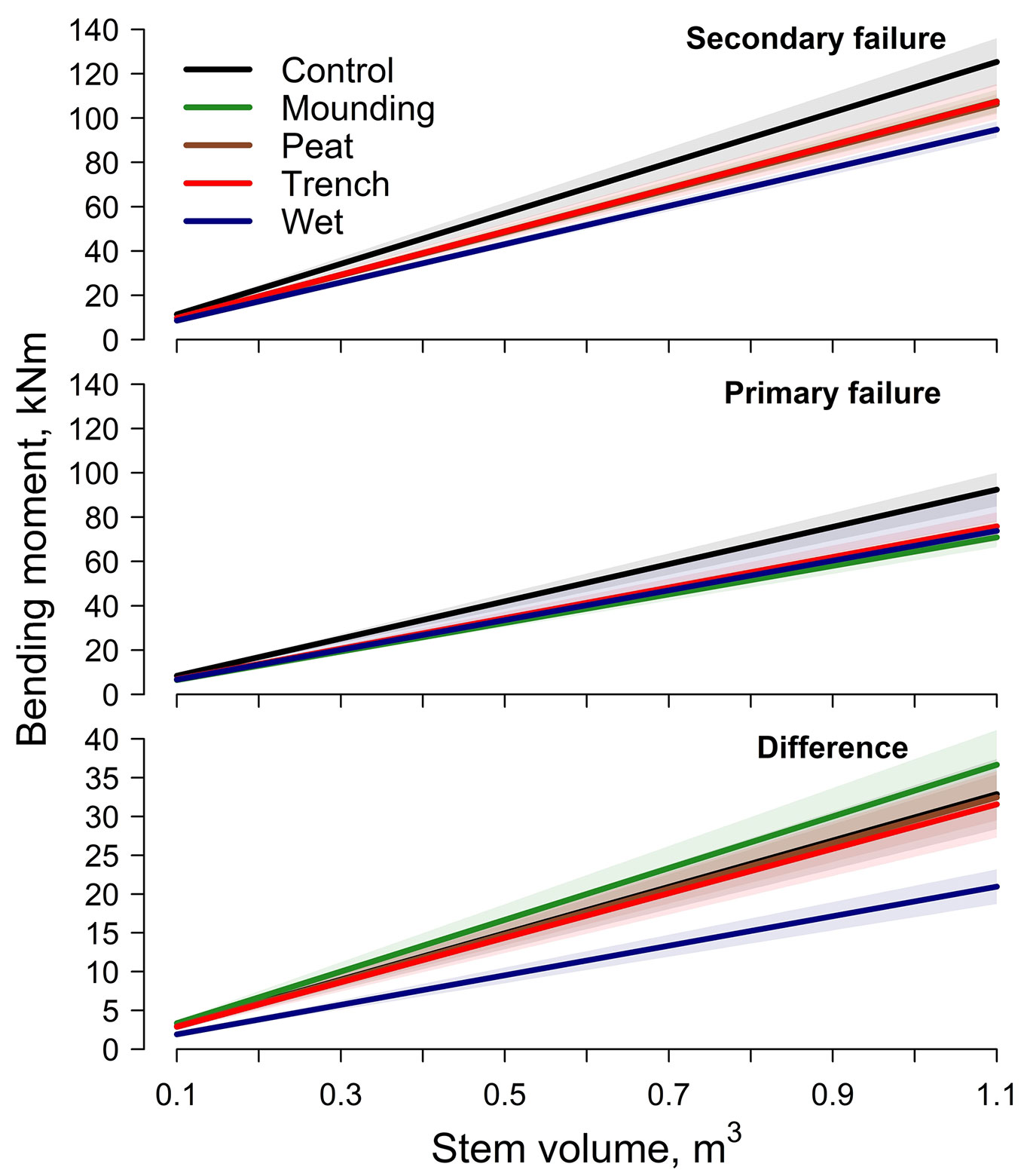
Mechanical stability differed among the tested site conditions, as the BM at the stem base, expressed per stemwood volume, varied (Tab. 3, Tab. 5, Fig. 2). Site conditions had a significant effect on BMPF and BMSF, but not on BMDIF (Tab. 7), indicating that while the onset of internal damage and the resistance to PF and SF varied, the post-failure stability margin remained relatively consistent. For BMPF, the highest resistance was observed in Control, which differed significantly (p < 0.05) from Peat and Wet trees (Tab. 5). Similarly, BMSF were highest in Control, while all other site conditions altogether formed a homogeneous group with significantly lower resistance (Tab. 5). The BMDIF, representing the remaining mechanical capacity after PF, was also highest in Control and lowest in Wet stands, as they differed significantly (p < 0.05) from each other (Tab. 5). In linear mixed-effects models, V was the best tree-size covariate for explaining variation in both BMPF and BMSF, as well as BMDIF (p < 0.001 - Tab. 7, Fig. 2). Meanwhile, significant interactions between V and site conditions were observed for all tested parameters of loading resistance (p < 0.001 - Tab. 7). Random effect (stand) accounted for 9-18% of the total variance (ICC), while model explanatory power was high, with marginal R2 values ranging from 0.76 to 0.93 and conditional R2 values up to 0.94 (Tab. 7).
Fig. 2 - The bending moment at the stem base of Scots pine at the moment of primary and secondary failure, and the difference among the studied site conditions. The coloured area represents the 95% confidence interval. Control - stands on dry mineral soils without initial preparation; Trench - stands on dry mineral soils established after disc trenching; Mounding - stands on waterlogged mineral soils with mounding; Wet - stands on waterlogged mineral soils without initial soil preparation; Peat - drained deep peat (organic) soils without initial preparation.
Tab. 7 - Estimates (Est.), strength (Wald’s χ2), and significance of the fixed effects from linear mixed-effects models (model ANOVA) for stemwood volume (V, m-3), type of soil preparation in Scots pine stands, and their interaction on the bending moment at the stem base, expressed per stemwood volume, for both primary (BMPF, kNm m-3) and secondary failures (BMSF, kNm m-3), and their difference (BMDIF, %). The table also includes the random-effect variances for site and model performance metrics (R2) for Scots pine under the studied site conditions. σ² - total variance of the response; τ11 - variance associated with the random effect/slope (stand); ICC - intraclass correlation coefficient; R2M - marginal coefficient of determination; R2C - conditional coefficient of determination. Control - stands on dry mineral soils without initial preparation; Trench - stands on dry mineral soils established after disc trenching; Mounding - stands on waterlogged mineral soils with mounding; Wet - stands on waterlogged mineral soils without initial soil preparation; Peat - drained deep peat (organic) soils without initial preparation. (***): p<0.001; (**): p<0.01; (*): p<0.05.
| Effects | Predictors | BMPF | BMSF | BMDIF | |||
|---|---|---|---|---|---|---|---|
| Est. | χ2 | Est. | χ2 | Est. | χ2 | ||
| Fixed effects |
V | 100.83*** | 204.78*** | 142.02*** | 390.94*** | 39.65*** | 65.48*** |
| Soil | - | 16.52** | - | 26.32*** | - | 5.16 | |
| Control | -12.09*** | - | -17.92*** | - | -5.05 | - | |
| Mounding | -1.89 | - | -1.20 | - | 0.52 | - | |
| Peat | -4.01 | - | -4.85 | - | -0.72 | - | |
| Trench | -2.38 | - | -1.54 | - | 0.67 | - | |
| Wet | -0.72 | - | -0.54 | - | 0.41 | - | |
| V : Soil | - | 14.58** | - | 33.20*** | - | 11.40* | |
| Mounding | -30.22** | - | -40.36** | - | -7.90 | - | |
| Peat | -27.95** | - | -38.16*** | - | -8.88 | - | |
| Trench | -26.46* | - | -40.60*** | - | -11.89 | - | |
| Wet | -33.10** | - | -55.51*** | - | -22.38** | - | |
| Random effects |
σ2 | 25.66 | - | 35.85 | - | 12.91 | - |
| τ11 stand:vol | 28.09 | - | 16.87 | - | 12.77 | - | |
| ICC | 0.18 | - | 0.09 | - | 0.17 | - | |
| N stand | 30 | - | 30 | - | 30 | - | |
| N tree | 158 | - | 158 | - | 158 | - | |
| R 2 M | 0.90 | - | 0.93 | - | 0.76 | - | |
| R 2 C | 0.92 | - | 0.94 | - | 0.80 | - | |
Discussion
Our results show that the mechanical stability of mid-aged Scots pine varies across site conditions, addressing Research Question (1) and suggesting that these differences might have important implications under the increasingly disturbance-prone climate of Northern Europe ([16], [51]). Scots pine stands of Control (unprepared freely draining mineral soils) consistently exhibited the highest mechanical stability characterised by resistance to both PF (primary failure), SF (secondary failure), as well as the largest post-primary failure stability margin quantified by BMDIF (Tab. 3, Tab. 5, Tab. 7, Fig. 2). These stands also showed the lowest risk of uprooting, indicating higher potential of resistance to wind disturbances. In contrast, Wet (unprepared, waterlogged mineral soils) and Peat (drained peat soils) showed consistently reduced stability and greater susceptibility to uprooting, indicating an increased risk of damage under amplified storminess. Soil preparation by mounding did not provide a clear long-term improvement in stability compared with unprepared Wet sites, suggesting limited effectiveness in mitigating windthrow risk under such site conditions. From a management perspective, regeneration strategies should prioritize selecting site-adapted species and consider the inherent limitations of wetter soils, where alternative species, e.g., birch ([22]), may provide greater long-term stability.
As no single dominant explanatory factor was identified in the models (Tab. 7), we speculate that the superior mechanical performance of Control trees reflects the combined effects of several factors, including larger RPW and RPD and lower G associated with larger stems ([17]). Generally, larger trees, especially in terms of V, are reported to have increased resistance to both PF and SF because higher BM is required to initiate structural failure, as loading resistance generally increases with tree size ([24], [26]). Lower θg and higher ρSoil (Tab. 1, Tab. 2, Tab. 3) might have also contributed to the superior mechanical performance of Control trees ([43], [13]), as higher ρSoil increases the mechanical strength of the soil matrix by improving particle contact and interlocking, which enhances soil shear strength and root-soil friction ([39], [10]), particularly under relatively dry to moderately moist conditions ([43]). A similar but inverse combination of factors likely explains the significantly lower BMDIF observed in Wet stands (Tab. 1, Tab. 2, Tab. 3).
A comparable limitation in mechanical stability may also explain the relatively low loading resistance observed in Peat stands, despite the relatively larger stem dimensions ([39], [11] - Tab. 1, Tab. 2). Moreover, no specific root adaptations were observed in these stands, contrary to expectations based on studies of older Scots pine or other species of similar size ([53]) as well as in other species of similar age and size ([22], [23], [24]). As stands mature and structural competition stabilizes, mechanical stability shifts from being primarily collective (stand-level) to increasingly determined by individual tree characteristics ([38], [45], [56]).
The studied Peat stands represent relatively recent growing conditions in north-eastern Europe, emerging from forest drainage and melioration since the 1960s ([41]). Accordingly, genotypes adapted to mineral soils may be insufficiently acclimated to deep peat conditions ([25]). The origin of the forest regeneration material used to establish the studied stands is unknown; yet, considering conventional forestry practices, generic sources were likely used, which would minimize differences in adaptation to local site conditions of the studied stands ([54]). Such interpretation is supported by the relatively low influence of microsite conditions on loading resistance, as indicated by the ICC (Tab. 7). Accordingly, trees from all tested groups may have tended to behave similarly while maintaining traits crucial for mechanical stability ([38], [56], [22], [23], [14], [53]), with some groups showing higher success (e.g., Control) and others lower success (e.g., Peat, Wet). The absence of site-specific acclimation might also explain the lack of differences in loading resistance observed between Wet and Mounding stands. Although mounding improves early establishment by elevating seedlings above the water table ([40], [3], [9]), its long-term effect on mechanical stability appears to be limited, as developing root systems ultimately depend on the surrounding soil conditions. Therefore, the establishment of Scots pine stands on mounds should be considered a supportive, rather than a decisive, measure in managing windthrow risk. In contrast, trees in Trench stands exhibited a higher frequency of stem breakage (Tab. 3), suggesting that root anchorage may have been sufficient and thus that the stems were mechanically better developed relative to stem strength ([35]).
Trees typically adjust growth between below- and aboveground parts in response to local conditions, balancing soil-root anchorage and height growth, supported by surrounding canopies, to maintain mechanical stability while remaining competitive for light ([56]). The relatively low frequency of stem breakage in Control trees, compared to the unexpectedly high frequency in Peat stands, can be explained by the combination of large stems that exceed root strength, thereby requiring higher loads to cause breakage, and the damping effects of peat soils ([35]). Under loose soil conditions, trees are likely subjected to higher wind-induced swaying frequencies ([46]), thus specific root adaptations might take place ([38], [22], [23]), which, however, were visually apparent through the soil-root plate dimensions in this study. The dimensions of the soil-root plate are constrained by the adaptive growth of roots in response to wind and site conditions, as evidenced by the T- and I-shaped cross-sections of structural roots. Such adaptations efficiently resist vertical flexing on the tree’s leeward and windward sides, respectively ([38]). Unfortunately, we did not examine the roots in this manner in this study.
The prevailing uprooting indicated roots as the weak part in “the chain” of mechanical stability ([42], [13]), particularly for trees in Wet stands. Weaker soil-root anchorage apparently led to significantly lower BMDIF and increased likelihood of rapid failure following primary damage. Accordingly, addressing Research Question (2), the joint analysis of PF and SF, along with the BMDIF, further revealed that trees in wetter soils had reduced stability after initial damage, indicating a higher likelihood of rapid collapse following PF. Trees with lower BMDIF (e.g., Wet trees) failed soon after the occurrence of PF, primarily due to weak soil-root anchorage rather than stem weakness, implying that trees experiencing stem breakage tend to “survive” primary failure longer, with the limiting factor shifting from roots to the stem. The relatively high ICC (Tab. 6) suggests that the mode of SF is strongly influenced by microsite conditions, highlighting the importance of individual tree resistance to loading for overall stand-level stability ([60]). Nevertheless, it should be acknowledged that the observed predominance of uprooting may partly result from the methodological approach of the static pulling test, in which the pulling line is attached at half the stem height, as stems with greater basal swelling are more resistant to breakage ([44], [14]).
In summary, the mechanical stability of Scots pine is strongly shaped by the interaction between tree size and soil conditions. Trees in dense mineral soils are better anchored but may face higher drought risk and thus greater negative impacts from secondary agents, such as pests ([52]), whereas trees in wet soils are more prone to uprooting. Still, lower loading resistance can expose trees growing in relatively better-watered soils to the negative impacts of storms ([12]). Accordingly, our results highlight the need to balance such trade-offs. This could be addressed by using Scots pine planting material suited to site conditions (preferably on freely draining mineral soils), lowering initial planting density to allow young saplings to develop wind resistance, and carefully applying thinning, either avoiding it or performing it at low intensity. The productivity gains from Scots pine cultivation on drained peat soils should be considered against increased windthrow risk and broader environmental costs, including carbon losses and altered hydrological functioning, as well as the use of alternative species or mixed stands.
Limitations and future research
Although the sample size was sufficient to detect general patterns, the number of stands per site conditions was relatively limited, which may constrain the generalization of the results across the region. The applied static tree-pulling test protocol introduces methodological limitations, as the de-topping of trees and the fixed attachment height at half of the tree height may influence force distribution and the mode of SF. However, the calculation of the bending moment accounts for the missing tree top, and thus the results are expected to be comparable to those obtained using established approaches ([39]). Moreover, a previous study by Seipulis et al. ([53]) has demonstrated the comparability of such approaches. The analysis of root systems was limited to generalized soil-root plate dimensions, without a detailed assessment of root architecture or structural root properties. As a result, important aspects of belowground adaptation, such as root distribution patterns and biomechanical properties, could not be fully evaluated. Future research should therefore focus on integrating high-resolution assessments of root system architecture (e.g., three-dimensional root mapping), extending analyses to older stands, where long-term acclimation might be more pronounced, and comparing responses across tree species while accounting for genotypic differences. This would improve understanding of the mechanisms underlying tree stability and enhance the transferability of results for forest management under changing environmental conditions.
Conclusions
This study demonstrated that the mechanical stability of mid-aged Scots pine varies significantly across site conditions, with the highest stability observed on freely draining mineral soils, confirming the first hypothesis (1). However, the hypothesis that mounding on waterlogged sites increases individual tree stability through improved root development (2) was not supported, as no significant long-term differences were observed compared to unprepared sites. While mounding may facilitate early establishment, it did not result in advanced root development and mechanical stability compared to unprepared waterlogged sites. Instead, long-term stability of Scots pine appeared to be driven primarily by tree size and, likely, by the combined effects of multiple site factors, highlighting that soil preparation alone is insufficient to fully compensate for unfavorable soil conditions. The integration of primary and secondary failure metrics revealed that trees on wetter soils not only exhibit lower resistance but also reduced stability margins after initial damage, increasing their vulnerability to failure. Accordingly, adaptive forest management that integrates site-specific soil considerations and assessments of mechanical stability is critical to sustaining forest resilience under climate change and enhancing long-term forest stand stability in the Eastern Baltic region.
List of abbreviations
The following abbreviations are used throughout the text:
- PF - primary failure;
- SF - secondary failure;
- Control - stands on dry mineral soils without initial preparation;
- Trench - stands on dry mineral soils established after disc trenching;
- Mounding - stands on waterlogged mineral soils with mounding;
- Wet - stands on waterlogged mineral soils without initial soil preparation;
- Peat -drained deep peat (organic) soils without initial preparation.
- V - stemwood volume;
- BM - bending moment at the stem base;
- BMPF - bending moment at the stem primary failure;
- BMSF - bending moment at the stem secondary failure;
- BMDIF - difference between BMPF and BMSF;
- DBH - diameter at breast height;
- ρSoil - soil bulk density;
- θg - soil gravimetric moisture content;
- NΔ - stem curvature;
- H - tree height;
- RPD - relative soil-root plate depth (attributed to the stem volume);
- RPW - relative soil-root plate width (attributed to the stem volume);
- ICC - intraclass correlation coefficient;
- N0 - stem inclinations at the base;
- N5m - stem inclination at 5 m height;
- F - pulling force;
- hAP1 - attachment height of the pulling line at half of tree height;
- Meα - median of the angle between the pulling line and the air-line between the sample and the anchor tree.
Acknowledgements
This study was funded by the JCS Latvia’s State Forests research programme “Effect of climate change on forestry and associated risks” (agreement No. 5-5.9.1_007p_ 101_21_78). Oskars Krišans was supported independently by Activity 1.1.1.9 “Post-doctoral Research” of the Specific Objective 1.1.1 “Strengthening research and innovative capacities and introduction of advanced technologies in the common R&D system” of the European Union’s Cohesion Policy Programme for 2021-2027 research application no 1.1.1.9/LZP/1/24/035 “A solution for reducing wind damage risk in uneven-aged management of Scots pine stands in the Eastern Baltic region”. Andris Seipulis was supported independently by the European Union Cohesion Policy Programme 2021-2027, specific support objective 1.1.1. “Strengthening research and innovation capacity and introducing advanced technologies into the common R&D system”, measure 1.1.1.8. “Doctoral grants”, agreement no. 1.1.1.8/1/24/I/002
References
Gscholar
Gscholar
Gscholar
CrossRef | Gscholar
Gscholar
CrossRef | Gscholar
Gscholar
CrossRef | Gscholar
Authors’ Info
Authors’ Affiliation
Roberts Matisons 0000-0002-4042-0689
Oskars Krišans 0000-0003-3315-7701
Latvian State Forest Research Institute “Silava”, 111 Rigas str., Salaspils LV-2169 (Latvia)
Ričards Antonovs
Latvia University of Life Sciences and Technologies, Faculty of Forest and Environmental Sciences, Akademijas str. 11, Jelgava LV-3001 (Latvia)
Corresponding author
Paper Info
Citation
Seipulis A, Matisons R, Antonovs Rč, Krišans O (2026). Mechanical stability of Scots pine across soil conditions and regeneration practices in hemiboreal forests. iForest 19: 226-236. - doi: 10.3832/ifor5131-019
Academic Editor
Marco Borghetti
Paper history
Received: Jan 15, 2026
Accepted: May 04, 2026
First online: Jun 14, 2026
Publication Date: Jun 30, 2026
Publication Time: 1.37 months
Copyright Information
© SISEF - The Italian Society of Silviculture and Forest Ecology 2026
Open Access
This article is distributed under the terms of the Creative Commons Attribution-Non Commercial 4.0 International (https://creativecommons.org/licenses/by-nc/4.0/), which permits unrestricted use, distribution, and reproduction in any medium, provided you give appropriate credit to the original author(s) and the source, provide a link to the Creative Commons license, and indicate if changes were made.

Web Metrics
Breakdown by View Type
Article Usage
Total Article Views: 1811
(from publication date up to now)
Breakdown by View Type
HTML Page Views: 472
Abstract Page Views: 781
PDF Downloads: 481
Citation/Reference Downloads: 0
XML Downloads: 77
Web Metrics
Days since publication: 100
Overall contacts: 1811
Avg. contacts per week: 126.77
Article Citations
Article citations are based on data periodically collected from the Clarivate Web of Science web site
(last update: Jul 2026)
(No citations were found up to date. Please come back later)
Publication Metrics
by Dimensions ©
Articles citing this article
List of the papers citing this article based on CrossRef Cited-by.
Related Contents
iForest Similar Articles
Research Articles
Fine root morphological traits and production in coniferous- and deciduous-tree forests with drained and naturally wet nutrient-rich organic soils in hemiboreal Latvia
vol. 16, pp. 165-173 (online: 08 June 2023)
Research Articles
Soil microorganisms at the windthrow plots: the effect of post-disturbance management and the time since disturbance
vol. 10, pp. 515-521 (online: 20 April 2017)
Research Articles
Amount and distribution of coarse woody debris in pine ecosystems of north-western Spain, Russia and the United States
vol. 7, pp. 53-60 (online: 28 October 2013)
Research Articles
The effect of clear-cut age on soil organic carbon and nitrogen indices in Scots pine (Pinus sylvestris L.) stands
vol. 18, pp. 146-153 (online: 09 June 2025)
Research Articles
Scots pine’s capacity to adapt to climate change in hemi-boreal forests in relation to dominating tree increment and site condition
vol. 14, pp. 473-482 (online: 18 October 2021)
Research Articles
Effects of planted European beech on the understory in Scots pine forests of Lithuania
vol. 7, pp. 12-18 (online: 07 October 2013)
Research Articles
Belowground biomass models for young oligotrophic Scots pine stands in Latvia
vol. 11, pp. 206-211 (online: 01 March 2018)
Research Articles
Growing season water balance of an inner alpine Scots pine (Pinus sylvestris L.) forest
vol. 11, pp. 469-475 (online: 02 July 2018)
Research Articles
Coping with spring frost-effects on polyamine metabolism of Scots pine seedlings
vol. 10, pp. 227-236 (online: 27 January 2017)
Research Articles
Effects of tree species, stand age and land-use change on soil carbon and nitrogen stock rates in northwestern Turkey
vol. 9, pp. 165-170 (online: 18 June 2015)
iForest Database Search
Search By Author
Search By Keyword
Google Scholar Search
Citing Articles
Search By Author
Search By Keywords
PubMed Search
Search By Author
Search By Keyword