
Managing salinity stress in Eucalyptus spp.: trait variation, mechanistic insights, and implications for salt-affected landscapes
iForest - Biogeosciences and Forestry, Volume 19, Issue 6, Pages 376-387 (2026)
doi: https://doi.org/10.3832/ifor5036-019
Published: Nov 06, 2026 - Copyright © 2026 SISEF
Review Papers
Abstract
Salinity is a growing global concern, aggravated by climate change and human activities, with severe impacts on forests and biodiversity. This review critically examines the following key points: (1) the systematic impacts of salinity on forestry and ecosystem functioning; (2) the multilevel mechanistic responses of Eucalyptus species, clones, and genotypes, emphasizing their operational deployment in salt-affected landscapes; and (3) the potential of contemporary genetic technologies and environmental strategies to enhance plant resistance. Although responses vary among taxa, salinity tolerance is generally mediated through an integrated physiological and molecular framework, and substantial intra- and interspecific variation offers a solid foundation for targeted selection, hybridization, and genetic improvement. While genetic transformation and large-scale application of omics approaches remain technically challenging, recent advancements in breeding and management practices provide effective pathways for developing salt-tolerant planting material. Importantly, most current knowledge comes from controlled studies on juvenile material, highlighting the need for long-term field validation. Despite this limitation, the Eucalyptus genus represents a strategic resource for afforestation, reforestation, and ecological restoration of salinity-affected regions. Future research should prioritize field-level validation, genotype-environment interactions, and translating molecular insights into scalable silvicultural practices that strengthen forest resilience under increasing salinity stress.
Keywords
Eucalyptus genus, Salinity Stress, Salt-tolerance Mechanisms, Ion Homeostasis
Introduction
Native forests and forest plantations worldwide are currently threatened by multiple natural and anthropogenic stress factors ([81]). Among these, soil salinity has become an increasingly critical abiotic challenge that hampers forest development and alters plant physiological processes, with far-reaching consequences for forest yield, biodiversity, carbon storage, and soil stabilization ([86]). Recent estimates indicated that about 1100 Mha (approximately 7% of the world’s land surface) is affected by salinity, underscoring the global urgency of addressing this environmental constraint ([66], [44]). According to FAO ([36]), based on ~73% of the land mapped, global salt-affected soils cover ~424 Mha of topsoil (0-30 cm) and ~833 Mha of subsoil (30-100 cm). It is well established that some of the worst affected areas are Africa, Southwest Asia, Central America, Australia’s Murray-Darling Basin, California’s San Joaquin Valley, the Yellow River Basin, and the Aral Sea Basin, where salinity has expanded at an alarming pace ([6], [44]). This arises from the accumulation of soluble salts, mainly sodium (Na+), magnesium (Mg2+), and calcium (Ca2+), along with anions such as chloride (Cl-), carbonate (CO3²-), and sulfate (SO4²-) ([1]). Among these ions, Na+ and Cl- are the dominant contributors to salinity stress. Excessive Na+, in particular, drives to osmotic and ionic imbalances in plants and leads to soil sodicity ([9]). Soil salinity can be categorized by origin as dryland salinity, driven by natural processes, and irrigation-induced salinity, resulting from unsustainable human agricultural practices ([75]). Its severity is commonly assessed by electrical conductivity (ECe), and divided into different levels ranging from normal (2.74-4.56 dS m-1), slightly (5.75-9.8 dS m-1), moderately (11.10-14.43 dS m-1), and highly salt-affected soils (14.69-36.81 dS m-1 - [64]). This phenomenon is especially pronounced in semi-arid and arid areas, where evaporation exceeds precipitation, thus accelerating salt accumulation in soil and groundwater ([9]). The scarcity of freshwater resources for irrigation further amplifies this problem, as reliance on ion-rich irrigation water coupled with recurrent drought episodes intensifies salt buildup.
The effects of salinity on trees are both immediate and progressive. Short-term exposure primarily triggers osmotic stress, reducing water availability, disrupting stomatal regulation and photosynthesis. Prolonged exposure leads to excessive accumulation of toxic ions, particularly Na+ and Cl-, resulting in ionic toxicity and severe imbalances in essential nutrients such as Ca2+, K+, and NO3- ([68], [9]). Collectively, these disturbances compromise metabolic stability, growth performance, and long-term forest viability. Recognizing these challenges, global efforts to safeguard forest ecosystems have increased in recent years, with numerous initiatives focused on developing strategies to mitigate salinity impacts. In response, genetic breeding programs have been conducted since the mid-20th century to develop new forest genotypes with enhanced productivity, quality, and stress resilience ([66]). However, these programs have been constrained by the biological complexity, long generation times, and low heritability of key adaptive traits in forest trees ([81]). Parallel efforts have increasingly shifted toward exploring biotechnological innovations, such as high-throughput sequencing, molecular genetics, and genomic-assisted selection to accelerate the development of salt-tolerant forest genotypes. Simultaneously, afforestation and agroforestry initiatives using deep-rooted, salt-tolerant, and fast-growing species have emerged as cost-effective and environmentally sustainable strategies for saline and sodic land reclamation ([70]). Nevertheless, much of the existing research has disproportionately focused on specific groups such as mangroves and halophytes, while economically important forest taxa such as Eucalyptus remain comparatively underexplored ([86]). The genus Eucalyptus is one of the most strategically important genera for global forestry because of its high economic value, pronounced ecological plasticity, and notable resistance to drought and salinity ([14]). Comprising approximately 900 species and subspecies, Eucalyptus exhibits broad genetic diversity that underpins its adaptation to diverse environmental conditions, ranging from tropical and oceanic to Mediterranean, semi-arid, and arid climates ([15]). This ecological versatility has facilitated its large-scale cultivation in over 100 countries, with plantations exceeding 22.57 Mha ([36], [64]). These plantations are largely dominated by the “big nine” species, namely: Eucalyptus grandis, E. camaldulensis, E. globulus, E. tereticornis, E. urophylla, E. nitens, E. pellita, E. dunnii, E. saligna, and their hybrids, which together account for more than 90% of the planted Eucalyptus forests ([56]). Certain Eucalyptus species can tolerate extreme salinity, with reported levels reaching up to 18 dS m-1 and, in exceptional cases, exceeding 31 dS m-1 ([13], [44]). This remarkable salt tolerance is mediated by coordinated morphological, biochemical, physiological, and molecular mechanisms that function synergistically to maintain growth under stress. Successful salt tolerance in eucalypt trees has been measured in terms of their survival and growth responses ([70]), improvement of nutrient acquisition, uptake, use, and retention ([3]), osmotic adaptation, increased antioxidant metabolism, upregulation of salinity-stress-specific genes, transcription factors, and endogenous phytohormones ([44]).
Despite substantial advances, the existing body of research remains fragmented, with much of the focus limited to several species or isolated mechanisms. Comprehensive and integrative review studies on the Eucalyptus genus are rare, if not entirely absent, highlighting the need for a consolidated synthesis that critically organizes current findings. To address this gap, the present review provides a structured, up-to-date synthesis of the multi-level responses of Eucalyptus spp. to salinity stress, encompassing morphological, physiological, biochemical, and molecular mechanisms. This review presents a strategic framework that bridges mechanistic insights with applied breeding and management approaches. By consolidating current knowledge, we provide a coherent reference to guide researchers and practitioners in developing and deploying salt-tolerant Eucalyptus species in salt-affected landscapes. Strengthening the role of Eucalyptus in saline environments is therefore pivotal to advancing sustainable forestry and enhancing resilience under climate change.
Salt tolerance in Eucalyptus: genetic variation, mechanisms, gaps, and silvicultural implications
Genetic variation: inter- and intraspecific levels
Scientists have demonstrated that the severity of salinity effects varies dramatically across eucalypt species, driven by multiple interacting factors including stress duration and intensity, climate conditions, physicochemical soil properties, plant developmental stage, biomass allocation, and species-specific tolerance. These factors complicate the identification of clear patterns of variation ([75]). Crucially, this variability is fundamentally rooted in substantial genetic divergence across species ([44]), which supports a continuum-based classification from extremely salt-tolerant to more sensitive taxa, as summarized in Tab. 1([48], [54], [35], [68], [73]). Eucalyptus species are grouped into five categories based on their tolerance to soil salinity: (1) extremely tolerant species, able to resist at ECe >16 dS m-1; (2) tolerant species, persisting at ECe 8-16 dS m-1; (3) moderately tolerant species, at 4-8 dS m-1; (4) species with limited tolerance, 2-4 dS m-1; and (5) highly sensitive species, restricted to ECe <2 dS m-1.
Tab. 1 - Classification of salt tolerance in Eucalyptus spp.: Salinity thresholds for mature trees, shrubs, and seedlings based on published literature ([35], [48], [54], [68], [73]). Classifications reflect reported performance under field and controlled experimental conditions.
| Salinity classes | Ece (dS m-1) |
Tolerance Level |
Eucalyptus species and subspecies |
|---|---|---|---|
| Extremely saline | >16 | Extremely tolerant | E. halophila, E.kondininensis |
| Very saline | 8-16 | Highly tolerant | E. agrophloia, E. cornuta, E. incrassata, E. grossa, E. microtheca, E. moluccana, E. raveretiana, E. sargentii, E. tetraptera, E. occidentalis, E. raveretiana, E. sargentii subsp. sargentii, E. spathulata subsp. Spathulate |
| Moderately saline | 4-8 | Tolerant | E. angustissima, E. astringens, E. blakelyi, E. brachycorys, E. camaldulensis, E. campaspe, E. diptera, E. famelica, E. foliosa, E. gomphocephala, E. largiflorens, E. lesouefii, E. leucoxylon, E. leucoxylon subsp. petiolaris, E. loxophleba, E. melliodora, E. microcarpa, E. mimica, E. moluccana, E. platycorys, E. platypus, E. phenax, E. polybractea, E. rigens, E. robusta, E. rudis, E. salicola, E. sideroxylon, E. stricklandii, E. tereticornis, E. utilis, E. varia subsp. salsuginosa, E. vegrandis, E. xanthonema |
| Slightly saline | 2-4 | Moderately tolerant | E. aggregata, E. bicostata, E. botryoides, E. brockwayi, E. calycogona subsp. calycogona, E. camphora, E. celastroides, E. celastroides ssp. Celastroides, E. citriodora, E. cinerea, E. cladocalyx, E. clelandiorum, E. concinna, E. conferruminata, E. coolabah, E. cornuta, E. crenulata, E. diversifolia, E. elata, E. flocktoniea, E. forrestiana, E. globulus subsp. globulus, E. grandis, E. intertexta, E. leucoxylon, E. leucoxylon ssp. Petiolaris, E. loxophleba, E. loxophleba ssp. Lissophloia, E. loxophleba ssp. Loxophleba, E. saligna, E. griffithsii, E. horistes, E. longicornis, E. macrandra, E. megacornuta, E. merrickiae, E. ovata, E. ovularis, E. salmonophloia, E. sieberi, E. torquata, E. tricarpa, E. viminalis, E. wandoo, E. yilgarnensis |
| Non-saline | < 2 | Sensitive | E. accedens, E. aggregata, E. albens, E. caesia, E. cloeziana, E. dundasii, E. goniantha, E. intermedia, E. polyanthemos, E. talyuberlup, E. tessellaris |
Beyond categorical classifications, a range of field trials and controlled experiments have shown interspecific differences, although outcomes often vary with experimental conditions. Mediterranean field trails have identified E. gomphocephala (Tuart), E. sargentii, E. microtheca, E. rudis, and E. occidentalis as particularly promising for cultivation on saline soils; meanwhile, studies conducted in South Africa have emphasized the salt tolerance potential of E. camaldulensis (River Red Gum), E. cladocalyx, E. polyanthemos, E. robusta, E. viminalis, E. gomphocephala, E. botryoides, E. sideroxylon, and E. sieberi ([34]). Consistently, E. camaldulensis has demonstrated outstanding salt and waterlogging tolerance, with survival rates exceeding 85% in saline soil conditions, as reported by Singh et al. ([70]). Further, Australian field research has provided a detailed breakdown of salinity tolerance across various Eucalyptus species. High salinity tolerance was observed in E. occidentalis, E. spathulata, E. raveretiana, and E. rudis, while moderate tolerance was observed in E. brassiana, E. citriodora, E. platypus, E. coolabah, and E. robusta. Intermediate to high tolerance was found in E. camaldulensis, E. moluccana, and E. tereticornis, and low to moderate tolerance in E. grandis ([48]). A comparative study between E. grandis and E. occidentalis at saline trial sites in southern Australia showed significantly higher salinity tolerance in E. occidentalis, comparable with the most salt-tolerant provenances of E. camaldulensis ([12]). Additionally, a comparison of three globally planted species, E. camaldulensis, E. globulus, and E. grandis, indicated that while E. globulus performed adequately under moderate salinity conditions (ECe = 4-8 dS m-1), E. camaldulensis was superior and more resilient under moderate to severe salinity conditions (ECe = 8-16 dS m-1 - [37]). Controlled settings using NaCl-induced salinity further confirmed this variability. Shariat & Assareh ([68]) evaluated salinity tolerance in seedlings of eight species: E. kingsmillii, E. tetragona, E. salubris, E. occidentalis, E. microtheca, E. camaldulensis, E. globulus, and E. sargentii under NaCl concentrations ranging from 0 to 200 mM. Their results revealed substantial interspecific variation, with E. sargentii exhibiting the highest tolerance and E. globulus the lowest. This aligns with earlier findings by Nasim et al. ([53]), who reported that E. camaldulensis maintained strong performance under saline-hypoxic conditions at 150 mol m-3 NaCl, reinforcing its robust salt tolerance.
At the population level, intraspecific variation extends to interclonal differences, as shown in hybrids of E. grandis × E. urophylla, where three clones (VC865, I144, and I224) exhibited distinct tolerance profiles ranging from highly sensitive to highly tolerant, even among closely related clones ([22]). The most tolerant clone, I144, maintained growth through osmotic adjustment, K+ homeostasis, and robust antioxidant defenses with minimal oxidative damage, while I224 proved highly sensitive and VC865 showed intermediate tolerance. Similarly, among six elite clones of E. tereticornis subjected to in vitro NaCl stress (0-500 mM), genotype KE8 emerged as superior, exhibiting stable water content, elevated antioxidant activity, enhanced proline accumulation, and reduced lipid peroxidation ([71]). Interestingly, hybridization may amplify protective mechanisms beyond those measured in parental lines. When comparing hybrids of E. camaldulensis × E. urophylla (H4, 58H2, 27A2) with five parental E. camaldulensis genotypes (T5, BD4, 1-7-1, H1, SH4), hybrids consistently outperformed their parental lines in salt tolerance ([13]), suggesting that interspecific crossing captures complementary tolerance traits through heterosis or transgressive segregation.
Numerous studies have documented inter- and intraspecific variation in salinity tolerance in species belonging to the genus Eucalyptus, though findings are often context-dependent and sometimes inconsistent. Field trials capture environmental complexity but are largely restricted to the Australian continent, while controlled experiments may overestimate tolerance by neglecting long-term field interactions. Intraspecific and hybrid studies revealed genetic potential for resilience, yet the stability and ecological relevance of these traits require further investigation.
Multi-level responses and mechanisms underlying Eucalyptus tolerance to salinity stress
Morphological adjustments: survival strategies or growth penalties?
Germination stage responses
At early developmental stages, salt stress primarily affects seed germination through multiple interrelated mechanisms. Salinity impairs seed imbibition, induces water stress, and generates osmotic pressure, thereby limiting water uptake during this stage ([25]). Concurrently, excessive salt accumulation in the soil solution causes ionic imbalances within the cell cytoplasm, which may trigger the production of reactive oxygen species (ROS), resulting in cell membrane lipid peroxidation, DNA damage, protein denaturation, carbohydrate oxidation, and decreased enzymatic activity, collectively inhibiting germination and delaying its onset ([41]). Despite these general effects, species- and even genotype-specific responses in Eucalyptus indicated considerable variation in salt tolerance during germination. As confirmed by De Sá-Martins et al. ([25]), seeds of different Eucalyptus species behave distinctly when exposed to different osmotic potentials of water and salt. Seeds of E. eremophila and E. occidentalis tolerated osmotic and ionic stress and germinated successfully in 200 mM NaCl, while E. robusta, E. sargentii, E. tereticornis, and the hybrid E. gompho-cornuta also demonstrated high germination rates under saline conditions ([51], [71]). Similarly, De Sá-Martins et al. ([25]) reported that although germination of E. urophylla, E. grandis, E. saligna, E. tereticornis, and E. camaldulensis was not entirely inhibited, their germination speed index (GSI) declined, suggesting a delayed water uptake under salinity. However, contrasting evidence emphasizes the complexity of salt stress effects. Other studies reported that salinity altered multiple germination parameters in Eucalyptus, including mean germination time, germination index, coefficient of velocity, final germination percentage, and germination rate, reflecting both osmotic and ionic toxicity ([71]). In addition, José et al. ([41]) demonstrated that salt stress significantly reduced germination percentage and speed in E. urophylla × E. grandis and E. urophylla, highlighting interspecific differences even among closely related genotypes.
Biomass allocation and root-to-shoot ratio
Salt stress is perceived primarily by the root system and poses multifaceted challenges to plant development ([68]). Disrupted ionic homeostasis compromises metabolic performance and inhibits growth patterns, particularly by suppressing meristematic cell division and elongation, especially in rapidly growing tissues ([6], [46]). As stress persists, modifications in biomass allocation emerge as a characteristic adaptive response in Eucalyptus under drought and saline conditions. However, the magnitude and nature of these responses depend on species and environmental context. Based on a literature review, De Souza et al. ([26]) reported minor alterations in stem diameter, height, and total biomass in E. urophylla subjected to saline irrigation (> 8 dS m-1), suggesting a certain degree of tolerance. In contrast, Singh et al. ([70]) observed that elevated salt accumulation on unmulched ridges significantly reduced biomass components, including roots, branches, timber wood, twigs, and leaves in five Eucalyptus clones. This decline was attributed to ion toxicity, reduced cell division, and impaired cellular turgor, ultimately decreasing total aboveground biomass productivity. Moreover, Amrutha et al. ([4]) and Chemlali et al. ([14]) revealed that under salt and water stress, the root-to-shoot ratios increase in eucalypt trees. This allocation strategy is thought to help sequester toxic ions in the roots, thereby reducing the salt load on the foliage ([25]). Eucalyptus roots can extend deep into the soil, sometimes reaching depths of 6-9 meters, which maximizes their capacity for water and nutrient uptake ([4]). El-Juhany et al. ([30]) observed comparable evidence in E. microtheca, and Pulavarty et al. ([61]) in E. citriodora roots, confirming a root-to-shoot dry weight ratio increase as a common response to salinity and drought stress in eucalypt trees. Additionally, other observations of E. camaldulensis trees have shown height stability and increased root biomass at salinity levels up to 20 dS m-1 ([63]). These changes may be attributed to root biophysical traits that induce structural reinforcement under saline conditions ([61]). Such features as lateral root development, root cortical senescence, exodermal thickening, production of aerenchyma, exodermis, endodermis with Casparian bands, suberin lamellae, thickened inner tangential walls, and the sclerification of older parts of the root system act as modular defense strategies in woody trees with salinized roots ([68], [46]). Salts also stimulate suberisation of the hypodermis and endodermis in woody tree roots, resulting in a well-developed Casparian strip closer to the root apex ([61]).
Foliar adjustments
Salt-tolerant Eucalyptus species generally develop smaller, thicker leaves, with reduced specific leaf area (SLA), matching the traits of plants adapted to arid environments, where high light conditions are often associated with increased cuticle thickness. Leaves typically exhibit smaller stomata and greater tissue density, features that strengthen the plant’s aptitude to manage water loss ([78]). A previous study by El-Juhany et al. ([30]), observed that specific leaf area (SLA) in E. microtheca declined under high water stress and salinity, a trend consistent with reports from other species like E. citriodora and hybrids (E. camaldulensis × E.globulus and E. camaldulensis × E.grandis - [38], [61]). Another evaluation of E. kingsmillii, E. tetragona, E. salubris, E. occidentalis, E. microtheca, E. camaldulensis, E. globules and E. sargentii under salinity stress indicated that E. sargentii is the most tolerant species, with optimal growth up to 200 mM NaCl, driven by osmoprotectant accumulation and reduced SLA ([68]). This SLA reduction is often accompanied by increased leaf thickness or tissue density to conserve water and mitigate oxidative stress ([78]). Yet, decreased SLA and leaf area reflect inhibited cell elongation, reduced cell volume and number, and altered organelle positioning ([62]). Even so, these structural adjustments must be weighed against potential reductions in photosynthetic efficiency and growth capacity, a balance rarely tested empirically across genotypes. Balti et al. ([7]) also reported obvious phenotypic changes under severe salt exposure, such as necrotic spots, leaf browning, and curling in E. torquata and E. gomphocephala, indicating severe cellular damage. Similarly, leaf abscission is another mechanism observed in woody trees, where Cl- accumulation triggers 1-aminocyclopropane-1-carboxylic acid (ACC) synthesis, inducing ethylene-mediated shedding ([25]). Here, does foliage loss really represent a survival strategy, or is it simply damage control under ion toxicity? Evidence from E. camaldulensis and E. microtheca suggests that reduced leaf number could help conserve plant hydraulic status and maintain tissue moisture under saline conditions ([26]).
Physiological adjustments: maintained function or managed decline?
Photosynthetic machinery responses
Salt exposure initiates a cascade of physiological responses in Eucalyptus, beginning with restricted stomatal conductance and a consequent decline in CO2 assimilation. These responses, largely mediated by abscisic acid (ABA) signaling and SnRK-dependent regulatory pathways ([83], [74]), help conserve water but simultaneously limit carbon fixation. Under prolonged exposure, Na+ accumulation in young leaves, excessive ROS production, and pigment concentrations further impair photosynthetic function by disrupting the electron transport chain and inhibiting Calvin Cycle enzymes ([21], [6]). Photochemical efficiency, particularly the maximum quantum yield of PSII (Fv/Fm), is regarded as an early indicator for assessing and selecting salt-tolerant Eucalyptus species ([1]). While severe chlorophyll a degradation has been observed in sensitive Eucalyptus clones ([13]), tolerant genotypes often maintain pigment stability and photosynthetic performance through enhanced non-photochemical quenching and energy dissipation, reflecting effective photoprotection ([1], [21]). This photosynthetic impairment, however, is neither the endpoint nor the entirety of the plant’s response; it triggers a cascade of coordinated cellular decisions: how does Eucalyptus then orchestrate ionic balance, oxidative control, and osmotic adjustment to defend cellular integrity against a progressively hostile environment?
Stomatal conductance and water-use efficiency
Reduced gas exchange under salinity, characterized by declines in stomatal conductance (gs), photosynthetic rate (A), and A/Ci ratios ([83]), reflects diminished carboxylation efficiency linked to impaired Rubisco activity and broader metabolic constraints ([21]). It was found in E. citriodora, that relative water content (RWC) and electrolyte leakage increased under salinity, while carotenoids and total chlorophyll content declined sharply (from 21.37 mg g-1 in control conditions to 9.07 mg g-1 at 120 mM NaCl), indicating degradation of chlorophyll-protein complexes, which increases the susceptibility to photooxidation and decreases the effectiveness of photoprotective capacity ([61], [21]). Maintenance of plant water status is a central component of salinity tolerance in this genus. Studies conducted by De Souza et al. ([26]) and Kholi et al. ([44]) reported that salt-tolerant species cope with salinity by reducing stomatal conductance and transpiration, while preserving relative water content through osmotic adjustment mediated by compatible solutes. These adjustments are reinforced by the accumulation of proline and soluble sugars, which help to alleviate ionic toxicity, stabilize cell membranes, maintain relative water content (RWC), and reduce electrolyte leakage ([1]). Comparative research highlighted marked interspecific variation in these responses. Under prolonged and severe salinity (EC ≥ 20 dS m-1), contrasting physiological trajectories emerged between salt-sensitive and salt-tolerant Eucalyptus genotypes ([74]). Comparative analyses of clones W-12 (sensitive) and B-112 (tolerant) revealed that although both experience reductions in transpiration, stomatal conductance, intercellular CO2 concentration, and net photosynthesis, these declines remain substantially attenuated in B-112, highlighting a superior capacity to buffer osmotic and ionic perturbations. This physiological stability reflects enhanced plasticity supported by coordinated molecular reprogramming, associated with the activation of osmolyte biosynthesis and hormonal cross-talk, particularly abscisic acid (ABA) and ethylene signaling pathways, coupled with MAPK cascade induction, antioxidant reinforcement, carbohydrate metabolism, and protein-folding protection. The upregulation of key stress-responsive regulators, including Ethylene Response Factors (ERFs), Dehydrins (DHN1), expansins, and cupredoxins, illustrates an integrated response linking stress perception, osmotic adjustment, redox homeostasis, and cell-wall remodeling ([74]). Observations from Kholi et al. ([44]) indicated that E. camaldulensis consistently preserved higher relative water content (RWC), chlorophyll, and carotenoid concentrations under NaCl exposure, whereas E. pellita, E. tereticornis, and E. citriodora exhibited substantial reductions in these parameters under the same conditions, reflecting impaired hydration status and pigment stability. The sustained survival rates for E. camaldulensis, E. grandis × E. urophylla, and E. globulus under moderate to severe salinity further reinforce the link between pigment preservation, water balance regulation, and overall physiological robustness ([21]).
Biochemical strategies: osmotic adjustments
The accumulation of compatible organic solutes is a conserved response to salinity across Eucalyptus species, yet the magnitude and functional relevance of this response vary substantially among genotypes. Proline, glycine betaine (GB), soluble sugars, trehalose, and cyclitols consistently increase with rising salt concentrations ([68]). These low-molecular-weight metabolites contribute to osmotic adjustment by decreasing intracellular osmotic potential (Ψs), which helps preserve cell turgor, membrane stability, and metabolic activity under saline conditions ([1]). Proline is the most extensively reported osmolyte and is frequently used as a marker of salt tolerance ([13]). Studies by Shariat & Assareh ([68]) and Pulavarty et al. ([61]) confirmed that proline accumulation is a ubiquitous response to salt stress in the Eucalyptus genus, acting not just as a stress marker but also as a multifunctional protector. Its biosynthesis via the P5CS pathway ([6]) is generally associated with osmotic adjustment, membrane stabilization, ROS mitigation, and improved K+/Na+ balance ([44]). However, comparative studies suggest that proline accumulation alone does not uniformly predict tolerance. For instance, Tavakoli Niya et al. ([76]) demonstrated that among E. sideroxylon, E. wandoo, and E. largiflorens exposed to increasing NaCl concentrations (0 - 200 mM), the superior tolerance of E. largiflorens was associated not only with elevated proline, but also with increased GB and soluble sugars, higher relative water content, and better biomass maintenance. Similarly, in hybrids of E. grandis × E. urophylla, three clones, VC865, I144, and I224, subjected to four NaCl concentrations (0, 1, 2, and 3 g NaCl kg-1 of soil), showed that enhanced proline accumulation correlated with reduced osmotic potential (Ψs) and lower Na+/K+ ratios with increasing NaCl levels ([22]). Yet the clones differed in the degree of ionic regulation, suggesting that proline functions synergistically with ion homeostasis mechanisms rather than acting as a standalone determinant of tolerance. Glycine betaine (GB) is a compound synthesized by plants under salt and drought stress; it is produced in the chloroplast, where it helps protect the thylakoid membrane and supports photosynthesis by maintaining the cell’s osmotic balance ([6]). In E. camaldulensis and E. sargentii, GB accumulation under salinity is associated with betaine aldehyde dehydrogenase (BADH) upregulation and stabilization of photosystem II ([68]). Compared with proline, GB appears more closely linked to protein protection, osmotic stabilization, and preservation of photosynthetic integrity, which may be critical for sustaining carbon assimilation under prolonged stress. However, its accumulation is not universally reported across all species, indicating genotype-specific biochemical strategies. Trehalose and soluble sugars further contribute to cell membrane stabilization. In E. citriodora, coordinated increases in trehalose, proline, and GB were observed under salinity ([61]), suggesting that tolerance may rely on combined osmolyte networks rather than individual metabolites. Ali et al. ([3]) emphasized trehalose’s role in membrane protection and inhibition of stress-induced damage, supporting its contribution to structural stability. Soluble sugars and cyclitols, especially quercitol, have been found in high concentrations in salt-tolerant species such as E. sargentii, E. raveretiana, E. spathulata, and E. loxophleba ([2]).
Oxidative stress and antioxidant defense
Salinity triggers oxidative stress through excessive production of reactive oxygen species (ROS), like hydroxyl radicals (OH-), hydrogen peroxide (H2O2), superoxide (O2•-), and singlet oxygen (1O2), which disrupt cellular structures and functions ([66]). Increased malondialdehyde (MDA) is another sign of membrane damage induced by salt stress ([6]). To neutralize ROS, Eucalyptus species activate an integrated antioxidant defense system, including enzymes such as superoxide dismutase (SOD), catalase (CAT), and ascorbate peroxidase (APX), along with non-enzymatic antioxidants like ascorbate (ASC), carotenoids, glutathione (GSH), flavonoids, phenolic compounds, and proline ([16]). Tolerant Eucalyptus genotypes consistently exhibit stronger coordination between ROS detoxification and growth maintenance, characterized by higher SOD, CAT, and POX/APX activities, reduced H2O2 and MDA accumulation, and sustained K+ uptake, as observed with E. tereticornis, E. grandis, and E. urophylla ([71], [22]). In this context, proline appears to contribute both to osmotic balance and redox stabilization ([22]). Singh & Kumar ([71]) indicated that salinity significantly increases the activity of SOD, CAT, and POX to assist ROS detoxification in species, and these enzyme activities were found to be higher in salt-resistant genotypes of E. tereticornis than in sensitive ones. In Eucalyptus clones resulting from hybridization between E. grandis and E. urophylla, De Andrade et al. ([22]) showed that increased proline levels were closely linked to enhanced antioxidant activity, lower lipid peroxidation, and improved K+ uptake. The most tolerant clone also had the highest SOD, CAT, and APX activity, the greatest relative growth increments, and the lowest H2O2 levels, indicating a robust oxidative defense system. Maintaining equilibrium between ROS production and their detoxification is critical for Eucalyptus to tolerate salt stress ([61]). In addition, hormonal regulation further strengthens this coordination. Brassinosteroids (BRs), notably 24-epibrassinolide (EBR), are key regulators of plant growth and development, influencing processes such as cell division and expansion, xylem differentiation, stem elongation, and root architecture, and their activation enhances plants’ tolerance to abiotic stresses, mainly drought, soil acidity, waterlogging, heat, heavy metal toxicity, and salinity ([58]). In E. urophylla, exogenous application of EBR has been shown to promote stomatal density, improve gas exchange, enhance differentiation of palisade and spongy parenchyma tissues, and stimulate overall biomass accumulation. These effects are primarily attributed to enhanced ionic homeostasis, particularly a more favorable K+/Na+ ratio and increased nutrient acquisition and assimilation ([24]). All these studies highlighted the protective role of many molecules, enzymes, and pigments in alleviating oxidative damage and strengthening plant salt tolerance.
Ion homeostasis and compartmentalization/exclusion process
Ion toxicity represents a major constraint to plant performance under salinity. In saline environments, the Non-Selective Cation Channels (NSCCs) located in the plasma membrane facilitate Na+ influx into root cells, resulting in excessive Na+ accumulation in both roots and shoot tissues and leading to unfavorable K+/Na+ and Ca2+/Na+ ratios ([66], [9]). Because Na+ competes with essential cations, mainly K+ and Ca2+, for membrane transport sites, maintenance of high cytosolic K+/Na+ and Ca2+/Na+ is essential for enzymatic activity, membrane integrity, and metabolic stability ([6]). Increased Cl- concentrations further restrict nitrogen assimilation in shoots due to antagonistic interactions between chloride and nitrate (Cl-/NO32- - [68]). To mitigate these effects, several gene transcripts homologous to known Na+/H+ antiporter genes, membrane-associated cation channels, and co-transporters were found to be up-regulated in woody trees under saline conditions; their activity was further amplified in the presence of NaCl ([1]). These genes have been detected in different eucalypt tissues, including roots, shoots, leaves, and flowers ([78], [38]). Accordingly, Pulavarty et al. ([61]) reported that higher plants cope with salinity primarily through exclusion, whereas tolerant genotypes can tolerate and even accumulate substantial amounts of salt in their tissues, functioning sequentially as excluders and later as accumulators. Within the Eucalyptus genus, species display two strategies to tolerate salt stress: (i) compartmentalization of excess ions, mainly Na+, into vacuoles to prevent cytosolic toxicity, and (ii) exclusion of Na+ and Cl- ions via active or passive transport processes ([66]). Eucalyptus species native to the salt-affected, nutrient-poor soils of Australia have evolved efficient ion exclusion and partitioning mechanisms to tolerate toxic concentrations of Na+ and Cl- in the rhizosphere ([38]). These mechanisms include sequestering salts into bark, tracheids, ray cells, cell walls, and older senescent leaves, which are subsequently shed to eliminate excess ions from the plant system ([37], [38]). Genotypic variation in ion accumulation patterns has been widely reported in Eucalyptus spp. In fact, progressive increases in Na+ concentrations occur in both roots and shoots of E. camaldulensis and its hybrids under rising NaCl levels ([61]). Meanwhile, K+ and P tend to be preferentially retained in young, upper-canopy leaves, whereas Na+, Ca2+, and Mg2+ accumulate predominantly in older leaves of E. camaldulensis and E. rudis clones ([40]). In E. gracilis, Na+ accumulation increases with salinity and irrigation Na+ levels, suggesting a reliance on compartmentalization rather than exclusion ([8]). Hybrid Eucalyptus genotypes exhibited distinct strategies for Cl- ion partitioning to minimize toxicity. For instance, E. camaldulensis × globulus allocated more biomass to foliage, whereas E. camaldulensis × grandis directed more Cl- ions to branch tissues and sequestered them in branch bark, thereby protecting photosynthetically active tissues ([38]). Additionally, salt exclusion capacity in Eucalyptus species appears to develop with plant age and ontogeny, suggesting a dynamic, developmental component of ionic tolerance ([8]). Overall, salinity tolerance in Eucalyptus relies on the coordinated regulation of ion uptake, transport, sequestration, and exclusion. The diversity of these ionic management strategies across species and genotypes reflects adaptive specialization and constitutes a key determinant of long-term performance under saline conditions.
Molecular responses and most identified gene families
Although transcriptomic resources in Eucalyptus have expanded considerably over the past two decades, the molecular basis of salinity tolerance remains unclear and still lacks comprehensive high-resolution transcriptome datasets, particularly in relation to long-term functional outcomes ([74]). This gap is particularly critical because environmental signal perception in woody plants involves a complex interplay of local and long-distance pathways that mediate the transport of diverse signaling molecules, including elicitors, hormones, sugars, proteins, and RNAs. These inputs converge on signaling cascades that activate transcription factors, which in turn bind cis-regulatory elements of target gene promoters, coordinating the expression of stress-resistant genes ([83]). Genome sequencing of E. grandis established a reference framework in woody plants ([52]). The remarkable diversity of specialized transcriptional and metabolic regulators in E. grandis reveals a rich and functionally diversified repertoire of gene families (WRKY, NF-YB, SnRK, NAC, SPL, FAR1/FHY3, HD-Zip, and SWEET) that collectively interconnect regulatory networks linking developmental growth and salinity tolerance ([18], [82]).
WRKY, NF-YB transcription factors: coordinated regulatory roles in salinity stress and vascular development
WRKY transcription factors (TFs) are central regulators of signal transduction and hormone-mediated pathways in Eucalyptus, integrating environmental cues with developmental processes ([33]). In E. grandis, 79 WRKY genes (EgrWRKY1-79) have been identified, many of which are implicated in tolerance to salt and cold stresses as well as in phytohormone-mediated signaling pathways. Functionally, WRKY proteins act as central regulators of signal transduction processes, frequently interacting with salicylic acid (SA), brassinosteroids (BR), and methyl jasmonate (MeJA). Similarly, the NF-YB transcription factor family adds a complementary layer of regulation in Eucalyptus, regulating both plant growth and development ([19]). In particular, overexpression of NF-YB genes has been shown to enhance tolerance to salinity, alkalinity, and drought while also boosting antioxidant activity, emphasizing their role as dual mediators of stress resilience and metabolic homeostasis ([67]). In E. grandis, 23 EgNF-YB genes have been identified and classified as LEC1-type or non-LEC1-type, with tissue-specific expression: EgNF-YB20 was most active in immature xylem, EgNF-YB10 in xylem, and EgNF-YB2/23 in phloem, demonstrating their crucial roles in vascular differentiation and assimilate transport ([19]). Several EgNF-YB members, including EgNF-YB4, EgNF-YB6, EgNF-YB13, EgNF-YB19, and EgNF-YB23, were strongly activated under salinity, heat, and cold stresses, underscoring their central role in orchestrating both developmental and adaptive responses in Eucalyptus.
SnRK and NAC transcriptional networks
The SnRK (sucrose non-fermentation-related protein kinase) constitutes a central signaling hub in plant abiotic stress responses, primarily through phosphorylation of target proteins, and mediates cross-talk among ABA-dependent signaling pathways and developmental regulation ([83]). Thus, in E. grandis, 34 EgrSnRK genes have been identified, with EgrSnRK2 and EgrSnRK3 being particularly important in mediating salt tolerance, particularly under high salinity (200 mM NaCl - [83]). Their activation underscores the importance of kinase-mediated signaling cascades in translating osmotic and ionic stress cues into adaptive physiological responses. NAC transcription factors operate at the transcriptional level to reinforce stress resilience. NACs contribute to salinity tolerance by modulating ABA signaling, reactive oxygen species (ROS) detoxification, and osmotic adjustment mechanisms ([80]). In woody species such as Populus tomentosa, NAC overexpression enhances salt tolerance, supporting their conserved functional relevance in perennial plants ([5]). In E. grandis, the identification of 189 EgrNAC genes classified into 22 subfamilies, with notable expansion in stress-associated clades, suggests that gene duplication and subsequent functional diversification have reinforced the genus’s adaptive capacity. Together, SnRK kinases and NAC transcription factors form interconnected regulatory modules that integrate signal perception, transcriptional reprogramming, and physiological adjustment under salinity stress.
SPL, FAR1/FHY3, HD-Zip, and SWEET: integration of growth and stress responses
The SQUAMOSA promoter-binding protein-like (SPL) transcription factors (EgSPLs, miR156-regulated) are plant-specific transcription factors that regulate signal transduction, development, growth, and responses to environmental stresses, including salinity ([11]). 23 EgSPL genes have been identified with tissue-specific expression in vascular and meristematic tissues in E. grandis ([5]), supporting their role in structural differentiation. Functional evidence indicates that SPL members also participate in oxidative stress modulation under salinity ([55]). Comparative genomic studies indicated variation in SPL number among other woody species; for example, 21 SPL genes were reported in hybrid poplar ([91]) and 18 in Betula luminifera ([45]), suggesting evolutionary diversification aligned with species-specific adaptive strategies. In contrast to SPLs, the FAR1/FHY3 gene family, comprising FAR-RED IMPAIRED RESPONSE1 (FAR1) and its homolog FAR-RED ELONGATED HYPOCOTYLS3 (FHY3), extends light-signaling pathways into abiotic stress adaptation. In E. grandis, FAR1 and FHY3 homologs coordinate photomorphogenic regulation with salinity and temperature responses ([18]), illustrating cross-talk between environmental sensing and growth control. HD-Zip transcription factors further reinforce this developmental-environmental interface. Particularly, EgHD-Zip27 and EgHD-Zip37 have been found to contribute to leaf anatomical traits and salinity resilience ([90]). At the metabolic level, the SWEET (Sugars Will Eventually be Exported Transporter) family is pivotal to carbohydrate allocation, supporting osmotic and metabolic balance under salinity stress. In E. grandis, among 52 SWEET genes identified, nearly half were transcriptionally responsive to NaCl treatment (200 mmol L-1); notably, EgSWEET9 and EgSWEET17 were downregulated under stress ([87]). This dynamic modulation of sugar transport reflects a shift from growth-oriented carbon distribution toward stress-adjusted metabolic balance.
Ion transporters and QTLs: molecular basis of ionic homeostasis
Molecular mechanisms underpin physiological observations of favorable K+/Na+ ratios in tolerant species. High-affinity K+ transporters genes such as EcHKT1 and EcHKT2 have been isolated from roots, stems, and leaves of E. camaldulensis, found to play crucial to maintain ionic balance (K+ homeostasis), osmolyte accumulation, antioxidant defense, and support processes like stomatal regulation, enzyme activity, and cell expansion ([32]). Complementing these findings, Subashini et al. ([72]) mapped 33 quantitative trait loci (QTLs) in E. camaldulensis × E. tereticornis hybrids under both control and field saline conditions, several of which were specific to salinity stress and loci co-localized with Na+/K+ transport traits, underscoring the genetic control of these physiological mechanisms. A previous study by Teulières et al. ([78]) also highlighted the pivotal role of Na+/H+ antiporters in Eucalyptus trees in relation to sodium accumulation in the leaves; it showed that the eucalypt antiporter gene EcgNaH becomes hyperactive when Na+ accumulation levels increase.
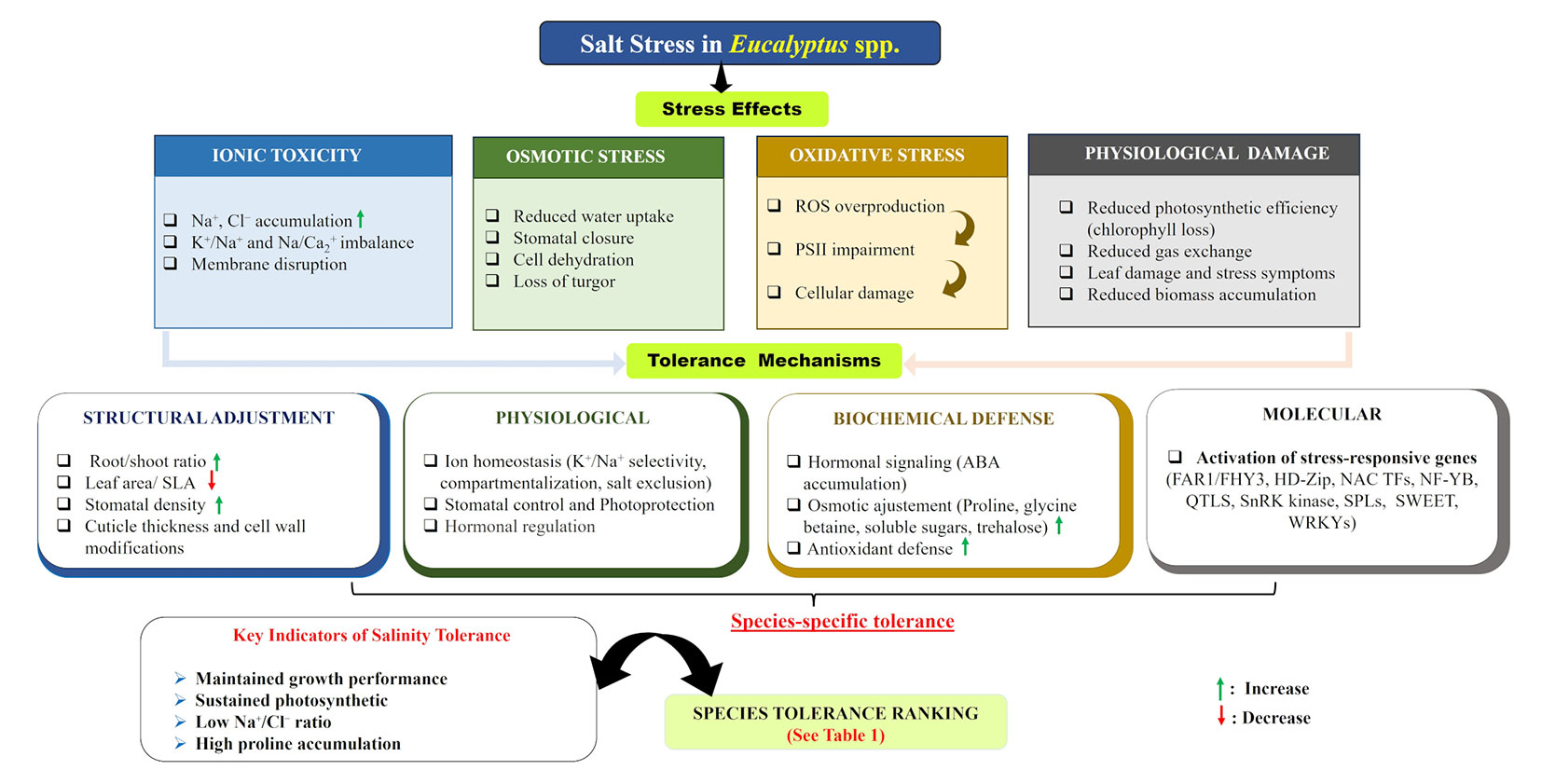
For clarity, Fig. 1 schematically summarizes these mechanisms.
Fig. 1 - Summary of salinity-induced effects and adaptive tolerance strategies in Eucalyptus spp. (ABA): abscisic acid; (FAR1/FHY3): Far-Red Impaired Response 1 / Far-Red Elongated Hypocotyl 3; (HD-Zip): Homeodomain-Leucine Zipper; (NAC): transcription factors; (NF-YB): Nuclear Transcription Factor Y subunit B; (PSII): photosystem II; (QTLs): quantitative trait loci; (ROS): reactive oxygen species; (SLA): Specific Leaf Area; (SnRK): sucrose non-fermentation-related protein kinase; (SPL): QUAMOSA promoter-binding protein-like, (SWEET): Sugars Will Eventually be Exported Transporter; (WRKY TFs): Transcription Factors.
Strategies and biotechnological approaches for enhancing salt tolerance in the Eucalyptus genus
Genetic, genomics and breeding in Eucalyptus
Tree genetic transformation has emerged as a pivotal strategy to enhance abiotic stress tolerance in Eucalyptus, enabling the targeted introduction of genes that improve growth and survival under adverse conditions ([65]). Despite the intrinsic challenges posed by genetic diversity, long life cycles, interspecific variability, and complex regeneration systems, considerable advances have been made in tree gene editing, transgenic technologies, and methods for delivering exogenous molecules ([84], [81]). Despite the well-documented recalcitrance of Eucalyptus genotypes to genetic transformation ([47]), many strategies have been developed. Broadly, transformation approaches in eucalypts fall into two categories: direct and indirect methods. Direct genetic transformation involves transferring the gene of interest using external forces, such as particle bombardment, microinjection, electroporation, and pollen tube mediation. In contrast, indirect transformation relies on Agrobacterium-mediated gene transfer, which exploits the bacterium’s natural ability to integrate exogenous DNA into the plant genome ([47], [82]). Generally, Agrobacterium-mediated transformation is one of the most commonly used methods of genetic transformation for the Eucalyptus genus: A. tumefaciens and A. rhizogenes are most frequently employed due to their high efficiency, good reproducibility, and simplicity ([57], [79], [81]). Functional studies consistently demonstrated that transgenic approaches targeting osmoprotectants, ion homeostasis, and vascular traits confer measurable improvements in salt tolerance, growth, and root development across multiple species and hybrids, including E. globulus, E. camaldulensis × E. tereticornis, and E. saligna ([28], [88], [79]). Empirical studies consistently demonstrated functional gains from these transformations. For instance, E. globulus hypocotyls transformed with the bacterial choline oxidase (codA) gene accumulated 12-fold higher glycine betaine and tolerated NaCl up to 300 mM ([50]). Similarly, using the EgCCR promoter to drive both β-glucuronidase (GUS) and GFP reporter genes in transformed E. globulus plantlets highlighted vascular tissue-targeted traits, suggesting the potential to reinforce lignin content and stress resilience ([23]). Other Transformation in E. camaldulensis × E. tereticornis F1 hybrids using yeast HAL2 showed that, out of 35, 11 transgenic plantlets had increased salt tolerance capacity, enhanced growth potential, and root development under 300 mM NaCl ([79]). While E. saligna cotyledons transformed with P5CSF129A and uidA genes via A. tumefaciens EHA105, increased proline accumulation fourfold, improving osmotic stress tolerance ([28]). Similarly, introduction of the mangrin gene (which encodes an allene oxide cyclase and contains a core protein domain that enhances salt stress tolerance of its host) in E. camaldulensis conferred improved salt tolerance without detectable biosafety risks ([88]), demonstrating the potential of targeted gene introduction for developing transgenic stress-resilient Eucalyptus species. Reviews of previous research revealed several successful transformation efforts across species and hybrids, including E. globulus ([47]), E. saligna cotyledons ([57]), E. urophylla × E. grandis DH32-29 hypocotyls using the hygromycin phosphate transferase (HPT) gene ([59]), E. urophylla × E. grandis DH32-29 Stem Segments using mCherry gene ([84]).
Complementing transformation, high-throughput omics technologies have greatly advanced forest tree breeding, following their success in crops. Genomics, transcriptomics, proteomics, metabolomics, and epigenomics now allow genome-wide identification of stress-responsive genes and pathways ([81]). Despite these advances, genomic resources in Eucalyptus remain relatively limited, with the E. grandis reference genome published in 2014 marking a major but still foundational milestone ([69], [39]). This genome sequencing enabled the characterization of stress-responsive genes and regulatory pathways underlying morphophysiological adaptation to abiotic constraints ([52]). Subsequent analyses highlighted structural variations, including gene duplications and translocations, as key drivers of genomic divergence, complex phenotypes, and local adaptation within the Eucalyptus genus ([39]). Furthermore, according to Wang et al. ([81]), comprehensive proteome characterization in woody species remains technically challenging due to: (i) the limitations of different proteome sequencing methods; (ii) the precision and reproducibility of proteome sequencing and existing proteomics pipelines are unsatisfactory. Consequently, large-scale protein identification and quantification in woody trees are still incomplete. Likewise, proteomic investigations in Eucalyptus, though limited, have largely centered on drought stress, leaving other abiotic constraints comparatively underexplored. For example, in E. saligna and E. tereticornis, drought-tolerant species showed higher levels of glutamine synthetase, ATP synthase, and vacuolar proteins, while other enzymes (RuBisCO, protease ClpA, transketolase, ferredoxin-NADP reductase, isofavone reductase, malate dehydrogenase, sedoheptulose-1-bisphosphatase and aminobutyrate transaminase) were induced exclusively in tolerant species under water stress ([49]). Correia et al. ([17]) analyzed the leaf proteome of two E. globulus accessions under different water-stress conditions and identified proteins especially related to photosystem II (PSII) and the Calvin cycle, such as glutamine synthetase, malate dehydrogenase, and isoflavone reductase-like protein. Additionally, metabolomics characterizes small-molecule metabolites and their concentration dynamics, which vary with genetic or physiological changes under stress conditions ([81]). Meanwhile, epigenomics explores DNA methylation, histone modifications, and non-coding RNA-mediated regulation of gene expression, linking environmental cues to phenotypic flexibility ([82]). These advances in omics methods have shown several successful applications in crops but remain insufficiently explored in the Eucalyptus genus, particularly under salinity stress.
Hybridization
Species of Eucalyptus are predominantly outcrossing, characterized by large effective population sizes, a broad geographic dispersion, and wide pollen and seed distributions, factors that naturally favor interspecific gene flow and genetic recombination ([82]). Hybridization has been used as a central silvicultural strategy to combine desirable traits such as rapid growth performance, adaptability to marginal environments, tolerance to abiotic stress, and high reproductive and processing characteristics ([72]). Operational hybrid programs have largely focused on controlled F1 hybrids or spontaneous first-generation (F1) composite populations, primarily within the subgenus Symphyomyrtus ([60]). Most commercial populations originate from taxa within the sections Maidenaria (E. globulus Labill., E. nitens [Deane and Maiden] Maiden), Exsertaria (E. camaldulensis Dehnh., E. tereticornis Sm.), and Transversaria (E. pellita F.Muell., E. grandis, E. urophylla) ([29]). Commercial forestry has particularly relied on combinations such as E. grandis × E. urophylla, E. grandis × E. camaldulensis, and related crosses involving E. saligna, E. pellita, E. exserta, and E. tereticornis, reflecting their consistent productivity and adaptability across diverse environments ([60], [79]). While inter-subgeneric hybridization is rare, gene exchange is relatively common within sections, reflecting phylogenetic proximity and partial reproductive compatibility ([65]). Hybrid vigor under salinity is consistently documented in Eucalyptus ([47]). Evidence indicated that crosses involving the salt-tolerant E. camaldulensis often exhibit enhanced tolerance when combined with fast-growing species such as E. grandis or E. urophylla. For instance, E. camaldulensis × E. grandis displayed greater salinity tolerance than E. camaldulensis × E. globulus, the latter reflecting intermediate performance likely associated with the salt sensitivity of E. globulus ([38]). Similarly, E. camaldulensis × E. urophylla demonstrated superior tolerance compared with pure E. camaldulensis genotypes under high NaCl concentrations (200 mM NaCl), maintained higher proline accumulation, better pigment retention, reduced photosynthetic inhibition, and less pronounced growth suppression ([13]). Consistent trends were also observed for E. camaldulensis × E. tereticornis, where improved tolerance was associated with efficient ion homeostasis, particularly favorable K+/Na+ ratios, and sustained biomass production ([20]). Together, these findings converge on improved osmotic regulation and ionic balance as central mechanisms underlying hybrid advantage. Further research by Oberschelp et al. ([56]) mentioned that the E. grandis × E. urophylla hybrid, widely recognized as “E. urograndis”, developed in Brazil during the 1980s, is used as a world-class benchmark for clonal forest productivity. This hybrid combines rapid growth, excellent rooting ability, versatile wood quality, and high tolerance to biotic and abiotic stresses. Germination studies further corroborate the resilience of hybrids under combined salinity and osmotic stress. Importantly, this trend is not restricted to vegetative growth. Germination studies under combined high salinity (NaCl 15% at 12 g L-1) and osmotic stress (61% at -1.6 MPa) showed that E. gomphocephala × E. cornuta maintained higher viability than several pure taxa, including E. torquata, E. sargentii, and E. gillii ([51]), suggesting that hybrid advantage may extend across developmental stages. Overall, the literature consistently supports the superior performance of hybrids over pure species under salinity stress. This advantage is primarily attributed to heterosis (hybrid vigor) and to exploiting increased allelic diversity through recombination and selection in backcrossed or advanced-generation (composite) hybrids ([60], [47]).
Effective and sustainable methods to minimize salinity’s impact
Beyond genetic and biotechnological approaches, the natural regenerative capacity of Eucalyptus, particularly the formation of lignotubers, plays a critical role in tolerance to abiotic stress. Lignotubers, basal woody structures containing dormant buds and stored nutrients, are present in approximately 95% of Eucalyptus species and support regeneration under drought, salinity, or fire ([10]). Importantly, genes associated with abiotic stress responses are localized near the ELig region of the lignotuber, highlighting its potential as a molecular target for breeding programs aimed at improving stress resilience. Symbiotic interactions with beneficial soil microbes, particularly arbuscular mycorrhizal fungi (AMF), offer another effective strategy. AMF are ubiquitous root-colonizing soil fungi associated with most terrestrial plants; they enhance host plant tolerance to environmental stresses, particularly to salinity ([31]). AMF improve salt resistance through several biochemical and physiological mechanisms: (i) improve water absorption and nutrient uptake while maintaining osmotic and ionic balance; (ii) regulate plant hormones and activate antioxidant defenses to mitigate ROS damage; and (iii) increase photosynthetic efficiency and protect the photosynthetic machinery ([77], [31]). Recent studies illustrated these benefits. Boorboori & Lackóová ([9]) showed that AMF enhanced saline soil structure (increasing N, P, K pools, organic matter content, and pH balance), improved plants’ water and nutrient uptake, and promoted root growth and conductivity by forming a wide hyphal network and spreading mycelium outside the rhizosphere. Similarly, ECM fungi such as Pisolithus albus isolate PA33 and Pisolithus tinctorius significantly improved growth (height and root collar diameter, fresh and dry biomass), root development, and stress tolerance in hybrids (E. camaldulensis × E. pellita) and E. globulus seedlings under high salinity compared to non-mycorrhizal controls ([85], [89]). Mechanistically, AMF colonization increases K+ ion absorption in roots and their accumulation in shoots by upregulating SKOR channels, enhances K+/Na+ ratios, supports enzymatic activity, and reduces protein degradation, while also regulating aquaporins (PIP), H+-ATPases (VHA-B), and Na+/H+ antiporters (NHX1, SOS1), which collectively regulate ion homeostasis and water potential ([31], [84], [27]). Another approach is chemical and nanotechnological interventions, which have shown promise in mitigating salinity stress. Selenium (Se) application has gained attention for its potential role in enhancing Eucalyptus seedlings’ resilience to stressors. Selenium alleviated salinity-induced stress in Eucalyptus genotypes (VCC 865 and AEC 0144) by enhancing photosynthetic efficiency, increasing energy connectivity with Photosystem II reaction centers, promoting greater clustering of Light Harvesting Complex II, reducing oxidative damage, boosting chlorophyll content, and improving growth ([42]). Soil conditioners and hydrophilic polymers, such as Super-AB-A-200, a tripolymer of acrylamide, acrylic acid, and potassium acrylate, improved soil water retention, reduced sodium uptake, and maintained favorable K+/Na+ ratios in E. globulus under salinity stress ([43]). Likewise, iron oxide nanoparticles (IONPs) triggered biochemical defenses in E. tereticornis, increased antioxidant enzyme activities, proline and soluble sugar accumulation, and reduced lipid peroxidation ([71]). Collectively, these studies highlighted that Eucalyptus resilience to salinity can be enhanced through integrated strategies: leveraging intrinsic regenerative traits, harnessing beneficial microbial associations, and applying targeted chemical or nanotechnological interventions. These approaches not only improve physiological and biochemical responses but also provide practical tools for reclaiming and managing saline-affected landscapes.
Literature limitations, mechanistic implications, and forestry relevance
The body of literature reviewed herein has considerably advanced our understanding of salinity tolerance in the Eucalyptus genus across multiple levels of biological organization. Nonetheless, important limitations must be critically acknowledged. Most available studies relied on short-term pot or hydroponic experiments conducted under controlled conditions. While these designs are methodologically indispensable for isolating specific mechanisms, they inherently simplify the ecological complexity of saline environments. Consequently, extrapolating early-stage mechanistic responses to long-term stand productivity, ecosystem stability, or carbon sequestration under field conditions requires caution. Bridging this gap between controlled experimentation and field-scale validation therefore constitutes a major research priority for advancing predictive and operational salinity-adaptive forestry. Despite these constraints, this review provides an integrative and strategically oriented synthesis of the available evidence, positioning Eucalyptus as a key biological resource for forestry development under increasing soil salinization. The accumulated research identified a core group of several salt-tolerant species, including E. sargentii, E. microtheca, E. rudis, E. occidentalis, E. gomphocephala, E. tereticornis, E. camaldulensis, E. robusta, E. moluccana, E. platypus, E. raveretiana, E. spathulata, E. sideroxylon, E. loxophleba; together with interspecific hybrids mainly E.camaldulensis × E. grandis, E. camaldulensis × E. urophylla, E. camaldulensis × E. tereticornis, E. grandis × E. urophylla, and E. gomphocephala × E.cornuta as operationally relevant genetic resources for salt-affected territories. From a strategic forestry perspective, the targeted deployment of empirically validated salt-tolerant taxa represents a scientifically grounded approach to afforestation and ecological restoration, particularly under escalating climatic variability and progressive soil salinization. Their documented physiological plasticity, the capacity to maintain biomass production under ionic stress, and their superior salt tolerance position them as ideal candidates for climate-resilient forestry systems ([61], [68], [22], [70]).
Accordingly, this mechanistic framework, which moves beyond descriptive reporting, provides a structured basis for predicting genotype performance and optimizing genotype selection and management strategies under salinity stress. In this context, Eucalyptus spp. offer several fundamental advantages. (i) Physiological plasticity and genetic variability: facilitate the identification or breeding of genotypes adapted to moderate-to-high salinity gradients, enabling targeted and effective improvement programs. (ii) High biomass productivity and economic viability: exceptional growth rates and carbon sequestration capacity sustain both ecological function and economic returns under suboptimal edaphic conditions. (iii) Ecosystem rehabilitation potential: root systems and symbiotic microbial interactions promote soil stabilization, enhance soil structure, and drive the progressive recovery of degraded saline landscapes.
Conclusion
By integrating insights across multiple biological scales, this review critically synthesizes recent advances in understanding Eucalyptus spp. responses to soil salinity, encompassing morphological and physiological adjustments as well as molecular and genomic regulatory networks that underpin salt tolerance. Documented intra- and interspecific variability has facilitated the identification and selection of promising salt-tolerant genotypes, providing a solid foundation for targeted genetic improvement. Nevertheless, translating these advances into operational forestry remains a critical frontier. Key tolerance-associated traits identified under controlled conditions require robust validation across long-term, heterogeneous plantation environments and developmental stages. Significant gaps persist in multi-year and ecosystem-scale studies evaluating growth stability, productivity, and ecological resilience under chronic salinity. Future progress will depend on a tighter integration of physiological performance, genomic architecture, and environmental context within predictive breeding and management frameworks. Advancing toward such a field-anchored, systems-level strategy will be decisive for unlocking the full potential of Eucalyptus in sustainable afforestation and restoration of salt-affected landscapes.
Acknowledgements
IC conducted the investigation, conducted the literature review, and wrote the original draft. KBY contributed to the manuscript’s conceptualization and revision process. ES contributed to conceptualization, writing, revision, and supervision of the manuscript.
This research was funded by the Institution of Agricultural Research and Higher Education (IRESA) through the AridoMell project.
References
CrossRef | Gscholar
CrossRef | Gscholar
CrossRef | Gscholar
CrossRef | Gscholar
Gscholar
Gscholar
Gscholar
CrossRef | Gscholar
CrossRef | Gscholar
CrossRef | Gscholar
CrossRef | Gscholar
Authors’ Info
Authors’ Affiliation
Ezzeddine Saadaoui 0000-0001-5991-0912
Regional Station of Gabes-LGVRF - LR11INRGREF01, National Institute of Research in Rural Engineering, Waters and Forests - INRGREF, University of Carthage, Tunis (Tunisia)
LEF - LG16INRGREF03, National Institute of Research in Rural Engineering, Waters and Forests - INRGREF, University of Carthage, Tunis (Tunisia)
Corresponding author
Paper Info
Citation
Chemlali I, Ben Yahia K, Saadaoui E (2026). Managing salinity stress in Eucalyptus spp.: trait variation, mechanistic insights, and implications for salt-affected landscapes. iForest 19: 376-387. - doi: 10.3832/ifor5036-019
Academic Editor
Marco Borghetti
Paper history
Received: Nov 11, 2025
Accepted: Apr 05, 2026
First online: Nov 06, 2026
Publication Date: Dec 31, 2026
Publication Time: 7.17 months
Copyright Information
© SISEF - The Italian Society of Silviculture and Forest Ecology 2026
Open Access
This article is distributed under the terms of the Creative Commons Attribution-Non Commercial 4.0 International (https://creativecommons.org/licenses/by-nc/4.0/), which permits unrestricted use, distribution, and reproduction in any medium, provided you give appropriate credit to the original author(s) and the source, provide a link to the Creative Commons license, and indicate if changes were made.

Web Metrics
Breakdown by View Type
Article Usage
Total Article Views: 48
(from publication date up to now)
Breakdown by View Type
HTML Page Views: 13
Abstract Page Views: 15
PDF Downloads: 16
Citation/Reference Downloads: 0
XML Downloads: 4
Web Metrics
Days since publication: 1
Overall contacts: 48
Avg. contacts per week: 336.00
Article Citations
Article citations are based on data periodically collected from the Clarivate Web of Science web site
(last update: Jul 2026)
(No citations were found up to date. Please come back later)
Publication Metrics
by Dimensions ©
Articles citing this article
List of the papers citing this article based on CrossRef Cited-by.
Related Contents
iForest Similar Articles
Research Articles
Characterization of two poplar homologs of the GRAS/SCL gene, which encodes a transcription factor putatively associated with salt tolerance
vol. 8, pp. 780-785 (online: 19 May 2015)
Research Articles
Two Populus deltoides W.Bartram ex Marshall clones cope differentially with sodium salinity stress
vol. 18, pp. 259-266 (online: 10 October 2025)
Research Articles
Effect of salt and drought on growth, physiological and biochemical responses of two Tamarix species
vol. 8, pp. 772-779 (online: 25 March 2015)
Research Articles
Genetic variation and heritability estimates of Ulmus minor and Ulmus pumila hybrids for budburst, growth and tolerance to Ophiostoma novo-ulmi
vol. 8, pp. 422-430 (online: 15 December 2014)
Review Papers
Indicators of drought effects in Pinus sylvestris: genetic analyses to corroborate the results of empirical methods
vol. 3, pp. 89-91 (online: 15 July 2010)
Research Articles
Seedling emergence capacity and morphological traits are under strong genetic control in the resin tree Pinus oocarpa
vol. 17, pp. 245-251 (online: 16 August 2024)
Research Articles
Stability analysis and selection of optimal Eucalyptus urophylla × E. grandis families
vol. 18, pp. 293-300 (online: 20 October 2025)
Research Articles
Patterns of genetic variation in bud flushing of Abies alba populations
vol. 11, pp. 284-290 (online: 13 April 2018)
Research Articles
Salinity strongly drives the survival, growth, leaf demography, and nutrient partitioning in seedlings of Xylocarpus granatum J. König
vol. 10, pp. 851-856 (online: 26 October 2017)
Research Articles
Genetic diversity of core vs. peripheral Norway spruce native populations at a local scale in Slovenia
vol. 11, pp. 104-110 (online: 31 January 2018)
iForest Database Search
Search By Author
Search By Keyword
Google Scholar Search
Citing Articles
Search By Author
Search By Keywords
PubMed Search
Search By Author
Search By Keyword