
Functional and antioxidant responses to natural heat stress in Fagus sylvatica and Quercus robur: effects of ecological adaptation and ontogenetic stage
iForest - Biogeosciences and Forestry, Volume 19, Issue 4, Pages 292-303 (2026)
doi: https://doi.org/10.3832/ifor4985-019
Published: Jul 28, 2026 - Copyright © 2026 SISEF
Research Articles
Abstract
Heat waves and prolonged droughts affect the ecological and physiological processes of forest trees, yet their responses vary by species and ontogenetic stage. In this study, we analyzed the functional and antioxidant responses of seedlings and mature trees of Fagus sylvatica (shade-tolerant species) and Quercus robur (light-demanding species) after a natural heat stress event and during a 10-day recovery period. Leaves collected immediately after the heat wave were maintained under controlled laboratory conditions. Photosynthetic parameters (chlorophyll a and b, chlorophyll a/b ratio, carotenoids, and the effective quantum yield of photosystem II) and antioxidant parameters (catalase activity and total phenolic content) were measured. Significant differences were observed between species and ontogenetic stages. The mature F. sylvatica exhibited limited recovery of photosynthetic pigments and a marked reduction in catalase activity under heat stress. In contrast, the mature Q. robur maintained high ΦPSII values and initially exhibited elevated total phenolic content, suggesting effective protection of the photosynthetic apparatus and a more robust antioxidant capacity under the conditions analyzed. The F. sylvatica seedling showed rapid recovery of chlorophyll a and ΦPSII, with higher amplitudes of photosynthetic and antioxidant parameters compared with the mature tree. The recovery index highlighted ontogenetic differences: the F. sylvatica seedling displayed rapid recovery of chlorophyll a (+15.2%) and ΦPSII (+19.5%), whereas the mature tree showed minor increases in chlorophyll b and ΦPSII, along with decreases in chlorophyll a (-3.3%) and carotenoids (-10.3%). In Q. robur, the mature tree maintained pigment stability and high ΦPSII values, while the seedling initially had higher chlorophyll and carotenoid amounts but a reduced functional recovery of ΦPSII and antioxidant response. Overall, responses to heat stress and recovery dynamics depend strongly on ontogenetic stage and on the specific functional and antioxidant traits measured, indicating that general ecological strategies of species do not fully reflect actual physiological performance under natural stress. This approach provides relevant insights for assessing forest resilience and developing adaptive management strategies under variable climatic conditions.
Keywords
Heat Stress, Seedlings, Mature Trees, Photosynthetic Parameters, Catalase, Phenolic Compounds
Introduction
Climate change, particularly the increasing frequency and intensity of heat stress episodes, poses major challenges to forest ecosystems, affecting not only the regenerative capacity of forests but also the survival of mature trees ([1], [19]). In this context, understanding how trees of different ages modulate their physiological responses to heat stress is essential for anticipating forest ecosystem resilience and developing effective management and restoration strategies ([10], [6]).
In several European regions, natural or artificial forest regeneration is compromised by high juvenile mortality rates caused by severe heat stress. Furthermore, the selection of species for afforestation does not always adhere to strict ecological criteria, often resulting in combinations of species with different requirements for local light, moisture, or tolerance to abiotic stress. Such mismatches can undermine long-term regeneration success and contribute to the loss of forest ecosystem resilience ([37], [30]).
The above situation raises the question of the validity of general ecological strategies for assessing species’ performance under stressful conditions. Several studies have highlighted a potential dissociation between a species’ general ecological strategy (e.g., heliophytes vs. sciophytes) and its physiological performance under abiotic stress. For instance, some shade-tolerant species may exhibit low tolerance to drought or high temperatures, despite their adaptations to low-light conditions ([40], [44]). This discrepancy underscores the limitations of approaches based solely on life-history strategies and suggests the need for direct exploration of functional traits that confer resistance or sensitivity to environmental stressors, particularly in unstable contexts.
Trees’ responses to abiotic stress, such as drought or extreme temperatures, are influenced not only by taxonomic affiliation or species-specific ecological characteristics but also by the tree’s physiological age ([34], [22]). Studies indicate that the ontogenetic stage plays a crucial role in modulating stress-response strategies, affecting key functional traits such as photosynthetic rate, water-use efficiency, stomatal regulation, and antioxidant enzyme activity ([43], [44]). Seedlings, being in an active growth phase, exhibit high physiological plasticity, whereas mature trees possess more stable regulatory mechanisms but may have reduced adaptability to severe stress. Additionally, mature trees often demonstrate higher stress tolerance due to more robust physiological regulation and accumulated ecological experience ([5], [24], [25], [50]).
Data from the literature indicate that stress responses can vary among species and developmental stages, including widely distributed species such as pedunculate oak (Quercus robur) and European beech (Fagus sylvatica). For example, Niemczyk et al. ([33]) reported that oak seedlings reduce water loss more efficiently than beech seedlings through more adaptive stomatal regulation, facilitating faster recovery under drought conditions. In contrast, beech seedlings maintain high transpiration and stomatal conductance until critical thresholds of water deficit are reached. The two species also differ in strategies for mobilizing non-structural carbohydrates: oak primarily accumulates soluble sugars, whereas beech mobilizes starch.
These differences are relevant for understanding how tree age influences forest ecosystem resilience, particularly under current climate pressures, and underscore the need for a comparative analysis of functional responses between seedlings and mature trees. Several studies show that mature trees may exhibit a progressive decline in photosynthetic efficiency relative to juveniles, due to morphological and physiological changes in leaves associated with aging. For instance, Day et al. ([10]) demonstrated that in Picea rubens, aging leads to decreases in photosynthetic rate and specific leaf area, even under controlled conditions, as evidenced by grafting onto juvenile rootstocks.
Niinemets ([34]) emphasizes that tree tolerance to stress increases as individuals progress through ontogeny, due to cumulative exposure to stressors and the accumulation of non-structural carbon reserves. Similarly, Valladares & Niinemets ([44]) show that shade tolerance is a complex ecological trait influenced by age and a range of biotic and abiotic factors, involving functional trade-offs between maximizing photosynthetic gain under low-light conditions and minimizing losses. In this context, phenotypic plasticity plays a key role in adaptation to environmental variability.
Studies on F. sylvatica highlighted differences between developmental stages, particularly regarding physiological responses to heat and water stress. Pflug et al. ([36]) demonstrated that beech seedlings exposed to summer drought exhibit significant declines in net photosynthesis and stomatal conductance as stress progresses. However, following re-watering, these seedlings rapidly recover both photosynthetic function and stomatal conductance, indicating good resilience. In contrast, mature trees display a greater capacity to regulate water loss and maintain photosynthetic function, especially under moderate drought conditions ([4]).
Antioxidant capacity plays a crucial role in protecting plant tissues against damage caused by heat stress, particularly through the detoxification of reactive oxygen species. Antioxidant enzyme activity differs significantly between seedlings and mature trees, depending on species, age, and stress severity ([12], [39]). In Q. robur, seedlings exhibit a more dynamic antioxidant response, rapidly inducing antioxidant enzymes in response to heat stress, which reflects a high metabolic plasticity. In contrast, mature trees display an antioxidant capacity based on pre-existing mechanisms, but these are less flexible in response to acute stress ([38], [21]).
Pedunculate oak (Quercus robur) and European beech (Fagus sylvatica), two dominant forest species in European woodlands, are often described as having contrasting ecological strategies, with Q. robur commonly regarded as subheliophilous and F. sylvatica as shade-tolerant. However, such broad ecological categories alone are insufficient to reliably predict actual physiological responses to thermal stress. For this reason, these two species provide a suitable model for a comparative investigation of physiological and antioxidant responses in relation to ontogenetic stage. The present study aims to comparatively analyze the recovery of photosynthetic and antioxidant traits in leaf extract samples of seedlings and mature trees of both F. sylvatica and Q. robur during the first ten days following a natural heat stress event. This integrated approach contributes to a better understanding of how functional and antioxidant traits vary with ontogenetic stage and adaptive strategy, providing relevant insights for the selection of biological material in sites undergoing natural regeneration under climate change pressure.
Materials and methods
Experimental design and sample selection
Leaves were collected from one mature tree and one juvenile (~10 years old) of Quercus robur and Fagus sylvatica in the Plaiul Fagului Scientific Reserve (Republic of Moldova). Mature trees were selected from forests representative of the site conditions for each species: F. sylvatica from a mixed forest type with Quercus petraea, F. sylvatica, and Tilia tomentosa, characterized by the presence of Carex brevicollis; Q. robur from a mixed forest dominated by Q. robur and Carpinus betulus, with Rubus caesius as the dominant understorey species.
The first stand, approximately 90 years old and including Fagus sylvatica, is located on a northern, fragmented, and heterogeneous slope with variable inclinations and slight microdepressions, at an altitude of around 340 m a.s.l. Abiotic conditions are primarily determined by altitude, aspect, and slope, influencing the local microclimate. The shaded slope is characterized by a cooler thermal regime and relatively high humidity.
The soil is a brown luvic type with a loamy-sandy texture, relatively homogeneous at the surface. The soil profile varies in depth depending on slope and the nature of the parent rock. At depth, sandy loams are underlain by layers of fine sand with fragments of sandstone ([11]).
The stand structure is mixed, with a dominance of mesophytic species. Species composition is dominated by: Fraxinus excelsior (30%), C. betulus (40%), T. tomentosa (10%), T. cordata (10%), Ulmus glabra (5%), Acer pseudoplatanus (5%), while scattered or solitary species include: F. sylvatica, Q. petraea ssp. polycarpa, A. platanoides, A. campestre, and Prunus avium.
The second stand, in which a Q. robur individual was analyzed, is approximately 90 years old and is located at the base of a southeast-facing slope at an altitude of 202 m. The slope is gentle (3-5°), and the terrain is relatively homogeneous in terms of site conditions.
The slope is covered by a layer of clayey loam and loamy or sandy clays, possibly resedimented through deluvial processes. Under these deposits, typical grey soils have formed locally, with an altitudinal range of 200 to 280 m. The soil profile is well differentiated into A (eluvial) and B (illuvial) horizons, with no carbonates present up to a depth of 110 cm ([11]).
The stand structure is less diverse compared to the first site. Species composition includes: Q. robur (35%), C. betulus (55%), F. excelsior (5%), T. cordata (5%), while scattered or solitary species comprise P. avium, U. glabra, and A. campestre.
The regeneration area is located approximately 3 km from the two mature stands and is the nearest naturally regenerating site where both F. sylvatica and Q. robur coexist, approximately 20 m apart. The site is situated on a northwest-facing slope at an altitude of 225 m, with a gentle slope inclination of 2-5°. In the seedling growth area, the slope is 2°, and the soil is typically grey, characteristic of these site conditions. Regeneration occurs in a young, mixed stand where both species develop under similar conditions. For analysis, vigorous seedlings of comparable size, fully exposed to sunlight, were selected.
Given the exploratory nature of the study and the objective of evaluating physiological differences between species and ontogenetic stages under well-characterized ecological conditions, one representative individual was selected for each species-ontogenetic stage combination. This approach allowed rigorous control of environmental variables (light, microtopography, soil type) and minimized interference from intra-population genetic variability, which would have required additional experimental effort and a substantial expansion of the study design.
Leaves were collected from the most light-exposed portions of each individual, according to crown architecture and species-specific light conditions. For seedlings, leaves were sampled from the upper part of the crown directly exposed to solar radiation, whereas for mature trees, leaves were taken from well-lit lower canopy regions. For Q. robur, fully sun-exposed leaves were selected, while for F. sylvatica, partially illuminated portions were chosen, completely avoiding shaded areas of the crown.
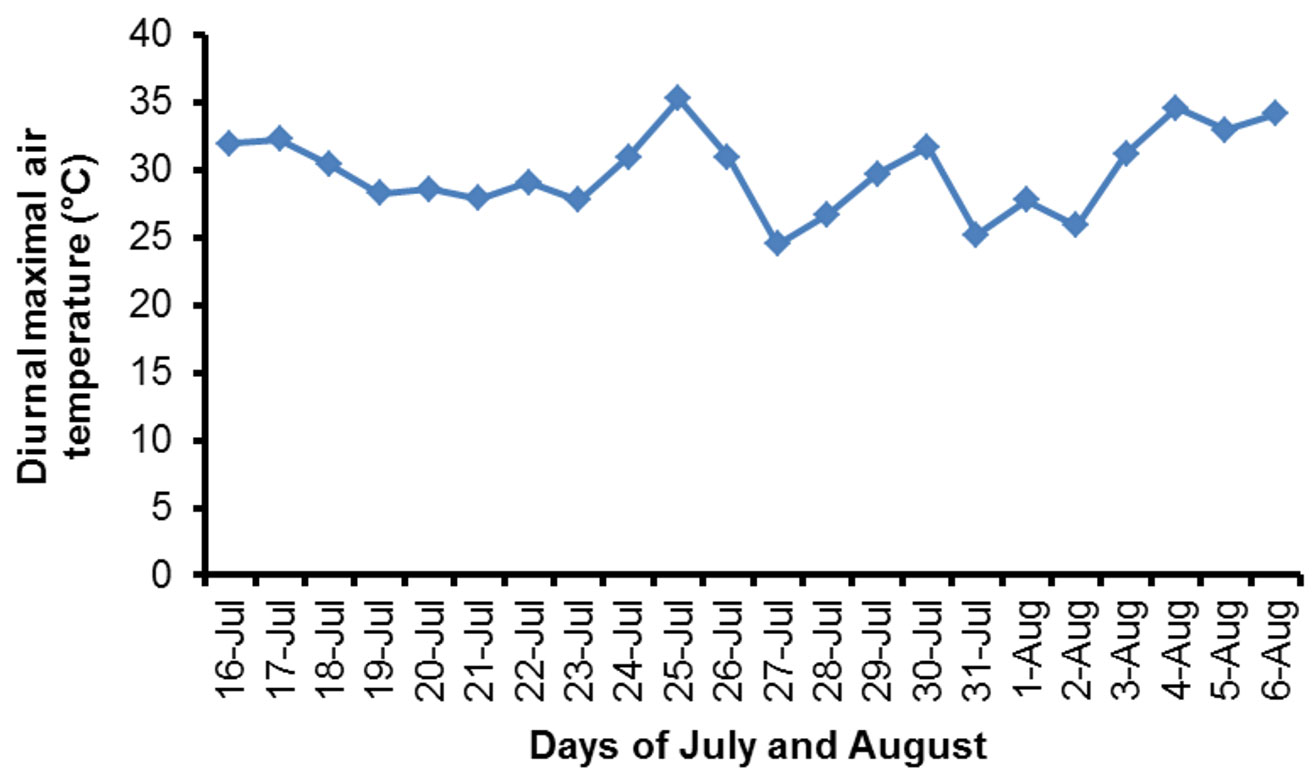
To assess the impact of the heat wave and elevated temperatures on the natural heat stress of the studied trees, leaf samples were collected at the beginning of August 2024, following a prolonged period of heat and drought. The dynamics of diurnal maximum temperatures during this period are shown in Fig. 1.
Fig. 1 - Variation in daily maximum temperatures during the period preceding leaf sampling for the analysis of physiological and biochemical indicators.
From each mature tree and seedling, 50 leaf samples were collected for physiological and biochemical analyses. Samples were placed in paper envelopes and transported to the laboratory in a portable cooler to maintain the samples’ physiological integrity.
In the laboratory, samples were maintained under artificially controlled conditions: a constant temperature of 25 °C, relative humidity of 85%, illumination of 200 lux, and a photoperiod of 16 h light followed by 8 h darkness. Leaves were sampled from the incubators at 1, 3, 5, 7, and 10 days to determine the following physiological and biochemical parameters: chlorophyll a and b contents, carotenoid content, effective quantum yield of photosystem II, catalase activity, and total phenolic content.
For the biochemical analyses of photosynthetic pigments, five leaves were collected at each time point and cut into narrow strips. These strips were pooled to create a composite sample, which was subsequently used for biochemical determinations.
Physiological and biochemical analyses
Determination of chlorophyll amount
From the composite sample, 0.1 g of fresh material was weighed and homogenized in 5 mL of 80% acetone. The extract was kept at 5 °C for 4 hours under low-light conditions, then centrifuged at 4,000 ×g for 10 minutes. The absorbance of the supernatant was measured at 662 and 644 nm using a spectrophotometer (PerkinElmer 124), with 80% acetone as the blank. Chlorophyll a and b amounts were calculated according to standard equations ([3]), and results were expressed in mg g-1 fresh weight.
Quantification of carotenoids
Carotenoids were determined from the same acetone extract used for chlorophyll analysis, except that optical density was measured spectrophotometrically at 440.5 nm.
Determination of the effective quantum yield of photosystem II (ΦPSII)
Measurements were performed using a portable PAM-2100 fluorimeter (Heinz Walz GmbH, Germany) on freshly collected leaves that had been exposed to actinic light. Ten leaves per individual were analyzed, with three measurements per leaf, under controlled conditions. The effective quantum yield of photosystem II was calculated using the formula ΦPSII = (Fm′ - Ft)/Fm′, where Fm′ is the maximal fluorescence in light and Ft is the steady-state fluorescence. This parameter reflects the efficiency of light utilization by photosystem II and serves as an indicator of the recovery of photosynthetic capacity following natural heat stress.
Determination of catalase activity
Catalase activity was determined by quantìifying the degradation of hydrogen peroxide (H2O2) via formation of a colored complex with ammonium molybdate, which exhibits maximum absorbance at 405 nm. For each species, 100 mg of fresh leaves were collected and homogenized in a mortar with 0.2 M Tris-glycine buffer. The homogenate was centrifuged at 15,000 ×g for 15 minutes (Sigma® 3K30 centrifuge), and the resulting supernatant was used for the enzymatic assay.
For the biochemical reaction, 100 μL of supernatant was used, initiated by adding 0.03% H2O2, and incubated at 37 °C for 10 minutes. The reaction was stopped by adding 4% ammonium molybdate. Optical density was measured at 405 nm using a Perkin-Elmer 124 spectrophotometer, in three replicates, with a blank sample containing no active enzyme.
Catalase activity was expressed as μMol of H2O2 decomposed per minute of incubation per 1 mg of protein, according to the formula (eqn. 1):
where Cat is the catalase activity (μmol H2O2 min-1 mg-1 protein), C(H2O2) is the hydrogen peroxide concentration (μMol), T is the incubation time (min), C(protein) is the protein concentration in the sample (mg ml-1), and V is the sample volume (ml).
Determination of total phenolic compounds
Leaves were dried at 40 °C to reduce water content and minimize degradation of phenolic compounds. From the dried material, 20 mg was weighed for each species and each analysis interval. The leaves were finely ground and homogenized in a mortar with 2 mL of 80% ethanol, yielding a suspension. This suspension was incubated for 30 minutes in a water bath at 80 °C, then centrifuged at 15,000 ×g for 15 minutes (Sigma 3K30). The resulting supernatant was collected and divided into three replicates for each species.
For the colorimetric reaction, 2.5 mL of Folin-Ciocalteu reagent was added to the supernatant, followed by a 3-minute preliminary reaction at room temperature. Subsequently, 2 mL of 7.5% sodium carbonate solution was added, and the mixture was incubated for 2 hours to form the characteristic blue complexes of phenolic compounds. Absorbance was measured at 765 nm using a spectrophotometer (Perkin-Elmer 124). Total phenolic content was expressed as gallic acid equivalents (GAE, mg g-1), based on a calibration curve.
Statistical analyses
Statistical analyses were performed using the software Centurion XVI (Statgraphics Technologies, Inc., VA, USA). For the five measured physiological variables (chlorophyll a and b, chlorophyll a/b ratio, carotenoids, and ΦPSII efficiency), as well as for the two antioxidant-related variables (catalase and total phenolic compounds), appropriate statistical methods were applied, as described below.
Each variable was analyzed using a multifactorial analysis of variance (ANOVA) with Type III sums of squares, including three factors: species, ontogenetic stage, and post-heat-stress recovery period (1, 3, 5, and 10 days), and incorporating all possible interactions among these factors.
Additionally, a multifactorial linear regression with dummy variables was applied to determine the magnitude, direction, and significance of the effects of the factors: species (F. sylvatica), ontogenetic stage (mature), and the comparison of recovery between the first and tenth day post-heat stress on the physiological and antioxidant variables.
Both the multifactorial ANOVA and the multifactorial linear regression were performed using the raw optical absorbance data, measured for each sample in three technical replicates for pigments and antioxidant compounds, and in ten leaf replicates for ΦPSII efficiency. This approach ensures a reliable assessment of experimental variation and the statistical significance of observed differences.
To quantify post-stress recovery efficiency, the recovery index (RI) was calculated for each variable and ontogenetic stage, according to the formula (eqn. 2):
where ValueDay10 is the physiological variable value on the tenth day post-stress, and ValueDay1 is the physiological variable value on the first day post-stress.
Results
Photosynthetic functional parameters
In Fagus sylvatica, the amount of chlorophyll a was higher in the seedling compared to the mature tree throughout the recovery period following heat stress. In the seedling, values increased gradually, indicating efficient recovery, whereas in the mature tree, values increased up to day 5, then declined slightly through the end of the observation period (Fig. 2a).
Fig. 2 - Recovery of photosynthetic pigments in mature trees and seedlings of Fagus sylvatica and Quercus robur during the ten-day post-stress period: (a) chlorophyll a; (b) chlorophyll b; (c) chlorophyll a/b ratio; (d) carotenoids. (1): Fagus sylvatica, mature; (2): F. sylvatica, seedling; (3): Quercus robur, mature; (4): Q. robur, seedling.
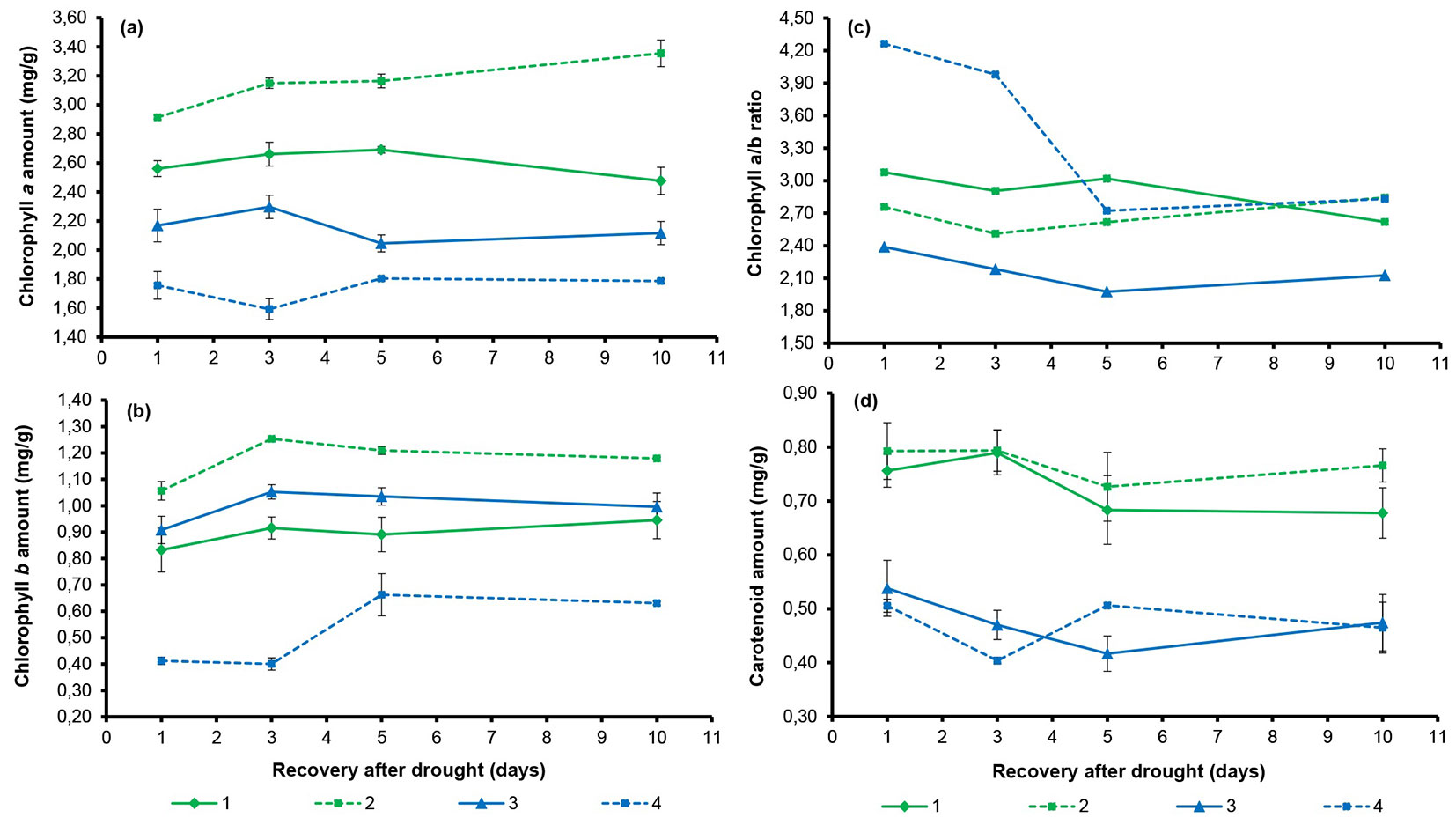
In Quercus robur, the amount of chlorophyll a in the seedling decreased until day three, then recovered completely by day five and remained nearly constant thereafter. In the mature tree, values were generally higher but showed no clear trend of increase or decrease over time. Comparatively, at the juvenile stage, F. sylvatica exhibited a significantly higher chlorophyll a amount than Q. robur, which may reflect a greater capacity for photosynthetic recovery between the two species under similar natural regeneration conditions (Fig. 2a).
Trends observed for chlorophyll b in F. sylvatica were similar to those for chlorophyll a, with higher values in the seedling compared to the mature tree. In Q. robur, during the recovery period, chlorophyll b amount was higher in the mature tree than in the seedling, suggesting a differential distribution of this pigment between ontogenetic stages (Fig. 2b).
The chlorophyll a/b ratio revealed clear differences between species and ontogenetic stages. In F. sylvatica, the mature tree exhibited a higher chlorophyll a/b ratio than the seedling during the first five days of recovery, and the parallel temporal trends suggest greater functional stability at this ontogenetic stage. In Q. robur, the a/b ratio was significantly higher in the seedling during the initial days, reflecting a relatively higher proportion of chlorophyll a, likely associated with intense photosynthetic activity at the juvenile stage. At this stage, Q. robur showed a higher a/b ratio compared to F. sylvatica (Fig. 2c).
Carotenoid amount in F. sylvatica was higher in the seedling than in the mature tree throughout the recovery period, suggesting an enhanced antioxidant capacity at the juvenile stage. In Q. robur, differences between ontogenetic stages were minor; values were generally higher in the mature tree, except on day five, when a pronounced decrease in carotenoids was observed, followed by recovery by day ten. Overall, the seedling of F. sylvatica exhibited significantly higher carotenoid amount than those of Q. robur, indicating more efficient antioxidant protection in this species at the juvenile stage (Fig. 2d).
Differences in the amount of photosynthetic pigments were largely confirmed by the multifactorial analysis, which revealed significant effects of species, ontogenetic stage, and recovery day on chlorophyll a, chlorophyll b, and carotenoids. For the chlorophyll a/b ratio, only ontogenetic stage and recovery day had significant effects. Significant interactions were also identified among most combinations of factors (Tab. 1).
Tab. 1 - Multifactorial analysis of variance for photosynthetic pigments depending on species, ontogenetic stage, and recovery day. (SS): Sum of squares; (MS): mean square; (df): degrees of freedom; (ns): not significant (p>0.05).
| Pigments | Effects | Source of variation | SS | df | MS | F ratio | P value |
|---|---|---|---|---|---|---|---|
| Chlorophyll a amount | Main effects |
A: Species | 2.925 | 1 | 2.925 | 17059.39 | <0.001 |
| B: Ontogenetic stage | 0.009 | 1 | 0.009 | 54.38 | <0.001 | ||
| C: Recovery day | 0.020 | 3 | 0.007 | 39.34 | <0.001 | ||
| Interactions | AB | 0.880 | 1 | 0.880 | 5135.24 | <0.001 | |
| AC | 0.025 | 3 | 0.008 | 47.78 | <0.001 | ||
| BC | 0.073 | 3 | 0.024 | 141.23 | <0.001 | ||
| ABC | 0.045 | 3 | 0.015 | 87.10 | <0.001 | ||
| - | Residual error | 0.005 | 32 | 0.000 | - | - | |
| Chlorophyll b amount | Main effects |
A: Species | 0.395 | 1 | 0.395 | 707.42 | <0.001 |
| B: Ontogenetic stage | 0.005 | 1 | 0.005 | 9.07 | <0.01 | ||
| C: Recovery day | 0.020 | 3 | 0.007 | 11.81 | <0.001 | ||
| Interactions | AB | 0.313 | 1 | 0.313 | 560.65 | <0.001 | |
| AC | 0.003 | 3 | 0.001 | 2.03 | ns | ||
| BC | 0.011 | 3 | 0.004 | 6.28 | <0.01 | ||
| ABC | 0.009 | 3 | 0.003 | 5.41 | <0.01 | ||
| - | Residual error | 0.018 | 32 | 0.001 | - | - | |
| Chlorophyll a/b ratio | Main effects |
A: Species | 0.018 | 1 | 0.018 | 1.72 | ns |
| B: Ontogenetic stage | 0.472 | 1 | 0.472 | 46.04 | <0.001 | ||
| C: Recovery day | 0.286 | 3 | 0.095 | 9.29 | <0.001 | ||
| Interactions | AB | 1.042 | 1 | 1.042 | 101.53 | <0.001 | |
| AC | 0.229 | 3 | 0.076 | 7.43 | <0.001 | ||
| BC | 0.048 | 3 | 0.016 | 1.56 | ns | ||
| ABC | 0.147 | 3 | 0.049 | 4.78 | <0.01 | ||
| - | Residual error | 0.328 | 32 | 0.010 | - | - | |
| Carotenoid amount | Main effects |
A: Species | 6.602 | 1 | 6.602 | 17886.41 | <0.001 |
| B: Ontogenetic stage | 0.002 | 1 | 0.002 | 5.39 | <0.05 | ||
| C: Recovery day | 0.004 | 3 | 0.001 | 3.36 | <0.05 | ||
| Interactions | AB | 1.199 | 1 | 1.199 | 3249.19 | <0.001 | |
| AC | 0.080 | 3 | 0.027 | 72.49 | <0.001 | ||
| BC | 0.134 | 3 | 0.045 | 121.28 | <0.001 | ||
| ABC | 0.070 | 3 | 0.023 | 63.24 | <0.001 | ||
| - | Residual error | 0.012 | 32 | 0.0004 | - | - |
The results were supported by the multiple linear regression analysis, which indicated that F. sylvatica had higher chlorophyll a, chlorophyll b, and carotenoid amounts than Q. robur. Additionally, the chlorophyll a/b ratio was significantly lower at the mature stage and progressively decreased throughout the recovery period (Tab. S1 in Supplementary material).
The effective quantum yield of photosystem II revealed contrasting responses between species and ontogenetic stages. In F. sylvatica, the seedling showed a gradual recovery, reaching a maximum on day 7, followed by a slight decline, indicating an almost complete restoration of photosynthetic function. The largest difference compared to the mature tree was observed on day five (42.4% higher), reflecting superior photosynthetic efficiency in the seedling during the intermediate stage of recovery. The mature tree exhibited a slower, more variable recovery, indicating complete functional restoration (Fig. 3).
Fig. 3 - Recovery of the effective quantum yield of photosystem II in mature trees and seedlings of Fagus sylvatica and Quercus robur during the ten-day post-stress period. (1): Fagus sylvatica, mature; (2): F. sylvatica, seedling; (3): Quercus robur, mature; (4): Q. robur, seedling.
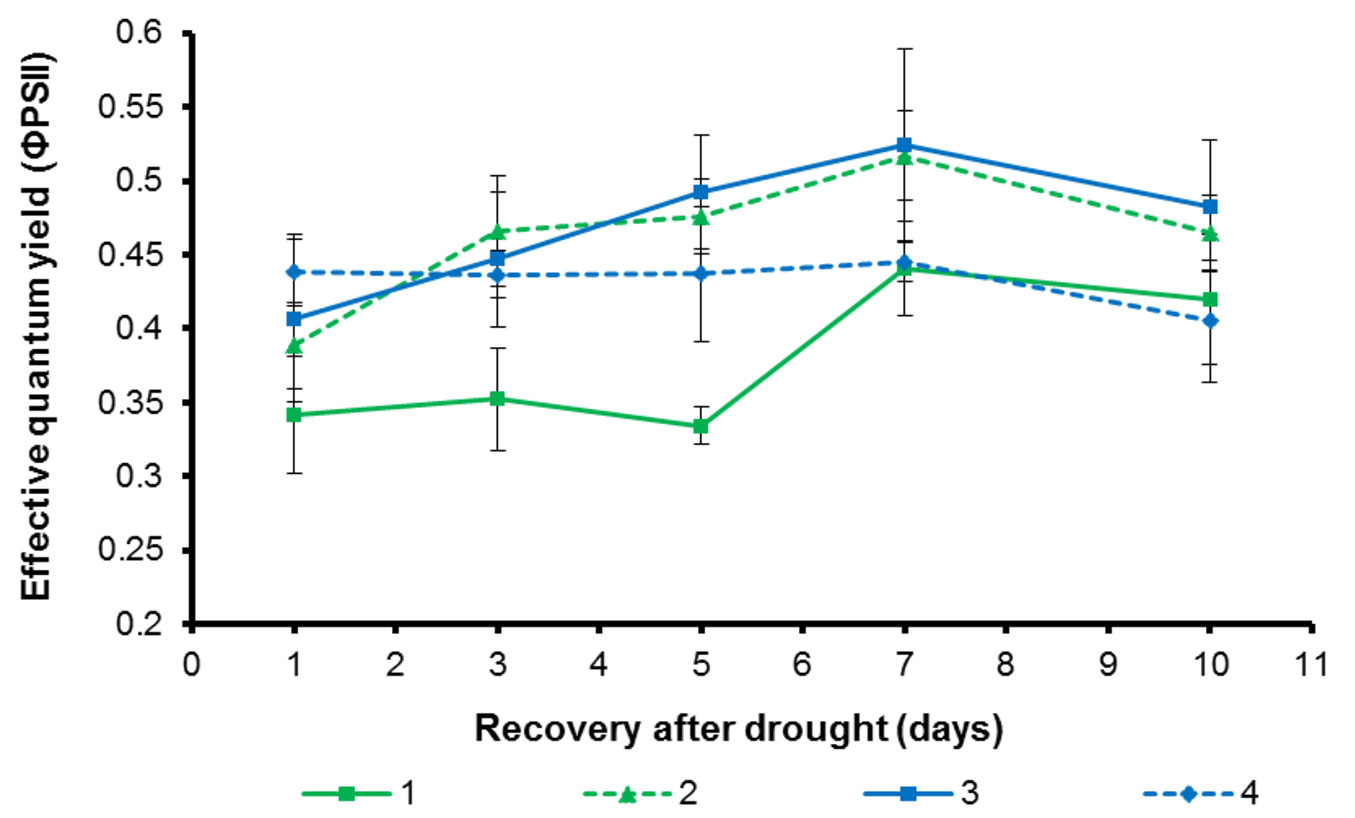
In Q. robur, the dynamics were different. Although the seedling initially showed a higher photosystem II yield, it gradually declined under stress and remained constant or slightly decreased, with no evident signs of recovery. In contrast, the mature tree exhibited a steady, gradual recovery, with a clear increase through day seven, indicating greater functional resilience than the seedling following natural stress (Fig. 3).
The multifactorial analysis revealed significant effects of all main factors: species, ontogenetic stage, and day of recovery on the quantum yield of photosystem II. The interaction between species and ontogenetic stage was particularly significant (F = 22.08, p < 0.001), indicating that responses to stress and recovery are largely determined by their combination (Tab. 2).
Tab. 2 - Multifactorial analysis of variance for the quantum yield of photosystem II, according to species, ontogenetic stage, and day of recovery. (SS): Sum of squares; (MS): mean square; (df): degrees of freedom; (ns): not significant (p>0.05).
| Effects | Source of variation | SS | df | MS | F ratio | P-value |
|---|---|---|---|---|---|---|
| Main effects |
A: Species | 0.061 | 1 | 0.061 | 12.09 | <0.001 |
| B: Ontogenetic stage | 0.031 | 1 | 0.031 | 6.14 | <0.05 | |
| C: Recovery day | 0.109 | 4 | 0.027 | 5.45 | <0.001 | |
| Interactions | AB | 0.111 | 1 | 0.111 | 22.08 | <0.001 |
| AC | 0.046 | 4 | 0.012 | 2.31 | ns | |
| BC | 0.043 | 4 | 0.011 | 2.13 | ns | |
| ABC | 0.020 | 4 | 0.005 | 1.00 | ns | |
| - | Residual error | 0.601 | 120 | 0.005 | - | - |
Complementarily, the multiple linear regression model applied to the effective quantum yield of photosystem II provides a quantitative estimation of these effects. On average, the negative coefficients associated with F. sylvatica and the mature ontogenetic stage reflect lower PSII values than those for Q. robur and the juvenile stage. In addition, the negative coefficient corresponding to the first day (relative to the tenth day) suggests a progressive recovery of PSII during the analyzed post-stress period. The variance inflation factor (VIF) values, all below the critical threshold of 10, confirm the absence of problematic collinearity among the model predictors (Tab. S2 in Supplementary material).
The recovery index (RI) for each photosynthetic parameter in F. sylvatica is summarized in Tab. 3, highlighting significant differences among ontogenetic stages. In the seedling, positive RI values were recorded for chlorophyll a, chlorophyll b, the a/b ratio, and the quantum yield of photosystem II, while carotenoids showed a slight decrease. In the mature tree, RI indicated increases for chlorophyll b and the quantum yield of photosystem II, whereas chlorophyll a, the a/b ratio, and carotenoids exhibited declines.
Tab. 3 - Recovery index (RI, %) of photosynthetic traits in seedlings and mature trees of Fagus sylvatica and Quercus robur after 10 days of post-heat-stress recovery.
| Species | Ontogenetic stage |
Parameter | Day 1 | Day 10 | RI (%) |
|---|---|---|---|---|---|
| Fagus sylvatica | Seedling | Chlorophyll a | 2.914 | 3.355 | 15.2 |
| Chlorophyll b | 1.057 | 1.179 | 11.5 | ||
| a/b ratio | 2.758 | 2.845 | 3.3 | ||
| Carotenoids | 0.793 | 0.766 | -3.4 | ||
| PSII yield | 0.389 | 0.465 | 19.5 | ||
| Mature | Chlorophyll a | 2.561 | 2.476 | -3.3 | |
| Chlorophyll b | 0.832 | 0.946 | 13.7 | ||
| a/b ratio | 3.077 | 2.619 | -14.9 | ||
| Carotenoids | 0.756 | 0.678 | -10.3 | ||
| PSII yield | 0.342 | 0.419 | 22.5 | ||
| Quercus robur | Seedling | Chlorophyll a | 1.757 | 1.787 | 1.7 |
| Chlorophyll b | 0.412 | 0.631 | 53.7 | ||
| a/b ratio | 4.263 | 2.832 | -33.6 | ||
| Carotenoids | 0.506 | 0.465 | -8.1 | ||
| PSII yield | 0.438 | 0.405 | -7.5 | ||
| Mature | Chlorophyll a | 2.169 | 2.117 | -2.4 | |
| Chlorophyll b | 0.908 | 0.996 | 9.7 | ||
| a/b ratio | 2.388 | 2.126 | -10.9 | ||
| Carotenoids | 0.538 | 0.474 | -12.0 | ||
| PSII yield | 0.407 | 0.483 | 18.7 |
The dynamics of photosynthetic parameters in Q. robur based on the recovery index revealed differences between the seedling and the mature tree. In the seedling, RI for chlorophyll b showed a considerable increase, whereas the a/b ratio and the quantum yield of photosystem II exhibited significant decreases. In the mature tree, RI indicated increases in chlorophyll b and the quantum yield of photosystem II, while the total pigment amount remained relatively stable (Tab. 3).
Antioxidant response parameters under heat stress
Catalase activity in mature F. sylvatica was high on the first day of recovery following heat stress, decreasing significantly by 52.3% by the third day and by 85.2% by the fifth day, after which it stabilized until the tenth day. In the seedling, catalase activity decreased progressively until the fifth day, after which the values remained relatively constant (Fig. 4).
Fig. 4 - Recovery of catalase activity in mature trees and seedlings of Fagus sylvatica and Quercus robur during the ten-day post-stress period. (1): Fagus sylvatica, mature; (2): F. sylvatica, seedling; (3): Quercus robur, mature; (4): Q. robur, seedling.
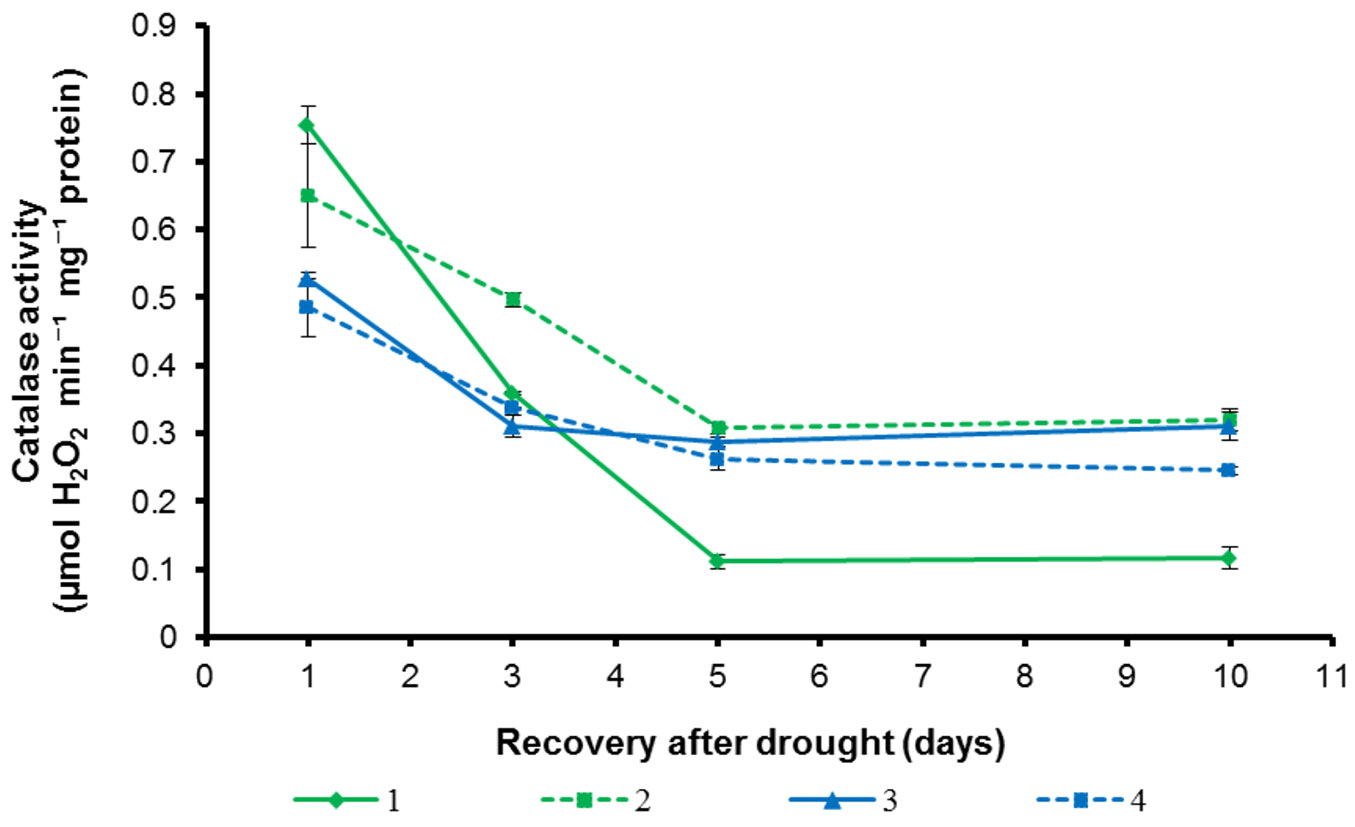
In Q. robur, catalase activity declined progressively in both seedling and mature tree, stabilizing after the fifth day at similar levels, slightly higher in the mature tree. During the recovery period, catalase activity in the F. sylvatica seedling remained consistently higher than in the Q. robur seedling, which exhibited a more rapid decline in catalase activity (Fig. 4).
For F. sylvatica, total phenolic content remained highly stable in the mature tree throughout the entire observation period. In the seedling, the initially high level of phenolic compounds decreased until the third day, followed by slight fluctuations. Throughout the whole period, the seedling maintained higher phenolic content than the mature tree (Fig. 5).
Fig. 5 - Recovery of total phenolic content in mature trees and seedlings of Fagus sylvatica and Quercus robur during the ten-day post-stress period. (1): Fagus sylvatica, mature; (2): F. sylvatica, seedling; (3): Quercus robur, mature; (4): Q. robur, seedling.
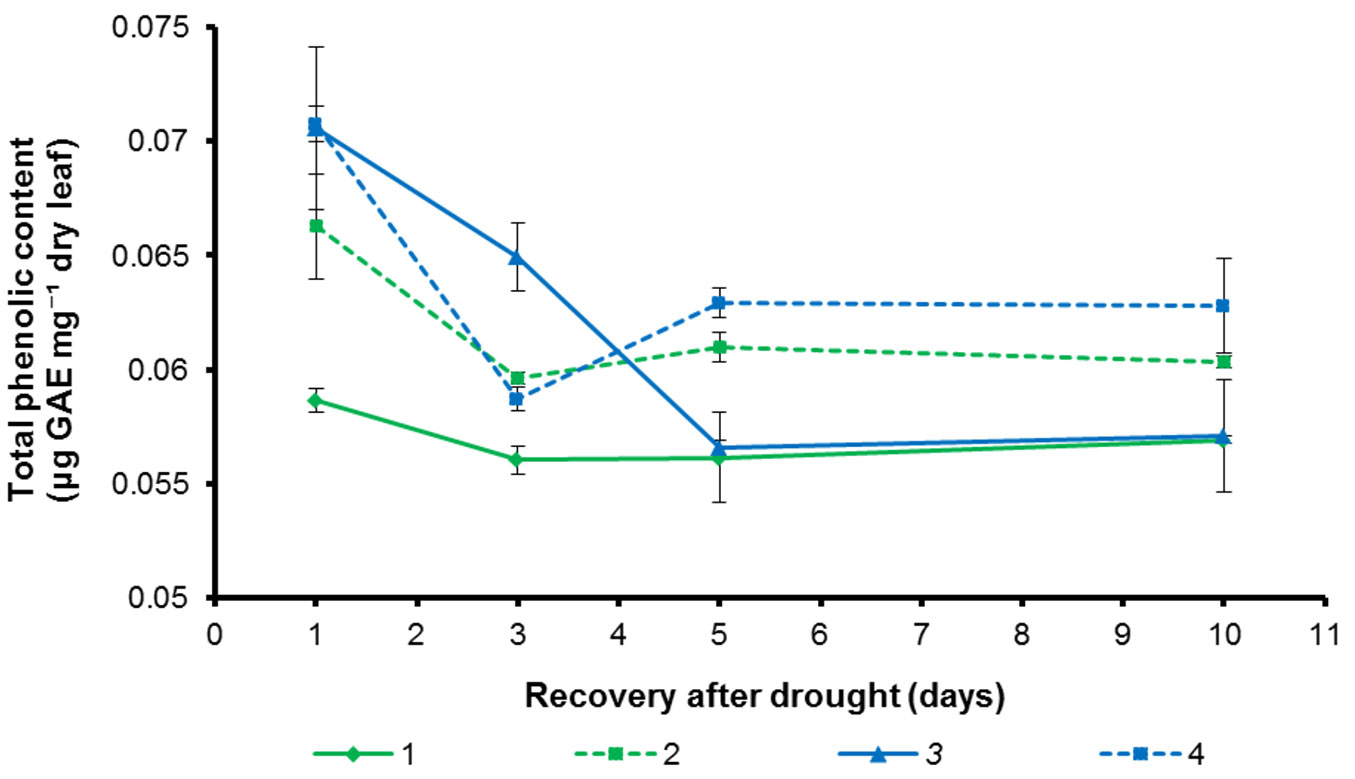
A distinct trend was observed in the mature Q. robur tree, in which the total phenolic content was highest on the first day of recovery, followed by a gradual decrease until the fifth day and stabilization during the latter part of the observation period. In the seedling, the initially high level decreased significantly by the third day, then recovered moderately until the fifth day, with slight stabilization thereafter (Fig. 5).
Comparative analysis highlighted a more pronounced change in total phenolic content during recovery in Q. robur seedling than in F. sylvatica throughout the observation period, except on the third day, when values were similar, and trends were slightly reversed.
Multifactorial analysis of variance indicated significant effects of species, ontogenetic stage, and recovery day on antioxidant parameters, as well as for most interactions among these factors (Tab. 4). These results were confirmed by multiple linear regression, which highlighted significant contributions of each factor to the variation in catalase and total phenolic content. For catalase, the effects of the species F. sylvatica and the mature ontogenetic stage were negative (with coefficient estimates of -0.098 and -0.195, respectively), indicating significantly lower activity than in the mature stage of Q. robur. The negative regression coefficient indicates that catalase activity in F. sylvatica, initially higher during the first three days of recovery, decreased toward the end of the observation period, whereas in Q. robur, activity remained relatively high and stable. In contrast, for total phenolic content, the first day of recovery was associated with a significant increase, with an estimated coefficient of 0.255 (p < 0.001 - Tab. S3 in Supplementary material).
Tab. 4 - Multifactorial analysis of antioxidant variation according to species, ontogenetic stage, and day of recovery. (SS): Sum of squares; (MS): mean square; (df): degrees of freedom; (ns): not significant (p>0.05).
| Antioxidant | Effects | Source of variation | SS | df | MS | F ratio | P-value |
|---|---|---|---|---|---|---|---|
| Catalase activity | Main effects |
A: Species | 0.460 | 1 | 0.460 | 701.43 | <0.001 |
| B: Ontogenetic stage | 1.822 | 1 | 1.822 | 2777.12 | <0.001 | ||
| C: Recovery day | 0.129 | 3 | 0.043 | 65.40 | <0.001 | ||
| Interactions | AB | 0.026 | 1 | 0.026 | 39.97 | <0.001 | |
| AC | 0.010 | 3 | 0.003 | 5.16 | <0.01 | ||
| BC | 0.044 | 3 | 0.015 | 22.11 | <0.001 | ||
| ABC | 0.004 | 3 | 0.001 | 1.97 | ns | ||
| - | Residual error | 0.021 | 32 | 0.001 | - | - | |
| Total phenolic content | Main effects |
A: Species | 0.369 | 1 | 0.369 | 28.43 | <0.001 |
| B: Ontogenetic stage | 0.273 | 1 | 0.273 | 21.06 | <0.001 | ||
| C: Recovery day | 1.048 | 3 | 0.349 | 26.91 | <0.001 | ||
| Interactions | AB | 0.077 | 1 | 0.077 | 5.96 | <0.05 | |
| AC | 0.219 | 3 | 0.073 | 5.63 | <0.01 | ||
| BC | 0.193 | 3 | 0.064 | 4.95 | <0.01 | ||
| ABC | 0.193 | 3 | 0.064 | 4.95 | <0.01 | ||
| - | Residual error | 0.415 | 32 | 0.013 | - | - |
The recovery index of antioxidant traits evolved differently for catalase and total phenolic content in the seedling and mature tree of F. sylvatica over 10 days of post-stress observation. Catalase activity decreased significantly in both ontogenetic stages, with a more pronounced reduction in the mature tree (RI = -84.6%). In contrast, the total phenolic content showed a minor decrease, similar in both stages (Tab. 5).
Tab. 5 - Recovery index (%) of antioxidant traits in the seedling and mature tree of Fagus sylvatica and Quercus robur after 10 days of post-stress recovery.
| Species | Ontogenetic stage |
Parameter | Day 1 | Day 10 | RI (%) |
|---|---|---|---|---|---|
| Fagus sylvatica | Seedling | Catalase activity | 0.651 | 0.320 | -50.9 |
| Total phenolic content | 0.066 | 0.060 | -9.1 | ||
| Mature | Catalase activity | 0.754 | 0.116 | -84.6 | |
| Total phenolic content | 0.059 | 0.057 | -3.4 | ||
| Quercus robur | Seedling | Catalase activity | 0.485 | 0.245 | -49.5 |
| Total phenolic content | 0.071 | 0.063 | -11.3 | ||
| Mature | Catalase activity | 0.527 | 0.310 | -41.2 | |
| Total phenolic content | 0.071 | 0.057 | -19.7 |
In Q. robur, the recovery index of catalase activity showed a significant decrease in both seedling and mature tree. In contrast, the total phenolic content exhibited a moderate decline, more pronounced in the mature tree than in the seedling.
Discussion
Functional and ecological characteristics of response to natural stress
The results highlight marked functional differences between mature trees of the two species studied, F. sylvatica and Q. robur, which manifest within the context of contrasting general ecological strategies. F. sylvatica is considered a shade-tolerant (sciophilous) species, whereas Q. robur is a light-demanding (subheliophilous) species, preferring high-light conditions but capable of tolerating moderate shade. However, the literature indicates that these general ecological labels are insufficient to fully explain the physiological response to thermal stress, which is strongly influenced by functional traits and ontogenetic stage ([32]).
During the maintenance of detached leaves under favorable artificial conditions, following exposure to natural thermal stress, pigment levels in F. sylvatica were significantly higher compared to Q. robur, both for chlorophyll a and carotenoids, as well as for the chlorophyll a/b ratio. This difference reflects an adaptive functional response of F. sylvatica under shaded conditions, characterized by elevated pigment amount that enhances light capture under limited irradiance, a pattern frequently reported in the literature for shade-tolerant species ([44], [34], [33]). Moreover, the dynamics of these parameters during the recovery period indicated that F. sylvatica exhibited a slower, less pronounced pigment restoration following thermal stress, while maintaining a relatively stable functional state. This behavior suggests a conservative stress-tolerance strategy, characterized by low ecological plasticity but a high capacity to maintain physiological balance in stable environments ([16]).
In this context, recent research emphasizes that shade tolerance constitutes a key adaptive strategy for shade-tolerant species, enabling them to persist and function efficiently under low-light conditions. This adaptation relies on specific molecular mechanisms that regulate growth and photosynthetic responses, explaining how these species optimize light capture and utilization in shaded environments ([28]).
In contrast, Q. robur exhibited a significantly higher photosystem II efficiency during the post-thermal-stress recovery period compared to F. sylvatica, suggesting superior light utilization and conversion into chemical energy, despite lower chlorophyll a amount during recovery. Interestingly, although the total chlorophyll level was lower, Q. robur accumulated more chlorophyll b, suggesting a possible compensatory mechanism for light capture under stress conditions.
This high functional efficiency is characteristic of light-demanding species, which possess a robust photosynthetic apparatus capable of performing efficiently under variable and more stressful light conditions ([26], [7]). Our data confirm that during the post-stress recovery period, Q. robur efficiently utilizes light, showing a significant increase in photosynthetic efficiency (PS II yield: +18.7%) and maintaining this high efficiency even during the late phase of recovery. In contrast, F. sylvatica, although showing a more pronounced increase in photosystem II efficiency (PS II yield: +22.5%), adopted a generally more conservative strategy to maintain functional balance amid slower, more gradual pigment recovery. These findings reinforce the hypothesis of a clear functional and ecological differentiation between the two species, based on distinct functional traits: F. sylvatica tends to maximize light capture in low-energy environments, whereas Q. robur prioritizes efficiency and functional stability under more variable and stressful conditions.
Ontogenetic differences between seedlings and mature trees were significant, reflecting distinct physiological and adaptive strategies within each species, as evidenced by recovery processes following natural thermal stress. The F. sylvatica seedling exhibited higher amounts of photosynthetic pigments, particularly chlorophyll and carotenoids, suggesting enhanced functional capacity at the juvenile stage. This trend may reflect an adaptive response specific to the juvenile phase, characterized by increased functional investment in the photosynthetic apparatus, ensuring high light-use efficiency and greater capacity to adjust to environmental fluctuations. Photosystem II efficiency was also higher in the seedling, indicating better tolerance to natural thermal stress and superior functional plasticity at this ontogenetic stage.
Our results are consistent with those reported by Mészáros et al. ([31]), who highlighted high physiological plasticity and efficient photoprotective mechanisms in F. sylvatica seedlings, as reflected in carotenoid accumulation and optimal functioning of the photosynthetic apparatus under strong light-contrast conditions. This adaptive capacity supports the idea that during the juvenile stage, plants adopt an “acquisitive” strategy, characterized by substantial investment in the photosynthetic apparatus and rapid responses to environmental changes ([17], [47]).
In contrast, the mature F. sylvatica tree in our study exhibited lower amounts of photosynthetic pigments, suggesting a more conservative strategy, characterized by efficient resource use but a reduced capacity for rapid adjustment to stress factors. This approach reflects long-term functional stability, albeit with diminished ecological plasticity. The literature indicates that with increasing age, the capacity for physiological adjustment to environmental conditions declines, and responses become slower and more rigid ([44], [16]).
Comparative studies show that deeply shade-tolerant species, such as F. sylvatica, exhibit high morphological plasticity during the juvenile stage but a reduced physiological capacity for adjustment at maturity, reflecting a functionally stable yet less flexible strategy in the face of environmental variability ([45], [16]). This transition, from high plasticity in early stages to functional stability in later stages, is considered a common ecological trade-off in tree ontogeny, balancing rapid growth capacity with long-term persistence ([43], [34]). According to a meta-analysis by Thomas & Winner ([43]), seedlings exhibit higher photosynthetic capacity per unit leaf mass, whereas mature trees develop leaves with greater mass per unit area, reflecting a conservative strategy and increased resource-use efficiency under environmental stress.
In our study, differences between the juvenile and mature stages regarding functional plasticity were reflected in distinct recovery capacities following natural thermal stress. The F. sylvatica seedling exhibited higher recovery indices, particularly for photosynthetic parameters such as chlorophyll a (+15.2%) and photosystem II efficiency (+19.5%) after 10 days. In contrast, the mature tree showed reduced recovery or even declines in essential parameters, including chlorophyll a (-3.3%) and carotenoids (-10.3%). These results reflect contrasting functional traits across ontogenetic stages: seedlings exhibit high functional plasticity and rapid responsiveness, whereas mature trees show greater functional stability, which may limit recovery dynamics but maintain long-term physiological equilibrium. Our findings on the recovery indices of F. sylvatica seedling are supported by Gallé & Feller ([15]), who reported a high capacity for post-stress physiological adjustment, as evidenced by the complete restoration of photosynthesis following a severe drought. These observations underscore the functional plasticity of seedlings and their enhanced adaptive potential under abiotic stress.
In Q. robur, recovery processes following natural thermal stress indicate that ontogenetic differences manifested as more pronounced functional stability in the mature tree, which maintained higher amounts of photosynthetic pigments than the seedling. The higher chlorophyll a/b ratio in the seedling suggests greater allocation to chlorophyll a, associated with an efficient photoadaptive strategy under high-light conditions. This trait reflects the specific ecological environment in which the studied seedling developed within a plot undergoing recent natural regeneration, characterized by increased light exposure and an open forest structure conducive to the expression of functional responses.
The dynamics of the quantum yield of photosystem II further complemented this functional differentiation: in seedlings, values were initially higher but then slowly declined after stress, with no evident recovery during the monitoring period, indicating temporary physiological vulnerability. In contrast, mature trees showed a gradual, steady increase in photosystem II efficiency, suggesting a moderate and sustained capacity for recovery. Therefore, the observed differences between ontogenetic stages confirm the plastic and reactive nature of seedlings, in contrast to the conservative strategy of mature trees, which emphasizes functional stability and resource-use efficiency, traits characteristic of functional evolution in perennial species ([17], [23]).
At a general level, our results are consistent with observations in secondary tropical forests ([35]), where shade-tolerant seedlings exhibited high functional plasticity and increased sensitivity to variation in light availability, suggesting that this ontogenetic stage is essential for effective understory establishment.
Experimental data highlight a clear functional difference between F. sylvatica and Q. robur seedlings in their response to natural thermal stress. Specifically, F. sylvatica exhibited higher amounts of chlorophyll a and b, as well as greater carotenoid amounts compared to the Q. robur seedling, indicating a strategy focused on efficient light capture. Although Q. robur initially displayed higher photosystem II quantum yield on the first day following thermal stress exposure, F. sylvatica demonstrated a significantly faster recovery, surpassing the values of the oak seedling from the third day of observation onward.
These findings are partially consistent with those reported by Valladares et al. ([45]), who highlighted greater tolerance to high light in Q. robur seedlings, attributed to superior physiological plasticity (including maximum photosynthetic rate and Rubisco activity). At the same time, the authors emphasized that F. sylvatica seedlings exhibit higher morphological plasticity and an adaptive strategy focused on shade tolerance, supported by an efficient capacity to capture diffuse light.
The analysis of post-thermal-shock recovery dynamics highlights a complex, temporally variable process influenced by both species and ontogenetic stage. Immediately after exposure to high temperatures, photosynthetic capacity was significantly reduced, confirming the temporary vulnerability of photosystem II to severe thermal stress, a phenomenon documented in recent studies ([29], [46]). Nevertheless, functional parameters such as chlorophyll amount and photosystem II quantum yield exhibited progressive recovery during the first 3-7 days, reaching a maximum around the seventh day, indicating an active mechanism of physiological adaptation and repair. This trend aligns with observations of forest tree species’ capacity to restore photosynthetic function after episodic stress through metabolic adjustments and antioxidant protection ([18], [14]).
The stabilization of the recovery process between days 7 and 10 suggests the establishment of a new functional equilibrium, supported by fine metabolic adjustments that provide extended protection against natural stress. This stage reflects the adaptability of forest species to prolonged or repeated adverse conditions, as highlighted in the literature, which emphasizes the importance of molecular and photosynthetic adjustments in maintaining ecological performance ([49], [41]).
The interspecific and ontogenetic differences identified in this study are reflected in distinct functional traits, consistent with patterns reported in recent ecophysiological research. F. sylvatica seedling stand out for its faster recovery and higher functional plasticity, reflecting juvenile-stage traits as documented by Valladares & Niinemets ([44]). In contrast, Q. robur exhibits greater functional stability in photosynthetic efficiency, particularly at maturity, reflecting measured resilience under thermal stress ([42]). These findings emphasize differences in functional traits between species and ontogenetic stages, which may contribute to their performance under variable environmental conditions.
Ecological and antioxidant features of the response to natural heat stress
The comparison between F. sylvatica and Q. robur, as observed in our study, revealed distinct physiological processes in their antioxidant responses to heat stress. Q. robur generally exhibited stronger antioxidant responses, reflected in both higher total phenolic content during the early stages of recovery and in a less pronounced decline followed by relative stabilization of catalase activity throughout the recovery period. In contrast, F. sylvatica exhibited higher catalase activity in the initial phases but a reduced ability to sustain this response, suggesting a less persistent defense capacity. These differences indicate that Q. robur possesses more robust and better-adapted protective mechanisms against oxidative stress, whereas F. sylvatica may rely on a rapid but transient response. Such traits highlight superior antioxidant plasticity in Q. robur in response to abiotic fluctuations, a finding supported by previous studies on the antioxidant behavior of tree species under stress conditions ([13], [27], [8], [9]).
From an ecological perspective, these observations align with the literature on F. sylvatica, which indicates that this species, being more vulnerable to intense solar radiation, may experience more pronounced oxidative stress, whereas Q. robur shows higher tolerance to such variations ([44]). These characteristics do not directly regulate antioxidant system activity but define the physiological context in which protective mechanisms are activated, providing a complementary explanation for the differences measured in our study.
The ontogenetic stage influenced antioxidant responses, reflecting distinct physiological processes between the two analyzed species. In F. sylvatica, the juvenile stage was characterized by substantially higher levels of phenolic compounds throughout the recovery period, as well as a more effective maintenance of catalase activity. The recovery index highlighted more sustained catalase activity in the seedling, with a decrease of 50.9%, compared to the mature tree, where the reduction exceeded 84.6%. This indicates an active and persistent defensive strategy during the juvenile stage. In Q. robur, catalase activity was comparable between mature tree and seedling, while phenolic compounds showed a stronger tendency to increase in seedling during the second half of the recovery period, suggesting a possible compensatory activation of the antioxidant system at this ontogenetic stage. Antioxidant functional responses are therefore species-specific and strongly influenced by the functional age of trees, reflecting differentiated ecological adaptations to heat stress.
The observed trends are supported by the specialized literature, which reports heightened antioxidant activity in seedlings subjected to abiotic stress, particularly through increased accumulation of total phenolic compounds and activation of enzymes involved in hydrogen peroxide detoxification. For instance, the study by Xiong et al. ([48]) highlighted a pronounced increase in catalase activity during the acute phase of water stress in seedlings of four oak species (Quercus spp.), followed by a progressive decline as drought persisted. These results reflect the plasticity of the enzymatic antioxidant system in the early stages of development. Similarly, Jafarnia et al. ([20]) observed that Q. brantii seedlings from more tolerant populations exhibited stronger activation of antioxidant enzymes (catalase, peroxidase, superoxide dismutase) and a greater accumulation of phenols and flavonoids under drought conditions. Together, these findings confirm that antioxidant responses in the juvenile stage are shaped by both ontogenetic age and the ecological origin of the genetic material, an essential consideration for reforestation practices and the conservation of forest genetic resources.
Our results indicate a significantly higher catalase activity in F. sylvatica seedling compared to Q. robur, whereas phenolic compound levels were generally higher in the Q. robur seedling, suggesting a differentiated antioxidant response during the juvenile stage in the two species. These differences support the hypothesis that antioxidant protection is influenced by species-specific functional traits and their expression at the juvenile stage. Findings are consistent with studies on F. sylvatica, such as that by Anev et al. ([2]), which reported increased antioxidant enzyme activity in leaves of seedlings exposed to high light following canopy opening, suggesting a possible compensatory physiological mechanism. However, tolerance to extreme stress was limited, being influenced by altitude and canopy cover.
The analysis of catalase activity dynamics and phenolic compound content during the recovery period following heat stress revealed distinct responses of enzymatic and non-enzymatic antioxidant systems. Catalase activity was initially high in both the seedling and mature tree of F. sylvatica, but decreased moderately by the fifth day of recovery, then stabilized. In Q. robur seedling, the initial level was significantly lower, and enzymatic activity continued to decline until the end of the observation period. This pattern suggests interspecific differences in the enzymatic antioxidant response and a possible delay in the activation of hydrogen peroxide detoxification mechanisms in seedlings. Conversely, the total phenolic content reached its highest level on the first day in both the seedling and the mature tree of Q. robur, reflecting a rapid and intense non-enzymatic antioxidant response. Subsequently, the mature tree showed a significant decline by the fifth day, followed by stabilization, while seedling exhibited a moderate recovery.
The dynamics of the observed recovery processes suggest rapid activation of the enzymatic system in F. sylvatica and significant activation of the non-enzymatic system in Q. robur, with variations in response intensity and duration by species and ontogenetic stage. Thus, the two antioxidant systems appear to act complementarily in post-stress adaptation, differing in efficiency and synchronization of the response. Similar processes have been reported in other studies on abiotic stress in trees, emphasizing the sustained activation of antioxidant enzymes ([13], [20], [48], [8]). Therefore, our data support a complementary model of antioxidant response that reflects the adaptability and functional plasticity of trees under fluctuating stress conditions.
Conclusions
The study demonstrated that Fagus sylvatica and Quercus robur exhibit distinct functional and antioxidant strategies in response to natural heat stress, differences that cannot be explained solely by general ecological classifications related to light preference. Although these two species are often categorized as shade-tolerant and subheliophilous, respectively, our results indicate that their physiological responses are more closely associated with species-specific functional traits and antioxidant regulatory capacity. In this context, Fagus sylvatica exhibited a functional response characterized by the maintenance of photosynthetic pigments and functional stability, whereas Q. robur showed a rapid increase in total phenolic content, particularly at the mature stage, along with a more pronounced recovery of photosynthetic performance following stress. Ontogenetic stage strongly influenced stress responses: seedlings exhibited greater functional plasticity and rapid antioxidant responses, whereas mature trees followed stable strategies that emphasized efficient resource use and long-term resilience. The complementary roles of enzymatic and non-enzymatic antioxidant systems differed between species and developmental stages, highlighting coordinated mechanisms that support adaptation to environmental stress. These findings underline the importance of species-specific ecological traits and developmental stage in shaping forest responses to abiotic stress. Overall, our results suggest that post-stress resilience should be viewed as an integrated functional property emerging from the interaction among ontogenetic stage, photosynthetic regulation, and antioxidant coordination, rather than as the outcome of isolated physiological responses. Clear insights into forest resilience inform conservation and sustainable management strategies under changing climatic conditions.
References
CrossRef | Gscholar
Gscholar
CrossRef | Gscholar
Gscholar
Gscholar
CrossRef | Gscholar
Gscholar
Gscholar
CrossRef | Gscholar
CrossRef | Gscholar
CrossRef | Gscholar
Gscholar
CrossRef | Gscholar
CrossRef | Gscholar
CrossRef | Gscholar

Authors’ Info
Authors’ Affiliation
Department of Geosciences and Forestry, Moldova State University, Chisinau (Moldova)
Nina Zdioruk 0009-0000-8879-3954
Institute of Genetics, Physiology and Plant Protection, Moldova State University, Chisinau (Moldova)
Corresponding author
Paper Info
Citation
Cuza P, Platovschii N, Zdioruk N (2026). Functional and antioxidant responses to natural heat stress in Fagus sylvatica and Quercus robur: effects of ecological adaptation and ontogenetic stage. iForest 19: 292-303. - doi: 10.3832/ifor4985-019
Academic Editor
Claudia Cocozza
Paper history
Received: Sep 12, 2025
Accepted: Mar 17, 2026
First online: Jul 28, 2026
Publication Date: Aug 31, 2026
Publication Time: 4.43 months
Copyright Information
© SISEF - The Italian Society of Silviculture and Forest Ecology 2026
Open Access
This article is distributed under the terms of the Creative Commons Attribution-Non Commercial 4.0 International (https://creativecommons.org/licenses/by-nc/4.0/), which permits unrestricted use, distribution, and reproduction in any medium, provided you give appropriate credit to the original author(s) and the source, provide a link to the Creative Commons license, and indicate if changes were made.

Web Metrics
Breakdown by View Type
Article Usage
Total Article Views: 881
(from publication date up to now)
Breakdown by View Type
HTML Page Views: 235
Abstract Page Views: 345
PDF Downloads: 258
Citation/Reference Downloads: 0
XML Downloads: 43
Web Metrics
Days since publication: 48
Overall contacts: 881
Avg. contacts per week: 128.48
Article Citations
Article citations are based on data periodically collected from the Clarivate Web of Science web site
(last update: Jul 2026)
(No citations were found up to date. Please come back later)
Publication Metrics
by Dimensions ©
Articles citing this article
List of the papers citing this article based on CrossRef Cited-by.
Related Contents
iForest Similar Articles
Research Articles
Identification and allelochemical activity of phenolic compounds in extracts from the dominant plant species established in clear-cuts of Scots pine stands
vol. 10, pp. 309-314 (online: 23 February 2017)
Research Articles
Photosynthetic parameters of urban greening trees growing on paved land
vol. 12, pp. 403-410 (online: 13 August 2019)
Short Communications
Preliminary indications for diverging heat and drought sensitivities in Norway spruce and Scots pine in Central Europe
vol. 13, pp. 89-91 (online: 01 March 2020)
Research Articles
Comparison of assimilation parameters of coppiced and non-coppiced sessile oaks
vol. 9, pp. 553-559 (online: 25 March 2016)
Research Articles
Effect of drought stress on some growth, morphological, physiological, and biochemical parameters of two different populations of Quercus brantii
vol. 11, pp. 212-220 (online: 01 March 2018)
Technical Notes
Effect of tree age on chemical compounds of ancient Anatolian black pine (Pinus nigra subsp. pallasiana) needles in Northwest Turkey
vol. 11, pp. 406-410 (online: 15 May 2018)
Research Articles
Relationship between volatile organic compounds released and growth of Cunninghamia lanceolata roots under low-phosphorus conditions
vol. 11, pp. 713-720 (online: 06 November 2018)
Research Articles
Response of juvenile progeny of seven forest tree species and their populations to simulated climate change-related stressors, heat, elevated humidity and drought
vol. 11, pp. 374-388 (online: 15 May 2018)
Research Articles
Links between phenology and ecophysiology in a European beech forest
vol. 8, pp. 438-447 (online: 15 December 2014)
Research Articles
Oak sprouts grow better than seedlings under drought stress
vol. 9, pp. 529-535 (online: 17 March 2016)
iForest Database Search
Search By Author
Search By Keyword
Google Scholar Search
Citing Articles
Search By Author
Search By Keywords
PubMed Search
Search By Author
Search By Keyword