
Pathways to increase supply of sustainable wood from planted forests and trees to address bioeconomy needs: a review
iForest - Biogeosciences and Forestry, Volume 19, Issue 3, Pages 168-185 (2026)
doi: https://doi.org/10.3832/ifor4949-019
Published: May 12, 2026 - Copyright © 2026 SISEF
Review Papers
Abstract
Forests not only supply wood but also provide vital ecosystem services such as biodiversity conservation and climate regulation. The rising demand for wood-based products, driven by the transition toward a forest-based bioeconomy and by environmental objectives such as decarbonization, is placing increasing pressure on both natural and plantation forests. The systematic review of the literature conducted in this study provides an inventory of pathways to increase the supply of sustainable wood from forests and planted trees to meet the needs of bioeconomy. Two core research questions were identified: (1) How to sustainably improve productivity in existing planted forests? (2) How to expand areas managed for timber production? A systematic literature review was conducted, providing insights from global research and best practices, covering both high-intensity industrial plantations and smallholder-based approaches. Planted forests, covering 7% of global forest area, supply over 33% of industrial wood. High wood productivity is primarily observed in Latin America and Asia, whereas in Europe and North America, mixed-species and sustainably managed plantations are increasingly prioritized. Wood productivity improvements are supported by advanced silvicultural practices, precision forestry, climate-resilient breeding programs, and alternative production systems such as Short Rotation Forestry. In addition, agroforestry systems and Trees Outside Forests represent important sources of wood and ecosystem services, particularly in developing countries. Challenges to expansion include land-use competition and socio-political barriers, and solutions include community forestry and mosaic-landscape approaches. Underutilized lignocellulosic resources offer additional potential. Sustainable intensification, diversification, circular economy practices, innovation, and inclusive governance are crucial for securing a resilient wood supply for the bioeconomy.
Keywords
Bio-Economy, Forest Plantations, Sustainable Strategies, Wood Productivity, Wood-based Products
Introduction
Forests provide a broad range of ecosystem services, both marketable and non-marketable, necessary and vital for individuals and society in meeting many of the challenges faced by humanity. Forests produce (i) wood (non-food biomass) for various uses depending on the species from which it comes and their qualities, and (ii) several food biomasses. Although wood is the major product with the easiest monetary value to estimate, forests also provide a multitude of essential ecosystem services, including biodiversity and wildlife conservation, carbon sequestration with associated climate-mitigation benefits, nutritional cycling, water regulation, soil protection, air purification, aesthetic and landscape values, as well as recreational opportunities ([68]). The Paris Climate Agreement and the United Nations (UN) Sustainable Development Goals ([93]) emphasize the importance of forests in mitigating climate change, providing goods and services, creating jobs, sustaining incomes, and supplying shelters, food, materials, and fuel. Forests are also a key element in the conservation of the world’s biodiversity.
The composition and diversity of tree species in forests affect ecosystem functions, stability, resilience, and the provision of ecosystem services. Consequently, the type of tree-based system, such as natural or planted forests, or agroforestry systems, determines the nature and range of services provided ([79]). Regardless of the ecosystems, quantifying ecosystem services beyond timber production remains challenging, as many are intangible despite their valuable positive externalities ([80]).
The Forest Europe process and the new European Union (EU) Forestry Strategy for 2030 ([17]) encourage sustainable forest management to support several priorities: rural development, environmental, climate, and biodiversity policies, provision of ecosystem services, and creation of sustainable growth and jobs. Amongst several measures, this strategy: (i) promotes sustainable forest management; (ii) aims at improving the size and biodiversity of forests, as well as the plantation of 3 billion trees by 2030; (iii) encourages the sustainable use of wood and wood-based products. The EU has emphasized the transition to an innovative bioeconomy as a key strategy for decoupling human progress from resource use and environmental degradation. Outside the EU, the sustainable management of natural, planted temperate or boreal forests is well documented in the 12 member countries of the Montreal Process since 1994 ([90]). Consultation with the Forest Europe (FE) process, the International Tropical Timber Organization (ITTO), and the Food and Agriculture Organization of the UN (FAO) has enabled the harmonization of criteria and requirements to ensure a relevant assessment of the forest resources of these countries. Furthermore, Holvoet & Muys ([45]) and Siry et al. ([88]) have collected global data on forest management showing that most of the countries concerned have implemented standards for sustainable forest management. Significant differences among sustainable forest management standards arise primarily from their scale of application (e.g., national vs. forest management unit level) and their geographical origin, which often reflects the country’s socio-economic development. Industrialized countries tend to stress ecological functions and data-driven approaches, whereas standards from developing nations prioritize social and economic sustainability ([45]). Sustainable forest management is a crucial tool in the context of the climate and biodiversity crises ([30]), as forests act as carbon sinks. In addition, wood and wood-based products still continue to store carbon. We are now facing this point of convergence between the need for sustainable forest management and the forest-based value-chain bioeconomy.
The bioeconomy provides a cross-cutting framework adaptable to shape different institutional mandates, depending on the country. This versatile concept transcends industry boundaries and offers a holistic approach to harnessing biological resources in a sustainable and innovative way ([31]). Environmental concerns and efforts to reduce dependence on non-renewable materials have led to discussions of a biomass-based economy to produce new raw materials without harming the environment, increasing greenhouse gas emissions, or depleting existing carbon stocks, while also reducing waste. The forest bioeconomy goes beyond waste minimization, resource substitution, and biotechnological innovation, and plays a central role in the transition from fossil-based to forest-based value chains, thereby contributing to the achievement of several United Nations Sustainable Development Goals, including poverty reduction, biodiversity conservation, and promotion of sustainable consumption. In addition, the forest bioeconomy encompasses non-timber forest products (NTFPs) such as food, medicinal resources, and industrial products (including rubber, resin, and cork), whose economic and environmental importance is growing. Verkerk et al. ([101]) have drawn up a broad overview of both conventional and emerging wood products that will shape the future of the forestry sector.
Wood is a source of fibers for the production of pulp for paper, cardboard, wrapping, and packaging. Verkerk et al. ([101]) noted a decline in demand for graphic paper due to digitization, but an increase in packaging (due to online commerce). Paper and cardboard remain a major industry in the forestry economy. The pulp production process and by-products vary by paper and cardboard type. The reprocessing of paper waste presents both environmental challenges and opportunities for technological development. Effluents from paper mills can be treated using conventional physicochemical methods, including coagulation-flocculation, chemical precipitation, and adsorption. However, these approaches face significant limitations, such as the large-scale generation of sludge, high capital and operating costs, the formation of secondary by-products, and substantial energy requirements. These constraints highlight the need for continued innovation in cost-effective and environmentally sustainable treatment technologies. Alternative biotechnologies using micro-organisms (fungi, bacteria) enable effluents (wastewater, sludge) to become a crucial platform for the recovery of valuable materials. The integrated approach of the biorefinery is notable for protecting the environment and taking advantage of this waste, which includes lignin, a source of valuable products such as lignin nanoparticles, a binder, a filler, or active ingredient in phenolic resins, a source of vanillin, and dimethyl sulfoxide ([60]). Waste products that can also be recovered include crude sulfate turpentine (used for perfumes, cleaning products, or as a solvent) and crude tall oil, the distillation of which generates multiple by-products with existing recycling channels (fatty acid, rosin, etc. - [44]). Furthermore, in the short or long term, (i) the textile sector could capture a share of wood-based fibers to produce viscose, cellulose acetate, lyocell, and modal viscose fibers, (ii) the plastics and packaging sector could also exploit some wood fiber (or flour) for flexible and rigid packaging, as well as for wood-plastic composites ([47]).
Wood is a building material whose conventional uses are now being joined by new, highly technical products that diversify and expand its applications ([101]). In addition to traditional sawn timber, there are Engineered Wood Products (EWP) such as laminated veneer lumber, wood I Beam, glued laminated lumber, cross laminated timber, finger jointed lumber, oriented strand lumber, plywood, oriented strand board (OSB), medium density fiber board (MDF), and particle board (PB). Some of these EWPs include glue inputs, for which there is also a shift from conventional (phenol-formaldehyde PF, melamine/ urea-formaldehyde MUF, UF) to eco-efficient bio-based adhesives such as lignin, tannin, and protein-based adhesives ([95]). EWPs allow the use of wood of different and lower qualities, to obtain custom dimensions (not limited by sawing length), to achieve more homogeneous properties, and improved dimensional stability compared to solid wood. Moreover, EWPs can reduce construction costs via prefabrication and shorter building times, lower emissions of ozone-depleting substances and embodied carbon, provide superior seismic performance, and enhance building energy efficiency due to their favorable thermal properties ([49]). EWPs enable a multitude of new uses, particularly for multi-story buildings and modular systems. Combined with new treatment types to improve their biological durability and fire resistance, EWPs enable a particularly effective fit-for-purpose strategy for their deployment in markets with adequate service life ([96]).
Verkerk et al. ([101]) address certain chemicals derived from woody biomass in the context of the bio-economy, in particular resins derived from pine (rosin, colophony, turpentine), lignin, and various tall oils derived from the paper industries, but new prospects can be added. Knots, until now considered a defect in construction products, are proving to be rich in biologically active molecules with high added value (lignans, phenolic compounds - [39]). Timber with highly durable heartwood also contains a wide range of molecules that make it resistant to wood-destroying organisms. These specific molecules, known as essential (or secondary) metabolites, are easily extracted, with high added value for industries such as wood protection, cosmetics, and perfumery ([52]).
The use of wood for energy production is also undergoing major changes. While wood and coal remain the only sources of energy in many countries in Africa, Asia, and South America, the use of wood for electricity and heat production in modern (non-traditional) technologies is also growing strongly. Demand and supply sources vary widely by geographical area and political and socio-economic context. Although some plantations are dedicated to energy production, forest waste from primary and secondary processing is generally allocated to energy uses. The diverse types of biomass resources and associated energy demands, combined with various conversion technologies (combustion, cogeneration, gasification, pyrolysis, pelletization or carbonization) create opportunities for developing new products and applications across multiple sectors, such as the possible technical routes of pyrolysis producing biochars (with multiple properties ranging from filters to carbon storage), bio-oils containing high added value molecules ([101]).
Altogether, it appears that bioeconomy is a significant opportunity for the forest-based value chain, but a challenge for wood supply. The development and distribution of wood-based products should continue to progress; however, the future development of traditional wood products, as well as products resulting from new technological routes, is subject to a high degree of uncertainty, depending on the geographical, socio-economic, and political contexts ([47]). Altogether, regardless of the context, can the available raw material meet the anticipated demand?
Forests covered 4,060 Mha (million hectares) of the global land (31%) in 2020 ([27]). Of this 4.060 Mha, 1,110 Mha were primary forest, 2,656 Mha secondary forest, 131 Mha forest plantation for wood production, and 163 Mha were other planted forests, which are not intensively managed, mainly intended for ecosystem restoration and the protection of soil or water quality. It is worth noting that previous definitions of forest typologies are not fully standardized; for example, artificially regenerated forests (i.e., Scandinavian countries) are classified as forests rather than planted forests, illustrating regional differences in classification. Globally, forests cover approximately 32% of Earth’s total land area, which spans 13 billion ha ([25]). A substantial portion (21%) is deemed unsuitable for crops, pasture, or forestry due to poor soil conditions and/or unfavorable climate. The remaining 47% of the land, or about 6.3 billion hectares, is shared among croplands (12%), pasturelands (26%), and urban lands (9%) - this is the primary zone where trees outside the forest (TOF) can be found.
More than half (54%) of the world’s forests are found in just five countries: the Russian Federation (20%), Brazil (12%), Canada (9%), the USA (8%), and China (5%). The natural forest area worldwide decreased from 3,740 million hectares (Mha) in 1990 to 3,562 Mha in 2020 (-4.76%). From 1990 to 2020, most forest loss occurred in tropical regions of South America (12.6 Mha), Africa (10.6 Mha), North and Central America (0.2 Mha), South and Southeast Asia ([51]). Asia lost about 0.4 Mha between 1990 and 2010, and reached its equilibrium in 2020. On the contrary, forest areas in Asia and Europe increased from 1990 to 2020, by 4.8 Mha and 2.3 Mha, respectively. In contrast, the area of planted forests (including forest plantations and other planted forests) has risen from 4% of the world’s total forest area in 1990 to 7% in 2020 ([27]). Among these 7%, forest plantations account for 3% and other planted forests for 4% of the global forest area ([29]). Given ongoing reforestation efforts, increased demand for wood and biomass, and climate mitigation initiatives, the area of planted forests is expected to continue expanding in the coming decades, reaching around 435 Mha in 2070 ([65]), potentially playing a key role in sustainable forest management and carbon sequestration strategies. Plantations are an essential and growing complement, as the amount of wood that can be harvested sustainably from natural forests is limited, whether harvesting is intensified in forests already managed for wood production or extended into areas currently not exploited. A fundamental trade-off exists between the expansion of forest-based bioeconomy products, the conservation of biodiversity, and the maintenance of forest carbon sinks, concluding that increasing demand will inevitably constrain the future supply of wood for bioeconomy purposes. Still, this discussion is increasingly shaped by the growing emphasis on long-term use of wood products - particularly in the building sector - where durable material use enables substantial carbon sequestration outside forests, a role now formally acknowledged by the EU through the Carbon Removals Certification Framework (CRCF) Regulation ([19]). Pena-Vergara et al. ([70]) believe that sustainable timber production that promotes the replenishment of timber stocks is possible but requires changes in logging practices and silvicultural treatments. It is necessary to take into account the specific conditions of each context to analyze synergies and trade-offs, with a view to developing appropriate policies and practices (including more efficient use of raw, reused, and recycled materials) to meet the global demand for biomass, particularly in regions where the need for land for various terrestrial ecosystem services is in strong competition.
Given the inherent trade-offs between conservation and resource exploitation, and recognizing that forest ecosystems will increasingly be exposed to multiple threats (extreme climatic events, wildfires, spread of pests and diseases), timber harvesting will be able to meet market demand and its diversification only by (i) mobilizing new wood resources through dedicated plantations, and (ii) promoting the parsimonious use of biomass by developing technologies and processes that minimize waste, valorize residues generated during processing, and support cascading use, reuse, and recycling of biomass.
Material and methods
A systematic review of the literature was conducted to compile an inventory of pathways to increase the supply of sustainable wood from forests and planted trees to meet the needs of the bioeconomy. The methodology applied comprises four stages: formulation of questions; identification, selection, and evaluation of studies; analysis; and synthesis.
Formulating the questions
Two research questions were identified: (Q1) How can the productivity of existing planted forests be sustainably improved? (Q2) Is it possible to expand the area of planted forests and trees (via various pathways, such as agroforestry, single tree silviculture, or other trees outside the forest) managed for timber production?
In both cases, adapting designs and management regimes to obtain wood products and characteristics that meet end-users’ expectations is essential.
Identification of studies
An exhaustive search for the most relevant studies was carried out on a wide range of sources to ensure comprehensive coverage of the topic, including academic databases (Google Scholar®, Scopus®, Web of Science®), government reports (i.e., EUR-Lex database), and technical documents (FAO and ITTO websites, Agritrop database).
A structured approach was used to retrieve articles and other papers, such as technical reports and documents related to the production of wood for the bioeconomy. The following keywords and phrases were used: “agroforestry”; “tree outside forest”, “forest plantation”, “planted forest”, “polycyclic plantation”, “well-managed forest plantation”, “future of forest plantation”, “forest plantation and bioeconomy”, “wood and bioeconomy”, “sustainable wood production”, “competition between crops and plantation”.
Selection and evaluation
Selection of titles and abstracts: titles and abstracts were assessed for relevance to the research questions.
Full-text assessment: the full texts of the remaining screened articles were reviewed, and studies were selected when relevant to answer the identified questions.
The selection process was performed according to the PICOS Framework (Core Relevance Criteria), based on the following criteria: P - Population (e.g., forests, plantations, specific species, regions, stakeholders); I - Intervention/Exposure (e.g., forest management, harvesting, bioeconomy practices); C - Comparator (e.g., managed vs. unmanaged, plantations vs. natural forests, baseline vs. treatment); O - Outcomes (biomass yield, carbon stocks, biodiversity, economic returns); S - Study Design (e.g., peer-reviewed primary data, meta-analysis, field experiment, model simulation).
Analysis and synthesis
This stage involved analyzing each study included in the review. This analysis was linked to the issues identified and includes, but is not limited to: (i) the sustainability dimensions, (ii) the assessment and/or optimization of forest wood supply chains. Following, a comprehensive table of all included studies was produced, and by cross-referencing the studies, key issues can be identified, and insights not evident from reading the individual studies can be developed.
Results and discussions
Wood production and sources of supply (outside of natural forests)
Demand for wood products
Industrial uses of wood include pulp and packaging, construction wood, wood panels, and particleboard, the latter being used in the furniture and construction industries, which showed the strongest growth over the last five years ([30]). Wood products are helping to meet the challenge of global warming because they not only sequester carbon over their lifetime, but also substitute for energy-intensive products such as steel and cement in the construction industry. When appropriately eco-designed, the long service life of wood products, mainly those used in the building sector, and the high recoverability of wood at end-of-life enable its full integration into a circular economy framework ([30]). Demand for forest products will increase in the future due to population growth, economic growth, and the replacement of fossil materials and fuels with bio-based alternatives on a large scale ([57]). The forecast consumption of primary wood products is 3.1 billion m3 (RWE) in 2050. This indicates a 37% increase in 2020. The associated industrial roundwood requirements will be 2.5-2.9 billion m3 ([28]). Additional demand for wood products to replace non-renewable materials could increase by 272 million m3 ([28]). In the context of bioeconomy, forest production systems will therefore face increasing pressure from the multiple demands for biomass for energy and material purposes ([101]). Some factors may ease the pressure on forest production systems, such as: (i) increased productivity in wood production; (ii) use of forest residues or derived materials; (iii) more efficient recycling of wood products; (iv) lower demand for paper; and (v) more efficient consumption of fuelwood (around half of the world’s roundwood production is fuelwood - [47], [101]).
Future demand could be met by a combination of increased production in naturally regenerated temperate and boreal forests and in planted forests ([28]). Warman ([103]) suggested a declining role for natural forests in global wood production, with the long-term sustainability of wood supply coming from trees cultivated for this purpose rather than from natural forest sources (Tab. 1).
Tab. 1 - Forest management types associated with various wood products (adapted from [26]).
| Wood products | Forest management type | Countries |
|---|---|---|
| Sawlogs and Sawnwood |
Intermediate- and long-rotation plantations | Canada, Chile, Finland, India, Sweden, USA |
| Natural forests | Brazil, Canada, Indonesia, Malaysia, Russia, USA | |
| Panels | Fast wood plantations | Brazil |
| Intermediate-rotation plantations | Canada, Chile, New Zealand, USA | |
| Veneer and Plywood |
Fast wood plantations | Brazil, China |
| Intermediate-rotation plantations | Canada, USA | |
| Natural forests | Brazil, Canada, Indonesia, Malaysia, USA | |
| Pulpwood | Fast wood plantations | Brazil, Chile, China, India, Indonesia, South Africa |
| Intermediate-rotation plantations | Canada, Japan, Sweden, USA | |
| Natural forests | Canada, China, Finland, India, Indonesia, Russia | |
| Biomass | Fast wood plantations | Brazil, China, India |
| Intermediate-rotation plantations | Canada, USA | |
| Natural forests | Dem. Rep. of Congo, Ethiopia, Nigeria, Tanzania |
Current wood production systems (outside natural forests)
Planted forests, including plantations
Forest plantations occupy approximately 131 million ha, representing 3.2% of the world’s forest area and constituting 45% of the overall area of planted forests. These plantations are highly managed, typically consisting of one or two uniformly aged species, planted in a structured manner (regular intervals and spacings), and primarily cultivated for timber production purposes. In contrast, other planted forests, which make up 55% of all planted forests, are subjected to less intensive management and, once mature, more like natural forests. Other planted forests serve various purposes, including ecosystem restoration and the enhancement of soil or water quality ([27], [29]). According to the Food and Agriculture Organization ([33]), forest plantations account for roughly 8% (312 million ha) of global forested areas but contribute over 33% of industrial wood production, underscoring their economic significance. Intensively managed forest stands, designed for industrial outputs such as timber, pulp, or bioenergy, are often large-scale operations employing fast-growing species like eucalyptus, acacia, and pine. This type of plantation features a single tree species, often chosen for uniformity in growth and harvesting. While economically efficient, monoculture is more generally vulnerable to pests, diseases, and climate change impacts ([43]), and commercial plantations focus on short rotation cycles to maximize economic returns ([3]).
Their distribution is uneven. Asia holds the largest share with 46% of global plantation areas, Europe accounts for 26%, and North and Central America comprises 16% ([27]). Countries with significant plantation areas include China, India, and the United States. These plantations are primarily established for timber production, but there is an increasing emphasis on their role in ecosystem services and carbon sequestration. Therefore, planted forests now play a crucial role in roundwood production. They supply 46% of the world’s demand for roundwood, including timber, woodfuel, and pulp production (Tab. 1), and provide a diversity of ecosystem services ([27]).
The IPC Consolidated Country Progress Reports ([48]) highlight the increasing role of fast-growing tree species, including poplars, willows, eucalyptus, and pines, in securing a stable wood supply for industrial applications. In absolute terms, planted forests increased from 167,5 to 292,587 Mha over the period 1990-2015 ([27]), and to reach 293,895 in 2020 ([27]), and 312,415 in 2025 ([33]) (Tab. 2).
Tab. 2 - Area of forests and trees planted by geographic area worldwide ([33], [75]). (*): “Europe” is defined by countries included in the Food and Agriculture Organization of the United Nations’ regional classification in its 2020 Global Forest Resources Assessment (FRA), minus the Russian Federation. See the “Europe” section of the 2020 FRA platform at ⇒ https://fra-ata.fao.org/assessments/fra/2020/EU/sections/specificForestCategories/. (**): Sources: Spatial Database of Planted Trees v2.0 and FAO ([33]).
| Region | Planted Forests (×1.000 ha) |
Tree crops (×1.000 ha) |
|||
|---|---|---|---|---|---|
| FAO (2025)** | SDPT v2.0** | SDPT v2.0 | |||
| Plantation forests |
Other planted forests |
Total planted forest |
Total planted forest |
- | |
| Africa | 11,759 | 2,327 | 14,085 | 5,742 | 3,742 |
| Asia | 103,909 | 42,215 | 146,124 | 140,181 | 49,617 |
| Europe* | 4,587 | 75,552 | 80,138 | 68,530 | 3,979 |
| North & Central America | 15,433 | 34,381 | 49,814 | 30,020 | 2,933 |
| Oceania | 4,553 | 369 | 4,923 | 4,448 | 327 |
| South America | 17,269 | 61.2 | 17,330 | 14,820 | 4,034 |
| Global | 157,510 | 154,905 | 312,415 | 263,626 | 54,632 |
Trees outside of forests, including in agroforestry systems
The Food and Agriculture Organization (FAO) defines Trees outside forest (TOF) as all trees and shrubs that do not fall under the “Forest” nor in the “Other Wooded Lands” categories in the FAO’s Forest classification. This category included all trees found in agricultural or urban lands, regardless of the extent of tree cover. Examples of TOF include agroforestry systems, boundary plantings, urban trees in city centers, and scattered dryland trees. TOF are now widely recognized for their significant environmental, social, and economic benefits. They offer essential resources, including food, fodder, fiber, medicinal plants, and fuelwood. Additionally, they enhance soil productivity and resilience, support livestock farming, prevent soil erosion and drought, create income and job opportunities, mitigate rising temperatures, increase adaptability to market fluctuation, regulate water levels, and contribute to carbon sequestration and storage.
Across the tropical regions, nearly 1.35 billion hectares of land contain TOF, with tree coverage spanning approximately 336 million ha (Fig. S1 in Supplementary material). The distribution of TOF varies significantly across the tropics, influenced by both human activities, such as land use, and natural factors, including water availability. More than 50% of the land in Southern Asia, Eastern Asia, and Western Africa contains TOF, while at least one-third of the land in Northern Africa, Eastern Africa, Southeast Asia, the Caribbean, and Southern Africa is similarly characterized by TOF.
TOF often represent the primary source of wood for local communities ([53]), particularly in developing countries, where nearly two-thirds of fuelwood originates from TOF ([89]). However, their significance is often overlooked in rural and agricultural regions, even though trees cover more than 10% of the total area on 40% of the world’s agricultural land ([105]). This pattern has been observed in South Asia, where the full potential of TOF remains underutilized ([105]).
Increasing productivity and yields in intensively managed forest plantations
Intensively managed plantations in tropical regions are highly efficient in wood production. While 720,000 ha of semi-natural coniferous forest in the boreal region are required to produce a million tons of pulp annually, a eucalyptus plantation in Brazil can achieve the same output using only 100,000 hectares ([99]). In 2020, planted forests accounted for approximately 46% of the global Industrial Roundwood (IRW) supply. However, their average global productivity remains relatively low. The study conducted by FAO ([28]) highlights that meeting future demand will require a combination of naturally regenerated temperate and boreal forests, alongside an increasing reliance on planted forests, particularly in the Global South. The findings suggest that to meet the projected IRW demand by 2050, an additional 33 million ha of highly productive plantation forests must be established, assuming that production from naturally regenerated forests remains stable.
To meet the growing global demand for industrial roundwood, recent research has focused on improving the productivity and resilience of fast-growing tree species via genetic modification and breeding programs. By utilizing selective breeding techniques, researchers have developed hybrid species with improved growth rates, increased resistance to pests and diseases, and enhanced wood properties suitable for bioenergy and industrial applications ([48]).
If naturally regenerated temperate and boreal forest productivity remains constant at 2020 levels (0.4 m3 ha-1), then the productivity of existing planted tropical and subtropical forests would need to rise from the current average of 2.7 to 7.2 m3 ha-1 y-1 to satisfy basic demand projections for 2050 ([28]). Stricter regulations on forest extraction within the EU-27 would likely result in a decline in IRW production from naturally regenerated temperate and boreal forests. To offset this reduction, the global average productivity of planted tropical and subtropical forests would need to increase to 8.3 m3 ha-1 y-1 to meet demand by 2050 ([28]). Additional sources of IRW and fuelwood could come from agroforestry systems and tree crop plantations ([28]). However, comprehensive data on their current contribution to global wood supply remains limited ([28]). Nonetheless, existing agroforestry areas are substantial, covering 45 million ha ([28]) and 9 million ha of rubber plantations ([85]), and could expand further as agricultural land expands for food production. Additionally, global Forest Landscape Restoration (FLR) pledges exceed 200 million ha, indicating significant potential for developing planted forests for multiple purposes, including roundwood production.
Mainstreaming the use of good silvicultural practices
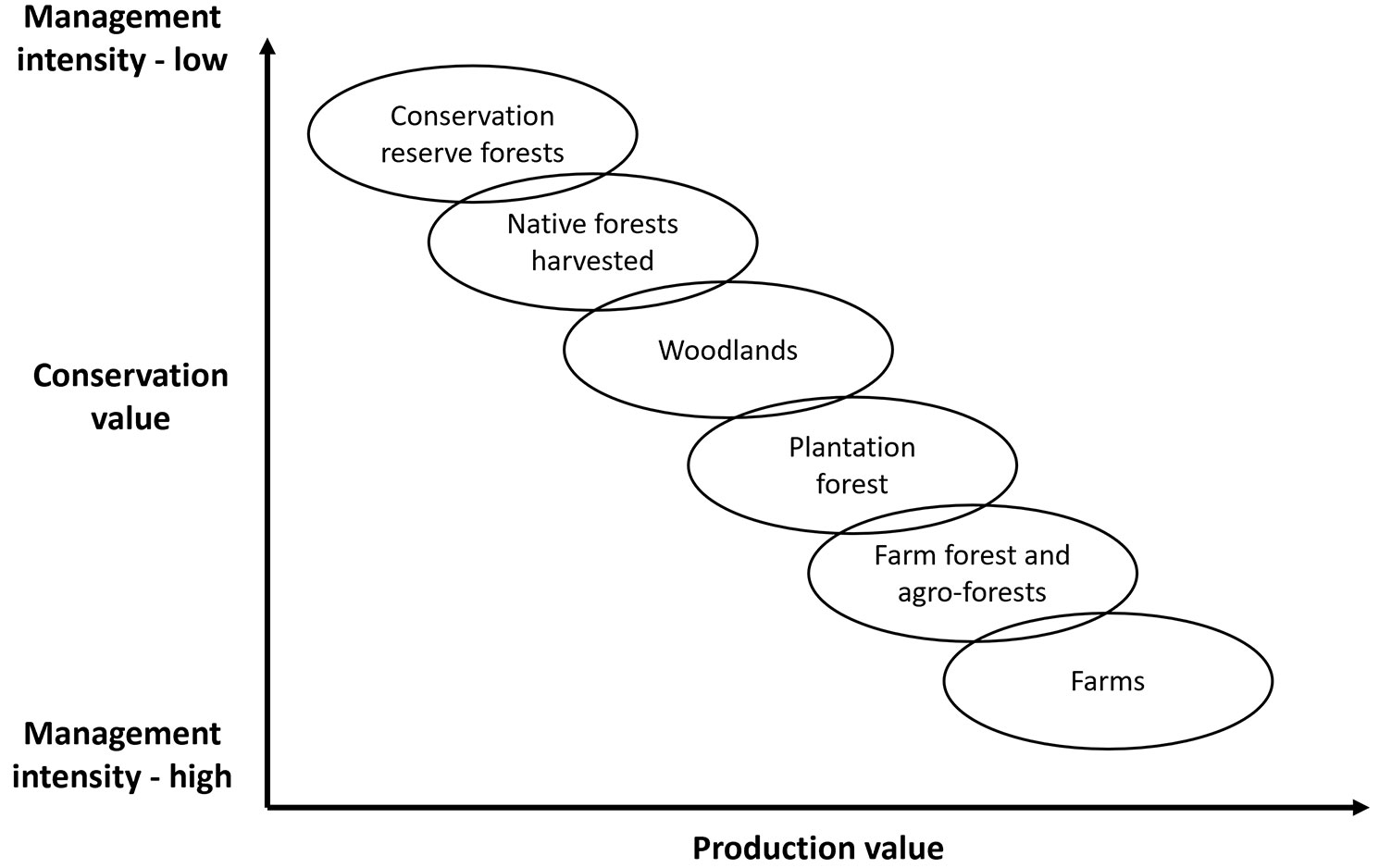
Sustainable management of production systems must be pursued, whether plantations are established for production, land and water protection, or environmental services ([78] - Fig. 1).
Fig. 1 - Conceptual diagram showing a continuum of land-use types arranged by conservation value (vertical axis) and production value (horizontal axis). Low-intensity systems with high conservation value, such as conservation reserve forests, appear at the upper left. Progressively more intensively managed and production-oriented systems - harvested native forests, woodlands, plantation forests, agroforests, and farms - extend toward the lower right, illustrating trade-offs between ecological conservation and productive use (adapted from [78]).
Quality is also important and depends largely on successful tree selection. For the final product to be of good quality, the wood’s technological properties must be uniform ([11]). The importance of a particular technological property varies with the wood products concerned, and its value varies with the crop type ([9] - Tab. 3).
Tab. 3 - Examples of products (not exhaustive) whose supply chain is affected by industrial fast-growing tree plantations and cultivated forests (types 1 and 2, respectively). Geographical origin and attempt to estimate importance are reflected for the French market ([9]).
| Sector | Concerned products | Key links | |||
|---|---|---|---|---|---|
| Examples of products/uses |
Production countries |
Related segment |
Countries of harvested forests* |
||
| Pulp & paper | Chemical, mechanical, fluff, kraft pulps | Brazil, Chile, Uruguay, Thailand, United States, Portugal | Timber harvesting, pulp & paper | Type1. Brazil, Chile, Uruguay, Thailand, Portugal Type 2. United States, Scandinavia, Landes | |
| Paper / cardboard |
Graphic | Office paper | France, Western Europe | Pulp & paper | |
| Hygienic paper | Toilet paper, absorbent pads | ||||
| Packaging | Cardboard | ||||
| Cardboard boxes for manufactured products | The same as the packaged product, often from China | Imported pulp, especially from China | Type 1. Brazil, Chile, Uruguay, Indonesia, South Africa, China | ||
| Publishing | Imported book | China, Malaysia, Singapore | Asian printing | ||
| Book or magazine | France, Western Europe | Pulp & paper | Type 1. Brazil, Portugal Type 2. United States Scandinavia, Landes | ||
| Furniture | Outdoor furniture | Vietnam, China | Timber harvesting, manufacturing | Type 1. Southeast Asia, China, Brazil | |
| Energy | Pellets for biomass power plant | France or countries of import | Timber harvesting, manufacturing | Type1. Brazil Type 2. United States | |
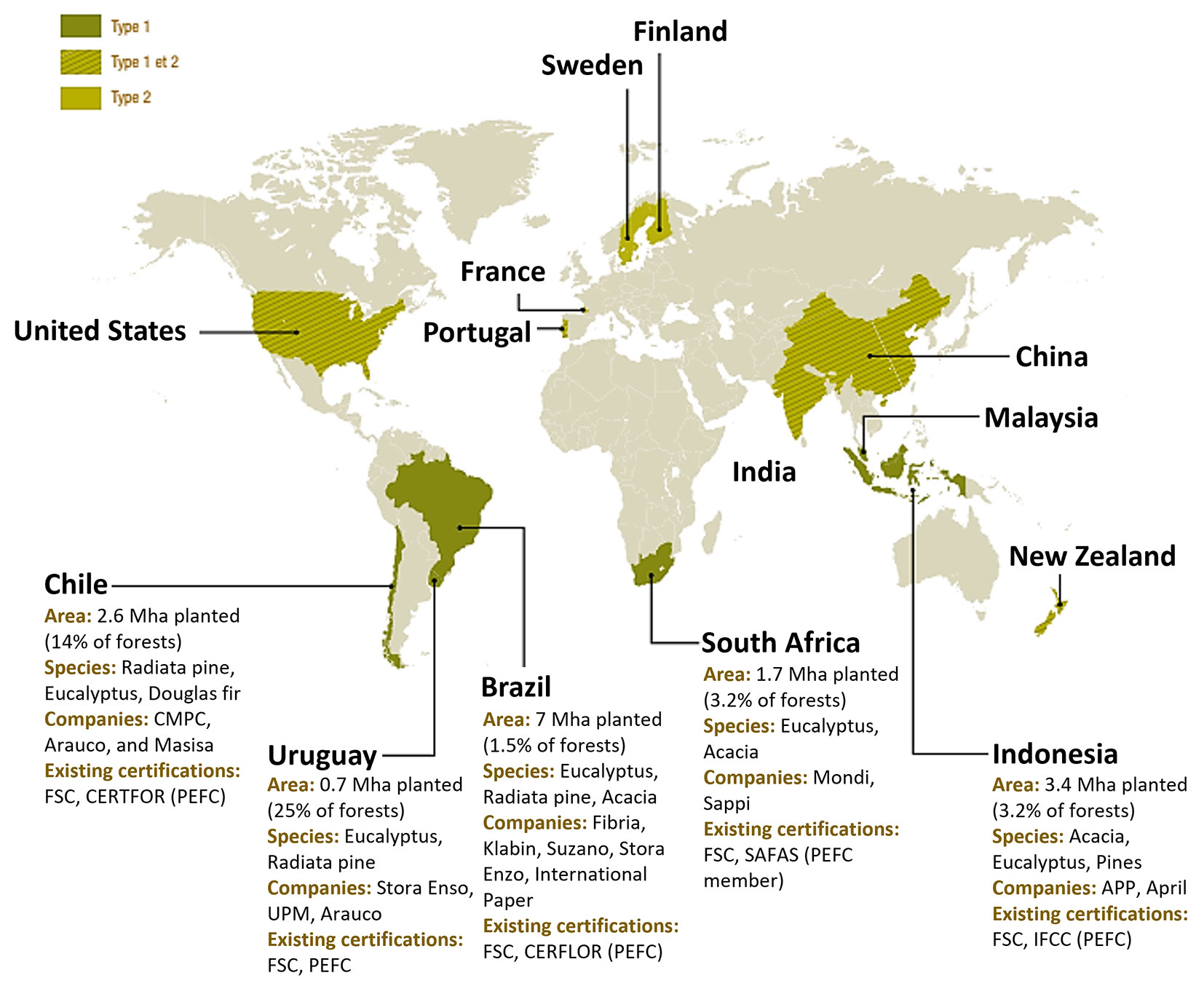
Fast-wood plantations represent the high-intensity end of the plantation productivity continuum. These plantations are concentrated in a limited number of countries ([9] - Fig. 2). Softwood plantations, in contrast, operate one step down in this hierarchy, producing sawn timber on longer rotations of 20-35 years, rather than the very short cycles of fast wood systems. The most productive plantations of this type cover a total area two to three times that of fast-wood plantations. These softwood systems generally rely on coniferous species (e.g., pines) and are managed for higher-value timber rather than for maximum annual fiber yield ([11]).
Fig. 2 - The main countries producing wood resources in industrial plantations of fast-growing trees (type 1) or in cultivated forests (type 2) (adapted from [9]). Plantation of type 1 is industrial and monoculture-focused, while plantation of type 2 is more diverse, multi-purpose, and ecologically sustainable.
The ecological impact of fast-growing industrial tree plantations is equivalent to that of any other agricultural crop. These plantations must be integrated into a multifunctional land-use plan in which agriculture, plantations, and natural ecosystems coexist ([9]). There are several historical reports of declining productivity in plantations. Examples include Picea and Populus plantations in Europe, Pinus radiata plantations in Australia, Cunninghamia plantations in China, and Eucalyptus plantations in India. The reason for this drop in productivity can be attributed to factors such as site degradation due to poor harvesting practices, subsequent site management that has depleted site resources, poor weed management, or poor species or germplasm selection ([78]).
Plantation management operations must ensure that the soil base is protected and that disturbances to ecological processes (carbon, nutrient, and water cycles) are managed within the known limits of a particular ecosystem’s resilience and ameliorative capacity to sustain long-term productivity beyond the current rotation. This is particularly important for intensive short-rotation forestry, as risks are higher as harvest frequency and intervention intensity increase.
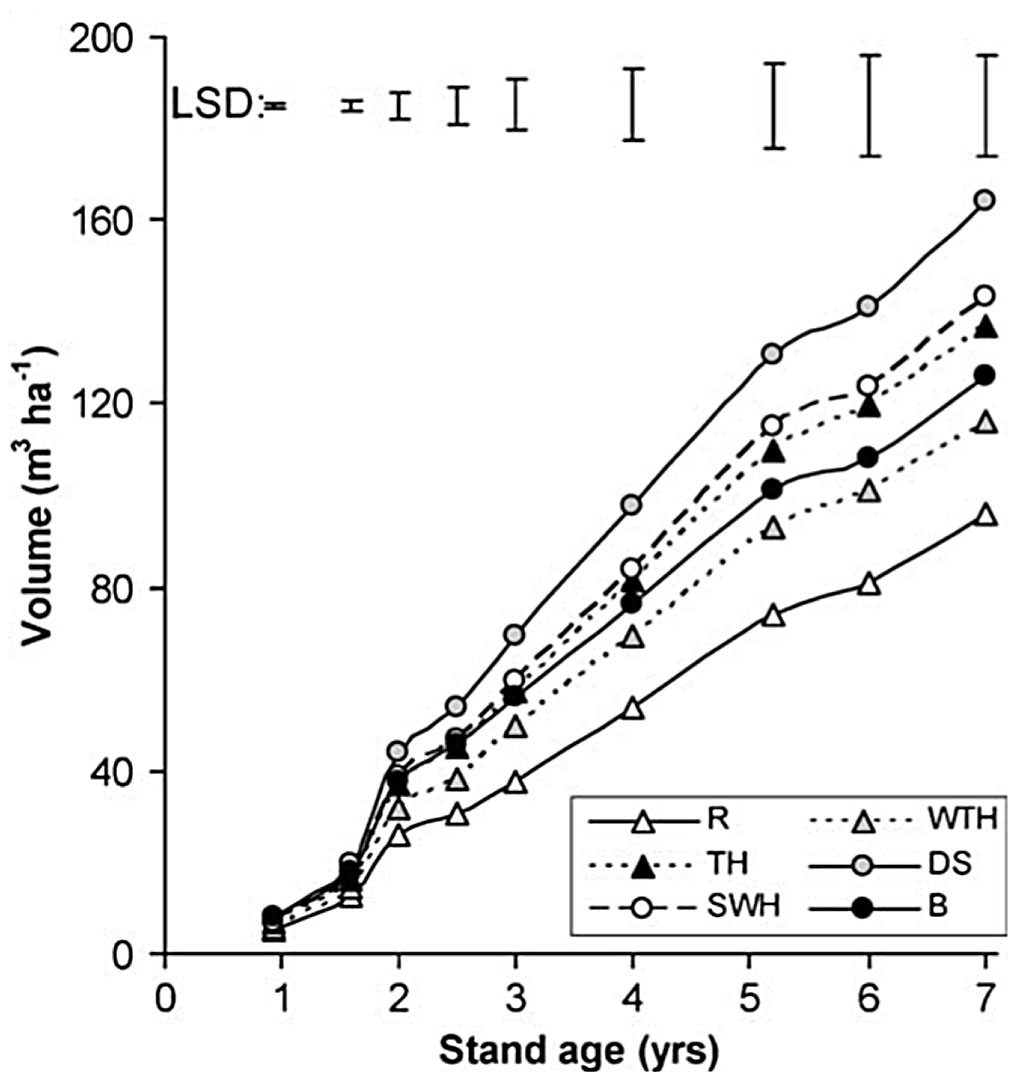
Increasing tree productivity enriches the soil rather than the other way round, provided that the organic matter (litter and harvest residues) is preserved ([54]). The impact of harvesting and site management on productivity tends to be strongest on fertility-poor soils. This is well demonstrated in a short-rotation hybrid eucalyptus plantation in Congo ([54] - Fig. 3). Here, in a second-rotation stand, wood volume at the end of the rotation was halved when all organic matter (slash plus litter from the first rotation) was removed at the start of the second rotation. Productivity increased linearly with the retained amount of organic matter (and nutrients) across various site management practices ([54]).
Fig. 3 - Effect of harvesting and inter-rotation management on productivity of eucalyptus hybrids on a sandy soil in Congo. All above-ground biomass, including litter removed (R); whole-tree harvested (WTH); all residues burned (B); only merchantable wood and bark harvested (TH); wood alone removed, debarked at stump (SWH); and double slash-slash form WTH plot added on top of the in-situ slash (DS). Bars indicate LSD values when differences between treatments are significant (p < 0.05) (adapted from [54]).
Alternative models exist beyond uniform, industrial-scale concessions. For instance, plantations established by smallholders are often perceived more favorably by local communities. Smallholders typically retain responsibility for their plots and often convert only a portion of their land to fast-growing monocultures, while the other part is set aside for agricultural use. In this way, owner-managers continue to derive a livelihood from their work in rural areas. Nevertheless, smallholder plantations remain limited in number, as the majority of plantation areas are now owned by large private or public forestry and/or paper companies ([4]). More difficult to set up and get certified, this model is a source of better income distribution, as it is based on small owners grouped together in cooperatives and organized by the industrialist acquiring the wood. The dialogue and participation of local populations in the governance of the landscape in which industrial plantations of fast-growing trees are established remain crucial to the acceptance of such projects.
Improved germplasm, productive and adapted species/varieties:
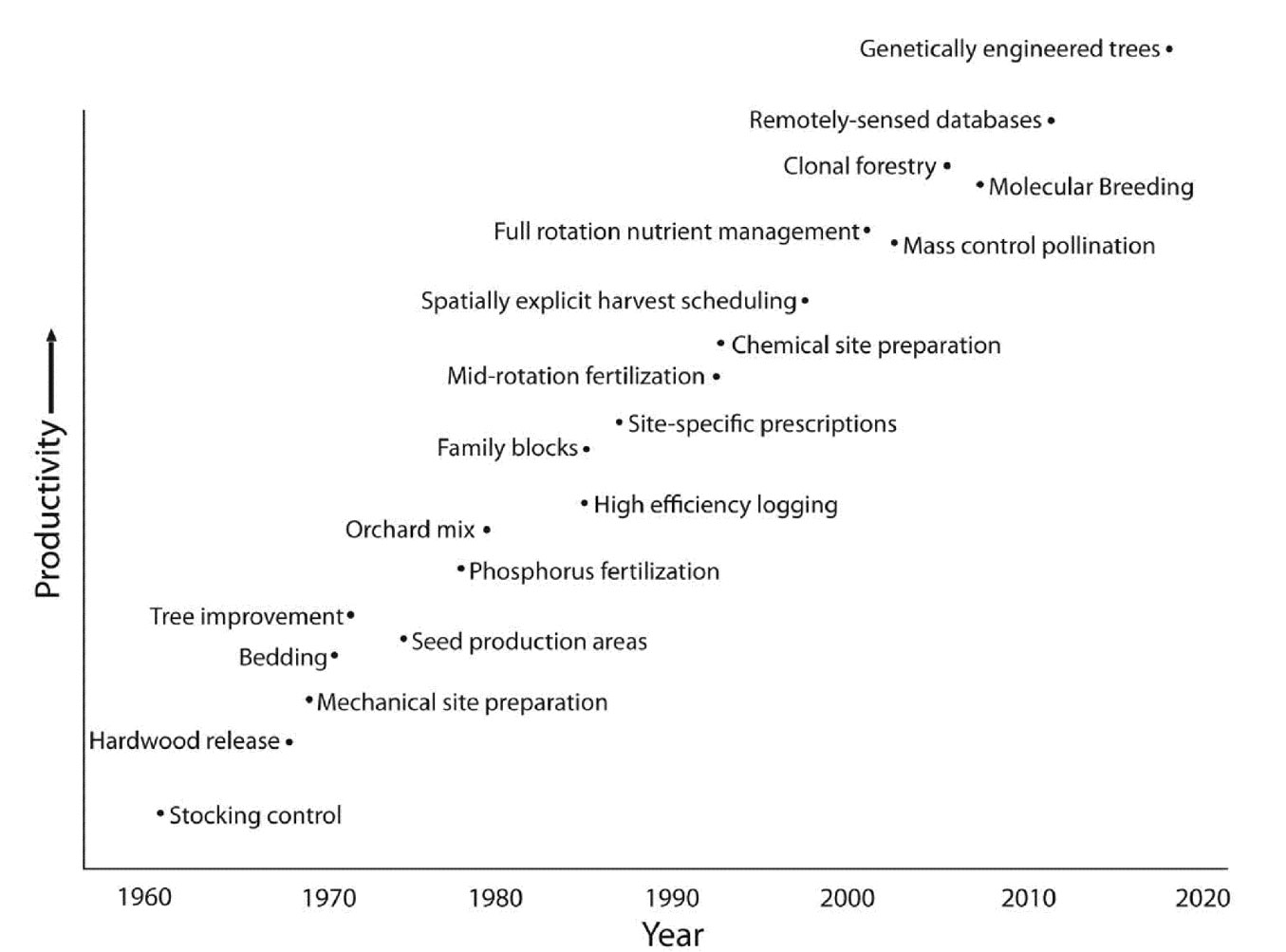
Productivity and yield improvements rely on manipulation of site resources, tree genetics, and stand structure to optimize tree growth and are most common on industrial forestland (Fig. 4). Vance et al. ([98]) illustrate the diverse factors that have driven productivity gains between 1960 and 2010, largely through the adoption of increasingly advanced techniques and technologies. Genetically engineered trees, remotely sensed databases, clonal forestry, and molecular breeding represent the culmination of these advancements - an influence that continues to shape the field in 2025.
Fig. 4 - Timeline illustrating forest management and technology advancements from 1960 to 2020 (adapted from [98]). Tree species, practices, and implementation dates vary across regions.
Fast-growing species such as eucalyptus and teak dominate commercial plantations due to their short rotation cycles and high economic value. Such plantations can reach a productivity of ~35 m3 ha-1 y-1.
Experimentation with planting densities, fertilization techniques, and site-specific cultivar selection helps maximize yields. These efforts are essential to maintaining high wood productivity despite increasing climate variability ([48]). Global productivity trends highlight significant variations across regions and species. According to Pena-Vergara et al. ([70]), eucalyptus plantations in Brazil, China, and New Zealand consistently achieve the highest yields, surpassing 30-35 m3 ha-1 y-1. Other productive regions include Indonesia, Australia, and Chile, where eucalyptus maintains competitive growth rates. In contrast, pine plantations, while widely cultivated, exhibit lower productivity, generally ranging from 10 to 30 m3 ha-1 y-1. Global pine productivity varies widely due to differences in climate, site conditions, and silvicultural practices. In New Zealand, plantations of Pinus radiata benefit from temperate, moist climates with long growing seasons, supporting mean annual increments (MAI) of 20-30 m3 ha-1 y-1, and in some optimal sites, even up to ~50 m3 ha-1 y-1 ([27]). Similarly, Brazil’s tropical and subtropical pine species (P. caribaea, P. taeda, P. elliottii) achieve growth rates of 8-30 m3 ha-1 y-1, driven by warm temperatures, abundant rainfall, and nutrient-rich soils ([24]). By contrast, northern European countries such as Sweden and Finland report substantially lower pine yields, typically below 10 m3 ha-1 y-1, as trees grow under cooler, boreal climates with shorter growing seasons and lower thermal sums, which constrain physiological growth and wood accumulation ([58]). Despite significant progress, challenges remain in scaling up high-yield forestry systems. The average productivity of planted tropical and subtropical forests remains below the potential maximum, necessitating further advances in breeding, silvicultural practices, and site-specific adaptation. Continuous innovation in clonal selection, improved forest management, and genetic engineering will be essential to sustaining productivity levels and ensuring a stable wood supply for the bioeconomy ([48]).
Optimizing plantation design, harvesting plan, and wood allocation
Successful forest plantations are those in which the climatic and edaphic conditions of the site are closely aligned with the ecological requirements of the selected tree species. Ensuring an optimal match between site characteristics and species traits is therefore fundamental to plantation performance. Outside natural forests, various wood production systems can be considered, and the characteristics of the site (climate) and soil (pedological characteristics) on which they are established guarantee high productivity, low susceptibility to pests and diseases, and low risk of abiotic disturbances.
Optimizing rotation lengths: short rotation forestry
Short Rotation Forestry (SRF) emerged as an efficient strategy to increase wood supply for bioeconomy needs. Its main advantages include high productivity, rapid biomass accumulation, carbon sequestration, and renewable bioenergy production. Additionally, SRF can contribute to land restoration by increasing vegetation cover and stabilizing soil, while its adaptability allows integration into agroforestry systems, improving land-use efficiency and economic diversification ([48]). However, SRF also presents challenges. Frequent harvest cycles can lead to soil depletion, high water consumption, and increased need for fertilizers. Monoculture SRF systems may be more vulnerable to pests, diseases, and biodiversity loss, requiring careful management. Additionally, economic viability depends on policy support, as scaling up SRF for bioenergy production faces financial and logistical barriers ([48]).
SRF involves growing trees on rotations that produce material with a 10-20 cm diameter at breast height over a rotation of between 10 and 20 years. Due to their fast initial growth, the species used are typically broadleaves rather than conifers, which dominate conventional production forestry in temperate countries. SRF may be an attractive option for landowners, as it provides more immediate financial returns than conventional forestry. Also, the ability to change genetic material more rapidly at the rotation end may make it more resilient to a changing climate than productive conifers and broadleaves. The recent focus on SRF has been to provide biomass for energy and heat generation. However, there are likely other industrial applications for SRF, such as the production of composite wood materials, biofuels, and extractives.
A distinction should be made between SRF and Short Rotation Coppice (SRC) that involves establishing cuttings, with very high stocking densities of 10.000 to 20.000 stems ha-1 for willow or poplar, for instance ([12]), with the crop being harvested usually every two to four years, or even more. Establishment and harvesting are highly mechanized, and SRC is normally planted on relatively flat, agricultural land. The harvested material is typically chipped on site and used as a biomass fuel. Drawbacks of the system as a biomass fuel supply include the small-dimension material produced, which has a high moisture content and a bark-to-wood ratio ([81]).
For plantations in tropical regions, rotation periods can be less than 10 years, whereas in temperate or boreal regions they are usually several decades, and rarely less than 20-25 years. In tropical regions, short-rotation woody plantations play a major role in climate change mitigation and adaptation plans, because of their high yields of woody biomass and fast carbon storage.
Polycyclic plantations (Italy)
Polycyclic plantations represent an innovative approach to sustainable forestry, integrating multiple tree species with varying growth cycles within a single plantation. This method enables the simultaneous production of timber, biomass, and other forest products, thereby enhancing both economic returns and ecological benefits. Typically, these plantations consist of: medium to long-cycle trees (e.g., walnut, hazelnut, cherry, oak, maple, ash, linden) harvested at 15-40-year intervals for structural timber or manufactured products; short-cycle trees (e.g., poplar) harvested at 8-14-year intervals for paper or packaging materials (i.e., wood veneer, plywood); very short-cycle trees (e.g., plane) harvested at 6-7-year intervals for firewood with the advantage of a periodical incomes; and shrubs that are periodically harvested for biomass and energy production, or that remain unharvested to contribute to soil coverage and biodiversity. This diverse composition ensures that interventions have minimal impact on the landscape and habitats, while also preserving soil carbon stocks and mitigating global warming. Such mixed plantations could provide periodic income from biomass harvests while also producing high-quality timber, thereby offering a sustainable model for combined production ([72]).
Italy has actively promoted fast-growing species for polycyclic systems, including poplar clones with broadleaf trees in medium- to long-cycle systems, as well as agroforestry models in which poplars are cultivated in rows alongside agricultural crops. Recent efforts to improve productivity and sustainability in these systems have included: (i) selection of high-quality clones: Italian poplar farming has traditionally relied on the I-214 clone due to its suitability for plywood production; however, its susceptibility to pests and diseases has led to the adoption of MSA (Greater Environmental Sustainability) clones, which offer enhanced resistance to shoot blight, rusts, and aphids. (ii) Certification and financial incentives: the Italian government and regional programs support afforestation projects with subsidies covering 60-80% of establishment costs for plantations using polyclonal setups or certified sustainable forest management practices (PEFC, FSC). (iii) Integration with agroforestry: although the use of several species groups with distinct rotation cycles in polycyclic plantations typically limits the availability of land for concurrent agricultural production, polycyclic systems can still be strategically integrated into agroforestry designs. Evidence shows that hybrid poplar clones within well-planned agroforestry systems enhance overall land productivity while maintaining soil health and biodiversity, thereby providing a robust model for sustainable timber production.
Italy is increasingly focusing on diversifying tree species in polycyclic systems to improve resilience to climate change. Douglas-fir, wild cherry, walnut, and Monterey pine are being tested in various polycyclic models, particularly in the Apennines, to assess their suitability for medium-long and long-term timber production under changing climatic conditions ([32]). These models aim to balance economic viability with ecological integrity, ensuring the long-term sustainability of planted forests. Such polycyclic systems could provide periodic income from biomass harvests while also producing high-quality timber, positioning them as a sustainable model for combined production in Italy.
Expanding the area of planted forests and integrating trees for wood production in the landscape
While large-scale intensive plantations have the potential to meet growing wood and timber demands, various constraints - such as environmental concerns, land tenure issues, and economic challenges - often hinder their widespread establishment, leading to a growing focus on small-scale approaches and the integration of trees within broader landscapes. Developing economies need wood for many purposes, from poles for expanding power grids to building materials in booming cities. The best way to meet these needs is to produce wood locally, rather than importing it or exploiting it industrially and indiscriminately in biodiversity-rich forests, some of which need to be entirely preserved. Indeed, the transition to the bioeconomy offers particular opportunities for developing countries with limited fossil fuel resources but abundant land. It can support a truly sustainable model of rural development, increasing the value generated by forestry and agriculture while (if well done) contributing to land restoration, improved ecosystem services, and reduced carbon emissions. As the range of products made from wood expands, small producers and SMEs have more opportunities to innovate and add value.
Alternative sources of timber from Forest and Landscape Restoration
In tropical and temperate regions, degraded landscapes have been restored through mosaics of new plantations, restoration of natural forests and agriculture, to the benefit of the industrial economy, the environment, and local populations. In the face of the climate crisis and the damage to biodiversity, the UN has declared the decade 2021-2030 the “Decade of Ecosystem Restoration” ([94]). In addition, the European nature regulation sets binding targets to restore degraded ecosystems, particularly those with the most potential to capture and store carbon, as well as to prevent and reduce the impact of natural disasters ([19]b). The integration of trees for wood production in restoration approaches must play a central and crucial role in the initiatives to be undertaken to restore habitats and ecosystem services, contribute to carbon sequestration, and also to the creation of rural development opportunities and the satisfaction of needs for wood and wood-based products in both southern and northern countries.
Establishment of small and medium-scale plantations and woodlots
Home and farm plantations are forests created mainly for subsistence or local sale. They are established through planting and/or seeding during afforestation or reforestation, featuring trees of similar age and evenly spaced. These plantations are usually small, and their products may be sold in a scattered, local market. Mosaic landscape restoration, with the establishment of woodlots, community forests, and plantations, as part of the package of restoration options implemented in the landscape, represents an opportunity to expand planted forests.
Small-scale plantations and woodlots, often integrated with agricultural production, are crucial for regional wood supply. In Thailand, for example, smallholders cultivate eucalypts on over 900,000 ha of private land, while in Lao PDR, there are around 67,000 ha of eucalypt plantations and 50,000 ha of teak under smallholder management. These plantations are frequently established on degraded or marginal agricultural land and utilize fast-growing, high-biomass species such as eucalyptus and acacias, contributing to both land restoration and a sustainable supply of wood for various industries. In Vietnam, the Binh Minh Agroforestry Cooperative, which started as a small group of acacia growers, now collectively manages 60 ha of FSC-certified acacia plantations, demonstrating how cooperative models can enhance smallholder participation in sustainable wood production.
Success stories provide good references for large-scale plantations using native species, with direct impact on the restoration of mosaic landscapes, alongside other interventions, such as the Atlantic Forest Restoration Pact (PACTO). By optimizing the organization of areas and finding the right compromises between land use and the development of natural resources, such a system helps to improve the quality of the environment. By bringing together the production and protection functions of forests, the expansion of wooded areas makes a major contribution to achieving global restoration objectives.
To achieve the objective of restorative activity, afforestation and reforestation must enhance biodiversity and ecosystem integrity. They should reinforce natural recovery processes rather than cause additional degradation. Aligned with the guiding framework, the ten golden rules for reforestation developed by Di Sacco et al. ([13]) offer relevant recommendations for conducting reforestation within forest restoration initiatives to maximize benefits for nature and people. A wealth of knowledge is now available on the main challenges facing the large-scale restoration movement, including monitoring and funding, as well as on specific restoration approaches, such as assisted natural regeneration. In the field of Forest and Landscape Restoration, numerous initiatives and experiments have proved their worth, but little of this knowledge has been capitalized on, and experience should be shared systematically and at a large scale ([29]).
Integration of fast-growing trees in mixed-species forest restoration
Brazilian pulp companies are now innovating in new areas of the bioeconomy, from the production of wood cellulose-based textiles to bio-oils, and the development of forest plantations is coupled with the restoration of natural forest stands ([102]). In Brazil’s Atlantic Forest, for example, around 2 million ha of former grazing have been transformed into a mosaic of landscapes by combining intensively managed Eucalyptus plantations and restored natural forests.
Afforestation of marginal or degraded lands
In Africa, overexploitation for fuelwood remains one of the most significant threats to natural forests. Establishing fast-growing plantations on marginal or degraded lands can help alleviate pressure on native forest stands by supplying biomass for the development of legal and sustainable charcoal or other wood-energy value chains ([2]). Although such plantations contribute to carbon sequestration, converting intact natural forests or grasslands into plantation systems may still generate net carbon emissions ([8]).
Agroforestry integration of trees in rural areas
In agroforestry systems, trees are integrated with agricultural crops or livestock to create multifunctional landscapes. Agroforestry models, such as silvopasture or alley cropping, aim to optimize land productivity while improving soil health and promoting biodiversity ([64], [63]). Spain’s long-established Dehesa system - and its Portuguese analog, the Montado - demonstrates the effectiveness of integrating tree species such as cork and holm oaks with agricultural and pastoral production. Spain has also implemented mixed cultivation systems that combine poplars with agricultural crops, optimizing timber production, biodiversity conservation, and water regulation. These plantations have also been used for riparian protection and landscape restoration, contributing to climate change mitigation strategies ([48]). Canada has promoted poplar-based silvopastoral systems, integrating poplars into pasturelands to provide shade, windbreaks, and improved forage quality, while simultaneously producing high-quality timber and biomass for bioenergy ([48]). Agroforestry models, such as silvopasture or alley cropping, aim to optimize land productivity while improving soil health and promoting biodiversity ([64], [63]).
New sources of wood and plant biomasses, and cascade uses
Although there were already many tree plantations for food purposes (including olive, walnut, chestnut, and other species), as early as 1929, Smith ([87]) considered “tree crops as a permanent agriculture” and described the value of tree crops for food production on steep and rocky soils as a sustainable alternative to agriculture with annual crops less suited to these terrains. Since then, tree plantations for purposes other than timber production have greatly intensified and diversified worldwide.
Tree crop plantations
Rubberwood (Hevea brasiliensis) is one of the major tree crop plantations worldwide. It is a tropical tree native to the Amazon Basin that was domesticated and planted, with strong commercial interest in latex production from the 1960s onwards. This plantation is a striking example of the genetic improvement of a tropical perennial species, in which clonal selections were aimed at the best latex yield, without considering wood quality. In addition, crop rotation times (20 to 30 years) are implemented to optimize latex production, not wood production. In fact, a longer growth period would make it possible to obtain higher-quality wood, with less juvenile wood and more mature wood ([36]). The first rubber plantations in Thailand date back to the 1900s. Thailand has large areas dedicated to rubber plantations, and in 2022 it was the world’s leading producer of natural rubber, accounting for more than 4.7 million tons, or about one-third of world production. Natural rubber is produced almost exclusively by smallholders (90%), i.e., 1.68 million smallholders for 3.9 million ha of plantations, making it a particularly fragmented sector ([18]). While little or no value was placed on rubberwood after it had been cut down (except for firewood or charcoal), following the entry into force of a government ban on wood logging in natural forests in 1989 (Order no. 32/2532), rubberwood became the primary wood feedstock available ([22]).
The uses of the rubber tree have since diversified greatly. When cut after a rotation of around 30 years, a cultivated rubber tree has a bole of around 3 m without branches, for a total height of approximately 30 m. The diameter at breast height (DBH) can reach 30 cm, making them small-diameter trees ([23]). Depending on the age of the log, rubberwood can contain varying proportions of juvenile and mature wood, causing variability in sawing (splits) and during drying (deformations). Wood is not durable against wood-destroying organisms (fungi, insects, including termites). Drying and treatment are necessary for most end uses, especially for long-term uses. This light wood, with non-distinct sapwood (no color change across the trunk), straight grain, and medium to coarse texture, has become an essential wood resource in Thailand. Rubberwood has shifted from waste material to a versatile, low-priced raw material for many uses ([36]). Rubberwood can still be used as firewood or for charcoal production. However, its success, driven by low prices and availability, as well as aggressive marketing, suggests it is valued for sawn timber, furniture, interior building components, kitchen utensils, parquet flooring, and composite panels (mainly Oriented Strand Boards, Medium Density Fiber Boards, and Chipboards). It can be used for the production of paper pulp (semi-chemical) and corrugated paper medium. Altogether, rubberwood products account for 60% of total exported wood products in Thailand, and they are also used to supply local electricity via biomass power plants ([84]).
In 2019, Côte d’Ivoire was the leading rubber-producing country in Africa and the sixth-largest globally (accounting for ~5% of global rubber production). Despite a few initiatives, the rubber industry has not yet been fully established, and technical wood-processing methods have not yet been implemented. Thus, there is a disparity in surface area, production, and sector depending on the country producing natural rubber and its by-product, the rubber tree. The 7 million ha of rubber tree plantations worldwide can provide a better supply of wood (improving sectors and processing). However, the role of rubberwood in the future supply of industrial roundwood remains uncertain, and due to its quality, it will be suitable only for certain uses ([28]). The rubber tree remains the archetypal tree crop that can provide timber. However, mango wood, apple wood, pear wood, and walnut wood (fruit tree woods) are available on the primary and secondary processing markets, but in very marginal quantities.
Utilization of wood residues for a broader range of higher-quality usages
Defining wood wastes and residues is important to avoid misunderstandings. The Waste Framework Directive of the EU (no. 2008/98/EC) defines waste as “any substance or object which the holder discards or intends to discard” (sic). According to the Renewable Energy Directive (2015/1513) and the Fuel Quality Directive (2009/30/EC) of the European Union, the term “residue” refers to substances that are not the end products of a process directly sought. A categorization of wood residues is necessary to allocate them to adequate valorization pathways, and can be defined as follows.
Primary wood residues: By-products of forest management activities related to industrial roundwood production, including harvesting, but also thinning, pruning, and other silvicultural treatments. They are sometimes referred to as logging or harvesting residues. They include tree tops, branches, bucking and trimming materials, and small/non-commercial trees. In some instances, roots and stumps are also considered as primary residues ([91]).
Secondary wood residues: By-products of wood processing and product manufacturing at sawmills and veneer plants (e.g., bark, wood chips, rejects, slabs, edgings, trimmings, sawdust, shavings, etc.) and paper mills (e.g., black liquor). Some of these materials, such as wood chips and sawdust, can be recovered and directed to other industries, for example, as feedstock for pulping, particle and fiberboard production, and other bioproducts ([91]).
Tertiary wood residues: Comprised of wood from products at their end-of-life, i.e., post-consumer wood, and other recovered wood derived from socio-economic activities outside of the forest sector. For example, this includes construction and demolition wood consisting of wood debris generated during the construction, renovation, and demolition of buildings and other infrastructure. Some of these residues can also be recovered and recycled back within the wood product value chain for further use ([91]).
Moreover, Karan & Hamelin ([50]) provide other definitions and categorizations. Forestry residues can be divided into two categories: (i) Primary forestry residues (PFRs), and (ii) Secondary forestry residues. PFRs are defined as residues left after logging operations (branches, stumps, treetops, bark, sawdust, etc.). In contrast to PFRs, secondary forestry residues are by-products and co-products of industrial wood-processing operations (bark, sawmill slabs, sawdust, wood chips, etc.). Although wood residues are an undeniable resource, it is necessary to emphasize that this resource: (i) consists of multiple elements from various sources with little homogeneity, (ii) is difficult to quantify both in its entirety and by category. Forestry and wood residues have long been used for energy production, but with advances in technologies and energy processes, new avenues for valorization can be envisaged ([91]). In addition, some new competitions are emerging. For example, logging slash can be used for energy production, but the collection of these harvest residues can negatively impact forest ecosystems (e.g., soil carbon regeneration). The panel industry also traditionally absorbs a large quantity of untreated wood residues (primary and secondary residues), in particular to produce particleboard or fiberboard. Faced with the pressure of the demand for wood, the introduction of wood particles/fibers from post-consumer wood is increasingly present, with technical challenges to overcome ([55]). However, the search for molecules among the broad range of wood residues is probably the highest-quality use envisaged so far. Large families of bioactive compounds can be found in wood secondary metabolites (outside cellulose, hemicellulose, and lignin) with very high added value in various fields such as pharmaceuticals, cosmetics, and agri-food ([66]).
Cascading wood use
Reichenbach et al. ([74]) define cascading wood use as the efficient utilization of resources, using residues and recycled materials to extend total biomass availability within a given system (sic). The cascading use of wood can be done in a single or multiple stages. In the case of multiple stages, wood is transformed into a product and used at least once before the end of its life (disposal or incineration for energy production). This is a virtuous system that makes it possible (i) to optimize the use of wood, several times and over a long-time span, (ii) thus increasing the duration of carbon storage in wood products, (iii) and limiting the pressure on forest ecosystems as well as reducing environmental impacts. It should be noted that the cascading use of wood is also in line with the principle of the bioeconomy ([56]). The principle of cascading wood utilization, reuse, and recycling, combined with waste reduction, is becoming increasingly important but faces limitations driven by the need to develop new technical pathways for reuse and recycling, their environmental impacts, and economic viability. Moreover, if wood should be used first for its higher-value applications, prioritization will differ depending on local needs and applied policies.
Securing long-term contributions from planted forests and trees to sustainable wood production: challenges ahead
Long-term wood production from planted forests depends on sustained genetic improvement, suitable silvicultural practices, and soil fertility management. However, their contribution to the bioeconomy cannot be separated from broader ecological, economic, and social sustainability. Market volatility, climate change, and increasing pressure on land resources challenge the ability of plantations, particularly those managed by smallholders to deliver stable wood supplies and equitable benefits.
Economic viability and rural development
Global timber price fluctuations strongly affect plantation profitability, especially in export-oriented regions ([11]). Due to long production cycles, forest economic sustainability requires policies distinct from short-term resource exploitation ([67]). Public intervention is crucial for regulating land tenure, balancing economic, social, and environmental objectives, and providing public goods. State intervention is critical for regulating land tenure, balancing economic, social, and environmental objectives, and providing public goods. Policies promoting wood supply should be complemented by measures to preserve forests, biodiversity, and landscape values, with impacts varying across political regimes. Market fluctuations, including timber prices and carbon pricing, affect sustainable development. Economic sustainability is achieved when silvicultural income exceeds forestry costs; theoretically, forestry returns should exceed those from alternative land uses. Efficiency improvements, such as optimized rotation ages, support sustainability. Markets must provide appropriate signals for resource allocation, yet maximizing profit does not always yield maximal social benefits. Plantation amenity values are often neglected, leading to inefficient short rotations. New economic and financial models, applied to both large-scale and village plantations, remain based on discounting principles to account for long-term benefits. Indeed, at all scales, plantation forests offer long-term benefits and therefore discounting in economic considerations is crucial. Discounting in economic value calculations refers to the use of a discount rate that reflects social preferences between having access to a product now and in the more distant future. Uncertainties persist regarding future wood demand, property rights, ecosystem services, institutional frameworks, and technological innovations ([67]).
Economic risks may also relate to the future technological, economic, environmental, and social dimensions of forestry and land-use systems in the broadest sense. Commercially, timber markets are globally open and governed by supply and demand. However, regulatory systems addressing legal timber origin and environmental impact exist in major consuming countries, e.g., Japan (Clean Wood Act), the USA (Lacey Act), Australia (Illegal Logging Prohibition Act), and the EU (EUDR) ([14]). The EU Timber Regulation ([21]) aimed to exclude illegally harvested timber from the EU market.
The EU Deforestation Regulation ([20]), postponed to end-2025, expands its scope beyond timber to include beef, palm oil, soy, coffee, cocoa, rubber, and their derivatives. Under EUDR, operators must: (i) collect detailed supplier, species, location, and production data; (ii) analyze deforestation risks considering country risk, forest presence, and deforestation prevalence; (iii) implement mitigation measures; and (iv) submit a due diligence declaration before market placement or export.
Non-compliance can incur penalties up to 4% of annual turnover, often more deterrent than under EUTR, with variation across the 27 EU member states ([38]).
Multifunctionality and landscape trade-offs
Social considerations are central to the increasing demand for ecosystem services from plantation forests. For plantations to gain social legitimacy, they must meet societal expectations and be managed for long-term sustainability. Short-rotation plantations can enhance multifunctionality but may increase land-use conflicts with agriculture or environmental priorities, requiring careful site selection to minimize negative impacts ([15]). Plantations in intensive agricultural areas often yield positive outcomes, but trade-offs must be assessed for each project.
Forest plantations, initially dominated by monocultures for timber, now encompass multiple functions including carbon sequestration, biodiversity conservation, and erosion control ([27]). Wood production must be balanced with other functions, such as ecosystem service provision, indigenous and local community rights, and carbon storage. Multifunctionality can constrain short-term timber yields; for example, longer rotations may be necessary to maximize carbon sequestration. Mixed-species plantations, combining two or more tree species, enhance ecological resilience, soil quality, and biodiversity, although they are less common due to complex management requirements, and offer long-term sustainability benefits. A study by Feng et al. ([34]) demonstrated that multispecies forest plantations outperform monocultures under various conditions, highlighting the value of landscape-level diversity in plantation management. The TreeDivNet network, comprising 29 experimental sites in 21 countries across boreal, temperate, Mediterranean, subtropical, and tropical zones, rigorously tests the effects of species diversity on ecosystem service provision ([29]). The benefits of including a greater diversity of tree species in planted forests have been demonstrated in numerous scientific publications and empirical studies ([29]). One of the main advantages of mixed planted forests is their multifunctional character, in which different species simultaneously provide a wider range of ecosystem services ([97]). However, this multifunctionality often prevents them from achieving the maximum level of a single function. Absolute productivity gains are rare, but relative gains from species mixtures are common, as shown in subtropical China ([46]).
Trade-offs between timber production and biodiversity are complex. Harris & Betts ([42]) evaluated reserve (focused on conservation), intensive (focused on timber production), and ecological management treatments (combining both previous objectives), showing that no single strategy maximizes all services; the optimal approach varies by service and timber production level. Flexible management can maintain wood supply while prioritizing trade-offs. Similarly, Venn ([100]) reviewed land-sparing vs. land-sharing in Queensland, Australia, finding that: (i) historical land-sparing policies coincided with a growing international ecological footprint; (ii) land sharing may offer superior long-term climate risk mitigation; (iii) land sharing overcomes economic barriers to domestic timber supply from land sparing; (iv) a mix of land sharing and sparing best conserves biodiversity by creating diverse ecological and structural conditions over time and space.
Mainstreaming climate change adaptation and approaches to enhance system resilience
Tropical and subtropical regions generally exhibit high rates of forest growth due to favorable climatic conditions, but extreme events such as droughts and cyclones can substantially reduce productivity ([3]). Enhancing plantation resilience under climate change, therefore, requires the development of adapted species and silvicultural practices. Genetic diversity is central to species survival, adaptation, and resistance to pests and diseases, and is essential for maintaining plantation performance. While forest plantations often rely on controlled germplasm, global change challenges geneticists to supply planting material adapted to future climates and emerging biotic threats. The use of genetically diverse and climate-adapted reproductive material is critical, as past failures - such as the introduction of frost-sensitive provenances into climatically unstable regions - have demonstrated the risks of unsuitable planting stock ([62]). Low biodiversity in monoculture plantations increases vulnerability to pest and disease outbreaks, with potentially severe economic consequences ([43]). In response, breeding programs are developing more resilient genotypes, including drought-tolerant poplar clones. For example, the Pinus nigra clone “Salari” has shown strong growth and drought resistance in Iran ([48]). Growing concerns about monocultures’ sensitivity to biotic and climatic stresses have encouraged more diverse planting strategies. As already mentioned, research on mixed-species plantations has shown that they enhance carbon sequestration, improve soil properties, and increase adaptability to climate variability. In France, recent initiatives promote multispecies poplar plantations that balance productivity with biodiversity objectives ([48]). In the face of accelerating global change, new experimental trials are needed to assess how silvicultural treatments influence growth, yield stability, and interspecific interactions in mixed plantations.
Adequacy of timber and wood products to meet bioeconomy market demands
Rising demand for wood has driven increasingly intensive forest management practices, often favoring short-rotation systems to rapidly increase supply. A comprehensive review by Barrette et al. ([1]) assessed the effects of such practices on wood quality across multiple conifer species and silvicultural treatments (Fig. S2 in Supplementary material). The results indicate that wood produced under short rotations generally exhibits lower mechanical performance, as key properties improve with increasing cambial age. Although selective breeding can partially mitigate these effects, reduced wood quality has important implications for downstream industrial uses and resource allocation. Similar patterns have been reported by Rocha et al. ([76]) for Eucalyptus plantations. These studies focused mainly on species with low to moderate biological durability and did not assess durability responses to management intensity. However, research on highly durable species shows comparable trends. Teak, valued for its resistance to fungal and insect attack, has been widely planted to meet market demand. Studies indicate that teak durability depends primarily on tree age rather than provenance (natural forest vs. plantation - [61]).
More broadly, many tropical timbers are sought after for their exceptional durability, mechanical performance, and aesthetic qualities, particularly for long-term applications. Demand for naturally durable wood remains high, especially as regulatory restrictions increasingly limit the use of chemical wood preservatives ([37]). This is particularly critical for applications such as hydraulic and marine structures, where preservative treatments are not permitted.
Limited availability of land
Rising demand for wood coincides with increasing pressure on land to meet global food needs. Agricultural production is projected to double by 2050 relative to 2005 ([92]) and is expected to shift spatially in response to climate change. While up to 1.5 billion ha of land may become newly suitable for agriculture by 2060-2080 ([41]), an estimated 2.2 billion ha are projected to become less suitable by 2071-2100 ([6]). Increased agricultural output can be achieved through yield improvements, production intensification, or expansion of arable land, each with implications for forest land availability.
Not all forest land becomes more suitable for agriculture under climate change. Combining projections of agricultural suitability with timber production maps, Bousfield et al. ([6]) estimate that 27-110 Mha of land will become less suitable for agriculture by 2070-2099, particularly in tropical regions (e.g., southern and eastern Brazil) and southern Europe (Fig. 5). These regions already face increasing heatwaves, droughts, and wildfire risks ([5]), conditions expected to intensify under future climate scenarios ([83]). Such trends reduce the suitability of land for both agriculture and timber production, intensifying competition for productive areas. Conversely, many tropical forest regions that are highly suitable for agriculture, such as the Brazilian Atlantic Forest and the Malaysian Peninsula, are expected to remain so, thereby increasing pressure from agricultural expansion ([77]). Boreal regions currently have limited agricultural footprints due to climatic constraints ([73]), but rapid warming at high latitudes is projected to expand agricultural activity northwards ([104], [41]). Declining yields in drought-prone regions may further drive this shift, while simultaneously increasing wildfire risks in boreal forests ([5]), limiting both timber and agricultural production to smaller, more productive areas, particularly in northern latitudes ([104]). Focusing on productive agricultural land, it is estimated that there will be a net increase of 65-84 Mha in agriculturally productive forest land by the end of the 21st century. This represents an increase of 13% and 18% compared with the historical period (1990-2009). Europe (including Russia) sees the biggest increase in productive land, with 42 Mha of forest land becoming newly productive by 2070-2099, increasing to 47 Mha. Similarly, by 2070-2099, over 16 Mha become productive in North America, an increase of 15.1%; this figure rises to 19 Mha. Worryingly, the biggest increases in productive agricultural land are in the world’s largest timber producers, including the USA, Russia, Canada, and China, as well as throughout Scandinavia ([30]).
Fig. 5 - Future changes in agricultural suitability of current forestry lands (adapted from [6]). a-d, Change is relative to the historical period (1990-2009) and is presented for RCP 2.6 (a, c) and RCP 8.5 (b, d) in the time periods 2040-2069 (a, b) and 2070-2099 (c, d). Pixels are aggregated to 50× the original resolution (~1 km2 at the equator) for visualization, with the value presented being the mean change across all aggregated pixels. Agricultural suitability is ranked from 0 to 100 according to Zabel et al. ([104]), with zero denoting not suitable, 1-32 marginally suitable, 33-75 moderately suitable, and 76-100 highly suitable. Thus, a change of +100 indicates that previously unsuitable land will be highly suitable for agriculture. Alaska and northeastern Russia are removed to improve visualization, as little forested land is mapped in these regions.
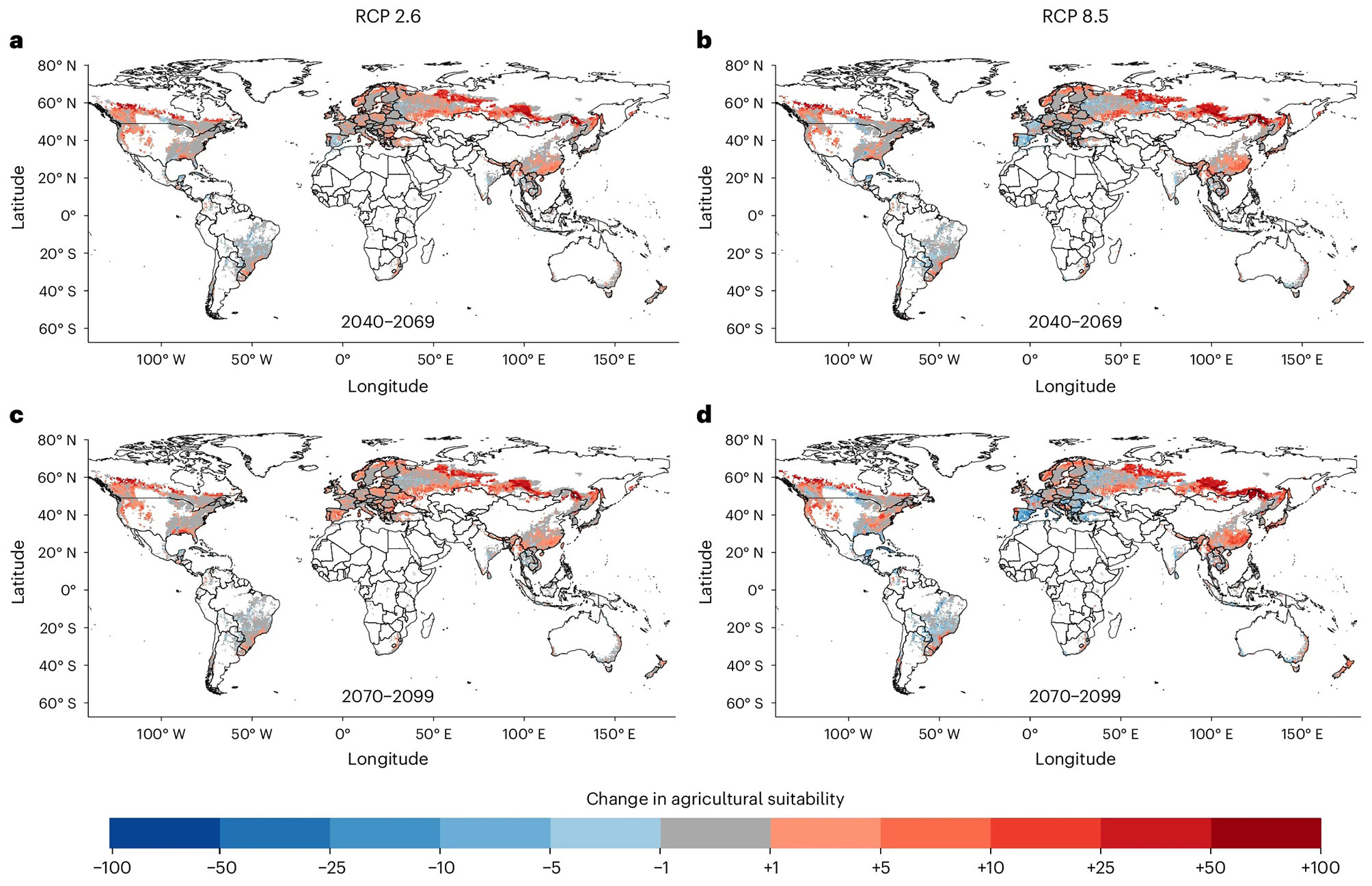
By 2100, 240-320 Mha of land currently used for timber production may become increasingly suitable for agriculture, with 62-80 Mha becoming highly productive. Pressure is concentrated in the four largest timber-producing countries, which account for 91% of forest land projected to become agriculturally productive ([6]). Northward forest expansion would intensify exploitation of old-growth boreal forests among the world’s last intact forest landscapes, which store substantial global carbon stocks, particularly in carbon-rich soils ([7]). Infrastructure expansion in these regions would further threaten biodiversity and cultural values in remaining wilderness areas ([35]). Increasing reliance on tropical timber reserves would pose even greater risks, as tropical forests are irreplaceable for biodiversity ([40]), carbon storage ([69]), livelihoods ([10]), and nature-based climate solutions ([82]). Such pathways must be avoided. Minimizing future land-use conflicts between agriculture and forestry, therefore, requires improving the efficiency of global food systems rather than expanding agricultural land ([6]).
Strategic land-use planning is essential if plantations are to actively support forest transitions, rather than merely responding to market scarcity ([71]). When well planned, plantations can generate development opportunities for local and indigenous communities through employment, land tenure security, income diversification, and infrastructure development. Benefits may include paid employment, access to non-timber forest products, intercropping opportunities, and improved access to roads, healthcare, and education. However, benefits are not always equitably distributed, underscoring the need for inclusive forestry policies to ensure long-term social acceptance and sustainability ([86]).
Forest certification systems can further enhance social legitimacy by promoting environmentally responsible, socially beneficial, and economically viable plantation management. Certification provides transparency along the supply chain and helps consumers identify sustainably managed wood products ([14]).
Ultimately, the appropriateness of plantation wood depends on environmental and social performance at the site level (soil rehabilitation, alternative to logging in surrounding regenerating forests, employment opportunities), alignment with market needs and resource efficiency, and the capacity of wood products to substitute for fossil-based materials such as plastics and petrochemicals ([59]).
Case studies
Case studies illustrate how forest management and tree-based systems contribute to a sustainable wood supply. In the Democratic Republic of Congo, the Makala Project increased wood resources for energy through planted forests, assisted natural regeneration, and integrated agroforestry. Uganda’s Sawlog Production Grant Scheme (SPGS) promoted small- and medium-scale commercial forestry, significantly expanding planted forest area and creating jobs while supporting sustainable timber production. China’s large-scale afforestation and reforestation programs boosted forest cover through fast-growing monocultures, thereby enhancing ecosystem services, but they also posed challenges to biodiversity and soil stability. In the Republic of Congo, the PREFOREST/PROREP initiative integrates trees into agricultural systems to reduce deforestation and greenhouse gas emissions through participatory mapping, agroforestry, and short-rotation plantations. Together, these examples highlight the potential to intensify existing plantations, expand tree-based systems, and integrate agroforestry to meet growing wood demand, with more detailed information on each project available in Appendix 1 (Supplementary material).
Conclusions
The transition to a bioeconomy - an economic model based on renewable biological resources - offers both opportunities and challenges. Wood and forest-based products are expected to substitute fossil-based materials in construction, textiles, packaging, energy, and chemicals. This shift can significantly contribute to climate goals and reduce environmental degradation. However, the increasing demand for wood products raises pressing concerns about the sustainability of supply, particularly given the ecological limits of natural forests. In this context, sustainably managed planted forests and integrated tree-based systems are not only necessary for addressing growing wood demand but also play a pivotal role in achieving broader sustainable development goals. Planted forests, accounting for an increasing share of the global forest area, already supply over one-third of industrial roundwood, underscoring their growing importance. However, the capacity of existing systems to meet future needs is limited. The present review highlights the need for strategic investment, policy support, and innovation to enhance the productivity, resilience, and sustainability of planted forests and other wood sources.
Improving the productivity of existing planted forests is central to increasing wood supply without exacerbating land-use pressures. Fast-growing species such as eucalyptus, acacia, and pine dominate industrial plantations and can produce high yields on relatively small areas of land. Technological advancements in genetics, nursery practices, silviculture, and site-species matching are helping to optimize plantation performance. Precision forestry and climate-resilient breeding programs are increasingly adopted to improve tree survival, reduce vulnerability to pests and diseases, and enhance wood quality. Countries like China, Argentina, and France have made notable progress in these areas. Silvicultural innovations such as Short Rotation Forestry and polycyclic plantation models offer flexibility and higher returns while ensuring a sustainable biomass supply. Nevertheless, it is important to note that sustainable intensification requires balancing economic goals with ecological health. Plantation management must safeguard soil fertility, biodiversity, water cycles, and carbon storage capacity. Poor harvesting practices and overexploitation can degrade sites and compromise long-term productivity. Thus, an integrated, ecosystem-based approach is essential.
In addition to intensifying existing plantations, expanding the area of tree-based systems is critical to meeting future wood demand. However, large-scale monoculture plantations often face opposition due to concerns about land-use conflicts, biodiversity impacts, and community displacement. Therefore, diverse and context-specific approaches are necessary. This work underscores the importance of smallholder and community-based forestry as inclusive and resilient models. Success stories from Vietnam, Thailand, and Côte d’Ivoire demonstrate how cooperatives and local enterprises can participate in sustainable wood production, add value through processing, and access international markets through certification schemes. These approaches contribute to rural development and foster local stewardship. Integrating trees into agricultural landscapes through agroforestry and Trees Outside Forests (TOF) presents another promising pathway. TOF systems, including urban trees, boundary plantings, and silvopasture, provide wood, food, and fuel while also providing ecosystem services and improving land productivity and climate resilience. Despite their significant contribution, TOF systems are often underreported and undervalued in national forest inventories. Including them in resource planning is vital for closing the wood supply gap. Forest and Landscape Restoration initiatives also present opportunities to expand planted forests in ways that align with ecological and sustainable development. Programs like the Atlantic Forest Restoration Pact in Brazil illustrate how mixed-use landscapes combining plantations and restored natural forests can deliver economic, environmental, and social benefits.
Beyond traditional plantations, this study explores alternative biomass sources, including tree crops (e.g., rubberwood), bamboo, and coconut palm. These resources, while regionally significant, currently play a marginal role in global wood supply. Technical and logistical barriers, such as durability, processing limitations, and market access, limit their broader adoption. Nevertheless, with targeted support and innovation, these resources could contribute more meaningfully to diversified and resilient supply chains.
The utilization of wood residues is another critical area of focus. Categorized as primary (from harvesting), secondary (from processing), and tertiary (from post-consumer use), wood residues represent a valuable yet underutilized resource. The cascading use principle, in which wood is used sequentially across multiple applications before final disposal, offers a model for maximizing resource efficiency, extending carbon storage, and reducing pressure on forests. Technological advances in recycling, biorefining, and material recovery are essential to unlock the full potential of wood residues. High-value applications, such as extracting bioactive compounds for pharmaceuticals, cosmetics, and food, offer promising opportunities for innovation and economic diversification.
Achieving a sustainable and secure wood supply for the bioeconomy requires enabling policy frameworks, coordinated governance, and sustained investment. Governments play a key role in setting land use priorities, providing incentives, and establishing regulatory standards for sustainable forest management. Certification schemes (e.g., FSC, PEFC), land tenure reforms, and participatory governance models enhance transparency, equity, and community engagement. The participation of smallholders and local stakeholders is essential for the social legitimacy and long-term success of plantation initiatives. Public and private investments must be directed toward research, infrastructure, and capacity building to support innovation, especially in the Global South, where the greatest potential for expansion exists. Knowledge sharing, regional cooperation, and adaptive management practices will help ensure that forest-based solutions are tailored to local ecological and socio-economic contexts.
The expansion of the forest-based bioeconomy is both an opportunity and a responsibility. While it presents a viable path toward sustainable development and climate mitigation, it also requires careful planning, responsible land use, and inclusive approaches to avoid repeating past mistakes. The success of forest-based bioeconomy pathways will depend on balancing competing goals: production and conservation, economic growth and social equity, innovation and tradition. Planted forests and integrated tree systems are not panaceas, but they are indispensable components of a broader strategy to transition to a more sustainable, resilient, and equitable global economy. Ultimately, the future wood supply will hinge on our collective ability to enhance productivity, diversify sources, optimize resource use, and ensure that forest landscapes remain healthy, multifunctional, and inclusive.
Acknowledgements
The authors thank Thaís Linhares-Juvenal and Olman Serrano from the Food and Agriculture Organization of the UN for their great support in structuring this review paper and for driving the collaboration between the two institutes.
References
Online | Gscholar
Gscholar
CrossRef | Gscholar
Online | Gscholar
Online | Gscholar
Online | Gscholar
CrossRef | Gscholar
CrossRef | Gscholar
CrossRef | Gscholar
CrossRef | Gscholar
CrossRef | Gscholar
CrossRef | Gscholar
CrossRef | Gscholar
Gscholar
CrossRef | Gscholar

Authors’ Info
Authors’ Affiliation
Loïc Brancheriau 0000-0002-9580-7696
Jean Gérard 0000-0002-5005-8636
Marie-France Thévenon 0000-0003-2985-2728
CIRAD, Research Unit BioWooEB, 34000, Montpellier (France)
Loïc Brancheriau 0000-0002-9580-7696
Jean Gérard 0000-0002-5005-8636
Marie-France Thévenon 0000-0003-2985-2728
BioWooEB, Université de Montpellier, CIRAD, Montpellier (France)
Laureana de Prado Viargues
Food and Agriculture Organization of the United Nations, Forestry Department, Rome (Italy)
Corresponding author
Paper Info
Citation
Candelier K, Brancheriau L, Gérard J, Thévenon M-F, Zoveda F, Viargues LP (2026). Pathways to increase supply of sustainable wood from planted forests and trees to address bioeconomy needs: a review. iForest 19: 168-185. - doi: 10.3832/ifor4949-019
Academic Editor
Marco Borghetti
Paper history
Received: Jul 25, 2025
Accepted: Mar 14, 2026
First online: May 12, 2026
Publication Date: Jun 30, 2026
Publication Time: 1.97 months
Copyright Information
© SISEF - The Italian Society of Silviculture and Forest Ecology 2026
Open Access
This article is distributed under the terms of the Creative Commons Attribution-Non Commercial 4.0 International (https://creativecommons.org/licenses/by-nc/4.0/), which permits unrestricted use, distribution, and reproduction in any medium, provided you give appropriate credit to the original author(s) and the source, provide a link to the Creative Commons license, and indicate if changes were made.

Web Metrics
Breakdown by View Type
Article Usage
Total Article Views: 3965
(from publication date up to now)
Breakdown by View Type
HTML Page Views: 1901
Abstract Page Views: 1132
PDF Downloads: 827
Citation/Reference Downloads: 0
XML Downloads: 105
Web Metrics
Days since publication: 136
Overall contacts: 3965
Avg. contacts per week: 204.08
Article Citations
Article citations are based on data periodically collected from the Clarivate Web of Science web site
(last update: Jul 2026)
(No citations were found up to date. Please come back later)
Publication Metrics
by Dimensions ©
Articles citing this article
List of the papers citing this article based on CrossRef Cited-by.
Related Contents
iForest Similar Articles
Research Articles
NIR-based models for estimating selected physical and chemical wood properties from fast-growing plantations
vol. 15, pp. 372-380 (online: 05 October 2022)
Research Articles
Interaction between planting spacing and wood properties of Eucalyptus clones grown in short rotation
vol. 14, pp. 12-17 (online: 02 January 2021)
Research Articles
Improving sustainability in wood coating: testing lignin and cellulose nanocrystals as additives to commercial acrylic wood coatings for bio-building
vol. 14, pp. 499-507 (online: 11 November 2021)
Research Articles
Characterization of VOC emission profile of different wood species during moisture cycles
vol. 10, pp. 576-584 (online: 08 May 2017)
Research Articles
Variation of wood and bark density and production in coppiced Eucalyptus globulus trees in a second rotation
vol. 9, pp. 270-275 (online: 08 September 2015)
Research Articles
Examining the evolution and convergence of wood modification and environmental impact assessment in research
vol. 10, pp. 879-885 (online: 06 November 2017)
Research Articles
Physical, chemical and mechanical properties of Pinus sylvestris wood at five sites in Portugal
vol. 10, pp. 669-679 (online: 11 July 2017)
Research Articles
Mechanical and physical properties of Cunninghamia lanceolata wood decayed by brown rot
vol. 12, pp. 317-322 (online: 06 June 2019)
Research Articles
Changes in moisture exclusion efficiency and crystallinity of thermally modified wood with aging
vol. 12, pp. 92-97 (online: 24 January 2019)
Research Articles
The potential of using xylarium wood samples for wood density calculations: a comparison of approaches for volume measurement
vol. 4, pp. 150-159 (online: 11 August 2011)
iForest Database Search
Search By Author
Search By Keyword
Google Scholar Search
Citing Articles
Search By Author
Search By Keywords
PubMed Search
Search By Author
Search By Keyword