
Influence of inorganic elements on the physical properties of bog oak: a CANOCO analysis
iForest - Biogeosciences and Forestry, Volume 19, Issue 5, Pages 348-351 (2026)
doi: https://doi.org/10.3832/ifor4766-019
Published: Sep 02, 2026 - Copyright © 2026 SISEF
Short Communications
Abstract
Bog oak is a waterlogged archaeological wood characterized by distinctive physical characteristics that depend on the burial environment, conditions, and duration, making each sample nearly unique. The aim of this study was to investigate the relationship between chemical composition and the physical characteristics of two bog oak samples using CANOCO analysis. The samples differ in age and were recovered from two different locations in northern Italy. Results show that the CANOCO analysis is a suitable tool for analyzing complex materials, as it provides a graphical output that enables immediate and reliable interpretation.
Keywords
Bog Oak, Elemental Analysis, Physical Characterization, CANOCO
Introduction
Bog oak is a dark, waterlogged archaeological wood typically found in bogs and wetlands, where specific grounds and hydrological conditions, combined with low temperature, allow the preservation of wood over long periods ([5], [9]). Because of its physico-mechanical properties, bog oak is difficult to work and is mainly used to manufacture valuable objects, i.e., vases, jewelry, consoles, and knife handles ([11]).
Depending on age and, above all, on the state of preservation, the physical parameters commonly used to characterize the bog wood decay (residual basic density, basic density, maximum water content, shrinkages) may vary considerably compared to those of contemporary wood of the same species ([6]). Despite the rarity of this material, several studies have addressed its characterization. However, a comprehensive analysis of its chemical composition and its influence on physical properties is still lacking. Accordingly, this study investigates how the elemental composition of wood may influence the physical parameters of two bog oak logs from northern Italy using CANOCO multivariate statistical analysis. Specifically, this study aims to (i) characterize the physical properties and inorganic elemental composition of two bog oak samples of different ages and depositional contexts; (ii) explore the relationships between elemental composition and wood physical parameters through multivariate analysis; and (iii) identify potential patterns linking mineral accumulation to wood degradation processes.
The working hypothesis is that differences in the surrounding environment and residence time may lead to variations in inorganic element accumulation, which in turn could influence the physical properties and degradation state of bog oak wood.
Materials and methods
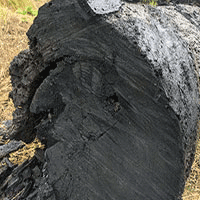
The two bog oak trunks were recovered from two riverbeds (Zero and Piavon) in northern Italy. They were dated to between 245 and 433 AD (Zero log) and around 1200 AD (Piavon log - [6]).
For each log, 5 (P: Piavon) to 6 (Z: Zero) samples were collected, depending on the degradation state. Samples were taken from inner (P01, P02, ZO8), intermediate (PM6, ZM1, ZN4), and outer portions (PG2, PH6, ZH1, ZH4) of a bog oak cross-section to determine elemental composition and physical parameters. In the analyzed logs, it was difficult to reliably identify and separate sapwood and heartwood because degradation and prolonged waterlogging alter the visual features that normally allow this distinction in oak. Therefore, we adopted a sampling strategy based on a radial gradient (from the outermost to the innermost portions) rather than assigning samples to sapwood or heartwood.
We determined the content of 22 elements for each sample. We measured carbon (C) and Nitrogen (N) content using a modified Dumas method performed with an Elementar Vario Macro Cube. The Inductively Coupled Plasma-Optical Emission Spectroscopy (ICP-OES - Arcos EOP, Spectro A.I. GmbH, Kleve, Germany) was used to quantify the following 19 elements: Al, As, B, Ba, Ca, Cr, Cu, Fe, K, Mg, Mn, Na, Ni, P, S, Si, Sr, Ti, Zn.
Basic density (BD), residual basic density (RBd), maximum water content (MWC), longitudinal (βl), tangential (βt), and radial (βr) shrinkages were measured according to Romagnoli et al. ([8]). Ash content (A) was determined according to EN ISO 18122: 2017: “Solid biofuels - Determination of ash content”.
The same characterizations were also performed on control wood (contemporary oak wood, Quercus sp.).
The influence of elemental composition on the physical parameters of the two bog oak samples was investigated using an ordination technique: Canonical Correspondence Analysis (CANOCO - [4], [1]). CANOCO was applied to observe, in the same multidimensional space, the contributions of both the element composition and physical parameters matrices ([10]). The ordination axes are linear combinations of the variables. Both matrices (element composition and physical parameters) were standardized using correlation matrices. CANOCO can perform direct gradient analysis, where the gradient in element composition is known a priori and the physical variables are a response to this gradient. The implementation in the software PAST ver. 2.17c (⇒ http://folk.uio.no/ohammer/past/) follows the eigen analysis algorithm given in Legendre & Legendre ([4]). The ordinations are given as site scores; fitted site scores are currently unavailable. We plot physical parameters as correlations with element composition. We applied Type 1 scaling ([4]). The final CANOCO graphical report is a triplot (displayed in two graphs for clarity), showing samples, element composition, and physical parameters simultaneously. Permutation tests (1000 iterations) were conducted on each dataset to assess the significance of axes in the models.
Results and discussion
Tab. 1 presents the elemental and physical characterization of the Piavon (P) and Zero samples (Z). Compared to control wood (contemporary oak), both bog oaks show higher contents of Ca, Fe, Mg, Na, Si, Sr, and Zn, whereas K and P are depleted. Ghavidel et al. ([3]) also reported decreased K and P, which may be related to long-term leaching during prolonged water and sediment contact. In contrast, Gelbrich et al. ([2]) observed increasing P in bacterial-depredated archaeological wood, suggesting that nutrient dynamics in waterlogged wood may follow different pathways depending on local conditions and degradation mechanisms. Additional differences distinguish the two logs: Arsenic was detected in Zero samples, Sr was present in both Piavon and Zero logs, and Cr was absent in the Zero log. These differences likely reflect interactions between wood and the surrounding environment, which may enable the uptake of elements normally absent or present in small amounts in contemporary wood.
Tab. 1 - Physical and elemental characterizations of 2 bog oak logs and current oak wood (control). (P): Piavon log; (Z): Zero log; (Bd): Basic density; (Rbd): Residual basic density; (MWC): Maximum water content; (βl): longitudinal shrinkage; (βt): tangential shrinkage; (βr): radial shrinkage.
| Type | Parameter | Units | P.O1 | P.O2 | P.M6 | P.G2 | P.H6 | Z.O8 | Z.M1 | Z.N4 | Z.G1 | Z.H1 | Z.H4 | control |
|---|---|---|---|---|---|---|---|---|---|---|---|---|---|---|
| Physical characterization | Bd | g cm-3 | 0.55 | 0.55 | 0.58 | 0.56 | 0.56 | 0.55 | 0.52 | 0.52 | 0.53 | 0.53 | 0.53 | 0.56 |
| RBd | % | 95 | 95 | 100.2 | 95.7 | 95.7 | 96.8 | 92.1 | 92.1 | 93 | 93 | 93 | 100 | |
| MWC | % | 113.2 | 113.2 | 104.2 | 110.6 | 110.6 | 116.1 | 117.9 | 117.9 | 115.4 | 115.4 | 115.4 | 102 | |
| Ash | % | 1.1 | 1.1 | 1.3 | 2.1 | 2.1 | 7.5 | 1.5 | 1.5 | 1.5 | 1.5 | 1.5 | 0.4 | |
| βl | % | 2 | 2 | 0.8 | 0.3 | 0.3 | 0 | 3.3 | 3.3 | 2.4 | 2.4 | 2.4 | 0.8 | |
| βt | % | 15.9 | 15.9 | 16.9 | 17.3 | 17.3 | 23.1 | 27.5 | 27.5 | 24.9 | 24.9 | 24.9 | 8.8 | |
| βr | % | 5.4 | 5.4 | 10.2 | 8.4 | 8.4 | 9.8 | 15.9 | 15.9 | 12.8 | 12.8 | 12.8 | 6.5 | |
| Elemental characterization | C | % | 47.8 | 47.5 | 46.9 | 46.8 | 46.9 | 46.4 | 47.1 | 46.6 | 46.4 | 47.3 | 46.6 | 45.8 |
| N | % | 0.2 | 0.2 | 0.1 | 0.1 | 0.1 | 0.1 | 0.1 | 0.1 | 0.1 | 0.1 | 0.1 | 0.3 | |
| Al | mg kg-1 | 24.6 | 10.6 | 2.5 | 3.6 | 5.3 | 4.7 | 3.7 | 4.7 | 3.6 | 1.5 | 4.9 | 4.3 | |
| As | mg kg-1 | 0 | 0 | 0 | 0 | 0 | 2.2 | 2.2 | 1.9 | 0.9 | 1.7 | 1.2 | 0 | |
| B | mg kg-1 | 4.9 | 5 | 5.2 | 4.5 | 7.1 | 5.6 | 5.1 | 5.7 | 9 | 5 | 9 | 2.8 | |
| Ba | mg kg-1 | 8.1 | 6.9 | 14.3 | 10.8 | 40.9 | 27 | 25.7 | 21.7 | 64.2 | 28.3 | 52.9 | 13.5 | |
| Ca | mg kg-1 | 3643.8 | 3450.3 | 4368.7 | 3962.6 | 5925.4 | 4866.2 | 5869.8 | 5016.1 | 7166.4 | 5780.6 | 7428.4 | 374.3 | |
| Cr | mg kg-1 | 0.2 | 0.3 | 0 | 0.1 | 0 | 0 | 0 | 0 | 0 | 0 | 0 | 0.4 | |
| Cu | mg kg-1 | 2.7 | 3.1 | 2.1 | 1.9 | 1.6 | 2.3 | 2 | 1.8 | 1.9 | 1.8 | 2 | 1.6 | |
| Fe | mg kg-1 | 338.7 | 283.3 | 886.8 | 1034.1 | 3470.4 | 3461.7 | 2877.3 | 3421.9 | 2906.2 | 25.9 | 3915.8 | 2.5 | |
| K | mg kg-1 | 53.7 | 43.8 | 40.4 | 36.7 | 38.4 | 30.4 | 32.1 | 37 | 20.6 | 30.7 | 29.8 | 598.2 | |
| Mg | mg kg-1 | 578.3 | 570.7 | 608.5 | 585.7 | 661.6 | 709.7 | 716 | 681.2 | 806.6 | 672.4 | 822.6 | 38.3 | |
| Mn | mg kg-1 | 17.8 | 16.3 | 17 | 19.4 | 26.8 | 61.5 | 51.9 | 51.3 | 49.2 | 28.5 | 64.8 | 14.7 | |
| Na | mg kg-1 | 140.6 | 147.4 | 140.7 | 136.5 | 136.5 | 118.1 | 127.4 | 123.2 | 128.8 | 135.3 | 124.2 | 19.3 | |
| Ni | mg kg-1 | 0.4 | 0.3 | 0.2 | 0.3 | 0.2 | 0.3 | 0.2 | 0.2 | 0.3 | 0.3 | 0.4 | 0.5 | |
| P | mg kg-1 | 29.3 | 19.5 | 8.9 | 9.6 | 16.9 | 14.9 | 8.5 | 24 | 11.6 | 9.7 | 13.4 | 90 | |
| S | mg kg-1 | 228.3 | 177 | 91.1 | 92.7 | 106.5 | 381.7 | 185.8 | 276.2 | 98.2 | 94.3 | 120.1 | 83.3 | |
| Si | mg kg-1 | 517.1 | 505.6 | 570.3 | 509.6 | 616.7 | 458.5 | 527 | 433.2 | 715.8 | 885.5 | 663.9 | 11.8 | |
| Sr | mg kg-1 | 9.9 | 9.2 | 12.9 | 13.6 | 19.9 | 22.2 | 15.5 | 17 | 10.8 | 8.2 | 11.1 | 0 | |
| Ti | mg kg-1 | 1.1 | 0.7 | 0.2 | 0.6 | 0.3 | 0.14 | 0.08 | 0.11 | 0.09 | 0.14 | 0.06 | 0.5 | |
| Zn | mg kg-1 | 4.1 | 4.7 | 3.8 | 3.9 | 3.7 | 3.9 | 3.9 | 3.8 | 3.8 | 3.6 | 3.9 | 0.8 |
The presence of As in the Zero bog oak may be related to its substantially longer residence time in the depositional environment (245-433 AD vs. 1200 AD for Piavon). A longer burial period may have favored bioaccumulation processes, possibly mediated by environmental bacteria ([9]). In addition, arsenic speciation and mobility are strongly influenced by environmental conditions and sulfate-reducing bacteria ([7]). Although detailed site characterization was not available, the observed elemental differences between the logs are consistent with prolonged exposure to mineral-rich environments.
The differing elemental compositions of the two bog oaks emphasize how chemical, biological, and physical site factors can affect the mineral profiles of waterlogged archaeological wood. This variability makes it challenging to directly compare the two historical wood samples, even though they were collected in the same geographical region.
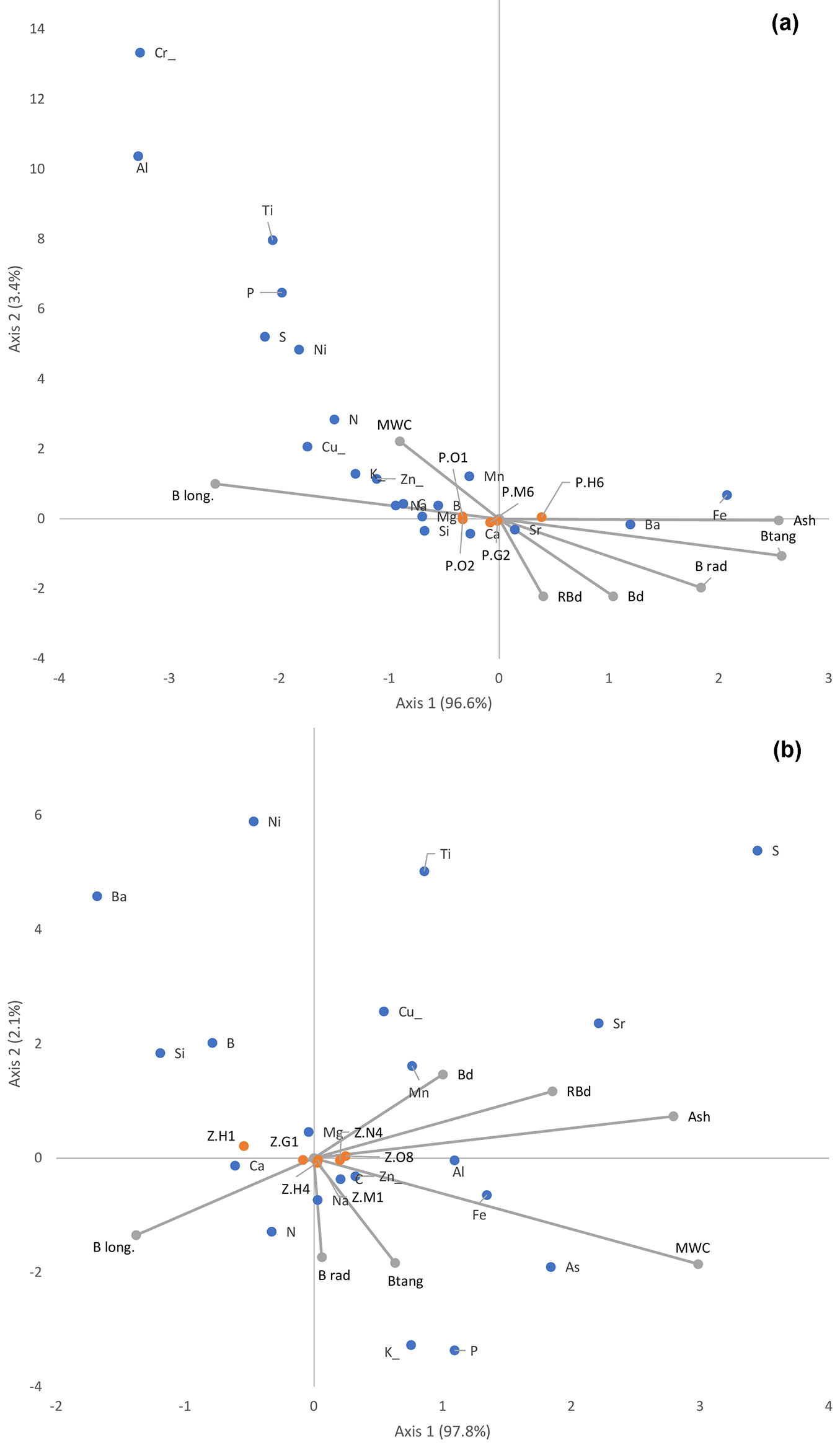
The relationship between elemental composition and physical parameters was explored through CANOCO analysis (Fig. 1). In both models, the first two axes explain nearly all model variance, with Axis 1 accounting for more than 96% in both cases.
Fig. 1 - Canonical Correspondence Analysis (CANOCO) representation of the first two axes. (a) Results for Site 1 (Piavon) samples; (b) Results for Site 2 (Zero) samples. Each graph reports observations (orange dots), element composition (blue dots), and physical parameters (gray vectors).
Piavon log
In the Piavon log (Fig. 1a), samples are distributed along Axis 1 according to a radial gradient from the inner to the outer portion. Inner samples (PO1, PO2) are associated with higher shrinkage (βl: 2%; βt: 15.9%) and MWC values (113.2%) and lower ash content (1.1%), whereas the outer sample (PH6) shows higher ash (2.1%) and tangential shrinkage (βt: 17.3%) but lower longitudinal shrinkage (0.3%) and MWC (110.3%).
The higher ash content in the outer portion is consistent with mineral ingress from surrounding sediments. MWC, commonly associated with degradation, shows positive relationships with several mineral elements (Fig. 1a). Ash-forming elements such as Fe, Ca, and S are more abundant in the outer portion (PH6 sample). The most influential elements in the Piavon model are Al, Cr, and Fe. Inner samples are characterized by higher Al and Cr but lower Fe, whereas the outer sample shows the opposite trend. A permutation test (1000 iterations), conducted to assess the significance of axes, showed significance only for the first axis (p = 0.016), likely due to the limited sample size.
This pattern suggests a relatively typical radial gradient in which mineral enrichment and degradation indicators increase toward the wood-sediment interface.
Zero log
In the Zero log (Fig. 1b), the radial trend is reversed: samples are arranged from the outer portion (ZH1) to the inner portion (ZO8), but the inner portion shows higher ash content and MWC. Since ash and MWC can be considered degradation indicators, this suggests more advanced degradation in the inner zone.
The radial crack in the Zero trunk likely facilitated sediment penetration and deterioration processes that propagated toward the center. ZH1 shows higher Ba and Si and lower S, whereas ZO8 displays the opposite pattern. Sidoti et al. ([9]) also reported sulfur enrichment in more degraded wood. A permutation test (1000 iterations), conducted to assess the significance of the axes, showed no significance (p < 0.05), likely reflecting the limited sample size.
Some elements with known wood-preserving properties, such as Cu and B, show negative correlations with degradation parameters, which may suggest a potential moderating effect on degradation. However, this relationship should be interpreted cautiously. One possible explanation is that degradation under waterlogged conditions may not follow a strictly linear pattern. As proposed by Sidoti et al. ([9]) and Moscatelli et al. ([7]), Cu and B may gradually accumulate in the wood during prolonged burial, and their biocidal properties could then reduce the activity of wood-degrading organisms, thereby slowing further degradation. Although this mechanism is plausible, it remains hypothetical and cannot be confirmed by the present study.
The most influential elements in the Zero model are Ba, Ni, Ti, and S. Ti and S correlate positively with BD, RBd, and ash content, whereas Ba and Ni correlate negatively with longitudinal shrinkage.
A key difference between the two logs is the inversion of radial degradation patterns. In Piavon, degradation indicators increase toward the outer wood, which is commonly observed in waterlogged wood. In Zero, higher degradation indicators occur toward the center. This inversion may be explained by the older age of the Zero log and its longer exposure to degradation agents (approximately 800-1000 years longer than Piavon), combined with structural pathways such as cracks that allowed deep sediment infiltration.
Taken together, the results indicate that both residence time and structural integrity may play major roles in shaping degradation pathways and mineral uptake in bog oak.
Conclusions
This study aimed to evaluate the influence of inorganic elemental composition on the physical properties of two bog oak logs from northern Italy using CANOCO analysis. The ordination approach proved useful for visualizing the multivariate relationships between elemental content and wood physical properties. In the Piavon log, several ash-forming elements were more abundant in the outermost portion of the sample, in contact with sediments, where higher ash content and degradation indicators were observed. Elements such as Fe, Ca, and S were positively associated with tangential shrinkage (βt). In contrast, the older Zero log (approximately 800-1000 years older than the Piavon) exhibited a different pattern, with strong degradation also affecting the inner portion of the trunk. This was likely facilitated by a radial crack that enabled sediment ingress and internal deterioration. In this sample, Ba, Ni, Ti, and S emerged as the most influential elements, with Ti and S positively correlated with basic density, residual basic density, and ash content.
Overall, the results highlight that mineral uptake and degradation patterns in bog oak are shaped by a combination of residence time and wood structural conditions. CANOCO analysis proved to be a valuable tool for interpreting the complex variability typical of waterlogged archaeological wood.
Acknowledgments
This research was funded by the University of Padova, grant no. DOR2122994/21 “Investigations on woods of historical, archaeological and archaeobotanical interest” (Project manager: Tiziana Urso).
The authors kindly thank Matteo Marton for providing the Zero log, and Rosalinda and Ruggero Zamuner for providing the Piavon log.
Author contributions
Conceptualization, T.U., M.Z.; methodology, T.U., M.Z.; validation, T.U., M.Z., C.C.; formal analysis, C.C., T.U., M.Z.; investigation, C.C., T.U. C.M.; resources, T.U., M.Z.; data curation, C.C., M.Z.; writing-original draft preparation, M.Z., T.U.; writing-review and editing, M.Z., T.U., C.C.; visualization, T.U., M.Z.; supervision, T.U. M.Z.; project administration, T.U.; funding acquisition, T.U.
References
Gscholar
CrossRef | Gscholar
CrossRef | Gscholar
Authors’ Info
Authors’ Affiliation
Chiara Meneghello
Michela Zanetti 0000-0002-9739-5330
Università degli Studi di Padova, Department of Land, Environment, Agriculture, and Forestry - TESAF, v.le dell’Università 16, IT-35020 Legnaro, PD (Italy)
Consiglio per la ricerca in agricoltura e l’analisi dell’economia agraria - CREA, Centro di ricerca Ingegneria e Trasformazioni agroalimentari, v. della Pascolare 16, IT-00015 Monterotondo, RM (Italy)
Corresponding author
Paper Info
Citation
Urso T, Costa C, Meneghello C, Zanetti M (2026). Influence of inorganic elements on the physical properties of bog oak: a CANOCO analysis. iForest 19: 348-351. - doi: 10.3832/ifor4766-019
Academic Editor
Manuela Romagnoli
Paper history
Received: Nov 25, 2024
Accepted: Aug 24, 2026
First online: Sep 02, 2026
Publication Date: Oct 31, 2026
Publication Time: 0.30 months
Copyright Information
© SISEF - The Italian Society of Silviculture and Forest Ecology 2026
Open Access
This article is distributed under the terms of the Creative Commons Attribution-Non Commercial 4.0 International (https://creativecommons.org/licenses/by-nc/4.0/), which permits unrestricted use, distribution, and reproduction in any medium, provided you give appropriate credit to the original author(s) and the source, provide a link to the Creative Commons license, and indicate if changes were made.

Web Metrics
Breakdown by View Type
Article Usage
Total Article Views: 1220
(from publication date up to now)
Breakdown by View Type
HTML Page Views: 462
Abstract Page Views: 393
PDF Downloads: 302
Citation/Reference Downloads: 0
XML Downloads: 63
Web Metrics
Days since publication: 50
Overall contacts: 1220
Avg. contacts per week: 170.80
Article Citations
Article citations are based on data periodically collected from the Clarivate Web of Science web site
(last update: Jul 2026)
(No citations were found up to date. Please come back later)
Publication Metrics
by Dimensions ©
Articles citing this article
List of the papers citing this article based on CrossRef Cited-by.
Related Contents
iForest Similar Articles
Research Articles
Deploying an early-stage Cyber-Physical System for the implementation of Forestry 4.0 in a New Zealand timber harvesting context
vol. 17, pp. 353-359 (online: 13 November 2024)
Research Articles
NIR-based models for estimating selected physical and chemical wood properties from fast-growing plantations
vol. 15, pp. 372-380 (online: 05 October 2022)
Research Articles
Characterization of VOC emission profile of different wood species during moisture cycles
vol. 10, pp. 576-584 (online: 08 May 2017)
Research Articles
Mechanical and physical properties of Cunninghamia lanceolata wood decayed by brown rot
vol. 12, pp. 317-322 (online: 06 June 2019)
Research Articles
Characterization of technological properties of matá-matá wood (Eschweilera coriacea [DC.] S.A. Mori, E. odora Poepp. [Miers] and E. truncata A.C. Sm.) by Near Infrared Spectroscopy
vol. 14, pp. 400-407 (online: 01 September 2021)
Research Articles
Physical, chemical and mechanical properties of Pinus sylvestris wood at five sites in Portugal
vol. 10, pp. 669-679 (online: 11 July 2017)
Research Articles
Examining the evolution and convergence of wood modification and environmental impact assessment in research
vol. 10, pp. 879-885 (online: 06 November 2017)
Research Articles
Identification of wood from the Amazon by characteristics of Haralick and Neural Network: image segmentation and polishing of the surface
vol. 15, pp. 234-239 (online: 14 July 2022)
Research Articles
Wood defects in Silver fir (Abies alba Mill.) from mixed uneven-aged forest stands
vol. 19, pp. 321-328 (online: 24 August 2026)
Research Articles
Estimation of total extractive content of wood from planted and native forests by near infrared spectroscopy
vol. 14, pp. 18-25 (online: 09 January 2021)
iForest Database Search
Search By Author
Search By Keyword
Google Scholar Search
Citing Articles
Search By Author
Search By Keywords
PubMed Search
Search By Author
Search By Keyword