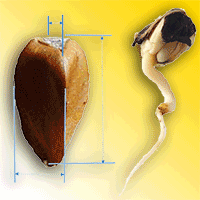
The maternal environment of European beech (Fagus sylvatica L.) affects intrapopulation variability in seed traits and germination
Vladan Popović (1) , Aleksandar Lučić (1), Mladen Ivanković (2), Branislav Cvjetković (3), Gregor Božič (4), Vlatko Andonovski (5), Danijela Miljković (6)
iForest - Biogeosciences and Forestry, Volume 19, Issue 2, Pages 114-121 (2026)
doi: https://doi.org/10.3832/ifor4806-018
Published: Apr 10, 2026 - Copyright © 2026 SISEF
Research Articles
Abstract
Interpopulation variation was investigated using seed samples originating from twenty-six European beech (Fagus sylvatica L.) populations across the Balkan Peninsula, a part of the species’ distribution range characterized by high ecological heterogeneity in key climatic factors, such as temperature (5.8-10.6 °C), precipitation (648-1632 mm), and elevation (185-1410 m a.s.l.). The statistical significance of intrapopulation differences was confirmed by analysis of variance (ANOVA) for all seed traits analyzed: seed weight (g), length (mm), width (mm), thickness (mm), eccentricity and flatness indices, and germination capacity (%). Multivariate principal component analysis (PCA) was applied to examine seed traits in relation to environmental variables of the maternal site, such as mean temperature and precipitation in September and October (the seed maturation period), revealing distinct patterns of relationships among the variables studied. Seed traits were significantly positively correlated with mean temperatures of the maternal site in September and October, indicating that temperature during the seed-filling period affects seed mass. Germination capacity was associated with precipitation during the same period, though the correlation coefficient was not statistically significant; a shorter vector length in the PC biplot suggests a weaker contribution to population separation. Elevation of the site of origin showed a significant negative correlation with temperature, precipitation, and seed traits. Agglomerative hierarchical clustering analysis identified three distinct population clusters. Higher temperature and precipitation values did not necessarily result in higher seed trait values or higher germination percentages. The population with the highest seed mass exhibited the lowest germination capacity (32%) during seed maturation under the lowest precipitation. Conversely, the population characterized by the lowest seed mass showed a higher germination rate of 68% in environments with high precipitation. These results provide valuable insights into the reproductive ecology of European beech, suggesting that other factors beyond those analyzed here may have a more substantial influence on seed germination. The variation in seed traits across habitats that are either drier and hotter or colder and wetter, along the elevation gradient of the studied populations, paves the way for future research and breeding efforts to enhance the species’ survival and reproductive success amid anticipated climate change scenarios.
Keywords
Seed Traits, Seed Germination, European Beech, Fagus sylvatica L., Environmental and Genetic Variation, Southeast Europe
Authors’ Info
Authors’ address
Aleksandar Lučić 0000-0002-4473-1791
Department of Genetics, Plant Breeding, Seed and Nursery Production; Institute of Forestry, Kneza Višeslava 3, 11030 Belgrade (Serbia)
Department for Genetics, Forest Tree Breeding and Seed Science, Croatian Forest Research Institute, Cvjetno naselje 41, 10450 Jastrebarsko (Croatia)
Faculty of Forestry, University of Banja Luka, Bulevar vojvode Petra Bojovića 1A, 78000 Banja Luka, Republic of Srpska (Bosnia and Herzegovina)
Department of Forest Physiology and Genetics, Slovenian Forestry Institute, Večna pot 2, 1000 Ljubljana (Slovenia)
University Ss. Cyril and Methodius, Hans Em Faculty of Forest Sciences, Landscape Architecture and Environmental Engineering, 16 Makedonska brigada 1, 1000 Skopje (North Macedonia)
Department of Evolutionary Biology, University of Belgrade, Institute for Biological Research “Siniša Stanković”, National Institute of the Republic of Serbia, Bulevar despota Stefana 142, 11060 Belgrade (Serbia)
Corresponding author
Paper Info
Citation
Popović V, Lučić A, Ivanković M, Cvjetković B, Božič G, Andonovski V, Miljković D (2026). The maternal environment of European beech (Fagus sylvatica L.) affects intrapopulation variability in seed traits and germination. iForest 19: 114-121. - doi: 10.3832/ifor4806-018
Academic Editor
Rafael Da Silveira Bueno
Paper history
Received: Jan 26, 2025
Accepted: Apr 09, 2026
First online: Apr 10, 2026
Publication Date: Apr 30, 2026
Publication Time: 0.03 months
Copyright Information
© SISEF - The Italian Society of Silviculture and Forest Ecology 2026
Open Access
This article is distributed under the terms of the Creative Commons Attribution-Non Commercial 4.0 International (https://creativecommons.org/licenses/by-nc/4.0/), which permits unrestricted use, distribution, and reproduction in any medium, provided you give appropriate credit to the original author(s) and the source, provide a link to the Creative Commons license, and indicate if changes were made.

Web Metrics
Breakdown by View Type
Article Usage
Total Article Views: 2952
(from publication date up to now)
Breakdown by View Type
HTML Page Views: 787
Abstract Page Views: 1269
PDF Downloads: 773
Citation/Reference Downloads: 0
XML Downloads: 123
Web Metrics
Days since publication: 195
Overall contacts: 2952
Avg. contacts per week: 105.97
Citation Metrics
Article Citations
Article citations are based on data periodically collected from the Clarivate Web of Science web site
(last update: Jul 2026)
(No citations were found up to date. Please come back later)
Publication Metrics
by Dimensions ©
Articles citing this article
List of the papers citing this article based on CrossRef Cited-by.
References
Seeds: Ecology, biogeography, and evolution of dormancy and germination (2nd edn). Academic Press/Elsevier, San Diego, CA, USA. pp. 277-373.
Gscholar
Morphological-biological properties of fruit and seed of beech (Fagus sylvatica L.) growing at different altitudes. Glas Šum Pokuse 44: 1-19.
Gscholar
Neke morfološke i fiziološke značajke sjemena bukve [Some morphological and physiological characteristics of beech seed]. In: Proceedings of “8 Hrvatski Biološki Kongres” (Besendorfer V, Kopjar N eds). Hrvatsko Biološko Društvo 1885, Zagreb, Hrvatska, pp. 196-197. [in Croatian]
Gscholar
Potential distribution of Abies, Picea, and Juniperus species in the sub-alpine forest of Minjiang headwater region under current and future climate scenarios and its implications on ecosystem services supply. Ecological Indicators 121 (1): 107131.
CrossRef | Gscholar
Analiza kvaliteta i morfometrijskuh karakteristika semena bukve (Fagus moesiaca/Domin, Maly/Czeczott) u Srbiji [Variability of morphometric characteristics of seed and height of one-year-old seedlings of different populations of beech (Fagus moesiaca/Domin, Maly/Czeczott) in Serbia]. Šumarstvo 1-2: 109-120. [in Bosnian]
Gscholar
The SAS System for Windows, release 9. 3. SAS Institute, Cary, NC, USA.
Gscholar
Salt stress represses soybean seed germination by negatively regulating GA biosynthesis while positively mediating ABA biosynthesis. Frontiers in Plant Science 8: 938.
CrossRef | Gscholar
Variation in xylem vulnerability to embolism in European beech from geographically marginal populations. Tree Physiology 38 (2): 173-185.
CrossRef | Gscholar
Forestry economics: a managerial approach (Vol. 3). Routledge, Abingdon, Oxon, UK and New York, NY, USA, pp. 382.
Gscholar
Is there a future for the isolated oriental beech (Fagus orientalis Lipsky) forests in southern Turkey? Acta Silvatica et Lignaria Hungarica 6: 111-114.
Gscholar
Related Content
Daskalakou EN, Koutsovoulou K, Oikonomidis S, Thanos CA
Vol. 15, pp. 331-338 (online: Aug 2022)
Ciocîrlan E, Sofletea N, Ducci F, Curtu AL
Vol. 10, pp. 916-922 (online: Dec 2017)
De Dato G, Teani A, Mattioni C, Marchi M, Monteverdi MC, Ducci F
Vol. 11, pp. 651-659 (online: Oct 2018)
Giannini R, von Wühlisch G
Vol. 2, pp. 104 (online: Jun 2009)
Collin E, Rondouin M, Joyeau C, Matz S, Raimbault P, Harvengt L, Bilger I, Guibert M
Vol. 13, pp. 41-47 (online: Feb 2020)
Ivetić V, Devetaković J, Nonić M, Stanković D, Šijačić-Nikolić M
Vol. 9, pp. 801-812 (online: Oct 2016)

Velasco-García Mario V, Muñoz-Gutiérrez L, Martínez-Cantera G
Vol. 17, pp. 245-251 (online: Aug 2024)
Mihai G, Mirancea I, Birsan MV, Dumitrescu A
Vol. 11, pp. 284-290 (online: Apr 2018)
Alan M
Vol. 11, pp. 510-516 (online: Aug 2018)
Yi X, Wang Z, Liu C, Liu G
Vol. 8, pp. 207-213 (online: Apr 2015)