
Morphological and physiological responses to water stress and potassium nutrition in Eucalyptus grandis Hill Ex Maiden seedlings
iForest - Biogeosciences and Forestry, Volume 19, Issue 6, Pages 396-402 (2026)
doi: https://doi.org/10.3832/ifor4968-019
Published: Nov 08, 2026 - Copyright © 2026 SISEF
Research Articles
Abstract
In this study, the response of Eucalyptus grandis seedlings to varied water availability and potassium fertilization in coarse-textured soil was investigated. The experiment took place in a greenhouse in Buenos Aires, Argentina, over 56 days, with 15 replicates for each treatment. We maintained pots in the non-water-limited group at field capacity (FC), while those in the water-restricted group were maintained at 40% FC. Each water regime received one of three potassium levels (K1, K2, and K3). We measured plant height and root-collar diameter periodically. At the end of the experiment, biomass allocation among plant parts was quantified. We also evaluated physiological traits by measuring stomatal conductance and relative water content (RWC). The results show that potassium fertilization did not improve seedling performance under water stress or enhance growth in well-watered seedlings. Water restriction was the main limiting factor. Keeping soil moisture at 40% of FC reduced height growth, root-collar diameter, biomass, and leaf area. It also negatively affected physiological traits such as stomatal conductance and RWC, but did not cause seedling mortality.
Keywords
Introduction
The establishment phase of forest plantations is critical for trees, as newly transplanted trees are very vulnerable to environmental stressors. These stress conditions are worse on coarse-textured soils, which are now a target for forest production ([34]). Such soils have low water retention, little organic matter, and fewer nutrients ([34]). In these conditions, effective nursery hardening and good soil management are essential for successful plantation establishment and productivity. Traditional hardening techniques usually involve regulating irrigation and adjusting nutrient supply.
Eucalyptus species require a substantial amount of water, which can lead to water shortages, particularly in areas with irregular rainfall ([6]). Water is the main factor limiting plant growth and development ([9]). Under water stress, plants may change structurally and functionally. In severe cases, these changes can lead to death ([2]). To cope with water stress, plants develop deeper roots, regulate stomatal conductance, adjust osmotic levels, and modify leaf size or shed leaves ([48], [46]). Severe water deficits reduce total biomass and leaf area ([28], [19]), directly affecting photosynthesis. Studies on Eucalyptus grandis show that limited water causes loss of turgor, reduced cell expansion, stomatal closure, and lower internal CO2 concentration, thereby reducing growth and productivity ([18], [47]).
In sandy-textured soils, low cation exchange capacity leads to poor nutrient retention and frequent deficiencies in essential macronutrients such as potassium. Fertilization efficiency depends on plant water status ([18], [11]). Adequate nutrient supply can improve plant tolerance to water stress ([3]). However, more nutrients can increase water uptake and transpiration, raising questions about whether potassium fertilization can help with stress hardening during drought.
Several studies on Eucalyptus microtheca, E. occidentalis, E. torquata, and E. camaldulensis show these species have many adaptive strategies for drought and water scarcity ([8]). Plants with sufficient potassium levels are more resistant to drought and low temperatures. Potassium is crucial for osmotic regulation and maintaining cellular water balance ([24]).
Climate change leads to prolonged droughts, wildfires, and more pest outbreaks, which increase forest mortality risk. These factors significantly impact forest structure, productivity, and biodiversity ([26], [50]). These effects have become more obvious in recent years. Fernandez et al. ([16]) documented severe drought impacts on forest plantations in Argentine Mesopotamia, where widespread tree mortality occurred. These findings highlight the long-term consequences of increased drought on plantations ([3]), especially since forest expansion often occurs on limited soils.
Globally, Eucalyptus plantations are a major source of raw materials for timber and non-timber products. This has led to a significant increase in planted areas over recent decades ([24]). In Argentina, Eucalyptus grandis has the highest commercial value and occupies the largest planted area ([14]). It adapts well to the environmental conditions of the Mesopotamian region. This species grows on various soil types, including sandy (Entisols), mixed (Mollisols), and clayey (Ultisols). Sandy soils, mainly along the Uruguay River basin, support forestry, agriculture, and mixed crop-livestock systems ([39]). These soils have very sandy surface horizons (1-2% organic matter), with denser layers of loam-sandy clay at about 60 cm depth ([39]). Given these soil conditions, any factor that improves plant water status during establishment is crucial for survival and early growth.
Considering the plasticity of Eucalyptus species under stress, this study aimed to evaluate the responses of Eucalyptus grandis seedlings to water restriction and varying potassium levels under controlled conditions. We hypothesized that potassium fertilization in sandy soils could reduce the effects of drought stress, making water-restricted and non-restricted treatments more similar.
Materials and methods
We conducted a controlled experiment in a greenhouse at the Faculty of Agronomy, University of Buenos Aires, over 56 days. The study used three-month-old Eucalyptus grandis seedlings from the Concordia Experimental Agricultural Station (INTA, Argentina), sourced from a clonal seed orchard (Basic Material No. 41E3066JE). Initially, seedlings were grown in 98 cm3 containers, then transplanted into 4-L pots for the experiment.
The pots contained soil classified as Udifluvents ([39]), collected from the top 20 cm of an E. grandis plantation in Gualeguaychú Department, Entre Ríos Province, Argentina. Laboratory tests showed the soil was sandy: 88.72% sand, 3.28% silt, and 8.00% clay ([5]). Soil pH (1: 2.5 soil: water ratio) was 4.6, indicating strongly acidic conditions. Organic carbon content was 0.96% ([42]). Exchangeable base-cation concentrations were 4.24, 0.35, and 0.13 cmol(c) kg-1 for Ca, Mg, and Na, respectively.
Treatments
The experiment tested two factors: (i) potassium (K) fertilization and (ii) soil water content. We used three potassium doses, namely 0 (zero) g (K1), 0.5 g (K2), and 1.0 g (K3) of K, applied as potassium nitrate (KNO3). All pots also received nitrogen (N) and phosphorus (P) fertilization. We applied phosphorus as triple superphosphate (0-20-0) at 2.4 g per pot ([18]). Nitrogen was supplied as urea (46-0-0), with rates based on the potassium treatment: 1.0 g urea (0.46 g N) for K1, 0.63 g urea (0.29 g N) for K2, and 0.22 g urea (0.10 g N) for K3, accounting for nitrogen from potassium nitrate.
Two soil water content levels were set: (i) field capacity (FC) for non-stress conditions and (ii) 40% of field capacity (FC40) for water-restricted conditions. We weighed pots every two days to maintain moisture levels. Non-stressed plants (FC) were watered every other day, while water-restricted plants were kept at a reduced weight to maintain a consistent soil moisture deficit. The design included 15 replicates per treatment, for a total of 90 plants.
We measured plant height with a tape measure from the stem base to the uppermost fully expanded leaf. Root collar diameter was measured with a digital caliper. We took measurements on days 7, 14, 21, 28, 35, 42, 48, and 56 of the experiment.
At the start of the experiment, 15 seedlings were randomly selected and harvested for initial biomass. We divided the plants into leaves, branches, stems, and roots. We repeated this process at the end of the experiment for the remaining seedlings. Samples were oven-dried at 70 °C until constant weight. Aboveground biomass (AGB) was estimated as the total dry mass of leaves, branches, and stems, and root biomass (RB) was assessed from dried root material. We then calculated the AGB: RB ratio.
We measured leaf area (LA) at the end of the experiment on seven randomly chosen plants per treatment. We measured all leaves from each selected plant with a LI-COR LI-3100 leaf area meter. Total leaf area per plant was the sum of all individual leaf areas.
Relative water content was assessed at the end (day 56) using seven randomly chosen plants per treatment. Fully expanded leaves were collected, and leaf discs were excised and weighed for fresh mass (FM). The discs were then saturated in deionized water, blotted dry, and reweighed for turgid mass (TM). Finally, samples were oven-dried at 70 °C for 72 hours to find dry mass (DM).
Relative water content was calculated using the following equation (eqn. 1):
where CRA is the relative water content, Pf is the fresh weight, Ps is the dry weight, and Psat is the saturated weight.
Stomatal conductance (gs) was measured in the greenhouse with a steady-state porometer (LI-1600, LI-COR Inc., Lincoln, NB, USA). We selected seven plants from each treatment for these readings. We took measurements around midday on a clear, sunny day. We used the uppermost fully expanded leaf of each plant, 56 days after the experiment began.
Statistical analysis
We performed an analysis of variance (ANOVA) to study how potassium (K) fertilization levels and soil water content affect the measured variables. Before the analysis, we checked the assumptions of normality and homogeneity of variance. When significant differences were found, the least significant difference (LSD) test at a set significance level was used to compare treatment means. We also conducted Pearson’s correlation analyses to explore relationships among morphological and physiological parameters. All statistical analyses were performed in Infostat/P ver. 1.1 ([13]).
Results
Tab. 1 shows the significance levels for each variable analyzed. We found no interaction effects between potassium fertilization and soil water content for any growth variables. However, each factor showed significant differences. Potassium fertilization significantly influenced the aboveground biomass-to-root biomass ratio (AGB: RB) and leaf area. In contrast, soil water content affected all measured variables.
Tab. 1 - Significance values for growth variables, aboveground biomass (AGB), root biomass (RB), AGB/RB ratio, leaf area, relative water content, and stomatal conductance for potassium fertilization and soil water content. (ns): not significant (p>0.05).
| Characteristics | Potassium Fertilization |
Soil water content |
|---|---|---|
| Height at the end of the experiment | ns | <0.001 |
| Collar diameter at the end of the experiment | ns | <0.001 |
| Aboveground Biomass (AGB) | ns | <0.001 |
| Root biomass (RB) | ns | <0.001 |
| AGB/RB ratio | 0.0182 | <0.001 |
| Leaf área | 0.0013 | <0.001 |
| Relative water content | ns | <0.001 |
| Stomatal conductance | ns | <0.001 |
Neither water restriction during the experiment nor potassium levels significantly impacted seedling mortality. By the end of the experiment, only one seedling died, and it was subjected to the K2 treatment at field capacity (K2FC).
At the start of the experiment, seedlings averaged 20.21 ± 1.88 cm in height and 0.26 ± 0.02 cm in root-collar diameter. Fig. 1 illustrates the changes in plant height and root-collar diameter over time. We detected no significant interaction between potassium dose and soil water content, nor differences among potassium treatments for these variables.
Fig. 1 - Plant height (a) and collar diameter (b) of E. grandis under different levels of potassium fertilization: K1: 0 g K, K2: 0.5 g K, K3: 1 g K; and soil water content levels: FC: maintenance at field capacity; FC40: maintenance at 40% of field capacity. Asterisks indicate differences between treatments with different water contents within each date after Fisher’s LSD test (p < 0.01).
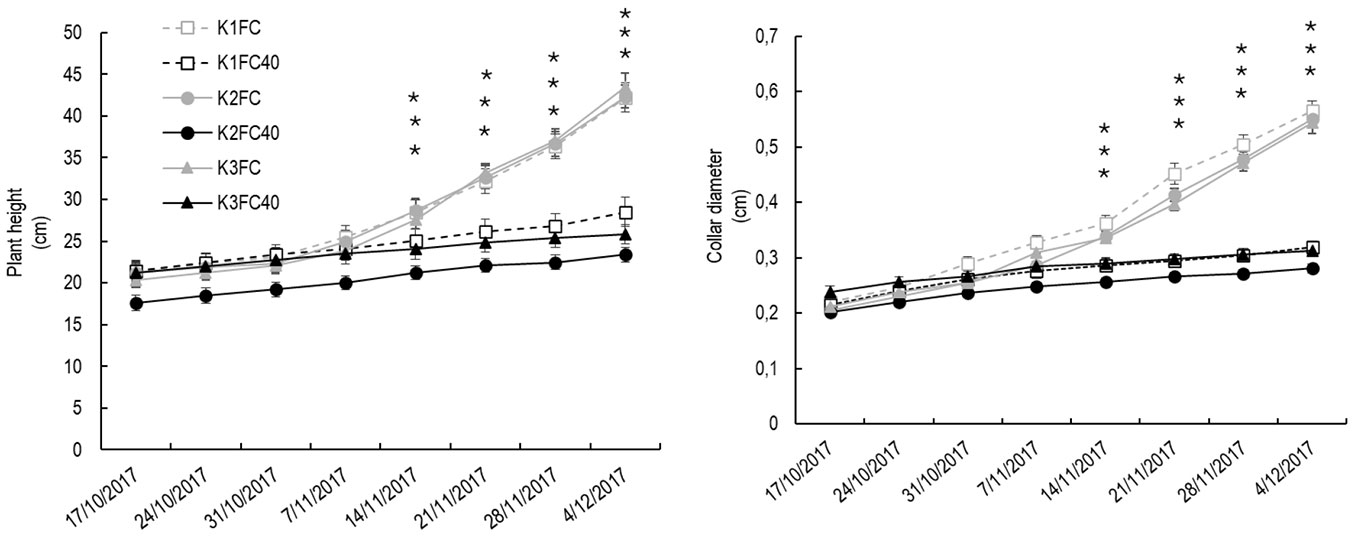
A clear separation between water regimes appeared from day 28 (14 November 2017). Seedlings at field capacity (FC) showed greater height and root-collar diameter than those at 40% of field capacity (FC40). Treatments without water limitation (K1FC: 0.57 cm, K2FC: 0.56 cm, and K3FC: 0.54 cm) had larger final root-collar diameters compared to the water-restricted treatments (K1FC40: 0.32 cm, K2FC40: 0.28 cm, and K3FC40: 0.31 cm).
These findings suggest that soil water availability, not potassium levels, was the main factor affecting early growth in Eucalyptus grandis seedlings.
Water restriction significantly reduced both aboveground biomass (AGB) and root biomass (RB). As shown in Fig. 2, seedlings under non-limiting water conditions (FC) had the highest biomass values, with AGB averaging 7.57 ± 0.32 g, compared to 1.66 ± 0.04 g under water-restricted conditions (FC40). Similarly, RB averaged 2.71 ± 0.13 g versus 0.93 ± 0.11 g under FC40.
Fig. 2 - Aboveground biomass (g) and root biomass (g) at the end of the experiment in E. grandis seedlings under different soil water contents: FC (maintenance at field capacity) and FC40 (maintenance at 40% of field capacity). Different letters indicate significant differences among treatments after Fisher’s LSD test (p < 0.05)
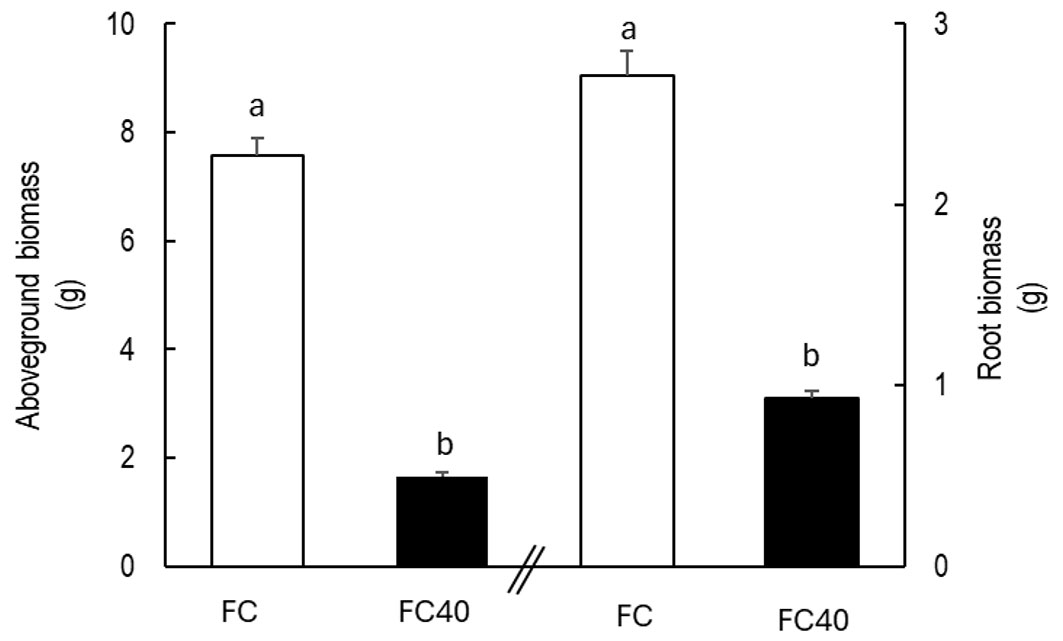
Water-limited treatments (40% of field capacity) showed a clear reduction in biomass accumulation. This highlights soil water availability as the key factor controlling biomass production in Eucalyptus grandis seedlings during the study.
The AGB: RB ratio differed significantly across potassium levels. The highest ratio occurred in the K3 treatment (2.59), while the lowest was in the intermediate level, K2 (2.14). The unfertilized treatment (K1) had an intermediate ratio (2.41), not significantly different from K3 or K2 (Fig. 3).
Fig. 3 - Aboveground biomass (AGB) to root biomass (RB) ratio in E. grandis seedlings under different levels of potassium fertilization: K1: 0 g K, K2: 0.5 g K, K3: 1 g K; and soil water content levels: FC: maintenance at field capacity; FC40: maintenance at 40% of field capacity. Different letters indicate significant differences among treatments after Fisher’s LSD test (p < 0.05).
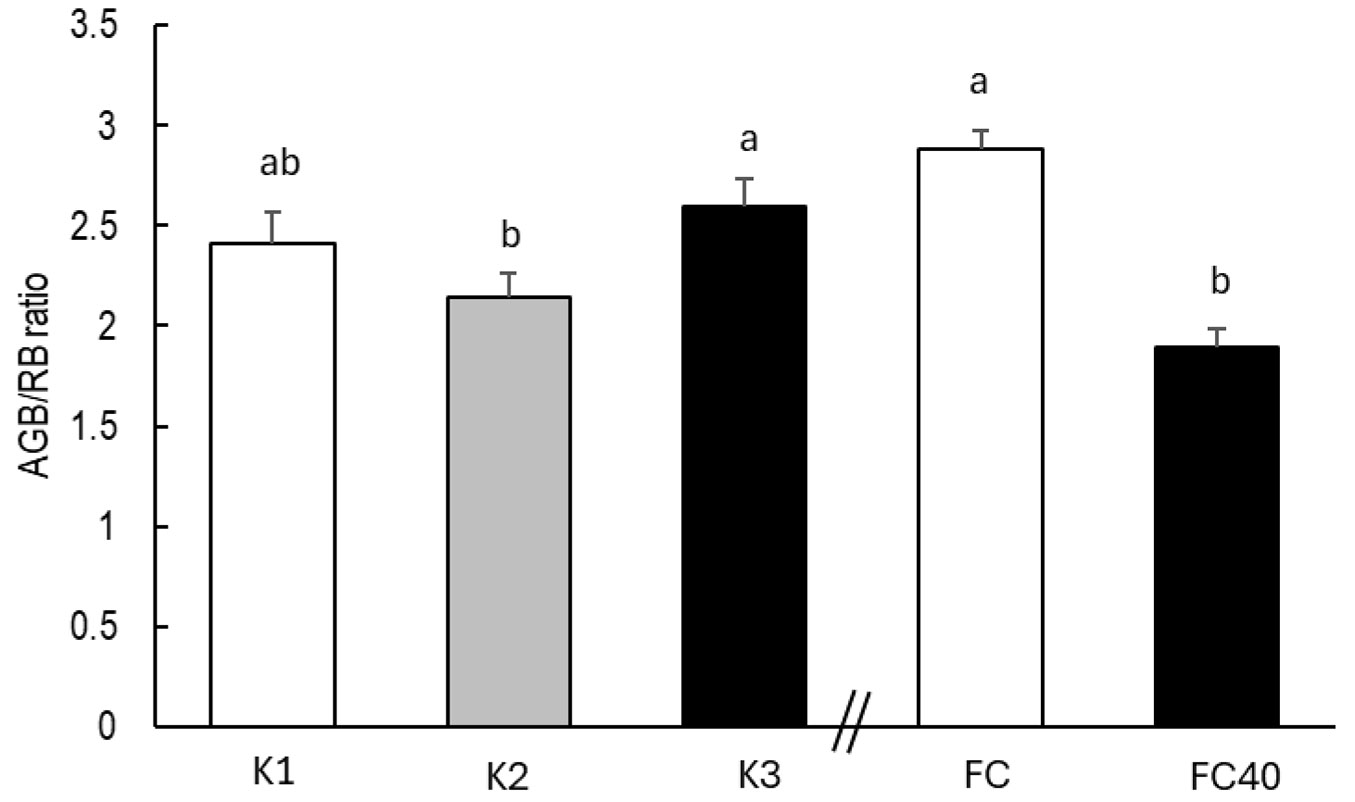
Soil water availability also influenced the AGB: RB ratio. Seedlings at non-limiting water conditions (FC) had the highest values (2.88), while those under water restriction (FC40) had a lower ratio (1.90), indicating increased root allocation under drought conditions.
Potassium levels significantly affected leaf area (LA). The unfertilized treatment (K1) had a higher mean leaf area (602.53 cm2) than the intermediate potassium level (K2: 410.54 cm2). The highest level (K3: 523.46 cm2) did not differ significantly from either K1 or K2 (Fig. 4).
Fig. 4 - Average leaf area (cm2) of E. grandis seedlings under different levels of potassium fertilization: K1: 0 g K, K2: 0.5 g K, K3: 1 g K; and soil water content levels: FC: maintenance at field capacity; FC40: maintenance at 40% of field capacity. Different letters indicate significant differences for each treatment after Fisher’s LSD test (p < 0.05).
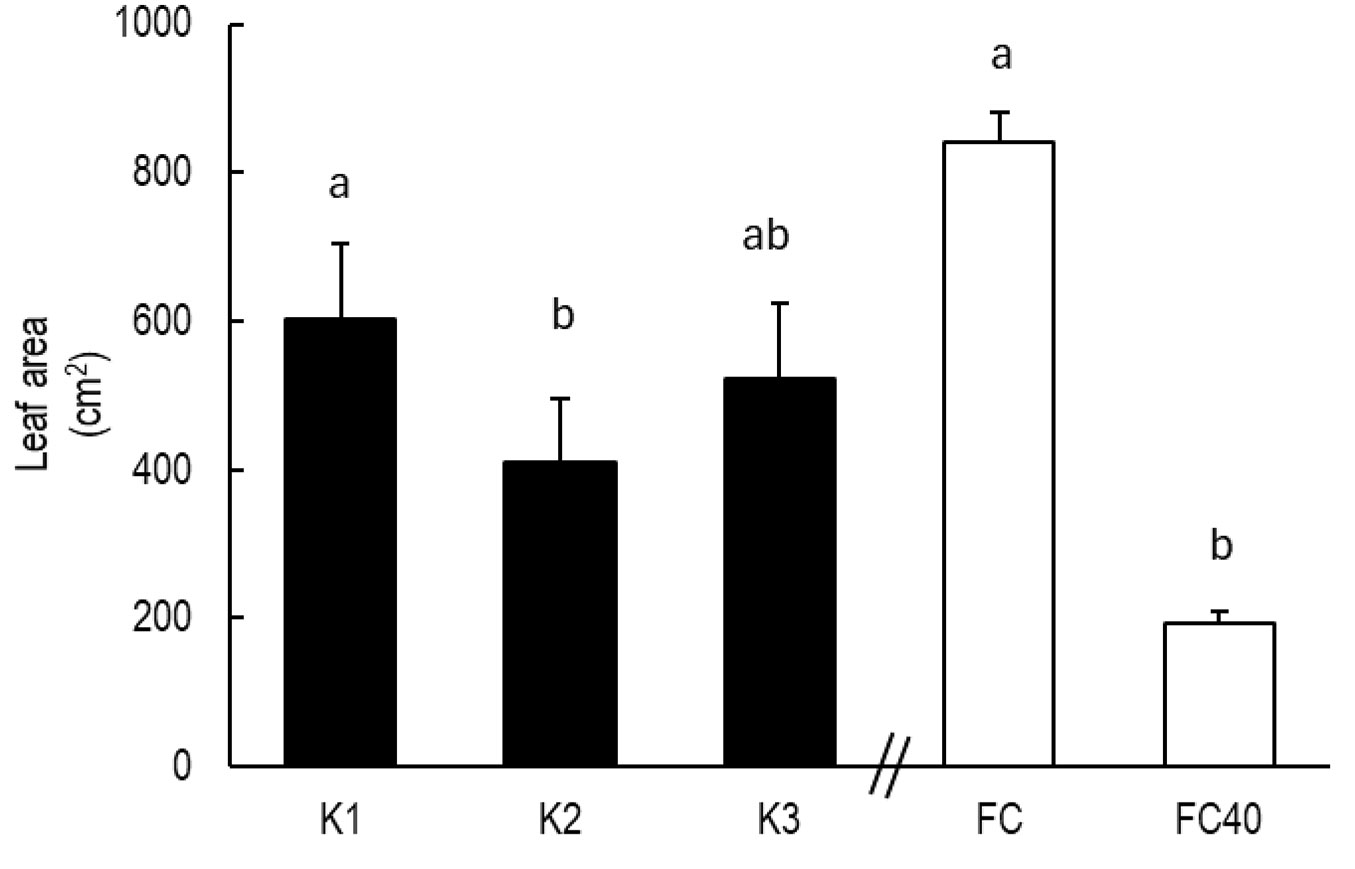
Soil water availability also significantly affected leaf area. Seedlings at field capacity (FC) had a mean leaf area about four times greater (843 cm2) than those under water restriction (FC40), which only reached 193.76 cm2.
Significant differences in relative water content (RWC) and stomatal conductance (gs) were found only between the two soil water content levels. Seedlings at field capacity (FC) showed higher RWC and stomatal conductance than those at 40% of field capacity (FC40 - Fig. 5).
Fig. 5 - Relative water content and stomatal conductance in E. grandis seedlings, evaluated at 51 and 57 days after the start of the experiment, respectively, under field capacity maintenance (FC) and maintenance at 40% of field capacity (FC40). Different letters indicate significant differences for each treatment after Fisher’s LSD test (p < 0.05).
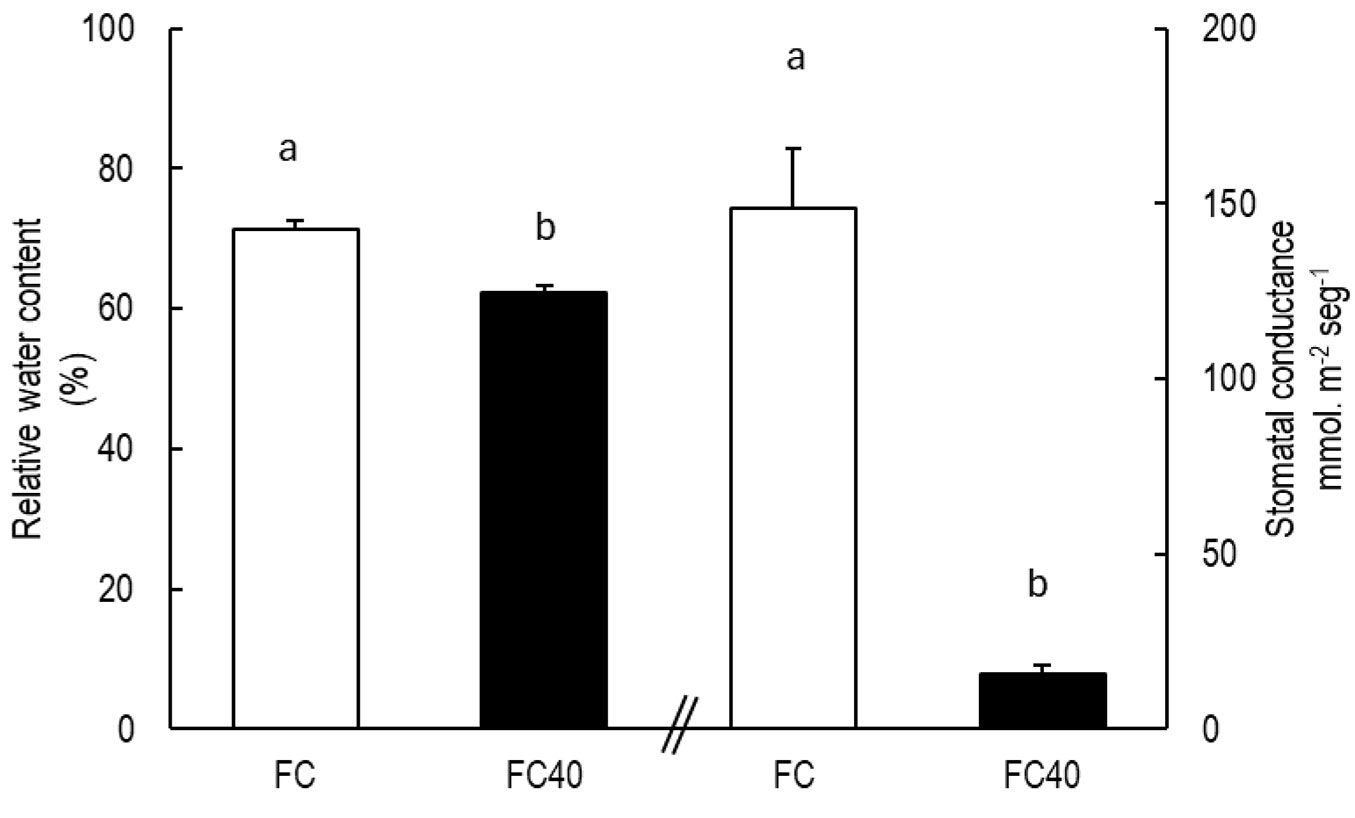
These findings suggest that soil moisture availability strongly affected plant water status and gas exchange. In contrast, potassium levels did not significantly affect these physiological parameters in this study.
RWC was not significantly linked to any biomass components (Tab. 2). However, stomatal conductance (gs) showed a strong positive linear relationship with several biomass variables and leaf area. This indicates a close link between gas exchange capacity and seedling growth performance.
Tab. 2 - Correlation matrix between different morphological and physiological variables. (Bram): branch biomass; (SB): stem biomass; (LB): leaf biomass; (RB): root biomass; (Btot): total biomass; (AGB): aboveground biomass; (LA): leaf area; (SLA): Specific leaf area; (LMA): leaf mass per area; (CRA): relative water content; (sc): stomatal conductance. (*): p<0.05; (**): p<0.01; (***): p<0.001.
| - | Bram | SB | LB | RB | Btot | AGB | LA | SLA | LMA | CRA |
|---|---|---|---|---|---|---|---|---|---|---|
| SB | 0.97** | 1 | - | - | - | - | - | - | - | - |
| LB | 0.98** | 0.98** | 1 | - | - | - | - | - | - | - |
| RB | 0.95** | 0.93** | 0.95** | 1 | - | - | - | - | - | - |
| Btot | 0.99** | 0.98** | 0.99** | 0.98** | 1 | - | - | - | - | - |
| AGB | 0.99** | 0.99** | 1** | 0.95** | 0.99** | 1 | - | - | - | - |
| LA | 0.77** | 0.83** | 0.83** | 0.71** | 0.8** | 0.82** | 1 | - | - | - |
| SLA | 0.09 | 0.24 | 0.2 | 0.02 | 0.14 | 0.19 | 0.68** | 1 | - | - |
| LMA | -0.12 | -0.25 | -0.23 | -0.09 | -0.18 | -0.22 | -0.58* | -0.85** | 1 | - |
| CRA | 0.24 | 0.26 | 0.32 | 0.27 | 0.29 | 0.3 | 0.2 | 0.1 | -0.27 | 1 |
| sc | 0.87** | 0.83** | 0.82** | 0.74** | 0.81** | 0.83** | 0.82** | 0.29 | -0.27 | 0.02 |
Water restriction was the main factor driving the physiological responses of the plants, which strongly influenced their morphological development. As shown in Fig. 6, reductions in leaf area and leaf biomass under water-restricted conditions occurred proportionally, leading to a linear decrease in stomatal conductance. Correlation analyses of the evaluated parameters further supported this pattern (Tab. 2).
Fig. 6 - Relationship between leaf biomass and leaf area (a) and leaf biomass and stomatal conductance (b) in E. grandis seedlings, evaluated at 51 days after the start of the experiment, under field capacity maintenance (FC - filled symbols) and maintenance at 40% of field capacity (FC40 - open symbols).
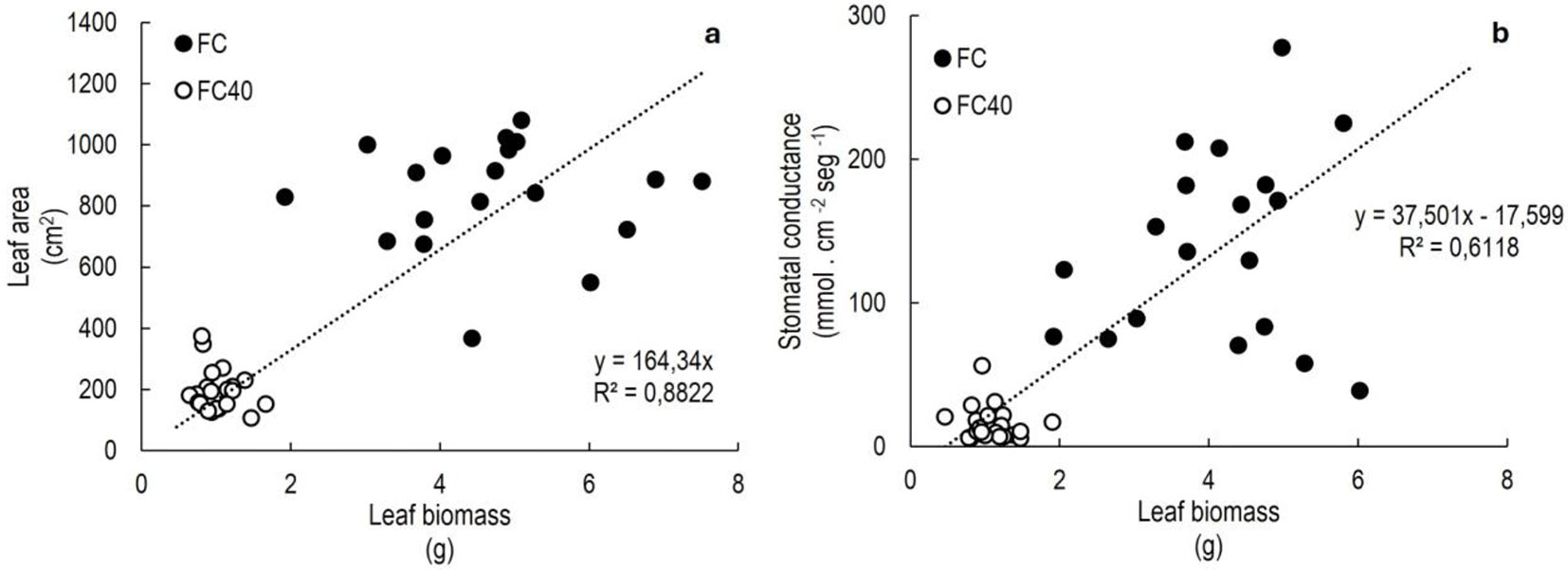
Strong positive linear relationships were found between leaf, branch, stem, and root biomass and total plant biomass (Tab. 2). Leaf biomass was also significantly associated with leaf area (Fig. 6). Root biomass showed a similar trend, but the correlation strength was lower than for aboveground biomass components (Tab. 2), indicating a weaker, though still positive, relationship.
Discussion
Growing Eucalyptus in sandy soils needs careful planning. These soils retain little water and have few nutrients, especially in the months after planting. As expected, the sandy substrate showed low organic matter and nutrient levels. This directly reduced water-holding ability. Under these conditions, seedlings rely heavily on available soil moisture for early growth.
Plants use many adaptive strategies to handle water stress. These responses can differ by species and environment. In this study, restricting water caused clear changes in Eucalyptus grandis seedlings. We observed growth inhibition, smaller leaf areas, and stomatal closure. These adaptations help reduce thermal stress and limit water loss through transpiration. Our results align with previous studies that report similar responses under drought ([1], [30]).
Effect of potassium fertilization
Potassium (K) fertilization is common at the nursery stage or during transplanting. It aims to boost plant tolerance to water deficits ([12]). However, in this study, K addition did not significantly affect height growth, root-collar diameter, or biomass in coarse-textured soil (Tab. 1). In water-restricted treatments, low soil water availability was the main limit on biomass production (Tab. 1, Fig. 1). Similarly, Susiluoto & Berninger ([38]) found no increase in root biomass under drought conditions.
Many studies reported that increased root biomass helps plants extract water from the soil when moisture is low ([18], [25]). However, Sá et al. ([36]) found that fertilization did not promote growth in water-stressed seedlings. Also, Maseda & Fernández ([29]) noted that root biomass in different Eucalyptus provenances decreased with increasing drought intensity. Graciano ([18]) found that applying nitrogen (N) and phosphorus (P) to sandy soils resulted in limited nutrient uptake when water was scarce.
Plant nutrient uptake depends on plant demand, soil nutrient availability, and soil physicochemical properties ([20]). In sandy soils, nutrient availability can be low because hydraulic conductivity drops sharply when soil moisture is low. This limits nutrient movement to the roots ([43]). Additionally, limited nitrogen and phosphorus can further reduce the effectiveness of potassium fertilization ([18], [36]).
In contrast to our findings (Tab. 1), other studies reported positive effects of potassium fertilization under drought. Gazola et al. ([17]) found that K fertilization partially reduced water-deficiency effects on Eucalyptus grandis seedlings. Teixeira et al. ([40], [41]) studied E. grandis, E. urophylla, E. camaldulensis, and a hybrid (E. urophylla × E. grandis). They found that adding potassium significantly boosted height growth and dry matter production across different K doses and soil water potentials.
Furthermore, Teixeira et al. ([41]) noted that K application improved photosynthesis by reducing stomatal conductance, limiting water loss through transpiration. They found K-deficient plants had lower photosynthetic rates and higher stomatal conductance, reducing water-use efficiency. Santos et al. ([35]) showed that responses to potassium fertilization varied by Eucalyptus genotype. Under severe drought, the E. urophylla × E. camaldulensis clone maintained biomass through K regulation, while the E. urophylla clone showed reduced K content and biomass.
Similarly, De Souza Mateus et al. ([12]) found that potassium improved osmotic adjustment and drought avoidance in Eucalyptus seedlings experiencing short-term water stress. This improved leaf development, gas exchange, mesophyll conductance to CO2, and water use efficiency. K-supplied plants acclimated better to osmotic stress than K-deficient plants, which had lower CO2 assimilation and dry matter accumulation.
In this study, potassium dose affected both the AGB: RB ratio and leaf area, though no clear trend emerged (Tab. 1, Fig. 3). Graciano ([18]) reported a reduction in the AGB: RB ratio in E. grandis grown in sandy soils with N and P under water stress. In contrast, Teixeira et al. ([41]) observed leaf area increased with K doses up to 100 mg dm-3, with increases over 200%.
Because Eucalyptus is the most widely planted tree genus and often grows in nutrient-poor, low-water soils, researchers have explored alternative nutritional strategies. Sodium (Na) can substitute for potassium in some physiological functions, affecting plant water relations. Recent studies ([30]) showed that Na can partially replace K in Eucalyptus seedlings, with optimal rates increasing with species drought tolerance, including Eucalyptus saligna, E. urophylla, and E. camaldulensis.
Effect of soil water content
Eucalyptus productivity is very sensitive to water availability ([7], [24]). Drought conditions significantly reduce growth, biomass production, and harvestable yield. These declines mainly result from reduced transpiration, which limits carbon assimilation by reducing photosynthesis ([45], [47]). Water stress also negatively affects dry matter production by restricting water flow through the plant-atmosphere continuum, which constrains photosynthesis ([45]).
In this study, reductions in height and root-collar diameter were noticeable by day 21 in water-stressed plants (FC40 - Fig. 1a, Fig. 1b). Limited soil water has been shown to reduce stem growth ([21], [22]). Drought reduced root-collar diameter and seedling height by over 20% in various tree species ([33], [47]). This is linked to reduced cell expansion and limited cell division under water-deficit conditions ([48]). Hernández et al. ([19]) found that water scarcity significantly affected height growth and leaf area in Eucalyptus globulus seedlings. However, our results differ from Maseda & Fernández ([29]), who found no significant effect of irrigation on leaf area in E. globulus and E. camaldulensis seedlings in greenhouses.
Lozano et al. ([27]) and Ishimwe & Deligöz ([22]) showed that water stress mainly affects leaves and roots, the organs most involved in water uptake and loss. In coarse soils with low water retention, root growth is crucial for water acquisition. Under drought, plants can improve water absorption by changing root length, structure, and internal features ([21], [46]). In our study, plants under FC40 showed marked reductions in various traits, including root biomass (down 65.79%) and aboveground biomass (down 78.12%), compared to FC treatments, leading to a lower stem-to-root ratio in water-stressed plants (1.90) than in well-watered ones (2.88 - Tab. 1, Fig. 2, Fig. 3).
Da Silva et al. ([10]) noted that potassium has limited effects on transpiration under severe water stress but is more influential under milder stress. This suggests that while potassium helps regulate stomatal behavior, seedlings’ acclimation to water stress is critical for this mechanism to work in the field.
Consistent with earlier findings ([31]), seedlings in this study responded to water stress with changes in both their structure and processes. Total biomass (AGB + RB) under FC40 was about four times lower than under the FC treatment (Fig. 2). The drop was more significant in aboveground biomass (4.5-fold decrease) than in root biomass (2.9-fold decrease - Fig. 2). This aligns with Ishimwe & Deligöz ([22]), who reported large decreases in both biomass types in Laurus nobilis under water restrictions in greenhouses.
Teixeira et al. ([40]) studied seedlings of E. grandis, E. urophylla, E. camaldulensis, and a hybrid (E. urophylla × E. grandis) under various potassium doses and soil moisture levels. They found that while water stress did not significantly affect height growth, it clearly reduced aboveground dry matter for all species evaluated. Although the differences were not significant, plants under non-water-limited conditions had the highest stomatal conductance. As shown in Fig. 5, plants significantly reduced stomatal conductance under FC40, indicating that E. grandis controlled water loss by closing stomata during moderate water stress. Similar trends in E. camaldulensis ([15]) suggest that Eucalyptus improves water-use efficiency by regulating stomatal conductance and using water conservatively during drought ([47]).
Leaf biomass and leaf area are closely linked (r = 0.83, p = 0.01), reflecting canopy size and function. Leaf area in water-deficient plants was 4.6 times lower than in non-water-limited plants (FC - Fig. 6). Graciano ([18]) and Oliveira et al. ([31]) noted that reduced leaf area reduces transpiration. This helps the plant absorb water from low-moisture soils, maintaining the turgor needed for physiological activity ([23]).
Binks et al. ([4]) noted drought-related adaptive responses, such as changes in leaf thickness. Leaf mass is vital for plant growth and indicates ecological strategies ([44]). In this study, leaf mass per area did not differ significantly between water regimes, with values of 6.39 ± 2.26 mg cm-2 for FC40 and 5.80 ± 2.49 mg cm-2 for FC (data not shown). However, a significant inverse relationship emerged between leaf mass and leaf area (R = -0.58; p = 0.0496 - Tab. 2), suggesting that as leaf area decreased under water stress, leaf mass per unit area increased.
Poorter et al. ([32]) found that leaves under low water availability expand less, leading to smaller, denser cells and thicker walls. This reduces the overall surface area for transpiration, lowering water demand during drought and acting as an effective acclimation strategy.
Plants also develop physiological defenses to protect their photosynthesis from drought damage ([37], [49]). [31], [46], and [22] noted that under mild stress, plants can usually regulate stomatal opening and transpiration, adjust leaf water potential, and recover when water improves. Sometimes, photosynthesis may even rise temporarily. However, moderate to severe drought stress typically leads to notable drops in net photosynthetic rate, stomatal conductance, and transpiration.
Soil water content was crucial for stomatal regulation in this study, consistent with Hernández et al. ([19]). Plants under the FC40 treatment showed a significant drop in both relative water content (RWC) and stomatal conductance (gs) by the end of the experiment (Fig. 5, Tab. 1). These results indicate that Eucalyptus grandis responded to moderate water stress by closing stomata, thus reducing transpiration. However, this did not prevent a decline in leaf RWC (from 71.2% to 62%), though it was sufficient to avoid plant mortality.
As noted by [19], seedlings in low soil water showed a marked decrease in stomatal conductance. Their reported values were lower than those in this study, likely due to more severe water restrictions. These findings highlight the sensitivity of stomatal regulation in Eucalyptus species and emphasize the importance of soil water availability as a key factor in physiological performance during early seedling development.
Conclusion
Under sandy soil conditions with low natural fertility, potassium fertilization did not help Eucalyptus grandis seedlings under water stress. Similarly, adding nitrogen and phosphorus with increasing potassium levels did not improve growth or physiological performance in seedlings with enough water.
In contrast, soil water availability was the main factor for seedling growth. Reducing water to 40% of field capacity significantly decreased height, root-collar diameter, total biomass, and leaf area. It also reduced key physiological metrics such as stomatal conductance and relative water content but did not cause seedling deaths.
These findings emphasize the need for adequate soil moisture during early Eucalyptus grandis growth, especially in coarse-textured soils. Water availability is more crucial than potassium fertilization for early seedling performance in these conditions.
List of abbreviations
AGB (aboveground biomass); CE (stomatal conductance); CRA (relative water content); EEA (agricultural experimental station); FC (field capacity); FC40 (maintenance at 40% of field capacity); INTA (National Institute of Agricultural Technology); K (potassium); LA (leaf area); N (nitrogen); P (phosphorus); RB (root biomass).
Acknowledgments
We thank El Potrero San Lorenzo SA Estancia; Leonel Harrand of EEA Concordia INTA for providing E. grandis seedlings; and Ana B. Guaranchelli for assistance with measuring physiological parameters.
Authors’ contributions:
LAU: Conceptualization, Data curation, Formal analysis, Investigation, Methodology, Project administration, Supervision, Validation, Visualization, Writing - original draft, Writing - review & editing. PLF: Conceptualization, Formal analysis, Funding acquisition, Project administration, Resources, Writing - original draft, Writing - review & editing. AML: Conceptualization, Formal analysis, Funding acquisition, Project administration, Resources, Writing - original draft, Writing - review & editing.
Funding
UBACYT (Project No. 20020150200175BA, 2016-2018) and Forest Project PIE016 del INTA funded this work.
References
CrossRef | Gscholar
CrossRef | Gscholar
CrossRef | Gscholar
CrossRef | Gscholar
Online | Gscholar
Gscholar
CrossRef | Gscholar
Online | Gscholar
Gscholar
Authors’ Info
Authors’ Affiliation
Universidad de Panamá, Facultad de Ciencias Agropecuarias, Campus Dr. Octavio Méndez Pereira, Transístmica (Panamá)
Facultad de Agronomía, Universidad de Buenos Aires, Av. S. Martín 4453, C1417DSE Cdad. Autónoma de Buenos Aires (Argentina)
CONICET, Av. Rivadavia 1917, Ciudad Autónoma de Buenos Aires (Argentina)
Instituto de Suelos, Centro de Investigaciones en Recursos Naturales - CIRN, Instituto Nacional de Tecnología Agropecuaria - INTA, de los Reseros y Nicolás Repetto s/n, B1686 Hurlingham, Province of Buenos Aires (Argentina)
Corresponding author
Paper Info
Citation
Urriola LA, Fernández PL, Lupi AM (2026). Morphological and physiological responses to water stress and potassium nutrition in Eucalyptus grandis Hill Ex Maiden seedlings. iForest 19: 396-402. - doi: 10.3832/ifor4968-019
Academic Editor
Claudia Cocozza
Paper history
Received: Aug 19, 2025
Accepted: May 08, 2026
First online: Nov 08, 2026
Publication Date: Dec 31, 2026
Publication Time: 6.13 months
Copyright Information
© SISEF - The Italian Society of Silviculture and Forest Ecology 2026
Open Access
This article is distributed under the terms of the Creative Commons Attribution-Non Commercial 4.0 International (https://creativecommons.org/licenses/by-nc/4.0/), which permits unrestricted use, distribution, and reproduction in any medium, provided you give appropriate credit to the original author(s) and the source, provide a link to the Creative Commons license, and indicate if changes were made.

Web Metrics
Breakdown by View Type
Article Usage
Total Article Views: 47
(from publication date up to now)
Breakdown by View Type
HTML Page Views: 12
Abstract Page Views: 15
PDF Downloads: 14
Citation/Reference Downloads: 0
XML Downloads: 6
Web Metrics
Days since publication: 1
Overall contacts: 47
Avg. contacts per week: 329.00
Article Citations
Article citations are based on data periodically collected from the Clarivate Web of Science web site
(last update: Jul 2026)
(No citations were found up to date. Please come back later)
Publication Metrics
by Dimensions ©
Articles citing this article
List of the papers citing this article based on CrossRef Cited-by.
Related Contents
iForest Similar Articles
Research Articles
Combined effects of short-day treatment and fall fertilization on growth, nutrient status, and spring bud break of Pinus tabulaeformis seedlings
vol. 10, pp. 242-249 (online: 11 February 2017)
Research Articles
Combined pre-hardening and fall fertilization facilitates N storage and field performance of Pinus tabulaeformis seedlings
vol. 9, pp. 483-489 (online: 07 January 2016)
Research Articles
Links between phenology and ecophysiology in a European beech forest
vol. 8, pp. 438-447 (online: 15 December 2014)
Research Articles
Response of artificially defoliated Betula pendula seedlings to additional soil nutrient supply
vol. 10, pp. 281-287 (online: 13 December 2016)
Research Articles
Photochemical efficiency and variation in photosynthetic pigments in Nothofagus pumilio seedlings growing under light intensity and soil moisture gradients
vol. 19, pp. 311-320 (online: 19 August 2026)
Research Articles
Effects of cultural treatments, seedling type and morphological characteristics on survival and growth of wild cherry seedlings in Turkey
vol. 5, pp. 283-289 (online: 17 December 2012)
Research Articles
Controlled-release fertilizers combined with Pseudomonas fluorescens rhizobacteria inoculum improve growth in Pinus halepensis seedlings
vol. 8, pp. 12-18 (online: 12 May 2014)
Research Articles
Retranslocation of foliar nutrients of deciduous tree seedlings in different soil condition under free-air O3 enrichment
vol. 9, pp. 835-841 (online: 17 June 2016)
Research Articles
Carbohydrate metabolism during new root growth in transplanted Larix olgensis seedlings: post-transplant response to nursery-applied inorganic fertilizer and organic amendment
vol. 10, pp. 15-22 (online: 22 September 2016)
Research Articles
Oak sprouts grow better than seedlings under drought stress
vol. 9, pp. 529-535 (online: 17 March 2016)
iForest Database Search
Search By Author
Search By Keyword
Google Scholar Search
Citing Articles
Search By Author
Search By Keywords
PubMed Search
Search By Author
Search By Keyword