
Root colonization and growth response of Pinus nigra seedlings to three types of ectomycorrhizal inoculum
iForest - Biogeosciences and Forestry, Volume 19, Issue 4, Pages 269-275 (2026)
doi: https://doi.org/10.3832/ifor4728-019
Published: Jul 23, 2026 - Copyright © 2026 SISEF
Research Articles
Abstract
Native mycorrhizal fungal species can colonize the roots of tree seedlings and positively influence their growth and survival. This study evaluates the effects of three native ectomycorrhizal fungi on the growth and root colonization of black pine (Pinus nigra) seedlings from three distinct origins. For this purpose, the experiment included (i) the production of pure cultures of selected local mycorrhizal fungal species in the laboratory environment and (ii) the production of mycorrhizal black pine seedlings carried out by inoculating plants with these cultures. Pure cultures of three fungal species (Rhizopogon luteolus, Russula raoultii and Chroogomphus rutilus) were obtained from eastern Mediterranean black pine forests of Turkey and mixed into sterilized growth substrate (a mixture of humus, river sand and forest soil) for inoculation. Two other treatments, with no mycorrhizal inoculations, were also added to the experiments and considered as sterile and non-sterile control treatments. Twenty-two months after inoculation, seed origin significantly affected seedling growth parameters and survival rates. Among the tested provenances, Egirdir consistently exhibited the lowest growth performance. Mycorrhizal inoculation did not significantly influence shoot growth; however, it markedly enhanced survival rates, root length, and the extent of mycorrhizal root colonization. The mean mycorrhizal infection rate was 1.6% in the sterile control and 27% in the non-sterile control. In contrast, inoculation with pure cultures increased colonization to 61%, 64%, and 69% for R. raoultii, C. rutilus, and R. luteolus, respectively. Survival rates showed a significant interaction between origin and mycorrhizal inoculation. R. luteolus consistently resulted in the highest survival rates across all treatments, with the most pronounced effect observed in the Egirdir provenance, where survival increased from 63% to 81% following inoculation. The improved seedling survival of the Egirdir origin, which had the smallest seeds and weakest initial growth, suggests that the benefits of mycorrhizal symbiosis may be especially important for weaker seedlings and under unfavorable environmental conditions.
Keywords
Pinus nigra, Ectomycorrhizal Fungi, Seed Origin, Seedling Inoculation, Root Colonization, Forest Nursery
Introduction
A large part of Turkey consists of arid and semi-arid areas, and afforestation in these areas is of great importance. These areas are generally sensitive ecosystems with eroded, nutrient-poor soils and limited biological activity. In many of these degraded areas, a lack of suitable mycorrhizal fungi may limit tree seedling establishment and growth ([31]). The use of seedlings inoculated with mycorrhizal fungi in such areas has the potential to rapidly increase soil biological activity and enhance the success of afforestation programs ([7]).
The success of afforestation depends on biotic interactions, especially with mycorrhizal fungi ([44], [21]). Many studies indicate that mycorrhizal fungi help plants survive in arid environments ([55], [56], [36]). Therefore, inoculating tree seedlings with ectomycorrhizal fungi (EMF) is key to promoting survival after planting, growth, and establishment under both normal and stressful conditions ([24], [37], [53], [11], [2]). EMF enhances the growth of host plants at the seedling stage ([9]). Turjaman et al. ([49]) also suggested that this improved early development will accelerate the rehabilitation efforts for degraded forests. Belowground fungal symbioses can regulate seedling survival, indicating that the presence of EMF is associated with the survival and potential colonizing capabilities of Pinaceae species ([26]). Inoculation of pine seedlings with ectomycorrhizal fungi has also been shown to improve drought tolerance ([20], [8]). EMF are also key to the optimal establishment and performance of forest tree species under nursery and planting conditions. In this context, given water scarcity and land degradation caused by extreme climatic conditions, outplanting mycorrhizal-inoculated seedlings will reduce the costs of reforestation and/or afforestation in such areas ([39], [41], [57], [35]).
Anatolian black pine (Pinus nigra Arnold subsp. pallasiana [Lamb.] Holmboe) is the third most widespread tree species in Turkey, covering an area of 4.08 million hectares, mostly in arid and semi-arid regions ([27]). Black pine is distributed in steppe regions and has emerged as one of the most frequently introduced pine species in the steppe environment ([23]). The species also occurs in dry forests, which are typically sparse and low in productivity, with the understory vegetation mainly composed of steppic herbaceous species ([3]). It is a highly preferred species for afforestation programs in semi-arid areas due to its widespread natural distribution, tolerance of harsh environmental conditions, and economic importance. For this reason, it is the second most-produced species in Turkey, with more than 43 million black pine seedlings grown in nurseries annually ([27]).
García et al. ([10]) and Sepahvand et al. ([43]) reported that the effect of native mycorrhizal fungi was greater and better than that of exotic fungi on Pinus greggii and Celtis caucasica, respectively. In addition, Karlsen-Ayala et al. ([18]) stressed the importance of including native ectomycorrhizal fungi in pine seedlings. However, in practise, the seedlings are deliberately not inoculated with mycorrhizal fungi in most nurseries, nor is there much research on the mycorrhizal status of young plants.
The objective of this study was to evaluate the effects of inoculation with pure cultures of native ectomycorrhizal fungi on the growth, survival, and root parameters of black pine seedlings under nursery conditions. It was assumed that the effect might depend on the fungal species and the host plant’s origin. Therefore, the effects of three mycorrhizal fungal species (Rhizopogon luteolus, Russula raoultii, and Chroogomphus rutilus) were tested on growth variables (root collar diameter, stem height, dry biomass), survival, and root parameters (colonization, length, surface area) of the black pine seedlings from three different seed origins. Control treatments included uninoculated seedlings grown in non-sterilized and sterilized substrates, with the expectation that non-sterilized substrates may support spontaneous ectomycorrhizal associations from natural soil inoculum, leading to better growth and root parameters compared to seedlings grown in sterilized substrates.
Materials and methods
Plant material
Pinus nigra seedlings were produced in a nursery operated by the Eastern Mediterranean Forestry Research Institute in southern Turkey. The seed sources of the seedlings grown in this study were collected from 3 different Pinus nigra seed stands (Tab. 1). Seeds were soaked in 30% (v/v) H2O2 for 20 seconds to sterilize the surface and rinsed thoroughly in sterile water. A peat-based growth substrate was used for germination. Peat was sterilized in an autoclave at 120 °C for 20 minutes. Multi-cell seedling trays (45 cells per tray) were filled with peat, and each cell was sown with three seeds in February. Germination was monitored in an indoor greenhouse. The seeds were irrigated for about 30 minutes by sprinkling at noon every day until germination was complete. In March, the healthiest seedlings (about 2-3 cm in height) were selected after germination and transferred to a new substrate in the Tekir forest nursery at an elevation of 1250 m a.s.l. Seedlings transferred to new pots were irrigated every 3-4 days until the end of June (on days without precipitation), depending on air temperature. Since June to September usually passed without precipitation, irrigation was done every 2 days. No fertilizer or pesticide was applied in the study. To avoid cold and frost damage, the seedlings were kept under cover from November to the end of March, at the end of the first year.
Tab. 1 - Information about seed stands.
| Stand | Aspect | Altitude (m a.s.l.) |
1000- seed weight (g) | Distance to the nursery (km) | Total annual precipitation (mm) |
|---|---|---|---|---|---|
| O1 - Beysehir | Various | 1320 | 25.95 | 416 | 496 |
| O2 - Erdemli | Northeast | 1500 | 27.16 | 100 | 606 |
| O3 - Egirdir | West | 1230 | 23.93 | 600 | 705 |
Fungal inoculum
A large number of sporocarps belonging to a wide variety of species were collected from black pine stands in different regions of the Bolkar Mountains (part of the Taurus Mountains in the Southern Mediterranean region of Turkey) during the autumn months, when the climatic conditions were suitable for fruiting. After the ectomycorrhizal species were identified, pure-culture studies were initiated in the laboratory. Three ectomycorrhizal species that were commonly found in these forests and can produce mycelium were used as inoculum: Rhizopogon luteolus Fr. & Nordholm, Russula raoultii Quéll. and Chroogomphus rutilus (Schaeff.: Fr.) O.K. Mill.
Mycorrhizal inoculum was cultured by surface sterilizing the pileus with 70% ethanol in a laminar-flow cabinet. Following drying in the laminar-flow air stream and aseptic removal of the skin, a 5-mm-diameter segment was taken from the inner parts of the pileus and transferred to Marx-modified ([40]) Melin-Norkrans (MMN) medium in 90-mm-diameter Petri dishes. The sealed Petri dishes were incubated in the dark at room temperature (24 ± 1 °C) and observed for mycelial growth under a binocular microscope. Cultures were maintained at room temperature for approximately 1 month to allow further mycelial growth.
To produce the inoculum, a peat-to-vermiculite mixture (1:4 ratio) was prepared, passed through a 5 mm sieve, and autoclaved at 120 °C. One liter of this substrate was dispensed into 1.5 L glass jars. After being plugged with hydrophilic cotton plugs, the jars containing the mixture were autoclaved at 121 °C for 20 minutes (excluding the uninoculated control treatment), and 640 mL of liquid MMN broth was added to each jar. Following a second autoclaving at 120 °C for 20 min, jars were transferred to a laminar flow hood and inoculated by transferring 3-4 pieces (4 × 4 mm) of mycelium plus agar from pure cultures. Inoculated jars were incubated at room temperature for approximately 4 months, after which they were stored at +4 °C until used for inoculations.
Experimental set-up and inoculation
A total of five treatments were applied in the experiment, which was structured as follows: (a) inoculation of sterile substrate with Rhizopogon luteolus (Rl); (b) inoculation of sterile substrate with Russula raoultii (Rr); (c) inoculation of sterile substrate with Chroogomphus rutilus (Cr); (d) no mycorrhizal inoculation of sterile substrate (Control 1, C1); and (e) no mycorrhizal inoculation of the non-sterile substrate (Control 2, C2). Except for C2 treatment, the substrates were sterilized twice for 20 minutes at 120 °C in an autoclave. Inoculation was carried out by mixing the fungal inoculum produced in solid culture into the sterilized growth substrate at a rate of 5% (v/v) for R. luteolus, R. raoultii, and C. rutilus. Six-week-old seedlings taken from cell trays were transplanted into polyethylene pots (25 cm depth × 12 cm diameter) filled with the new substrates.
The substrate (growth medium of the seedlings) used in the nursery experiment consisted of humus, river sand, and forest soil, mixed in a 1:1:1 (v:v:v) ratio. The humus and soil were collected from the nearby black pine stands, and the forest soil was also taken from the pine forest. The substrate compositions were collected together in equal quantities and thoroughly mixed. The substrate was analyzed before sterilization and was slightly alkaline (pH 7.8), with 7.6% CaCO3, 3.11% organic matter, and an electrical conductivity of 0.3 mS cm-1. Other parameters were: 0.7% N, 11 mg P2O5 kg-1, 242 mg K kg-1, 3200 mg Ca kg-1, 271 mg Mg kg-1, 9.1 mg Fe kg-1, 2.3 mg Zn kg-1, 3.4 mg Mn kg-1, and 4.6 mg Cu kg-1.
A randomized complete block design was employed in this experiment, consisting of 15 treatments (5 [3 EMF species, 2 non-mycorrhizal] × 3 [origins]) and a total of 45 units with 3 repetitions. Each treatment included 100 seedlings.
Measurements
Morphological characteristics, including shoot height (H), root collar diameter (D), shoot dry weight (SDW), and root dry weight (RWD), were measured on 20 seedlings randomly selected from each of 45 treatment plots after the end of the second growth season. Mortality data were also recorded for each treatment, and survival rates (SUR, %) were calculated using the following formula (eqn. 1):
where Nalive is the number of living seedlings, and Ninit is the number of initial seedlings.
For the morphological measurements, seedlings were gently removed from the soil, roots were washed in running water, and the roots and shoots were separated at the collar. The samples were then placed in paper bags and dried in a forced-ventilated oven at 65 °C until reaching constant mass. The SDW, RDW, and total dry weight (TDW) were determined using a semi-analytical balance (0.01 g). The shoot/root dry weight ratio (S/R) of the seedlings was also calculated.
The root surface area (RSA) and root length (RLN) of 20 randomly selected seedlings from each experimental unit were obtained using the software WinRhizo® Pro v. 2009 (Regent Instrument Inc., Quebec, Canada).
Fig. 1 - Visual appearance of mycorrhizal P. nigra roots.
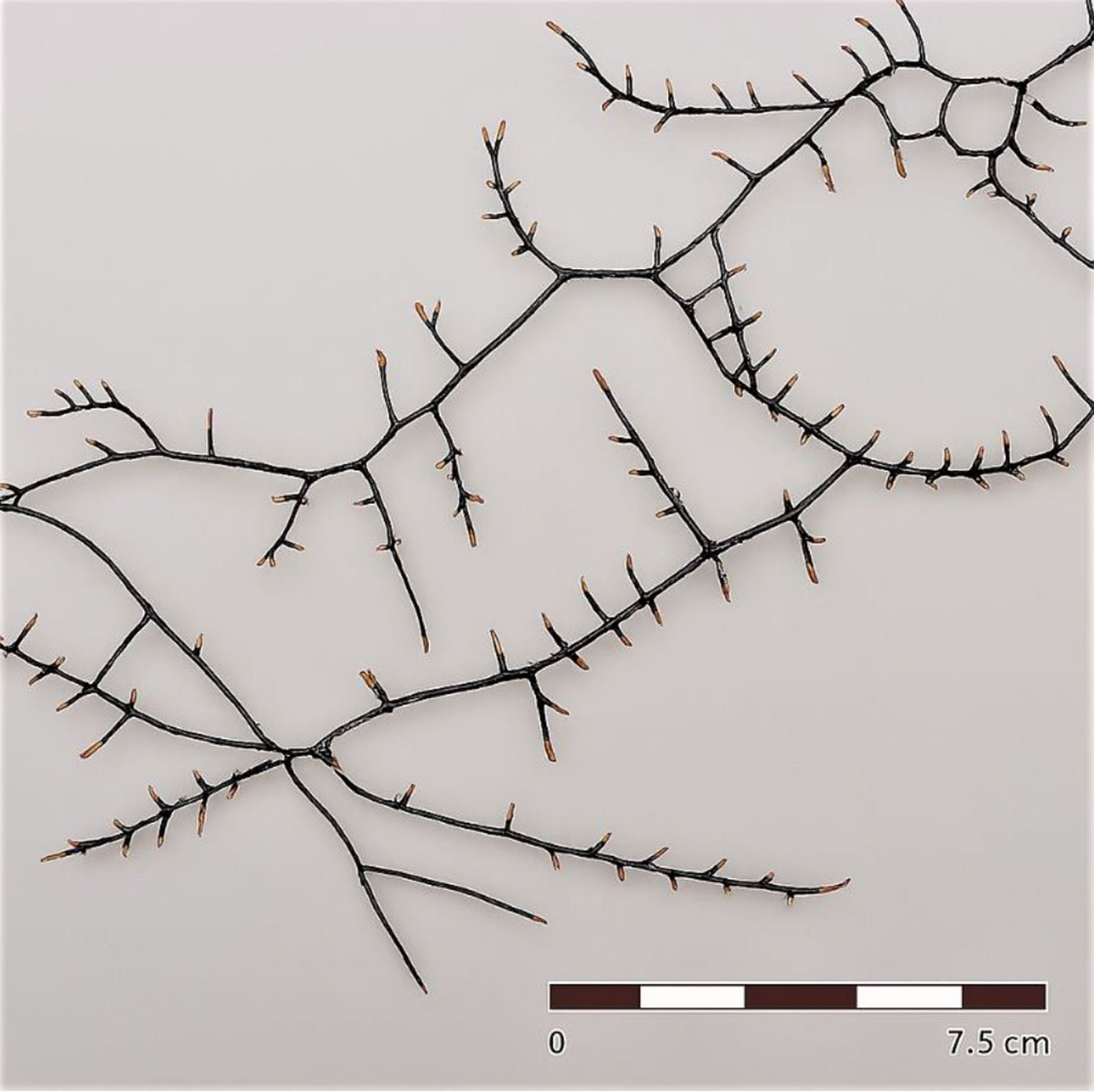
Dichotomous branching of short lateral roots is a diagnostic feature of ectomycorrhizas in many pine species ([19] - Fig. 1). Mycorrhizal and non-mycorrhizal roots were calculated by taking this property into account. Mycorrhizal root colonization (MRC, %) was enumerated on the roots of ten randomly selected seedlings from each experimental unit. The gridline intersection method of Giovannetti & Mosse ([12]) was used to estimate mycorrhizal root colonization. Using a dissecting microscope at 40× magnification, roots corresponding to the vertical and horizontal dimensions on the grid lines were counted and recorded as mycorrhizal or non-mycorrhizal, and the percentage of mycorrhizal roots was calculated (eqn. 2):
where MRC is the mycorrhizal root colonization (%), MR is the number of mycorrhizal roots, and TR is the total number of roots.
It is important to determine the mycorrhizal dependence of different crop plants grown in a region and select those that are highly mycorrhizal-dependent for inoculation ([4]). By comparing the dry weights of mycorrhizal and non-mycorrhizal plants, the mycorrhizal dependency (MD, %) of the plants was calculated as a percentage. Total dry weight (TDW) was used to evaluate the dry weight for each experimental unit and determine the MD (eqn. 3):
where +M is the total dry weight of inoculated seedlings; -M is the total dry weight of non-inoculated seedlings.
Statistical analysis
The measured parameters were analyzed by two-way analysis of variance (ANOVA) in SPSS® v. 20.0 (IBM, Armonk, NY, USA). The survival and root variables were transformed by arcsin(sqrt) prior to statistical analysis where required, to ensure homogeneity of variances. Means were presented with standard errors and separated by Tukey’s significance difference (p≤0.05). A Pearson’s correlation analysis was also conducted to determine if there was a relationship between plant growth variables and root morphologies in mycorrhiza-inoculated and non-inoculated seedlings.
Results
Seed origin significantly affected all growth variables measured for the seedlings, whereas there was no difference between mycorrhizal inoculation treatments (Tab. 2). The growth parameters such as diameter (D, 23%-27%), height (H, 32%-37%), shoot dry weight (SDW, 80%-100%), and root dry weight (RDW, 27%-60%) for seedlings from O1 (Beysehir) and O2 (Erdemli) origin were significantly higher than those from O3 origin (Egirdir - Fig. 2a-d). Additionally, the S/R ratios of the O1 seedlings were significantly higher compared to the O2 and O3 seedlings (Fig. 2e).
Tab. 2 - P values of the ANOVAs for diameter (D), height (H), shoot dry weight (SDW), root dry weight (RDW), and S/R (shoot/root ratio) of P. nigra seedlings under the different treatments tested. (df): Degree of freedom; (*): p≤0.05; (**): p≤0.01; (***): p≤0.001. ns: non-significant.
| Source | df | D | H | SDW | RDW | S/R |
|---|---|---|---|---|---|---|
| Origin (O) | 2 | <0.001*** | <0.001*** | <0.001*** | <0.001*** | <0.001*** |
| Mycorrhiza (M) | 4 | 0.171ns | 0.084ns | 0.052ns | 0.673ns | 0.826ns |
| O×M | 8 | 0.101ns | 0.514ns | 0.001*** | <0.001*** | 0.033* |
Fig. 2 - Some growth and morphological characteristics of P. nigra seedlings and mycorrhizal root colonization. Fig. 2legends: (a) Diameter (D), (b) height (H), (c) shoot dry weights (SDW), (d) root dry weights (RDW), (e) shoot/root ratio (S/R), (f) root surface area (RSA), (g) root length (RLN), (h) survival (SUR), (i) mycorrhizal root colonization (MRC) of P. nigra seedlings in five inoculation treatments and three seed origins. For each mycorrhiza treatment, different minor letters in each bar denote significant differences among inoculation treatments according to Tukey’s test (p≤0.05). For origin treatment, capital letters denote significant differences among sterilization treatments according to Tukey’s test (p≤0.05). Bars indicate standard deviation. Rl (Rhizopogon luteolus), Rr (Russula raoultii), Cr (Chroogomphus rutilus). C1 (no mycorrhiza added to sterile substrate), C2 (no mycorrhiza added to the non-sterile substrate, native). O1 (Beysehir origin), O2 (Erdemli origin), O3 (Egirdir origin).
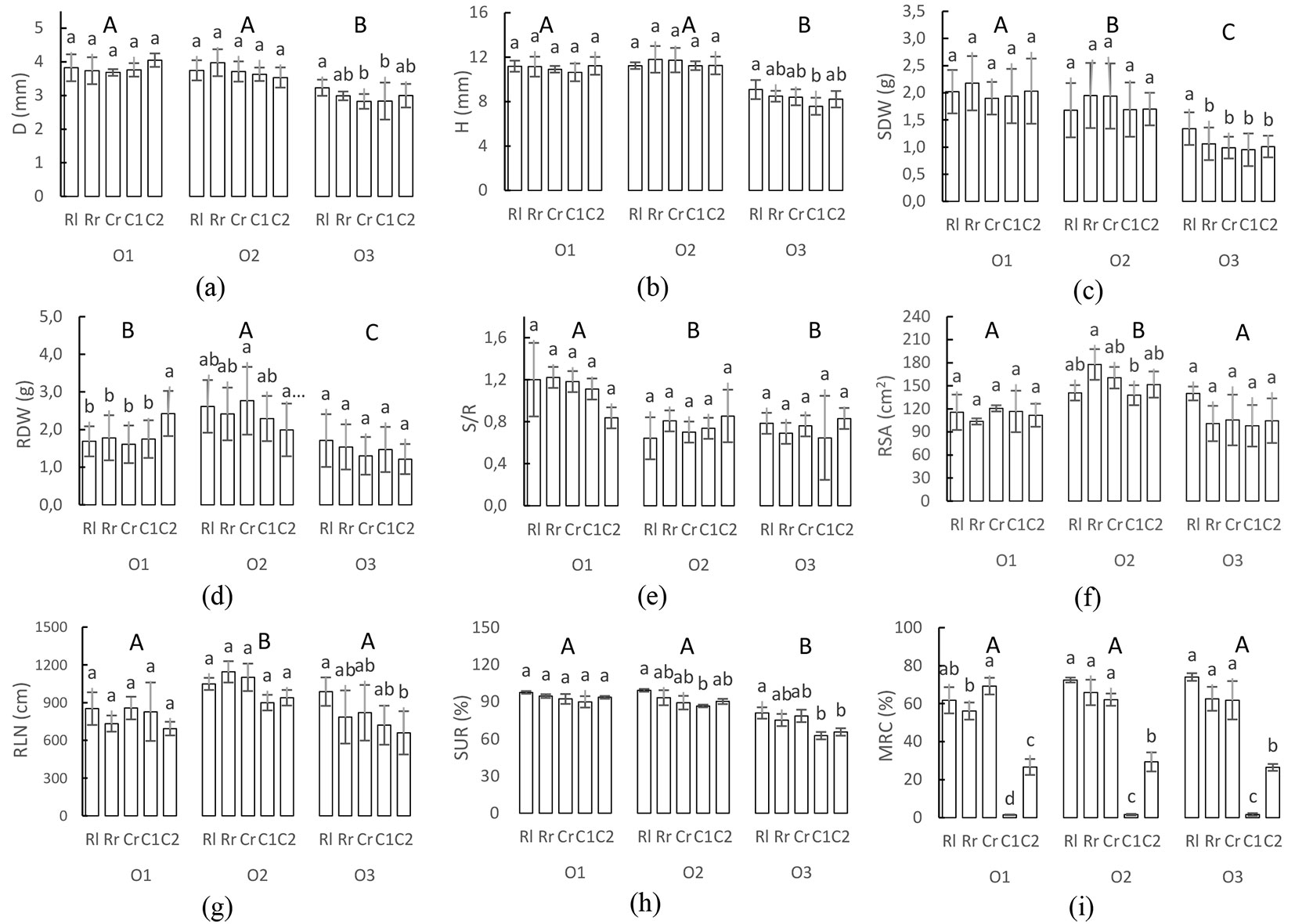
Origins also significantly affected the RSA and RLN averages of seedlings (Tab. 2). O2 had a significantly higher average RSA (153 cm2) than O1 (114 cm2) and O3 (110 cm2 - Fig. 2f, Fig. 2g). While there was no difference in RSA values in inoculation treatments (p=0.512), significant differences were observed in RLN averages (p=0.029). There was a difference in the RSA values of O2 plants (p≤0.001), with the C1 treatment showing the lowest RSA. In RLN averages, O2-origin seedlings had the highest RLN average, reaching 1026 cm (p≤0.001).
At the conclusion of the experiment, significant differences in seedling survival rate (SUR) were observed across origins and inoculation treatments (Tab. 3). The mean SUR values for O1, O2, and O3 were 93.7%, 91.8%, and 72.7%, respectively, and O3 differed significantly from the other two origins (Fig. 2h). R. luteolous inoculation showed the highest SUR rates in each origin, and its effect was most pronounced in O3.
Tab. 3 - P values of the ANOVAs for survival rate (SUR), root surface area (RSA), root length (RLN), and mycorrhizal root colonization (MRC) of P. nigra seedlings under the different treatments tested. (df): Degree of freedom; (*): p≤0.05; (**): p≤0.01; (***): p≤0.001. ns: non-significant.
| Source | df | RSA (cm2) | RLN (cm) | SUR (%) | MRC (%) |
|---|---|---|---|---|---|
| Origin (O) | 2 | <0.001*** | <0.001*** | <0.001*** | 0.221ns |
| Mycorrhiza (M) | 4 | 0.512ns | 0.029* | <0.001*** | <0.001*** |
| O×M | 8 | 0.099ns | 0.476ns | 0.018* | 0.056ns |
No significant difference in mycorrhizal colonization was found among the origins (p=0.221), while there was a significant difference in the inoculation treatments (p≤0.001 - Tab. 3). No mycorrhizal roots were present in the seedlings before transplantation. Control treatments had relatively low MRC values (1.6% in C1 and 27% in C2). Mycorrhizal inoculation significantly increased this value to 56%-74%, where the maximum level was achieved in O3 with R. luteolus inoculation (Fig. 2i).
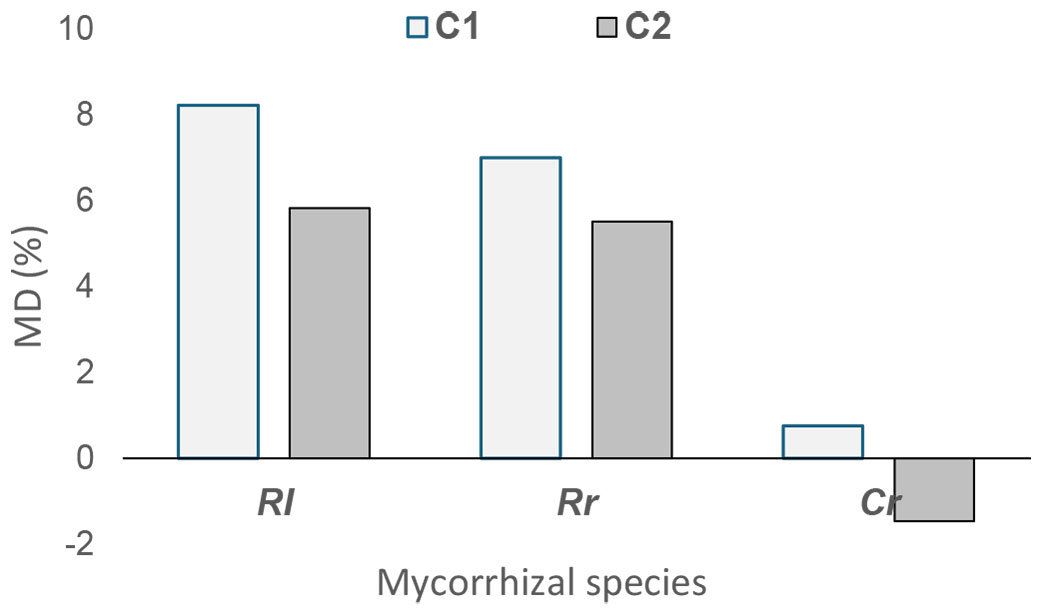
Compared to the C1 treatment, the highest MD (8.23%) value was observed in plants inoculated with R. luteolus, while the lowest MD (0.75%) occurred in those inoculated with C. rutilus (Fig. 3). Similarly, relative to the C2 treatment, the highest MD (5.83%) was again recorded in seedlings inoculated with R. luteolus, whereas the lowest MD (-1.47%) was found in those inoculated with C. rutilus.
Fig. 3 - Mycorrhizal dependency (MD) of P. nigra seedlings according to Control 1 and Control 2 treatments. Rhizopogon luteolus (Rl), Russula raoultii (Rr), Chroogomphus rutilus (Cr), Control 1 (C1), Control 2 (C2).
Spearman’s correlation analysis revealed that most measured variables were positively correlated with each other. SUR of seedlings showed a positive correlation with all other variables. D and H of seedlings were positively correlated with all variables except for MRC (Tab. 4).
Tab. 4 - Pearson correlation coefficients (r) of morphological parameters of black pine seedlings. D (root collar diameter), H (shoot height), SUR (survival rate), SDW (shoot dry weight), RDW (root dry weight), S/R (shoot/root ratio), RSA (root surface area), RLN (root length), MRC (mycorrhizal root colonization). (*): p≤0.05; (**): p≤0.01; (***): p≤0.001. (ns): non-significant.
| - | D | H | SUR | SDW | RDW | S/R | RLN | RSA |
|---|---|---|---|---|---|---|---|---|
| H | 0.820*** | - | - | - | - | - | - | - |
| SUR | 0.737*** | 0.810*** | - | - | - | - | - | - |
| SDW | 0.888*** | 0.833*** | 0.724*** | - | - | - | - | - |
| RDW | 0.739*** | 0.665** | 0.539** | 0.671** | - | - | - | - |
| S/R | 0.301* | 0.339* | 0.366* | 0.516** | -0.271ns | - | - | - |
| RLN | 0.369* | 0.360* | 0.374* | 0.286ns | 0.608** | -0.286ns | - | - |
| RSA | 0.491* | 0.470* | 0.385* | 0.349* | 0.644** | -0.269ns | 0.905*** | - |
| MRC | 0.094ns | 0.170ns | 0.338* | 0.072ns | 0.096ns | 0.040ns | 0.345ns | 0.222ns |
Discussion
In this study, seedlings originated from Egirdir (O3) exhibited the lowest values across all parameters, except for root infection; this may be attributed to the fact that the smallest seeds were those from Egirdir. Mycorrhizal treatments solely influenced the diameter and height growth of seedlings from Egirdir. It is well known that larger seeds germinate more quickly than smaller ones, produce seedlings with higher growth rates, and promote greater root development in young plants ([32], [1]). Urgenç ([52]) also suggested that seedlings grown from large seeds benefited from having a stronger embryo and endosperm containing greater amounts of nutrients. Bernier et al. ([5]) emphasized that the shoot/root ratio can be used to evaluate seedlings’ potential to avoid drought; they recommended that the S/R ratio be lower than 2 in arid areas ([52]). This study aimed to produce seedlings for improved establishment success in semi-arid areas. The average shoot/root ratio of 0.94 and a root-to-whole seedling ratio exceeding 50% may indicate that the seedlings were morphologically acceptable for planting in such environments.
The effects of mycorrhizal treatments on plant growth and survival are quite complex, and the results may be contradictory. Wang et al. ([54]) reported that ectomycorrhiza decreased the mortality rate and increased height, root biomass, and leaf biomass of pine seedlings under moderate and severe drought stress. Similarly, Pera et al. ([34]) indicated that the positive effects of inoculation on height, root collar diameter, and trunk volume of Douglas fir (Pseudotsuga menziesii) seedlings continued even after 5 years of field growth. However, Rincón et al. ([38]) found that inoculation of mycorrhizal species (Melanogaster ambiguus, Pisolithus tinctorius) had no effect on the development of Pinus pinea seedlings. There is marked variability in response depending on the nature of the fungus-plant relationship ([51], [6], [13], [48]). Ortega et al. ([31]) indicated that different fungal associations do not each provide similar benefits to host plants. Different results in terms of plant survival and growth can be obtained depending on the EMF strains and plant hosts used ([28], [46]).
A wide range of studies has indicated that mycorrhizal infections increase seedling survival rates ([16], [47], [25], [14], [39], [15]). Seedling survival in this study was significantly affected by both origin and mycorrhizal inoculation, and the interaction was also significant. The Egirdir origin had the smallest seeds and seedlings, as well as the lowest survival rates, while the R. luteolus treatment consistently had the highest survival across all origins. The effect of R. luteolus was more obvious in the seedlings from Egirdir. In this origin control, seedlings (C1) had the lowest survival rate, at 63%, and the application of R. luteolus increased this to 81%. This may indicate that the effects of mycorrhizae are more pronounced in weaker seedlings.
Mycorrhizal inoculation of seedlings from Erdemli effectively increased root surface area. Total root length of the seedlings was significantly affected by both origins and mycorrhizal inoculation. Seedlings in the R. luteolus mycorrhiza treatment had the longest roots, while those in the C2 treatment had the shortest roots. A strong root system, particularly one rich in fine roots, is crucial for successful plantation establishment. Seedlings with well-developed root systems can absorb more water and nutrients, exhibiting improved root growth potential after planting ([17]).
Mycorrhizal root colonization also differed significantly between the inoculation treatments. Mycorrhizal-inoculated seedlings formed higher mycorrhizal roots, up to 74%, as expected. Turjaman et al. ([49]) detected 30% infection in the roots of control treatments and over 87% in mycorrhizal-inoculated Shorea pinanga seedlings. Parkash et al. ([33]) found a 25% infection rate in Eucalyptus saligna control treatments. Ruehle & Marx ([40]) determined 18% mycorrhizal infection in the control treatment of pine seedlings. In this study, control seedlings (C1: sterilized medium with no inoculation) had a very low infection rate (1.6%), indicating that mycorrhizal infection from natural sources during the study period was negligible under these nursery conditions. On the other hand, the 27% root infection rate in the C2 treatment was likely due to the use of unsterilized growth medium, which may have contained live native spores at the start of the trial. Nevertheless, the difference between C2 and other inoculation treatments remained substantial (up to 48%), indicating that the ordinary non-sterilized growing medium used in the nurseries does not provide sufficient spores or suitable conditions for mycorrhizal symbiosis.
The MD findings were consistent with other morphological variables measured in the seedlings. All growth variables and MD values of seedlings grown on sterilized substrates were higher. Ortas ([29]) stated that soil sterilization has a significant effect on plant growth and the development of mycorrhizal fungi by removing other soil microorganisms that compete with plant roots for nutrients and other beneficial organic materials. Many studies have suggested that soil sterilization increases plant growth ([42], [22], [30], [50]). It is known that mycorrhizal species cannot create similar root infections in every plant with the same efficiency. Many mycorrhizal fungi are selective regarding the plant species they infect ([45]). The varied responses of mycorrhizal fungi used for inoculation may result from infection by a mixture of fungal species, individual fungal species, or physiological differences among plant species.
Conclusions
It is likely that forests and afforestation projects will face additional stresses in the future due to rising temperatures and associated droughts. It is critical, therefore, that planted tree seedlings are healthy, resistant to stresses, and survive well after planting. In this study, we inoculated black pine seedlings with native EMF’s collected and isolated from pine stands to determine their impacts on the growth and survival of the seedlings to be planted in semi-arid areas. Mycorrhizal colonization of seedling roots led to improved survival rates over the two-year trial period. While most seedling characteristics showed no differences between the Beysehir and Erdemli provenances, significant differences were observed for the Egirdir origin, indicating the importance of inoculum-host plant interactions. Mycorrhizal dependency values indicated that Rhizopogon luteolus and Russula raoultii had positive effects on seedling morphology. These results suggest that the effects of mycorrhizal treatments on seedling growth and survival may depend on seed origin, and that weaker plants may benefit more from mycorrhizal symbiosis.
For successful afforestation, seedlings associated with mycorrhizal fungi should be produced in nurseries. However, not all EMFs may be suitable for restoration efforts. Identifying mutualistic symbioses between native mycorrhizal fungi and trees is an important step toward restoring forest areas under extreme conditions. More research is needed on the habitat adaptation of various mycorrhizal associations to increase the success of afforestation efforts in dry and semi-arid areas.
List of abbreviations
EMF: ectomycorrhizal fungi; D (root collar diameter); H (shoot height); SDW (shoot dry weight); RDW (root dry weight); S/R (ratio of shoot dry weight and root dry weight); RSA (root surface area); RLN (root length); SUR (survival rate); MRC (mycorrhizal root colonization); MD: mycorrhizal dependency; C1: no mycorrhizal inoculation of sterile substrate; C2: no mycorrhizal inoculation of the non-sterile substrate; O1: Beysehir origin; O2: Erdemli origin; O3: Egirdir origin.
Acknowledgements
We are grateful to Stephen Woodward for his insightful comments, which significantly improved the quality of this manuscript. We also thank forest engineers H. Cemal Gültekin, Osman Polat, and Sevda Polat for their contributions to the laboratory and nursery work. The study was supported by the Scientific and Technical Research Council of Turkey (TUBITAK) project no. TOVAG-109O425.
References
Gscholar
Gscholar
CrossRef | Gscholar
Gscholar
Gscholar
CrossRef | Gscholar
Gscholar
Gscholar
Authors’ Info
Authors’ Affiliation
Ali Topal 0000-0003-0265-8511
Eastern Mediterranean Forestry Research Institute, Karabucak, Tarsus (Turkey)
Isparta University of Applied Sciences, Forestry Faculty, Department of Silviculture, Isparta (Turkey)
Corresponding author
Paper Info
Citation
Tüfekçi S, Gürlevik N, Topal A (2026). Root colonization and growth response of Pinus nigra seedlings to three types of ectomycorrhizal inoculum. iForest 19: 269-275. - doi: 10.3832/ifor4728-019
Academic Editor
Federica Brunoni
Paper history
Received: Sep 20, 2024
Accepted: Feb 10, 2026
First online: Jul 23, 2026
Publication Date: Aug 31, 2026
Publication Time: 5.43 months
Copyright Information
© SISEF - The Italian Society of Silviculture and Forest Ecology 2026
Open Access
This article is distributed under the terms of the Creative Commons Attribution-Non Commercial 4.0 International (https://creativecommons.org/licenses/by-nc/4.0/), which permits unrestricted use, distribution, and reproduction in any medium, provided you give appropriate credit to the original author(s) and the source, provide a link to the Creative Commons license, and indicate if changes were made.

Web Metrics
Breakdown by View Type
Article Usage
Total Article Views: 2360
(from publication date up to now)
Breakdown by View Type
HTML Page Views: 798
Abstract Page Views: 864
PDF Downloads: 602
Citation/Reference Downloads: 0
XML Downloads: 96
Web Metrics
Days since publication: 93
Overall contacts: 2360
Avg. contacts per week: 177.63
Article Citations
Article citations are based on data periodically collected from the Clarivate Web of Science web site
(last update: Jul 2026)
(No citations were found up to date. Please come back later)
Publication Metrics
by Dimensions ©
Articles citing this article
List of the papers citing this article based on CrossRef Cited-by.
Related Contents
iForest Similar Articles
Research Articles
Fertilisation of Quercus seedlings inoculated with Tuber melanosporum: effects on growth and mycorrhization of two host species and two inoculation methods
vol. 10, pp. 267-272 (online: 13 December 2016)
Research Articles
Effects of substrate and ectomycorrhizal inoculation on the development of two-years-old container-grown Norway spruce (Picea abies Karst.) seedlings
vol. 8, pp. 487-496 (online: 10 November 2014)
Research Articles
The combined effects of Pseudomonas fluorescens CECT 844 and the black truffle co-inoculation on Pinus nigra seedlings
vol. 8, pp. 624-630 (online: 08 January 2015)
Research Articles
Forest litter as the mulch improving growth and ectomycorrhizal diversity of bare-root Scots pine (Pinus sylvestris) seedlings
vol. 8, pp. 394-400 (online: 20 August 2014)
Research Articles
Fungal and bacterial communities in a forest relict of Pinus pseudostrobus var. coatepecensis
vol. 16, pp. 299-306 (online: 09 November 2023)
Research Articles
Maximizing growth of Acacia confusa through native plant growth-promoting bacterial inoculation and seed pelleting for revegetation in landslide areas
vol. 19, pp. 28-37 (online: 11 January 2026)
Research Articles
Ectomycorrhizal fungal community in mature white poplar plantation
vol. 14, pp. 540-547 (online: 26 November 2021)
Research Articles
Ectomycorrhizal diversity in a mature pedunculate oak stand near Morović, Serbia
vol. 16, pp. 345-351 (online: 22 November 2023)
Research Articles
Forecasting the field performance of Austrian pine seedlings using morphological attributes
vol. 10, pp. 99-107 (online: 13 October 2016)
Research Articles
Optimum light transmittance for seed germination and early seedling recruitment of Pinus koraiensis: implications for natural regeneration
vol. 8, pp. 853-859 (online: 22 May 2015)
iForest Database Search
Search By Author
Search By Keyword
Google Scholar Search
Citing Articles
Search By Author
Search By Keywords
PubMed Search
Search By Author
Search By Keyword