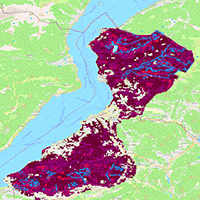
Assessing forest resilience after windthrow: linking deadwood, regeneration, and landscape-scale susceptibility - A case study in a Pre-Alpine forest in Italy
Thu Uyen Bui , Giorgio Vacchiano
iForest - Biogeosciences and Forestry, Volume 19, Issue 2, Pages 102-113 (2026)
doi: https://doi.org/10.3832/ifor4982-019
Published: Apr 07, 2026 - Copyright © 2026 SISEF
Research Articles
Abstract
Severe windstorms account for nearly half of all damage to European forests. South of the Alps, windstorms such as Storm Vaia in 2018 and Storm Alex in October 2020 have left forest managers uncertain on how to assist habitat recovery and how to prevent further damage in the intact portions of the forest. Since storms did not occur regularly in this part of Europe, questions remain about whether to remove windthrown deadwood and which stand, topographic, and microclimatic traits most strongly predispose forests to future windthrow. This study investigates the characteristics affecting the likelihood of windthrow and the effects of windthrow severity on forest regeneration and habitat recovery across three study sites in Alto Verbano, Lombardy, Italy. The objectives of the study were twofold: (i) to examine the relationship between deadwood accumulation and forest regeneration, and (ii) to assess the influence of forest structure, topography, and microclimate on windthrow susceptibility. We combined field sampling with drone-based optical imagery to collect detailed data on deadwood biomass and cover, as well as forest regeneration. We investigated the relationship between deadwood and regeneration indices using Generalized Linear Models and Structural Equation Modeling to test for effects both direct and indirect, i.e., through changes in topographical and environmental factors. To assess windthrow susceptibility, we used Sentinel-2 satellite data, integrated with microtopographic information from satellite products, to assess landscape-level vulnerability to windthrow using non-parametric machine learning methods. The results reveal a negative influence of deadwood on regeneration, irrespective of topographical features and threats to regeneration levels at the sites (i.e., ungulate browsing). On the other hand, forest structure, topography, and microclimate had a critical role in determining forest vulnerability to windthrow. These findings emphasize the importance of carefully considering deadwood management and future forest structural features when carrying out forest restoration actions. Assessing the consequences of deadwood accumulation and understanding forest vulnerability to windthrow are essential for optimizing forest regeneration and resilience.
Keywords
Post-windthrow, Forest Recovery, Ecological Resilience, Deadwood-regeneration Relationship
Authors’ Info
Authors’ address
Giorgio Vacchiano 0000-0001-8100-0659
Forest Lab, Department of Agricultural and Environmental Sciences, University of Milan (Italy)
Corresponding author
Paper Info
Citation
Bui TU, Vacchiano G (2026). Assessing forest resilience after windthrow: linking deadwood, regeneration, and landscape-scale susceptibility - A case study in a Pre-Alpine forest in Italy. iForest 19: 102-113. - doi: 10.3832/ifor4982-019
Academic Editor
Marco Borghetti
Paper history
Received: Sep 09, 2025
Accepted: Feb 01, 2026
First online: Apr 07, 2026
Publication Date: Apr 30, 2026
Publication Time: 2.17 months
Copyright Information
© SISEF - The Italian Society of Silviculture and Forest Ecology 2026
Open Access
This article is distributed under the terms of the Creative Commons Attribution-Non Commercial 4.0 International (https://creativecommons.org/licenses/by-nc/4.0/), which permits unrestricted use, distribution, and reproduction in any medium, provided you give appropriate credit to the original author(s) and the source, provide a link to the Creative Commons license, and indicate if changes were made.

Web Metrics
Breakdown by View Type
Article Usage
Total Article Views: 3441
(from publication date up to now)
Breakdown by View Type
HTML Page Views: 783
Abstract Page Views: 1312
PDF Downloads: 1227
Citation/Reference Downloads: 0
XML Downloads: 119
Web Metrics
Days since publication: 198
Overall contacts: 3441
Avg. contacts per week: 121.65
Citation Metrics
Article Citations
Article citations are based on data periodically collected from the Clarivate Web of Science web site
(last update: Jul 2026)
(No citations were found up to date. Please come back later)
Publication Metrics
by Dimensions ©
Articles citing this article
List of the papers citing this article based on CrossRef Cited-by.
References
Schutzwirkung und Resilienz von Gebirgswäldern nach natürlichen Störungen [Protective effect and resilience of mountain forests after natural disturbances]. In: “Aus Störungen und Extremereignissen im Wald lernen” [Protective effect and resilience of mountain forests after natural disturbances] (Bebi P, Schweier J eds). WSL Berichte, WSL, Birmensdorf, Switzerland, vol. 144, pp. 41-48. [in German]
Gscholar
Ungulati selvatici e foresta: i danni prodotti alla rinnovazione forestale del Parco [Wild ungulates and the forest: the damage caused to the park’s forest regeneration]. Ente Parco Naturale Paneveggio - Pale di San Martino, Belluno, Italy, pp. 51-65. [in Italian]
Gscholar
Remote sensing role in emergency mapping for disaster response. In: “Engineering Geology for Society and Territory - Volume 5. Urban Geology, Sustainable Planning and Landscape Exploitation” (Lollino G, Manconi A, Guzzetti F, Culshaw M, Bobrowsky P, Luino F eds). Springer International Publishing, Cham, Switzerland, pp. 17-24.
CrossRef | Gscholar
Analysis of the capacity of habitats for reconstruction and long-term resistance to pressures of windthrow and the presence of ungulates. Technical Report, Department of Agricultural and Environmental Sciences, Production, Land, and Agroenergy (DiSAA), University of Milan, Italy.
Gscholar
Windthrow-induced changes in faunistic biodiversity in alpine spruce forests. Forest Snow and Landscape Research 77 (2): 117-131.
Gscholar
Windthrow effects on biodiversity of natural forest ecosystems at a local scale. Human and Environment 9: 65-72.
Gscholar
Surviving trees and deadwood moderate changes in soil fungal communities and associated functioning after natural forest disturbance and salvage logging. Soil Biology and Biochemistry 166: 108558.
CrossRef | Gscholar
Comparison of vulnerability to catastrophic wind between Abies plantation forests and natural mixed forests in northern Japan. Forestry 92 (4): 436-443.
CrossRef | Gscholar
Significant increase in natural disturbance impacts on European forests since 1950. Global Change Biology 29 (5): 1359-1376.
CrossRef | Gscholar
Patterns and drivers of recent disturbances across the temperate forest biome. Nature Communications 9: 4355.
CrossRef | Gscholar
Related Content
Latifi H, Galos B
Vol. 3, pp. 98-101 (online: Jul 2010)
Corona P, Lamonaca A, Chirici G
Vol. 1, pp. 6-12 (online: Feb 2008)

Ciesielski M, Sterenczak K
Vol. 12, pp. 498-510 (online: Dec 2019)

Jackson CM, Adam E
Vol. 13, pp. 286-300 (online: Aug 2020)

Martin H, Labbé S, Baldet P, Archaux F, Philippe G
Vol. 10, pp. 215-219 (online: Feb 2017)
Mancino G, Nolè A, Urbano V, Amato M, Ferrara A
Vol. 2, pp. 154-161 (online: Jul 2009)
Cavalli A, Francini S, Cecili G, Cocozza C, Congedo L, Falanga V, Spadoni GL, Maesano M, Munafò M, Chirici G, Scarascia Mugnozza G
Vol. 15, pp. 220-228 (online: Aug 2022)
Martin H, Monnet JM, De Boisvilliers M, Chevalier R, Villar M
Vol. 13, pp. 409-416 (online: Oct 2020)
Figueiredo De Souza RL, Dionizio EA, Lopes Cavalcante RB
Vol. 19, pp. 85-93 (online: Apr 2026)

Ürker O, Tavsanoglu C, Gürkan B
Vol. 11, pp. 635-642 (online: Oct 2018)