
The impact of Sorbaria sorbifolia invasions on soil seed banks in the southern taiga of Eurasia
iForest - Biogeosciences and Forestry, Volume 19, Issue 4, Pages 276-282 (2026)
doi: https://doi.org/10.3832/ifor4791-019
Published: Jul 27, 2026 - Copyright © 2026 SISEF
Research Articles
Abstract
This study aimed to assess how the invasion of the shrub Sorbaria sorbifolia affects the soil seed bank in the urban forests of Ekaterinburg (Middle Urals, Russia). We compared species composition and abundance in the above-ground vegetation and seed banks across three forest vegetation types: those dominated by the invasive shrub S. sorbifolia, those dominated by the native shrub Rubus idaeus, and those without either species. In the presence of S. sorbifolia, the total cover of plants in the herb-dwarf shrub layer decreased by two orders of magnitude, the species richness decreased by 4-6 times, and the number of above-ground vegetation species decreased by 3-4 times. The species composition of the seed banks differed qualitatively from that of the above-ground vegetation and showed little relationship with the different vegetation types. While the species composition and richness of the seed bank remained unaltered by the S. sorbifolia invasion, its size was significantly decreased by 2.0-2.4 times. The ability to negatively affect the abundance of soil seed banks demonstrates that S. sorbifolia can be reasonably categorized as a transformer species. Therefore, this invasive plant requires special attention, as its further dispersal could have major consequences for native vegetation.
Keywords
Alien Plants, Invasive Plants, Biodiversity, Urbanized Forests, Clonal Plants, Above-ground Vegetation, Seed Bank, Sorbaria sorbifolia
Introduction
The influence of invasive plants on natural communities has been studied primarily at the level of above-ground vegetation composition and structure ([38]). Few studies have examined the impact of invasive plants on seed banks, which are reservoirs of propagules for community recovery after disturbance ([42], [12], [2]). The impact of invasive plants on seed banks can be low ([12], [20]), but is more commonly observed to decrease seed bank density, species richness, or species diversity ([8], [5]). Seed bank composition can be affected by seed contributions from invasive species ([32]), changes in the overstory community composition, and the availability of basic resources ([10]).
Invasive plants with active seed propagation often form seed banks that provide the genetic diversity necessary to overcome various barriers to their persistence ([11]). However, the invasion of some plant species can occur exclusively through vegetative propagation. An example of such a species is the perennial Reynoutria japonica Houtt., which originated in East Asia and has become one of the three most invasive terrestrial plants in the UK, with no recorded seed deposition ([26]).
Sorbaria sorbifolia (L.) A. Braun is an invasive shrub that propagates mainly vegetatively outside its native habitat, but it has high seed productivity and germination rates. Based on the species ontogenesis analysis, we classified S. sorbifolia as a geoxylic, vegetatively mobile shrub ([36]). Its natural range covers Western and Eastern Siberia, the Far East, Kamchatka, Japan, Korea, China, and Central Asia. It grows along shores, in forests, and at forest edges ([9]). Outside its natural range, it is considered an invasive species (colonophyte) in central Russia ([40]) and a transformer species in the European part of Russia ([28]), where S. sorbifolia can be found on roadsides, in suburban forests, parks, and wastelands. This species was introduced in Europe as an ornamental plant in the mid-XVIII century ([40]), but has now been recorded as invasive in Poland ([35]), Latvia ([18]), Lithuania ([7]), and Finland ([22]). In Latvia, S. sorbifolia is considered a threat to native species ([18]), whereas in Belarus it poses a high invasion risk, with extensive thickets reported in some regions. Additionally, it is recognized as capable of becoming adventive in North America ([15]).
S. sorbifolia naturally ranges 1000-1500 km east of Ekaterinburg, where it was introduced in the late 1950s and has since spread as thickets to many forest parks. It is known for its pollution resistance ([25]), and it is commonly used in landscaping, leading to its expansion beyond its native range and resulting in invasions of natural vegetation. However, the impacts of S. sorbifolia invasion on local plant communities remain underexplored.
Few studies have examined the impact of S. sorbifolia on the species composition of the herb and dwarf shrub layer within its thickets. Research indicates that species richness and coverage are significantly reduced beneath its crowns ([22], [36]) due to its ability to form dense thickets ([24]) and high shading capacity ([37]). Lanta et al. ([23]) reported that within S. sorbifolia thickets, the litter’s chemical makeup differs from that of the native Rubus idaeus, leading to a slower decomposition rate of the leaf litter. This effect may be associated with high levels of toxic hydrogen cyanide in the leaves of S. sorbifolia ([19]), which may have ecosystem-wide effects.
Invasive species can significantly affect the species composition of seed banks ([12], [21]). A greater understanding of the long-term consequences of S. sorbifolia invasion is required to develop effective measures to contain it. A previous study indicated that S. sorbifolia did not affect the composition of soil seed banks ([36]). However, this initial research depended on a relatively small number of observations, which may have led to underestimating small but significant effects. The objective of this study was to characterize changes in the soil seed bank associated with the invasion of S. sorbifolia. Specifically, the following questions were formulated: (i) How are the species composition of the seed bank and the above-ground vegetation of the studied forest vegetation types related to each other? (ii) Is the seed bank species composition or seed number altered in S. sorbifolia-dominated vegetation types relative to non-invaded vegetation types?
Materials and methods
Study area
The study was conducted in Ekaterinburg (Russian Federation), a large city with a population of 1.5 million, in the southern taiga subzone of the boreal zone of the Middle Urals. The climate is moderately continental; the annual average temperature is +3 °C, with a January average of -12.6 °C and a July average of +19.0 °C, and the average annual precipitation is 537 mm. Pine herb forests, pine herb-dwarf shrub forests, and pine green moss forests on sod-podzolic and brown forest soils prevail in the vicinity of the city. Pollution levels in the city are high due to numerous industrial enterprises and a dense transportation network.
Forest vegetation was studied in Uktussky and Yugo-Zapadny Forest Parks. The prevailing vegetation in these territories consists of pine stands that are remnants of formerly primary Pinus sylvestris forests dating to before the onset of urban development. The stands are relatively even-aged, with most trees 90-120 years old. Uktussky Forest Park is located on the southern outskirts of the city, 7-11 km from the center, and partially borders suburban forests. The forest park lies in the northern part of the Uktus Mountains, where basic and ultrabasic rocks are exposed at the ground surface in some areas. Yugo-Zapadny Forest Park is located 5-7 km from the city center and is surrounded by areas that have been heavily developed over the last 45-50 years. The relief is gently sloping; soils are typical, podzolized, brown, slightly to medium stony, and well-drained.
Pine forests in Uktussky Forest Park have a herb-dwarf shrub layer (total cover: 70%-85%) with a high abundance of typical forest and forest-margin species (Calamagrostis arundinacea, Vaccinium myrtillus, Brachypodium pinnatum, Carex digitata, Pteridium latiusculum, Rubus saxatilis) and a shrub layer (total cover: 1%-50%) with native species such as Rosa acicularis, R. majalis, Rubus idaeus and alien species like Cotoneaster lucidus, Ribes alpinum, etc. The herb layer of pine forests in the Yugo-Zapadny Forest Park has a total cover of 40%-90% and is dominated by Calamagrostis arundinacea, Carex montana, Glechoma hedera-cea, Aegopodium podagraria, and Urtica dioica. A common feature of the communities in both forest parks is a pronounced layer of tall shrubs and understory trees that includes many alien species. The moss layer is fragmentary ([36]).
Experimental design
We selected several sites in the Uktussky and Yugo-Zapadny forest parks, taking care of including the three types of vegetation therein: those dominated by S. sorbifolia thickets (henceforth: “S.sor.”) had sizes ranging from 20×30 m2 to 50×100 m2 and, on average, an above-ground density of 22 shoots m2. Forest vegetation dominated by Rubus idaeus L. (“R.ida.”) was chosen as a phylogenetically related species (family Rosaceae) with the same life form (geoxylic vegetatively mobile shrub). Forest vegetation without either of the above species (“forest”) was selected for comparison.
The above-ground vegetation was recorded in June-July 2019 for each vegetation type at the three selected sites (two sites in Uktussky Forest Park and one in Yugo-Zapadny Forest Park) and six sites in 2020 (three in Uktussky and three in Yugo-Zapadny). At each site, three replicate 10 m2 plots were used. In 2019, three sites were studied, and three relevés (in S.sor., R.ida., and forest) were made at each site, i.e., nine relevés in total. In 2020, three more sites were added to the three previously studied sites, and three vegetation types were also studied at each site. The sites studied in 2019 were investigated again in 2020. A total of 18 relevés were completed in 2020.
The aboveground species composition and total plant cover (%) were recorded. Species richness was estimated as the number of species per 100 m2, and the Shannon index was calculated. Species were grouped based on: (i) life forms, divided into the broad groups of shrubs (shrubs, dwarf shrubs, and dwarf semishrubs), herbs (dicotyledonous and monocotyledonous herbaceous plants with broad leaves), graminoids (grasses, sedges, and rushes), and cryptogams (ferns, club mosses, and horsetails); and (ii) seed dispersal mode, divided into autochores, anemochores, and zoochores ([41]). Plant names were given according to Govaerts ([15]).
The seed banks of each plot were assessed in the 0-5 cm layer where most viable seeds accumulated ([8]). After the removal of surface forest litter, three replicate samples of 2 dm3 each were collected from each plot to obtain a representative measure of species diversity ([31], [21]). The samples were taken from plots separated by several meters. Overall, we collected 27 soil samples in 2019 (3 sites × 3 plots × 3 samples) and 54 in 2020 (6 sites × 3 plots × 3 samples). The distance between the sites was 140-300 m in Uktussky Forest Park and 70-2.570 m in Yugo-Zapadny Forest Park. The distance between the Forest Parks was ~ 7 km.
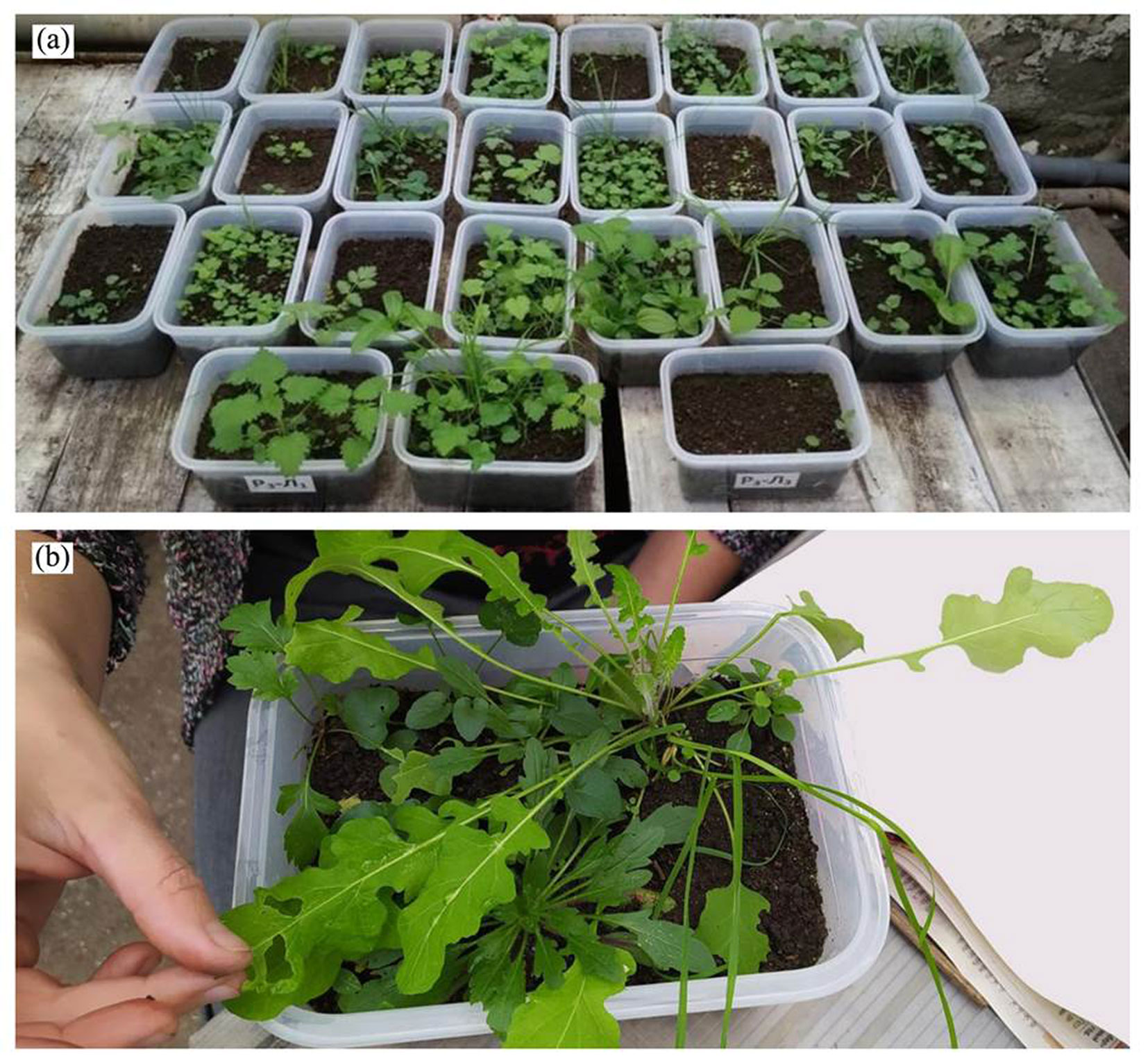
The seed bank samples were analyzed using the seedling emergence technique ([34]). Briefly, each soil sample was sieved through a 5-8 mm mesh sieve to remove residual litter, and then placed in a 20 × 15 × 10 cm pot (~2 dm3 soil per pot) under greenhouse conditions with moderate irrigation (Fig. 1). Seedling germination was assessed once a month for four months after placement. Each month, emergent seedlings were removed for plant identification, which, in some cases, was limited to the genus level. Those that could not be taxonomically distinguished during germination were replanted in separate pots for later identification based on post-germinal aspects of morphology.
Fig. 1 - Seed bank vegetation pots in a polycarbonate greenhouse (a). Each pot (b) represents one independent soil sample (pot size 20 × 15 × 10 cm, soil volume in the pot 2 dm3).
Statistical analysis
In the statistical analysis of the above-ground vegetation and seed bank data, significance testing was conducted using the STATISTICA v. 8.0 package (StatSoft Inc., Tulsa, OK, USA). Two-way ANOVA with Tukey’s tests was used for pairwise comparisons of continuous mean values. The response variables were the richness and diversity of forest vegetation types, and the explanatory variables were forest vegetation types (S.sor., R.ida., forest) and years (2019, 2020). Categorical and proportional data were arcsine-transformed prior to ANOVA. χ2 tests were used to compare fractions, and the Pearson’s correlation coefficient (r) was calculated to assess the relationship between variables. The observation unit was: (i) the value of a variable in a relevé (i.e., in one study plot) when analyzing the above-ground vegetation; (ii) the average value of a variable in three vegetation pots with soil from one vegetation type when analyzing data on seedlings grown from the soil seed bank. Variables expressed in fractions were arcsine-transformed prior to ANOVA. Rarefaction curves were evaluated using the software EstimateS v. 9.1.0 (⇒ https://osf.io/su57f/overview).
The relationship between the above-ground vegetation and the seed bank was examined using non-metric multidimensional scaling (NMDS), which is considered the best method for graphical representation of floristic relationships ([4]). NMDS was built using a Jaccard’s similarity coefficient (J) based on the presence/absence of species to facilitate comparison of data types from the above-ground vegetation surveys (percent cover) and the below-ground soil seed bank surveys (count data). NMDS and J were calculated using PAST v. 2.17 software ([17]). J coefficients were first used to compare species composition between the soil seed bank and above-ground vegetation at each study site. Sørensen’s similarity index was then calculated as J = [2C/ (A + B - C)] × 100, where C is the number of species shared by both samples, and A and B are the number of species in samples A and B, respectively. The indices were statistically compared using a Kruskal-Wallis H test.
Results
Species richness of aboveground vegetation and seed banks
The lowest species diversity and total aboveground cover were found in S.sor. sites, with 4-6 times lower species richness (average number of species per 100 m2), a 2-2.5 times lower Shannon index, and 100-200 times lower ground cover in the herb-dwarf shrub layer (Tab. 1). Considering the data from all three types of forest vegetation, estimates of species richness and shrub layer cover showed a negative and significant correlation (r = -0.67; n = 27; p = 0.0001), whereas species richness and coverage by the herb-dwarf shrub layer were positively related (r = 0.90; n = 27; p < 0.0001).
Tab. 1 - Species richness and mean abundance estimates (± standard error) of forest vegetation types without Sorbaria sorbifolia and Rubus idaeus (forest), dominated by Rubus idaeus (R.ida.), and dominated by Sorbaria sorbifolia (S.sor.).
| Component | Characteristics | Forest vegetation types | Significance (P) in two-way ANOVA | ||||
|---|---|---|---|---|---|---|---|
| forest | R.ida. | S.sor. | Vegetation type (1) |
Year (2) |
(1)×(2) | ||
| Aboveground vegetation | Number of species of all layers per 100 m2 | 54.0 ± 2.8 | 37.2 ± 3.9 | 8.2 ± 1.5 | <0.0001 | 0.9801 | 0.4691 |
| Shannon index for the herb-dwarf shrub layer | 2.3 ± 0.1 | 1.9 ± 0.1 | 0.9 ± 0.1 | <0.0001 | 0.6695 | 0.3170 | |
| Total cover of aboveground parts, % | Shrubs and understory | 54.1 ± 16.2 | 109.8 ± 9.9 | 123.1 ± 9.0 | 0.0044 | 0.6461 | 0.8045 |
| Herb-dwarf shrub layer | 74.4 ± 5.2 | 43.2 ± 10.0 | 0.3 ± 0.1 | <0.0001 | 0.4669 | 0.2538 | |
| Seed bank | Number of species in three pots | 15.1 ± 1.2 | 12.1 ± 0.9 | 13.1 ± 1.7 | 0.3946 | 0.5060 | 0.7636 |
| Shannon index | 1.9 ± 0.2 | 1.3 ± 0.1 | 2.0 ± 0.2 | 0.0183 | 0.3895 | 0.8445 | |
| Number of seedlings in three pots, ind. | 109.0 ± 17 | 129.0 ± 24 | 53.0 ± 9 | 0.0136 | 0.9637 | 0.1672 | |
The species richness in seed banks did not differ significantly among the three vegetation types, although the Shannon indices were slightly higher in soils from S. sor. than in R.ida. However, the viable seed density (estimated over four months from germination tests) was 2-2.4 times lower in S.sor. than in the other vegetation types. Species richness and the density of viable seeds in seed banks were not correlated with each other (r = 0.06; n = 27; P = 0.7843).
Species compositions of aboveground vegetation and seed banks
The species composition of aboveground vegetation and seed banks differed qualitatively, as indicated by a low mean J coefficient (8.1% ± 4.7%) across vegetation types (Fig. 2). Two clusters of relevés stood out in the above-ground vegetation. A separate but not very compact cluster is the S. sor. relevés (the mean J similarity coefficient within this group was 31.0% ± 14.5%). The R.ida. and forest vegetation types were also not very homogeneous; the similarity coefficients within these types were 30.0% ± 9.4% and 37.5% ± 10.5%, respectively. The S.sor. differed significantly in species composition from the other types: the average J values were 8.8% ± 5.4% between S.sor. and forest, and 11.6% ± 7.1% between S.sor. and R.ida., while the average J value 32.8% ± 10.1% between R.ida. and forest was higher (H=10.3; n=108; df=2; p=0. 0059).
Fig. 2 - Two-dimensional non-metric multidimensional scaling (NMDS) ordination of soil seed banks and aboveground vegetation (stress value = 0.18). Ordination is based on presence/absence data. (Circles): above-ground vegetation; (squares): seed bank; (blue): forest vegetation type dominated by Sorbaria sorbifolia; (pink): dominated by Rubus idaeus; (green): without Sorbaria sorbifolia and Rubus idaeus.
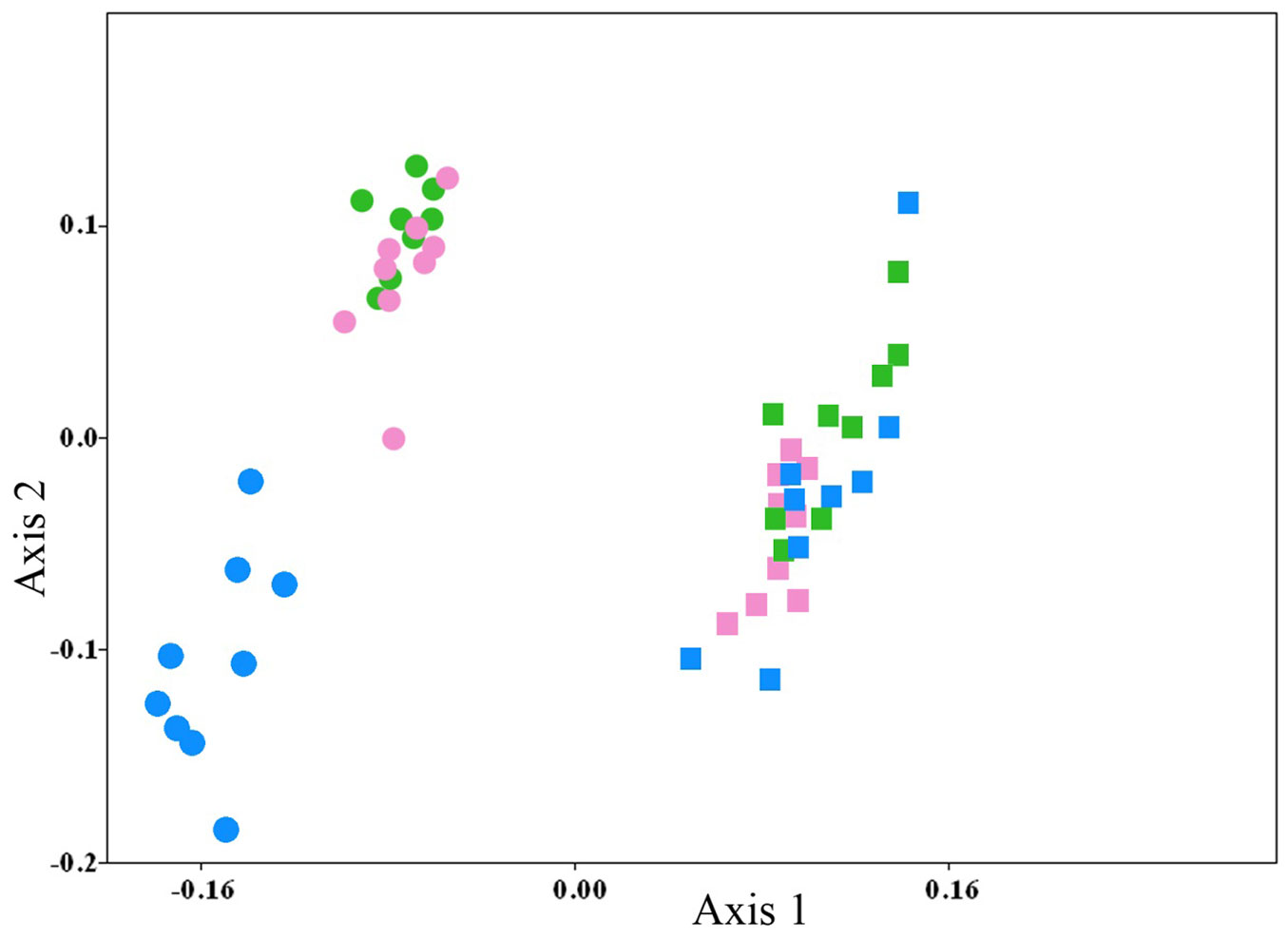
No noticeable features were found in the species composition of seed bank seedlings from different vegetation types. Within types, the average J values were low (26.0% ± 11.6% for S.sor., 28.9% ± 9.0% for R.ida., 25.0% ± 7.2% for forest) and between types were low too (26.1% ± 10.2% for S.sor. - R.ida., 23.6% ± 8.1% for S.sor. - forest, 25.8% ± 10.4% for R.ida. - forest). Seedling composition did not differ among S.sor., R.ida., and forest vegetation types (H=3.6; n=108; df= 2; p=0.1681). This is evidenced by the lack of divergence of seed bank-related points in the ordination diagram (Fig. 2).
The similarity of seed bank species composition to above-ground vegetation within vegetation types was generally low, as indicated by a low mean J coefficient (8.1% ± 4.7%). However, in R.ida. and forest vegetation types, the average J values were 12.0% ± 4.0% and 10.2% ± 3.1%, respectively. The similarity in species composition was significantly lower in S.sor. (J=5.5% ± 3.9%; H =85.5; n=243; df=2; p<0.0001).
Taxonomic diversity and group composition of aboveground vegetation and seed banks
Over both the study years, 155 species of higher plants belonging to 111 genera and 49 families were identified in the aboveground vegetation (Tab. 2). The seedling emergence assay indicated that seed banks contained half that number, with the identification of 72 species belonging to 53 genera and 24 families (see Tab. S1 in the Supplementary material for a complete list of species found in the above-ground vegetation and the seed banks).
Tab. 2 - Taxonomic diversity and group composition of above-ground vegetation and seed banks of forest vegetation types without Sorbaria sorbifolia and Rubus idaeus (forest), dominated by Rubus idaeus (R.ida.) or Sorbaria sorbifolia (S.sor.). Cumulative data for 2019-2020. The proportion of different life forms and dispersal modes is reported in parentheses.
| Group | Characteristics | Above-ground vegetation | Seed bank | ||||||
|---|---|---|---|---|---|---|---|---|---|
| total | forest | R.ida. | S.sor. | total | forest | R.ida. | S.sor. | ||
| Taxonomy | Number of species | 155 | 139 | 110 | 33 | 72 | 53 | 40 | 45 |
| Number of genera | 111 | 105 | 80 | 31 | 53 | 38 | 32 | 38 | |
| Number of families | 49 | 47 | 43 | 20 | 24 | 22 | 20 | 21 | |
| Life forms | Trees | 13 (8.4%) | 11 (7.9%) | 11 (10.0%) | 8 (24.2%) | 3 (4.2%) | 2 (3.8%) | 3 (7.5%) | 1 (2.2%) |
| Shrubs, dwarf shrubs | 25 (16.1%) | 19 (13.7%) | 21 (19.1%) | 6 (18.2%) | 4 (5.5%) | 2 (3.8%) | 2 (5.0%) | 4 (8.9%) | |
| Herbs | 91 (58.7%) | 84 (60.4%) | 62 (56.4%) | 11 (33.4%) | 56 (77.8%) | 43 (81.1%) | 27 (67.5%) | 34 (75.6%) | |
| Graminoids | 16 (10.3%) | 15 (10.8%) | 10 (9.1%) | 4 (12.1%) | 9 (12.5%) | 6 (11.3%) | 8 (20.0%) | 6 (13.3%) | |
| Cryptogams | 10 (6.5%) | 10 (7.2%) | 6 (5.4%) | 4 (12.1%) | 0 | 0 | 0 | 0 | |
| Seed dispersal modes |
Autochores | 45 (29.0%) | 42 (30.2%) | 30 (27.3%) | 6 (18.2%) | 32 (44.4%) | 23 (43.4%) | 15 (37.5%) | 20 (44.5%) |
| Anemochores | 60 (38.7%) | 53 (38.1%) | 35 (31.8%) | 14 (42.4%) | 22 (30.6%) | 16 (30.2%) | 14 (35.0%) | 14(31.1%) | |
| Zoochores | 50 (32.3%) | 44 (31.7%) | 45 (40.9%) | 13 (39.4%) | 18 (25.0%) | 14 (26.4%) | 11 (27.5%) | 11(24.4%) | |
Herbs formed the largest proportion of species (59%-78%) in both the aboveground vegetation and the seed banks. However, annual and biennial herbs were detected only in the seed banks. The proportion of woody plant species (including trees, shrubs, and dwarf shrubs) in the seed banks was also two times lower than in the aboveground vegetation. In terms of seed dispersal mode, the aboveground vegetation species were represented by autochores (including ballistae), anemochores, and zoochores in approximately equal proportions (29%-39% each). The seed bank was dominated by autochores (44%), with fewer anemochores (31%) and zoochores (25%). The proportion of autochores was significantly higher than the proportion of zoochores (χ2=6.01; df=1; p=0.0143).
We identified 49 species common to both the seed bank and the above-ground vegetation, primarily consisting of forest and edge species, including perennial herbs, graminoids, and woody plants. The most consistently observed species were Carex digitata, Fragaria vesca, Glechoma hederacea, Luzula pilosa, Poa palustris, P. pratensis, P. trivialis, Rubus idaeus, Urtica dioica, Veronica chamaedrys, and Viola nemoralis.
There were 106 species recorded only in the above-ground vegetation. The dominant above-ground vegetation species, including Aegopodium podagraria, Brachypodium pinnatum, and Rubus saxatilis, were not identified in seed banks. Conversely, 23 species were detected only in seed banks and consisted mostly of perennial, annual, or biennial herbs that are considered edge or ruderal species. These species did not contribute to many seedlings and appeared due to accidental drift. The most consistently detected species in this group were Androsace filiformis, Cardamine amara, Melilotus sp. (M. officinalis + M. alba), Sonchus arvensis, and Stellaria media. Of the species detected in the seed banks, 69% were represented by few seedlings (1-10). Of the seedlings, 73% belonged to five taxa: Betula sp. (6%, B. pendula + B. pubescens), Rubus idaeus (29%), Veronica chamaedrys (7%), Viola nemoralis (5%), and Urtica dioica (26%).
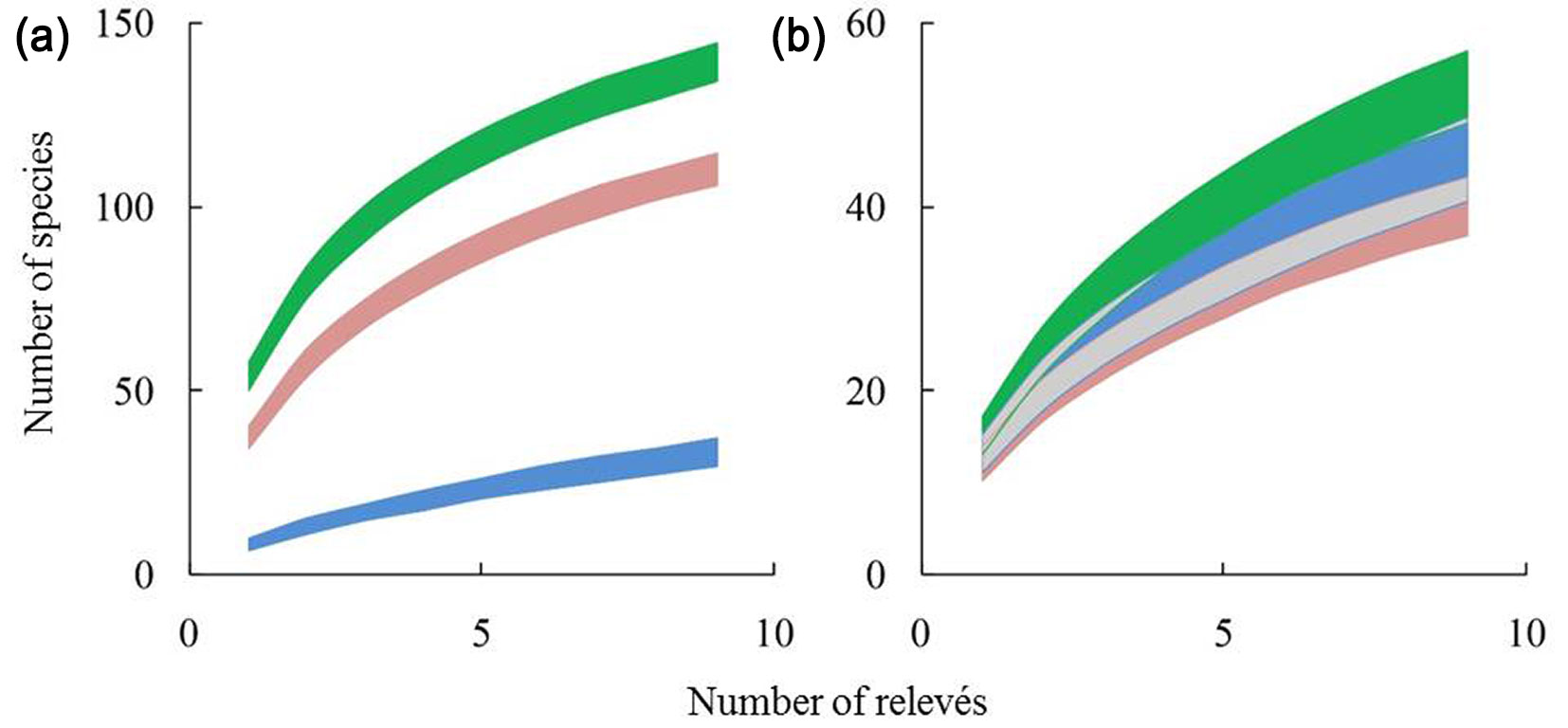
At the species level (Fig. 3), the taxonomic diversity in above-ground vegetation in S.sor. was four times lower (33 ± 4 species in nine relevés) than in the forest (139 ± 5 species in nine relevés). In contrast, the taxonomic diversity in seed banks differed little between the S.sor., R.ida., and forest vegetation types (40 ± 3 to 53 ± 4 species in nine plots). Changes in the diversity characteristics of seedlings from the soil seed bank due to the high abundance of S. sorbifolia were not observed either in the first year of the study or at the end of the two-year period.
Fig. 3 - Rarefaction curves of the number of detected aboveground vegetation species (a) and species from the soil seed bank (b) by increasing in the number of surveyed plots in forest vegetation types without Sorbaria sorbifolia and Rubus idaeus (forest - green fill), dominated by Rubus idaeus (R.ida., pink fill), and dominated by Sorbaria sorbifolia (S.sor., blue fill). The width of the bands correspond to 2×SD.
Discussion
Our results on the effect of S. sorbifolia invasion on species composition indicated that this invasive species had no significant impact on seed bank composition, which confirms our earlier study ([36]). However, aboveground taxonomic diversity in S. sorbifolia thickets was lower than in other forest habitats. In addition, the similarity between the aboveground vegetation and seed bank composition in the S. sorbifolia-dominated vegetation type was also lower than in other vegetation types in the local forest.
In both native vegetation types and S. sorbifolia thickets, the species composition of the seed bank and aboveground vegetation was observed to vary significantly. The presence of a small proportion of aboveground species in the seed bank is characteristic of forests ([29], [2]) and other plant communities ([42]). Seed banks in stable vegetation types are short-lived, and most forest species do not form a permanent seed bank ([33]). According to our estimates, the seed bank species composition across the three studied vegetation types was more similar to each other than to that of the above-ground vegetation. This pattern has also been reported in other seed bank studies ([14], [8]). Most species represented in the seed banks are herbaceous, while of the 13 tree and 25 shrub/dwarf shrub species observed in the aboveground vegetation, only 3 and 4, respectively, were detected in the seed banks. This agrees with the generally observed predominance of herbs and the low representation of woody species in forest seed banks ([2]). The composition of the above-ground vegetation and the seed banks differed in seed dispersal mode, with the seed banks showing a significantly higher number of autochores. The invasion of plant communities by Stenotaphrum secundatum (Walter) Kuntze was shown to reduce the number of seed-bank zoochores in endangered coastal swamp forest seed banks of eastern Australia ([14]). However, our study indicated that the group ratio, based on seed dispersal mode in seed banks, was unaffected by S. sorbifolia invasion.
We observed inconsistencies between the species composition of the aboveground vegetation and that of the seed banks. Some dominant species in the herb and dwarf shrub layers were absent from their corresponding seed banks. This could be due to reduced seed production from asexual reproduction (e.g., Aegopodium podagraria) or because some species require specific germination conditions not tested in our assays (Brachypodium pinnatum needs long cold stratification), or both (Rubus saxatilis) ([27]). The most abundant and common species in the seed bank of pine forests are pioneer species such as Betula sp., Luzula pilosa, Rubus idaeus, and Urtica dioica, which usually germinate en masse when the tree canopy is disturbed. These species are often found in the seed banks of boreal forests that have experienced some anthropogenic impact ([16]). The large number of seeds of these species in the soil can be explained by their survival from previous stages of community development and by the presence of fruiting individuals in the modern urbanized vegetation of Ekaterinburg.
Based on two years of observations (2.626 seedlings), we obtained statistically reliable evidence of a decrease in the seed bank abundance in S. sorbifolia-invaded forest vegetation. This contrasts with our earlier study, which was based on fewer observations and failed to detect any significant differences ([36]). However, the effects of S. sorbifolia invasion on seed bank density were not accompanied by any significant alterations to the seed bank species richness and diversity. This distinguishes S. sorbifolia from many invasive plants that negatively affect all seed bank characteristics ([12], [8], [5], [1]). The effects of S. sorbifolia on the seed bank are consistent with those of the invasive shrub, Cytisus scoparius (L.) Link, which has also been reported to decrease seed bank density without significantly affecting species richness in subalpine vegetation ([42]).
According to our observations, S. sorbifolia contributes little to the seed banks in the local forests of Ekaterinburg (4 S. sorbifolia seedlings were identified in 2019 and 26 in 2020). This contrasts with other invasive shrubs such as Cytisus scoparius ([42]), Rhododendron maximum L. ([5]), and Nicotiana glauca Graham ([1]) and likely reflects the predominantly asexual propagation of S. sorbifolia outside its native range ([24]). It is known that clonal invasive plant species usually have a stronger impact on the species richness of native communities compared to sexually reproducing invasive plants ([39]), which is consistent with our observations.
Generally, it is acknowledged that without replenishing seed stocks from vegetation, the number of viable seeds in seed banks will decline exponentially due to aging and the effects of phytophages and pathogens. ([30]). The displacement of native species from communities due to conditions created by invasive species is considered the main cause of seed bank depletion ([13]). Two reasons can be hypothesized for seed bank depletion in the S. sorbifolia thickets: (i) seed production is reduced due to the low abundance and diversity of plants in S. sorbifolia thickets ([36]), and (ii) seed deposition from surrounding forest plant communities is reduced due to the high stem density and dense canopy of S. sorbifolia ([24]). The latter pattern has been demonstrated in Cytisus scoparius thickets ([42]). Light competition is recognized as a major driver in the impact of invasive species on plant communities. Many invasive species form dense canopies, which can significantly reduce the amount of light available to native species ([6], [3]). Compared with aggressive invaders such as Fallopia japonica, Gunnera tinctoria, and Heracleum mantegazzianum ([12]), which have large, fully developed leaves, S. sorbifolia has leaves with a more openwork structure. Nonetheless, it creates a dense, multilayered canopy that intercepts about 93% of the incident light ([37]). Thus, S. sorbifolia not only suppresses the growth of smaller native plants, reducing their contribution to the seed bank, but also likely physically hinders seed deposition from surrounding plant communities.
Conclusions
The invasion of S. sorbifolia into the forest vegetation of the Middle Urals has been accompanied by a noticeable transformation of the above-ground vegetation (species richness, total cover, composition). In contrast, S. sorbifolia has no significant impact on seed bank species composition, but it significantly reduces the total number of seeds present. The likely ways S. sorbifolia affects seed banks are through its influence on growth conditions, which in turn impacts seed production for native species, and by physically obstructing seed deposition from surrounding plant communities. Our studies indicate that seed banks in S. sorbifolia-invaded forest vegetation could significantly reduce the capacity of native communities to regenerate, even after complete removal of the invasive species. S. sorbifolia is one of the few invasive species in the Middle Urals capable of vegetative growth, and it has demonstrated long-term persistence in closed, relatively undisturbed forest communities. Understanding the mechanisms underlying the success of S. sorbifolia invasion is necessary for an objective assessment of its potential long-term consequences for natural plant habitats and its current popular use in urban landscaping. The ability to reduce seed abundance in the soil demonstrates that S. sorbifolia is reasonably categorized as a transformer species requiring special attention, as its further dispersal can have major consequences for native vegetation.
Funding
This study was performed as part of the state assignment of the Institute of Plant and Animal Ecology, Ural Branch, Russian Academy of Sciences, grant no. 122021 000092-9.
Conflict of interest
The authors declare that they have no conflicts of interest.
Author Contributions
Conceptualization: Veselkin DV, Zolotareva NV; Methodology: Zolotareva NV, Podgaevskaya EN; Formal analysis and investigation: Veselkin DV, Zolotareva NV, Podgaevskaya EN, Lipikhina YuA; Writing - original draft preparation: Zolotareva NV, Lipikhina YuA; Writing - review and editing: Veselkin DV, Zolotareva NV, Podgaevskaya EN, Lipikhina YuA; Funding acquisition: Veselkin DV; Resources: Kiseleva OA; Supervision: Kiseleva OA.
References
Gscholar
Gscholar
Gscholar
Gscholar
Gscholar
Gscholar
Gscholar
Gscholar
Gscholar

Authors’ Info
Authors’ Affiliation
Natalya V Zolotareva 0000-0003-1895-4681
Elena N Podgaevskaya 0000-0003-2355-5781
Denis V Veselkin 0000-0002-2902-2903
Institute of Plant and Animal Ecology, UB RAS, Ekaterinburg (Russian Federation)
Ural Federal Agrarian Scientific Research Center, UB RAS, Ekaterinburg (Russian Federation)
Corresponding author
Paper Info
Citation
Lipikhina YA, Zolotareva NV, Podgaevskaya EN, Kiseleva OA, Veselkin DV (2026). The impact of Sorbaria sorbifolia invasions on soil seed banks in the southern taiga of Eurasia. iForest 19: 276-282. - doi: 10.3832/ifor4791-019
Academic Editor
Michele Carbognani
Paper history
Received: Jan 09, 2025
Accepted: Jan 03, 2026
First online: Jul 27, 2026
Publication Date: Aug 31, 2026
Publication Time: 6.83 months
Copyright Information
© SISEF - The Italian Society of Silviculture and Forest Ecology 2026
Open Access
This article is distributed under the terms of the Creative Commons Attribution-Non Commercial 4.0 International (https://creativecommons.org/licenses/by-nc/4.0/), which permits unrestricted use, distribution, and reproduction in any medium, provided you give appropriate credit to the original author(s) and the source, provide a link to the Creative Commons license, and indicate if changes were made.

Web Metrics
Breakdown by View Type
Article Usage
Total Article Views: 945
(from publication date up to now)
Breakdown by View Type
HTML Page Views: 284
Abstract Page Views: 356
PDF Downloads: 254
Citation/Reference Downloads: 0
XML Downloads: 51
Web Metrics
Days since publication: 50
Overall contacts: 945
Avg. contacts per week: 132.30
Article Citations
Article citations are based on data periodically collected from the Clarivate Web of Science web site
(last update: Jul 2026)
(No citations were found up to date. Please come back later)
Publication Metrics
by Dimensions ©
Articles citing this article
List of the papers citing this article based on CrossRef Cited-by.
Related Contents
iForest Similar Articles
Review Papers
Methods of soil seed bank estimation: a literature review proposing further work in Africa
vol. 15, pp. 121-127 (online: 26 March 2022)
Review Papers
Soil seed banks of pioneer tree species in European temperate forests: a review
vol. 11, pp. 48-57 (online: 25 January 2018)
Research Articles
Windstorm disturbance triggers multiple species invasion in an urban Mediterranean forest
vol. 11, pp. 64-71 (online: 25 January 2018)
Research Articles
Essential environmental variables to include in a stratified sampling design for a national-level invasive alien tree survey
vol. 12, pp. 418-426 (online: 01 September 2019)
Research Articles
Clonal structure and dynamics of peripheral Populus tremula L. populations
vol. 7, pp. 140-149 (online: 13 January 2014)
Research Articles
Taxonomic distinctness of climbing plants and epiphytes in central-Chilean forests: an alternative diversity measure from unequal species lists
vol. 18, pp. 283-292 (online: 20 October 2025)
Research Articles
Moderate wildfire severity favors seed removal by granivores in a Mexican pine forest
vol. 18, pp. 121-127 (online: 24 May 2025)
Short Communications
Biodiversity and ecosystem functioning: exploring large-scale patterns in mainland China
vol. 5, pp. 230-234 (online: 02 October 2012)
Research Articles
Single-tree influence on understorey vegetation in five Chinese subtropical forests
vol. 5, pp. 179-187 (online: 02 August 2012)
Short Communications
Evidence of Alectoris chukar (Aves, Galliformes) as seed dispersal and germinating agent for Pistacia khinjuk in Balochistan, Pakistan
vol. 14, pp. 378-382 (online: 22 August 2021)
iForest Database Search
Google Scholar Search
Citing Articles
Search By Author
Search By Keywords
PubMed Search
Search By Author
Search By Keyword