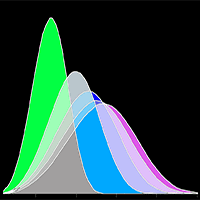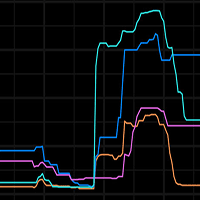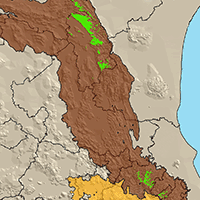
This study employed ensemble species distribution models (SDMs) using the “biomod2” package and different General Circulation Models (GCMs) to assess the impacts of climate change on the potential distribution of Pinus cembroides in Mexico. Using presence and pseudo-absence data, along with bioclimatic variables from CHELSA v2.1, future habitat suitability was projected for the near future (2041-2060) and far future (2061-2080) under two CMIP6 scenarios (SSP245 and SSP585). Our results predict that under future climate conditions, P. cembroides will likely undergo substantial range contractions, with losses of approximately 65%-85% of the current suitable habitat and no colonization of novel areas. Temperature-related predictors, particularly Bio8 (mean temperature of the wettest quarter) and Bio9 (mean temperature of the driest quarter) were identified as the primary drivers of the species’ distribution. These results suggest that under warming scenarios, P. cembroides will be confined to high elevation refugia, thereby increasing fragmentation and reducing its adaptive capacity. Overall, our findings provide a critical baseline for adaptive forest management strategies, such as assisted migration and the conservation of high elevation refugia, to mitigate the impacts of climate change on P. cembroides.
Keywords
, , , ,
Citation
Martínez-Sánchez JN, Cavazos T, Gárate-Escamilla H, De Luna M, Cuéllar-Rodríguez G (2026). Ensemble modeling of Pinus cembroides Zucc. distribution under future CMIP6 climate scenarios in northern Mexico. iForest 19: 1-8. - doi: 10.3832/ifor4880-018
Academic Editor
Maurizio Marchi
Paper history
Received: Apr 14, 2025
Accepted: Sep 02, 2025
First online: Jan 10, 2026
Publication Date: Feb 28, 2026
Publication Time: 4.33 months
© SISEF - The Italian Society of Silviculture and Forest Ecology 2026
Open Access
This article is distributed under the terms of the Creative Commons Attribution-Non Commercial 4.0 International (https://creativecommons.org/licenses/by-nc/4.0/), which permits unrestricted use, distribution, and reproduction in any medium, provided you give appropriate credit to the original author(s) and the source, provide a link to the Creative Commons license, and indicate if changes were made.
Breakdown by View Type
(Waiting for server response...)
Article Usage
Total Article Views: 100
(from publication date up to now)
Breakdown by View Type
HTML Page Views: 17
Abstract Page Views: 56
PDF Downloads: 24
Citation/Reference Downloads: 0
XML Downloads: 3
Web Metrics
Days since publication: 2
Overall contacts: 100
Avg. contacts per week: 350.00
Article Citations
Article citations are based on data periodically collected from the Clarivate Web of Science web site
(last update: Mar 2025)
(No citations were found up to date. Please come back later)
Publication Metrics
by Dimensions ©
Articles citing this article
List of the papers citing this article based on CrossRef Cited-by.
(1)
Aceves-Rangel LD, Méndez-González J, García-Aranda MA, Nájera-Luna JA (2018)Distribución potencial de 20 especies de pinos en México [Potential distribution of 20 pine species in Mexico]. Agrociencia 52: 1043-1057. [in Spanish]
Gscholar
(2)
Ahmad R, Khuroo AA, Charles B, Hamid M, Rashid I, Aravind NA (2019)Global distribution modelling, invasion risk assessment and niche dynamics of
Leucanthemum vulgare (Ox-eye Daisy) under climate change. Scientific Reports 9: 476-485.
CrossRef |
Gscholar
(3)
Alfaro-Ramírez FU, Ramírez-Albores JE, Vargas-Hernández JJ, Franco-Maass S, Pérez-Suárez M (2020)Potential reduction of Hartweg’s pine (
Pinus hartwegii Lindl.) geographic distribution. PLoS One 15 (2): e0229178.
CrossRef |
Gscholar
(4)
Allouche O, Tsoar A, Kadmon R (2006)Assessing the accuracy of species distribution models: prevalence, kappa and the true skill statistic (TSS). Journal of Applied Ecology 43: 1223-1232.
CrossRef |
Gscholar
(5)
Almazroui M, Islam MN, Saeed F, Saeed S, Ismail M, Ehsan MA, Diallo I, O’Brien E, Ashfaq M, Martínez-Castro D, Cavazos T, Cerezo-Mota R, Tippett MK, Gutowski Jr WJ, Alfaro EJ, Hidalgo HG, Vichot-Llano A, Campbell JD, Kamil S, Rashid IU, Sylla MB, Stephenson T, Taylor M, Barlow M (2021)Projected changes in temperature and precipitation over the United States, Central America, and the Caribbean in CMIP6 GCMs. Earth Systems and Environment 5: 1-24.
CrossRef |
Gscholar
(6)
Anderegg WR, Trugman AT, Badgley G, Anderson CM, Bartuska A, Ciais P, Cullenward D, Field CB, Freeman J, Goetz SJ, Hicke JA, Huntzinger D, Jackson RB, Nickerson J, Pacala S, Randerson JT (2020)Climate-driven risks to the climate mitigation potential of forests. Science 367 (6485): 1027-1031.
CrossRef |
Gscholar
(7)
Araújo MB, Guisan A (2006)Five (or so) challenges for species distribution modelling. Journal of Biogeography 33: 1677-1688.
CrossRef |
Gscholar
(8)
Araújo MB, Anderson RP, Barbosa AM, Beale CM, Dormann CF, Early R, Garcia RA, Guisan A, Maiorano L, Naimi B, O’Hara RB, Zimmermann NE, Rahbek C (2019)Standards for distribution models in biodiversity assessments. Science Advances 5: eaat4858.
CrossRef |
Gscholar
(9)
Bellard C, Bertelsmeier C, Leadley P, Thuiller W, Courchamp F (2012)Impacts of climate change on the future of biodiversity. Ecology Letters 15 (4): 365-377.
CrossRef |
Gscholar
(10)
Bower AD, Frerker KL, Pike CC, Labonte NR, Palik BJ, Royo AA, Anderson SM, Ferreira AR, Brandt LA (2024)A practical framework for applied forestry assisted migration. Frontiers in Forests and Global Change 7: 1454329.
CrossRef |
Gscholar
(11)
Breiman L (2001)Random forests. Machine Learning 45: 5-32.
CrossRef |
Gscholar
(12)
Busby JR (1991)BIOCLIM - a bioclimate analysis and prediction system. In: “Nature Conservation: Cost Effective Biological Surveys and Data Analysis” (Margules CR, Austin MP eds). CSIRO, Melbourne, Australia, pp. 64-68.
Gscholar
(13)
Cavazos T, Luna-Niño R, Cerezo-Mota R, Fuentes-Franco R, Méndez M, Pineda-Martínez LF, Valenzuela E (2020)Climatic trends and regional climate models intercomparison over the CORDEX-CAM (Central America, Caribbean, and Mexico) domain. International Journal of Climatology 40: 1396-1420.
CrossRef |
Gscholar
(14)
CONABIO (2020)Sistema Nacional de Información sobre Biodiversidad. Registros de ejem-plares [National Information System on Biodiversity. Specimen Records]. Comisión Nacional para el Conocimiento y Uso de la Biodiversidad - CONABIO, Ciudad de México, México, website. [in Spanish]
Online |
Gscholar
(15)
Constante-García V, Villanueva-Díaz J, Cerano-Paredes J, Cornejo-Oviedo EH, Valencia-Manzo S (2009)Dendrocronología de
Pinus cembroides Zucc. y reconstrucción de precipitación estacional para el sureste de Coahuila [Dendrocronology of
Pinus cembroides Zucc. and reconstruction of seasonal precipitation for southern Coahuila]. Revista Mexicana de Ciencias Forestales 34: 17-39. [in Spanish]
Gscholar
(16)
Cruz-Cárdenas G, López-Mata L, Silva JT, Bernal-Santana N, Estrada-Godoy F, López-Sandoval JA (2016)Potential distribution model of Pinaceae species under climate change scenarios in Michoacán. Revista Chapingo Serie Ciencias Forestales y del Ambiente 22: 135-148.
CrossRef |
Gscholar
(17)
Elith J, Ferrier S, Huettmann F, Leathwick J (2005)The evaluation strip: a new and robust method for plotting predicted responses from species distribution models. Ecological Modelling 186: 280-289.
CrossRef |
Gscholar
(18)
Elith J, Graham CH, Anderson RP, Dudik M, Ferrier S, Guisan A, Huettmann JJ, Leathwick JR, Lehmann S, Li F, Loiselle SA (2006)Novel methods improve prediction of species’ distributions from occurrence data. Ecography 29: 129-151.
CrossRef |
Gscholar
(19)
Elith J, Franklin J (2013)Species distribution modelling. In: “Encyclopedia of Biodiversity” (Levin S ed). Academic Press, Waltham, MA, pp. 692-705.
Gscholar
(20)
Eyring V, Bony S, Meehl GA, Senior CA, Stevens B, Stouffer RJ, Taylor KE (2016)Overview of the Coupled Model Intercomparison Project Phase 6 (CMIP6) experimental design and organization. Geoscientific Model Development 9: 1937-1958.
CrossRef |
Gscholar
(21)
Fielding AH, Bell JF (1997)A review of methods for the assessment of prediction errors in conservation presence/absence models. Environmental Conservation 24: 38-49.
CrossRef |
Gscholar
(22)
García-Aranda MA, Méndez-González J, Hernández-Arizmendi JY (2018)Potential distribution of
Pinus cembroides,
Pinus nelsonii and
Pinus culminicola in northeastern Mexico. Ecosistemas y Recursos Agropecuarios 5: 3-13.
CrossRef |
Gscholar
(23)
Goberville E, Beaugrand G, Hautekete C, Piquot Y, Luczak C (2015)Uncertainties in the projection of species distributions related to general circulation models. Ecology and Evolution 5 (5): 1100-1116.
CrossRef |
Gscholar
(24)
Gómez-Díaz JD, Monterroso-Rivas AI, Tinoco-Rueda JA, Toledo-Medrano ML, Conde-Alvarez C, Gay-García C (2011)Assessing current and potential patterns of 16 forest species driven by climate change scenarios in México. Atmósfera 24: 31-52.
Gscholar
(25)
Gómez-Pineda E, Sáenz-Romero C, Ortega-Rodríguez JM, Blanco-García A, Madrigal-Sánchez X, Lindig-Cisneros R, Lopez-Toledo L, Pedraza-Santos ME, Rehfeldt GE (2020)Suitable climatic habitat changes for Mexican conifers along altitudinal gradients under climatic change scenarios. Ecological Applications 30 (2): e02041.
CrossRef |
Gscholar
(26)
Guisan A, Tingley R, Baumgartner JB, Naujokaitis-Lewis I, Sutcliffe PR, Tulloch AI, Regan TJ, Brotons L, McDonald-Madden E, Mantyka-Pringle C, Martin TG, Rhodes JR, Maggini R, Setterfield SA, Elith J, Schwartz MW, Wintle BA, Broennimann O, Austin M, Ferrier S, Kearney MR, Possingham HP, Buckley YM (2013)Predicting species distributions for conservation decisions. Ecological Letters 16 (12): 1424-1435.
CrossRef |
Gscholar
(27)
Guisan A, Thuiller W, Zimmermann NE (2017)Habitat suitability and distribution models with applications in R. Cambridge University Press, Cambridge, UK, pp. 462.
Online |
Gscholar
(28)
Gustafson EJ, Kern CC, Kabrick JM (2023)Can assisted tree migration today sustain forest ecosystem goods and services for the future? Forest Ecology and Management 529: 120723.
CrossRef |
Gscholar
(29)
Harris I, Jones PD, Osborn TJ, Lister DH (2014)Updated high-resolution grids of monthly climatic observations - the CRU TS3.10 dataset. International Journal of Climatology 34 (3): 623-642.
CrossRef |
Gscholar
(30)
Hartmann H, Bastos A, Das AJ, Esquivel-Muelbert A, Hammond WM, Martínez-Vilalta J, McDowell NG, Powers JS, Pugh TAM, Ruthrof KX, Allen CD (2022)Climate change risks to global forest health: emergence of unexpected events of elevated tree mortality worldwide. Annual Review of Plant Biology 73: 673-702.
CrossRef |
Gscholar
(31)
Hastie TJ, Tibshirani RJ (1990)Generalized additive models. Chapman and Hall, New York, USA, pp. 352.
Gscholar
(32)
Hastie T, Tibshirani R, Buja A (1994)Flexible discriminant analysis by optimal scoring. Journal of the American Statistical Association 89: 1255-1270.
CrossRef |
Gscholar
(33)
Herrera-Soto G, González-Cásares M, Pompa-García M, Camarero JJ, Solís-Moreno R (2018)Growth of Pinus cembroides Zucc. in response to hydroclimatic variability in four sites forming the species latitudinal and longitudinal distribution limits. Forests 9 (7): 440.
CrossRef |
Gscholar
(34)
Huang Y, Li T, Chen W, Zhang Y, Xu Y, Guo T, Wang S, Liu J, Qin Y (2024)Analysis of the distribution pattern of
Phenacoccus manihoti in China under climate change based on the BIOMOD2 model. Biology 13 (7): 538.
CrossRef |
Gscholar
(35)
Kaky E, Nolan V, Alatawi A, Gilbert F (2020)A comparison between ensemble and MaxEnt species distribution modelling approaches for conservation: a case study with Egyptian medicinal plants. Ecological Informatics 60: 101150.
CrossRef |
Gscholar
(36)
Karger DN, Conrad O, Böhner J, Kawohl T, Kreft H, Wilber R, Zimmermann NE, Linder HP, Kessler M (2017)Climatologies at high resolution for the Earth’s land surface areas. Scientific Data 4 (1): 1-20.
CrossRef |
Gscholar
(37)
Karger DN, Chauvier Y, Zimmermann NE (2023)Chelsa-cmip6 1.0: a Python package to create high-resolution bioclimatic variables based on CHELSA Ver. 2. 1 and CMIP6 Data. Ecography 2023 (6): e06535.
Gscholar
(38)
Khan S, Verma S (2022)Ensemble modeling to predict the impact of future climate change on the global distribution of Olea europaea subsp. cuspidata. Frontiers in Forests and Global Change 5: 977691.
CrossRef |
Gscholar
(39)
Knutti R, Sedláček J, Sanderson BM, Lorenz R, Fischer EM, Eyring V (2017)A climate model projection weighting scheme accounting for performance and interdependence. Geophysical Research Letters 24: 4529-4538.
CrossRef |
Gscholar
(40)
Lobo JM, Jiménez-Valverde A, Real R (2008)AUC: a misleading measure of the performance of predictive distribution models. Global Ecology and Biogeography 17 (2): 145-151.
CrossRef |
Gscholar
(41)
Manzanilla-Quijada GE, Osuna-Vallejo V, Zacarías-Correa AG, Gómez-Pineda E, Gallardo-Salazar JL, Sáenz-Romero C (2024)Zonas de transferencia de semillas para la reforestación en la Reserva de la Biosfera Mariposa Monarca y la Meseta Purépecha ante el cambio climático [Seed transfer zones for reforestation in the Monarch Butterfly Biosphere Reserve and the Meseta Purépecha facing climate change]. Revista Chapingo Serie Ciencias Forestales y del Ambiente 30 (2): 1-21. [in Spanish]
CrossRef |
Gscholar
(42)
Martínez-Sánchez JN, Cuéllar Rodríguez LG, Yerena Yamallel JI, Cavazos Pérez MT, Gárate Escamilla HA (2023)Comparación de bases de datos climáticos en la modelación de distribución potencial de
Pinus cembroides Zucc. [Comparison of climatic databases in modeling the potential distribution of Pinus cembroides Zucc.]. Revista Mexicana de Ciencias Forestales 14 (79): 135-158. [in Spanish]
CrossRef |
Gscholar
(43)
Martínez-Sifuentes AR, Villanueva-Díaz J, Manzanilla-Quiñones U, Becerra-López JL, Hernández-Herrera JA, Estrada-Avalos J, Velázquez-Pérez AH (2020)Spatial modeling of the ecological niche of
Pinus greggii Engelm. (Pinaceae): a species conservation proposal in Mexico under climatic change scenarios. iForest 13: 426-434.
CrossRef |
Gscholar
(44)
McCullagh P, Nelder JA (1989)Generalized linear models (2nd edn). Chapman and Hall, London, UK, pp. 532.
Gscholar
(45)
Montoya-Jiménez JC, Valdez-Lazalde JR, Angeles-Perez G, De Los Santos-Posadas HM, Cruz-Cárdenas G (2022)Predictive capacity of nine algorithms and an ensemble model to determine the geographic distribution of tree species. iForest 15: 363-371.
CrossRef |
Gscholar
(46)
Murray-Tortarolo GN (2021)Seven decades of climate change across Mexico. Atmósfera 34 (2): 217-226.
CrossRef |
Gscholar
(47)
Pearson RG, Dawson TP (2003)Predicting the impacts of climate change on the distribution of species: are bioclimate envelope models useful? Global Ecology and Biogeography 12(5): 361-371.
CrossRef |
Gscholar
(48)
Pecl GT, Araújo MB, Bell JD, Blanchard J, Bonebrake TC, Chen C, Clark TD, Colwell RK, Danielsen F, Evengård B, Falconi L, Ferrier S, Frusher S, Garcia RA, Griffis RB, Hobday AJ, Janion-Scheepers C, Jarzyna MA, Jennings S, Williams SE (2017)Biodiversity redistribution under climate change: Impacts on ecosystems and human well-being. Science 355 (6332): eaai9214.
CrossRef |
Gscholar
(49)
Peterson AT, PapeÅŸ M, Soberón J. (2008)Rethinking receiver operating characteristic analysis applications in ecological niche modeling. Ecological Modelling 213: 63-72.
CrossRef |
Gscholar
(50)
Phillips SJ, Anderson RP, Schapire RE (2006)Maximum entropy modeling of species geographic distributions. Ecological Modelling 190: 231-259.
CrossRef |
Gscholar
(51)
R Core Team (2020)R: a language and environment for statistical computing. R Foundation for Statistical Computing, Vienna, Austria.
Online |
Gscholar
(52)
Ripley BD (1996)Pattern recognition and neural networks. Cambridge University Press, Cambridge, UK, pp. 403.
Gscholar
(53)
Romero-Sánchez ME, González-Hernández A, Pérez-Miranda R, Velasco-Bautista E, Moreno-Sánchez F (2017)Efecto del cambio climático a nivel local en la distribución potencial de cuatro especies de la cuenca Río Bravo-San Juan, Coahuila, México [Effect of climate change at local level on the potential distribution of four forest species in the Río Bravo-San Juan Basin, Coahuila, México]. Agroproductividad 10: 42-47. [in Spanish]
Gscholar
(54)
Ridgeway G (1999)The state of boosting. Computing Science and Statistics 31: 172-181.
Gscholar
(55)
Rzedowski J (1978)Vegetación de México [Vegetation of Mexico]. Limusa, Ciudad de México, MX, pp. 432. [in Spanish]
Gscholar
(56)
Sáenz-Romero C, Rehfeldt GE, Duval P, Lindig-Cisneros RA (2012)Abies religiosa habitat prediction in climatic change scenarios and implications for monarch butterfly conservation in Mexico. Forest Ecology and Management 275: 98-106.
CrossRef |
Gscholar
(57)
Sáenz-Romero C, Lamy JB, Ducousso A, Musch B, Ehrenmann F, Delzon S, Cavers S, Chalupka W, Dagdas S, Hansen JK, Lee SJ, Liesebach M, Rau HM, Psomas A, Schneck V, Steiner W, Zimmermann NE, Kremer A (2017)Adaptive and plastic responses of
Quercus petraea populations to climate across Europe. Global Change Biology 23 (7): 2831-2847.
CrossRef |
Gscholar
(58)
Santos-Hernández AF, Monterroso-Rivas AI, Granados-Sánchez D, Villanueva-Morales A, Santacruz-Carrillo M (2021)Projections for Mexico’s tropical rainforests considering ecological niche and climate change. Forests 12: 119.
CrossRef |
Gscholar
(59)
Sun Y, Zhang H, Jiang K, Xiang D, Shi Y, Huang S, Li Y, Han H (2024)Simulating the changes of habitat suitability of chub mackerel (
Scomber japonicus) in the high seas of the North Pacific Ocean using ensemble models under medium to long-term future climate scenarios. Marine Pollution Bulletin 207: 116873.
CrossRef |
Gscholar
(60)
Thuiller W, Guéguen M, Renaud J, Karger DN, Zimmermann NE (2019)Uncertainty in ensembles of global biodiversity scenarios. Nature Communications 10 (1): 1-9.
CrossRef |
Gscholar
(61)
Thuiller W, Georges D, Gueguen M, Engler R, Breiner F, Lafourcade B, Patin R, Blancheteau H (2025)BIOMOD2: ensemble platform for species distribution modeling. CRAN, R package version 42:6-2, website.
Online |
Gscholar
(62)
Valavi R, Guillera-Arroita G, Lahoz-Monfort JJ, Elith J (2022)Predictive performance of presence-only species distribution models: a benchmark study with reproducible code. Ecological Monographs 92 (1): e01486.
CrossRef |
Gscholar
(63)
Zamora-Maldonado HC, Avila-Foucat VS, Sánchez-Sotomayor VG (2025)Modeling climate change impacts on the potential distribution of bighorn sheep in Mexico. Frontiers in Climate 7: 1386632.
CrossRef |
Gscholar