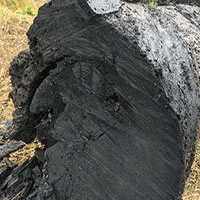
Influence of inorganic elements on the physical properties of bog oak: a CANOCO analysis
Tiziana Urso (1), Corrado Costa (2), Chiara Meneghello (1), Michela Zanetti (1)
iForest - Biogeosciences and Forestry, Volume 19, Issue 5, Pages 348-351 (2026)
doi: https://doi.org/10.3832/ifor4766-019
Published: Sep 02, 2026 - Copyright © 2026 SISEF
Short Communications
Abstract
Bog oak is a waterlogged archaeological wood characterized by distinctive physical characteristics that depend on the burial environment, conditions, and duration, making each sample nearly unique. The aim of this study was to investigate the relationship between chemical composition and the physical characteristics of two bog oak samples using CANOCO analysis. The samples differ in age and were recovered from two different locations in northern Italy. Results show that the CANOCO analysis is a suitable tool for analyzing complex materials, as it provides a graphical output that enables immediate and reliable interpretation.
Keywords
Bog Oak, Elemental Analysis, Physical Characterization, CANOCO
Authors’ Info
Authors’ address
Chiara Meneghello
Michela Zanetti 0000-0002-9739-5330
Università degli Studi di Padova, Department of Land, Environment, Agriculture, and Forestry - TESAF, v.le dell’Università 16, IT-35020 Legnaro, PD (Italy)
Consiglio per la ricerca in agricoltura e l’analisi dell’economia agraria - CREA, Centro di ricerca Ingegneria e Trasformazioni agroalimentari, v. della Pascolare 16, IT-00015 Monterotondo, RM (Italy)
Corresponding author
Paper Info
Citation
Urso T, Costa C, Meneghello C, Zanetti M (2026). Influence of inorganic elements on the physical properties of bog oak: a CANOCO analysis. iForest 19: 348-351. - doi: 10.3832/ifor4766-019
Academic Editor
Manuela Romagnoli
Paper history
Received: Nov 25, 2024
Accepted: Aug 24, 2026
First online: Sep 02, 2026
Publication Date: Oct 31, 2026
Publication Time: 0.30 months
Copyright Information
© SISEF - The Italian Society of Silviculture and Forest Ecology 2026
Open Access
This article is distributed under the terms of the Creative Commons Attribution-Non Commercial 4.0 International (https://creativecommons.org/licenses/by-nc/4.0/), which permits unrestricted use, distribution, and reproduction in any medium, provided you give appropriate credit to the original author(s) and the source, provide a link to the Creative Commons license, and indicate if changes were made.

Web Metrics
Breakdown by View Type
Article Usage
Total Article Views: 1254
(from publication date up to now)
Breakdown by View Type
HTML Page Views: 480
Abstract Page Views: 404
PDF Downloads: 306
Citation/Reference Downloads: 0
XML Downloads: 64
Web Metrics
Days since publication: 52
Overall contacts: 1254
Avg. contacts per week: 168.81
Citation Metrics
Article Citations
Article citations are based on data periodically collected from the Clarivate Web of Science web site
(last update: Jul 2026)
(No citations were found up to date. Please come back later)
Publication Metrics
by Dimensions ©
Articles citing this article
List of the papers citing this article based on CrossRef Cited-by.
References
Numerical ecology (2nd edn). Elsevier, Amsterdam, Netherlands, pp. 853.
Gscholar
Sediments surrounding waterlogged archaeological wood: could arsenic be involved in preserving wooden pile dwelling from microbial decay? The Gran Carro case study (Lake Bolsena, central Italy). Journal of Cultural Heritage 75: 12-22.
CrossRef | Gscholar
Micro-morphological, physical and thermogravimetric analyses of waterlogged archaeological wood from the prehistoric village of Gran Carro (Lake Bolsena, Italy). Journal of Cultural Heritage 33: 30-38.
CrossRef | Gscholar
Related Content
Humphrey P, Harvey C, Visser R
Vol. 17, pp. 353-359 (online: Dec 2024)

Assis Loureiro B, Arriel TG, Guedes Ramalho FM, Hein PRG, Trugilho PF
Vol. 15, pp. 372-380 (online: Oct 2022)
Sassoli M, Taiti C, Guidi Nissim W, Costa C, Mancuso S, Menesatti P, Fioravanti M
Vol. 10, pp. 576-584 (online: Jun 2017)
Li S, Gao Y, Brunetti M, Macchioni N, Nocetti M, Palanti S
Vol. 12, pp. 317-322 (online: Jun 2019)
Nascimento CSD, Nascimento CCD, Araújo RDD, Soares JCR, Higuchi N
Vol. 14, pp. 400-407 (online: Oct 2021)
Fernandes C, Gaspar MJ, Pires J, Alves A, Simões R, Rodrigues JC, Silva ME, Carvalho A, Brito JE, Lousada JL
Vol. 10, pp. 669-679 (online: Aug 2017)
Burnard M, Posavčević M, Kegel E
Vol. 10, pp. 879-885 (online: Dec 2017)
de Souza Vieira GL, Moutinho da Ponte MJ, Pereira Moutinho VH, Jardim-Gonçalves R, Pantoja Lima C, de Albuquerque Vinagre MV
Vol. 15, pp. 234-239 (online: Aug 2022)
Knežević J, Musić J, Halilović V, Comaga A, Pamić E, Karišik A
Vol. 19, pp. 321-328 (online: Aug 2026)
Teixeira Mancini L, Guedes Ramalho FM, Trugilho PF, Gherardi Hein PR
Vol. 14, pp. 18-25 (online: Feb 2021)