

The impact of afforestation on vegetation, soil properties, and Pinus brutia Ten. recruitment in post-fire P. brutia forests
iForest - Biogeosciences and Forestry, Volume 19, Issue 6, Pages 421-428 (2026)
doi: https://doi.org/10.3832/ifor4833-019
Published: Nov 12, 2026 - Copyright © 2026 SISEF
Research Articles
Abstract
In post-fire environments, non-native species plantations can significantly affect community dynamics, including species composition, diversity, and ecosystem processes. Long-term studies are essential to assess stand invasiveness, the persistence of planted species, and the re-establishment of native species. This study examines Eucalyptus camaldulensis (River red gum), Pinus pinea (Stone pine), and Pinus brutia (Turkish red pine) plantations in post-fire P. brutia forests in Turkey by assessing the vegetation characteristics and soil properties, as well as the allelopathic effects of these species on the seed germination and seedling development of P. brutia. A total of 17 woody taxa were recorded across three types of plantation sites. The E. camaldulensis stand had the highest species richness (14 species), followed by the P. brutia and P. pinea stands (10 and 9 species, respectively). An 11-year monitoring study of tree canopy cover in plantation forests revealed that P. brutia successfully colonized and expanded its canopy cover within the E. camaldulensis stand. In contrast, P. brutia entered and later established in the P. pinea stand. Leaf extract and soil experiments to detect the potential allelopathic effects of E. camaldulensis and P. pinea indicated that, unlike the inhibitory effects observed in P. pinea, E. camaldulensis may promote P. brutia seed germination. Regarding soil properties, the E. camaldulensis stand showed higher cation exchange capacity, electrical conductivity, organic matter content, and nutrient availability than the other stands. In conclusion, our findings demonstrate that P. brutia has a high potential to re-colonize areas afforested with other species after a fire, and the time required for its re-colonization depends on the facilitating or inhibiting effect created by other species, the size of the plantation stand, and the distance to the P. brutia stands.
Keywords
Eucalypt, Stone Pine, Turkish Red Pine, Post-fire Restoration, Plantation
Introduction
P. brutia Ten. is a characteristic species of low altitudes in the East-Mediterranean region. Its geographical range extends widely across the Eastern Mediterranean, from Greece to Lebanon, with the largest distribution at low altitudes in Turkey, encompassing 3.8 million ha of the 4 million ha in the Mediterranean Basin ([18]). Fire is a critical ecological factor and a key driver of vegetation dynamics in P. brutia forests, as in many other Mediterranean ecosystems ([25]). P. brutia is a fire-resilient pine species, characterized by the production of a high number of serotinous cones, small seeds, and early reproductive capability, similar to other Mediterranean pine species ([15]). Like P. brutia, other species in the community cope with fire using post-fire regeneration strategies ([44]). After fire, an autosuccession process occurs with the natural regeneration of P. brutia ([21]).
Several factors influence post-fire regeneration of pine forests, including fire severity and seed accumulation during the pre-fire period. When the number of seedlings is not sufficient to ensure natural regeneration or when additional concerns arise (e.g., minimizing soil erosion and runoff, evaluating burned trees, planning, and establishing less flammable and more resilient forests and landscapes), post-fire management practices become necessary ([29]). Restoration strategies for burned forests vary depending on fire-related variables such as fire severity, ecosystem responses in affected forest types, and overarching management goals ([20]). Post-fire rehabilitation treatments are implemented to mitigate the short- and long-term effects of fire on physical and biotic ecosystem components ([42]).
A traditional strategy for managing burned areas in the Mediterranean Region has been reforestation or afforestation with conifers, predominantly pines ([29]). Reforestation activities using P. brutia seeds and seedlings are widely implemented in burned P. brutia forests in Turkey. In addition to their rapid regeneration capability in post-fire areas, their role in wood production and soil protection has made P. brutia the preferred species for reforestation efforts ([18]).
Native species are commonly used in post-fire afforestation efforts ([15]). In most Mediterranean Basin countries, including Turkey, native conifers (mainly pines) as well as non-native conifers and eucalypts have been widely used in afforestation over the last century ([35]). Conifer species, such as P. pinea and Cupressus sempervirens L., along with eucalypts, are utilized in afforestation for various purposes. These include promoting rapid vegetation development, reducing fuel load accumulation, preventing flammable homogeneous forests, and providing a potential food supply in some post-fire areas ([17], [35]).
The genera Eucalyptus and Pinus, which include the species evaluated in this study, can become invaders or dominant species because of their strong allelopathic effects ([40]). Eucalypt trees, in particular, have been extensively planted in several regions of the Mediterranean Basin. Although they are not currently considered invasive, these species with fire-stimulated germination may pose a risk of becoming invasive in the future ([25]). Increased seedling recruitment in post-fire areas, combined with their high fire-proneness, may increase the invasion risk of eucalypt species ([13]).
Afforestation with exotic species has been identified as a threat to natural ecosystems, raising concerns such as biodiversity loss ([34]). While exotic species may frequently coexist with neighbors in their natural habitat, they can competitively exclude and eliminate native species when introduced into a different ecosystem ([22]). Several mechanisms have been proposed to explain this inhibition effect, including release from natural enemies, broader tolerance limits, more efficient resource use, hybrid vigor, and allelopathic processes ([48]). Notably, invasions by exotic species through odd allelochemicals disrupt co-evolved interactions among long-associated native species ([40]). Consequently, the negative effects of non-native species on soil structure and native-species establishment have been well documented ([28], [49]).
In P. brutia ecosystems, E. camaldulensis and P. pinea are commonly used in post-fire plantations. There is still limited knowledge about the environmental changes caused by the introduction of these species in the area. Additionally, understanding their interactions with native species, the sustainability of these plantations, and the ability of native species to enter and successfully establish within afforested areas remains insufficient.
This study investigated the potential for the native species P. brutia to recolonize areas planted with non-native species. To achieve this, we assessed the vegetation characteristics and soil properties in plantation areas. Additionally, we examined the allelopathic effects of the non-native species on the seed germination and seedling development of P. brutia.
Material and methods
Study area
The study focused on plantations created after a fire in 1996 that affected about 7.090 hectares in northern Marmaris, Mugla Province, southwestern Turkey. Following the fire, most burned trees were removed through salvage logging. While some areas were left for natural regeneration, the majority underwent active restoration, which included removing resprouting shrubs and planting P. brutia seedlings. Habitat patches of 10 to 15 hectares were established, which are now surrounded by P. brutia stands, either spontaneously regenerated or actively restored. Reforestation and afforestation activities involved planting saplings at intervals of 2 to 10 m along terraces spaced 3 to 10 m apart after clearing vegetation ([3]).
The study area has a typical Mediterranean climate characterized by hot and dry summers, with an annual average precipitation of 1206.71 mm and a dry period lasting approximately five months from May to September. The mean annual temperature is 15.1 °C, ranging from 5.3 °C in January to 26.4 °C in July ([4]).
The sampling sites were selected in afforested and reforested areas located in close proximity to each other. These areas share the same geological formation (ophiolitic rocks) and exhibit similar topographic characteristics, consisting of flat or slightly sloping terrain (Tab. 1). Vegetation sampling, as well as leaf and soil collection, was conducted in the central parts of each area to minimize the influence of surrounding vegetation. Due to the small size and environmental uniformity of the afforestation patches, sampling was conducted at one representative site within each stand. This approach reduced environmental variability and edge effects, allowing for a more controlled comparison among different plantation types.
Tab. 1 - Locations, elevations, and fire types of sampling sites.
| Stands | Latitude | Longitude | Elevation (m) | Fire type/Fire intensity |
|---|---|---|---|---|
| P. brutia | 36.913611 | 28.242222 | 274 | Crown fire/High |
| E. camaldulensis | 36.921944 | 28.245555 | 240 | Crown fire/High |
| P. pinea | 36.917777 | 28.242222 | 247 | Crown fire/High |
Vegetation comparisons
To evaluate potential changes in the understorey plant community due to afforestation, understorey woody plants were sampled to determine species composition. Additionally, the total cover and canopy cover of dominant tree species (P. brutia, E. camaldulensis, and P. pinea) were monitored over time using data collected in 2012, 2018, and 2023. For understorey woody plant composition, only the data collected in 2023 were used. Sampling was performed using the point quadrat technique ([11]). Understorey woody plant species were recorded at 1-meter intervals along four transects, each 25 meters long, within each site. At each sampling point, we recorded whether the point was covered by the tree canopy. Canopy cover was determined by the ratio of canopy-covered points to the total number of points.
Allelopathic effects on seed germination and seedling development
To assess the potential allelopathic effects of the species used for plantation (i.e., E. camaldulensis and P. pinea) on the germination and seedling development of P. brutia, we conducted experiments using leaf extracts and soil samples. Leaf and soil samples were collected in October 2023, and the experiments started immediately after the samples were brought to the laboratory. The seeds used in both experiments were obtained from the Gökova Forest Nursery, under the General Directorate of Forestry, and stored at +4 °C in the dark.
Leaf samples were harvested from the crowns of five randomly selected plants of each species at the plantation sites. The air-dried leaves were powdered in the laboratory before extraction. A total of 35 grams of powdered leaf samples were extracted with 350 ml of ethanol (ETOH 96%) and water by stirring in a water bath at 40°C for 24 hours. The residue underwent three additional extractions before filtering the ethanolic extract. The filtered extracts were evaporated to dryness using a rotary evaporator, and then a stock solution was prepared by redissolving in 100 ml of distilled water. Fifty P. brutia seeds of similar size were placed into each Petri dish, covered with two sheets of filter paper moistened with 5 ml of distilled water, and treated with different concentrations of leaf extracts (5 ml of 25%, 50%, and 100% solutions; control group = 0%) to determine the effects of varying amounts of allelopathic chemicals on seed germination. Each concentration was replicated four times. Seeds were germinated in an incubator at 20 °C, with daily checks and removal of germinated seeds. Germination was recorded when the radicle emerged from the seed coat.
The objective of the soil experiment was to assess the effects of allelopathic chemicals accumulated in the soil over time by afforestation tree species on the germination and seedling development of the native species P. brutia. Soil samples were collected randomly from each plantation site at a depth of 0-5 cm, with five subsamples per site. These subsamples were then mixed to create one representative soil sample for each site. The representative soil samples were placed in pots (10 × 9 × 10 cm, 0.5 liters) in four replicates, and 25 P. brutia seeds were sown in each pot. The pots were kept in an incubator at 20 °C and watered regularly for 90 days. At the end of this period, the stem and root lengths of each seedling were measured to the centimeter level, and the stem/root length ratio was calculated. The seedlings were then oven-dried at 65 °C for 72 hours, and their dry weights were measured.
Seed germination data were analyzed using a generalized linear model (GLM) with a binomial error distribution and a logit link function, treating the number of germinated seeds as a proportion of the total seeds tested per replicate. Plantation species (P. brutia, E. camaldulensis, and P. pinea) and extract concentration (25%, 50%, and 100%) were included as fixed factors, and their interaction was tested to evaluate species-specific responses to extract concentration. Model significance was assessed using likelihood ratio tests. Germination probabilities and corresponding 95% confidence intervals were estimated from the fitted model to compare treatment effects among plantation types and concentration levels, and pairwise comparisons among treatments were performed using estimated marginal means with Tukey adjustment. All statistical analyses were conducted using R software ([39]).
Differences in seedling characteristics, including seedling count, dry weight, stem and root length, and stem/root length ratio of P. brutia seedlings grown in soils from different plantation types, were analyzed using generalized linear models (GLMs). Soil taken from different plantations was included as a fixed factor, and differences among plantation types were evaluated separately for each response variable. Pairwise comparisons among soil sources were conducted using post hoc tests with Bonferroni adjustment. All analyses were performed using R statistical software ([39]).
Soil properties
To determine the effect of afforestation on soil structure, we analyzed soil samples from the study sites. Two soil samples were taken at 0-20 cm depth for each plantation site. Soil texture was determined using the Bouyoucos hydrometer method ([9]). Soil acidity (pH) and electrical conductivity (EC) were measured using a glass-electrode pH meter and EC meter in a 1:2.5 soil-water mixture ([23], [2]). Total inorganic carbonate (TIC) and total soil organic matter (SOM) were assessed with the Walkley-Black method ([23]). Soil phosphorus was analyzed by the Olsen method ([32]), while total nitrogen was measured by wet oxidation using the Kjeldahl method ([10]). Cation exchange capacity (CEC) was determined using the ammonium acetate method ([1], [37]).
Results
Vegetation comparisons
A total of 17 woody taxa were recorded across the three types of plantation sites (Tab. 2). The E. camaldulensis stand exhibited the highest species richness, with 14 species identified. In comparison, 10 species were recorded in the P. brutia stand and 9 species in the P. pinea stand. Cistus creticus, Cistus salviifolius, Erica manipuliflora, Phillyrea latifolia, and Quercus infectoria were common species detected in all plantation stands.
Tab. 2 - Species composition of woody plants in the understorey vegetation of plantation sites.
| Species | Plantation sites | ||
|---|---|---|---|
| P. brutia | E. camaldulensis | P. pinea | |
| Callicotome villosa | - | x | - |
| Cistus creticus | x | x | x |
| Cistus salviifolius | x | x | x |
| Cytisopsis dorycniifolia | x | - | x |
| Erica manipuliflora | x | x | x |
| Genista acanthoclada | x | - | - |
| Inula viskosa | - | x | x |
| Lavandula stoechas | x | x | - |
| Myrtus communis | - | x | x |
| Phillyrea latifolia | x | x | x |
| Pistacia lentiscus | - | x | - |
| Pistacia terebinthus | - | - | x |
| Quercus coccifera | - | x | - |
| Quercus infectoria | x | x | x |
| Ruscus aculeatus | x | x | - |
| Sarcopoterium spinosum | x | x | - |
| Smilax aspera | - | x | - |
The canopy cover in the stands was assessed in 2012, 2018, and 2023, with intervals of 5-6 years. Across all three stands, the canopy cover of plantation trees increased between the first and second sampling periods. By the third sampling period, canopy cover of E. camaldulensis and P. pinea remained stable in their respective areas, while canopy cover of P. brutia increased substantially. In the E. camaldulensis stand, P. brutia was initially represented by a small number of individuals in the first sampling period but expanded dramatically in the second, with its canopy cover reaching 2.5 times that of E. camaldulensis. P. brutia was observed for the first time in the P. pinea plantation stand during the third sampling period. Total cover increased across both sampling intervals, with a particularly significant increase in the first period. By the third sampling period, canopy cover was almost complete in P. brutia and E. camaldulensis stands (Tab. 3).
Tab. 3 - Canopy cover (%) by dominant species at plantation sites in the three years of survey (2012, 2018 and 2023). (Pb): Pinus brutia; (Ec): Eucalyptus camaldulensis; (Pp): Pinus pinea.
| Afforestation site | Year | Canopy Cover (%) | ||
|---|---|---|---|---|
| Pb | Ec | Pp | ||
| Pinus brutia | 2012 | 18 | - | - |
| 2018 | 34 | - | - | |
| 2023 | 82 | - | - | |
| Eucalyptus camaldulensis | 2012 | 2 | 12 | - |
| 2018 | 52 | 20 | - | |
| 2023 | 54 | 26 | - | |
| Pinus pinea | 2012 | 0 | - | 16 |
| 2018 | 0 | - | 56 | |
| 2023 | 26 | - | 58 | |
| Total | 2012 | 70 | 45 | 61 |
| 2018 | 84 | 94 | 84 | |
| 2023 | 98 | 100 | 92 | |
Allelopathic effects on seed germination and seedling development
Leaf extracts of the three species (E. camaldulensis, P. pinea, and P. brutia) were prepared by ethanol-water extraction and applied to P. brutia seeds at three concentrations. Mean germination ranged from 43 to 48.5 out of 50 seeds. Generalized linear model analyses showed that germination responses varied between the two experimental datasets. In the first experiment set using ethanol extracts, seed germination success was significantly influenced by extract concentration, with responses varying among plantation species (species × concentration interaction: LR χ² = 13.50, p = 0.009). Overall, germination probabilities remained high across treatments; however, high extract concentration significantly reduced germination in extracts derived from P. brutia compared with low concentration (odds ratio = 0.35, 95% CI = 0.16-0.76), whereas no inhibitory effect was observed in E. camaldulensis extracts. Extracts from P. pinea also tended to reduce germination, although differences among concentration levels were not statistically significant. The fitted model accounted for approximately half of the variation in germination success (pseudo R² ≈ 0.54), indicating a substantial combined influence of plantation species and extract concentration on germination results. In contrast, the second experiment using water extracts showed weaker treatment effects, with neither plantation species nor concentration levels significantly influencing germination success. Tab. 4presents estimated germination probabilities, variability measures, and pairwise treatment comparisons expressed as odds ratios.
Tab. 4 - Germination response of P. brutia seeds exposed to leaf extracts from different plantation species under varying extract concentrations.
| Extracts | Species | Solution(%) | Germinationprobability (mean ± SD) |
95% CI | Comparison | Odds ratio (OR) |
p-value |
|---|---|---|---|---|---|---|---|
| Ethanol extracts | P. brutia | 25 | 0.96 ± 0.03 | 0.916-0.976 | 25 vs. 50 | 0.66 | 0.433 |
| 50 | 0.97 ± 0.01 | 0.935-0.986 | 25 vs. 100 | 2.89 | 0.009 | ||
| 100 | 0.88 ± 0.02 | 0.827-0.918 | 50 vs. 100 | 4.41 | 0.002 | ||
| E. camaldulensis | 25 | 0.92 ± 0.04 | 0.873-0.950 | 25 vs. 50 | 0.61 | 0.228 | |
| 50 | 0.95 ± 0.05 | 0.910-0.973 | 25 vs. 100 | 0.61 | 0.228 | ||
| 100 | 0.95 ± 0.04 | 0.910-0.973 | 50 vs. 100 | 1.00 | 1.000 | ||
| P. pinea | 25 | 0.93 ± 0.02 | 0.879-0.954 | 25 vs. 50 | 1.52 | 0.230 | |
| 50 | 0.89 ± 0.04 | 0.839-0.926 | 25 vs. 100 | 1.68 | 0.132 | ||
| 100 | 0.88 ± 0.07 | 0.827-0.918 | 50 vs. 100 | 1.10 | 0.754 | ||
| Water extracts | P. brutia | 25 | 0.92 ± 0.07 | 0.854-0.986 | 25 vs. 50 | 0.73 | 0.435 |
| 50 | 0.94 ± 0.02 | 0.917-0.963 | 25 vs. 100 | 1.42 | 0.308 | ||
| 100 | 0.89 ± 0.05 | 0.841-0.939 | 50 vs. 100 | 1.94 | 0.077 | ||
| E. camaldulensis | 25 | 0.89 ± 0.04 | 0.856-0.924 | 25 vs. 50 | 1.16 | 0.642 | |
| 50 | 0.88 ± 0.05 | 0.823-0.927 | 25 vs. 100 | 1.32 | 0.365 | ||
| 100 | 0.86 ± 0.03 | 0.832-0.888 | 50 vs. 100 | 1.14 | 0.658 | ||
| P. pinea | 25 | 0.91 ± 0.05 | 0.856-0.954 | 25 vs. 50 | 1.55 | 0.165 | |
| 50 | 0.86 ± 0.04 | 0.818-0.902 | 25 vs. 100 | 0.83 | 0.596 | ||
| 100 | 0.92 ± 0.04 | 0.884-0.956 | 50 vs. 100 | 0.53 | 0.058 |
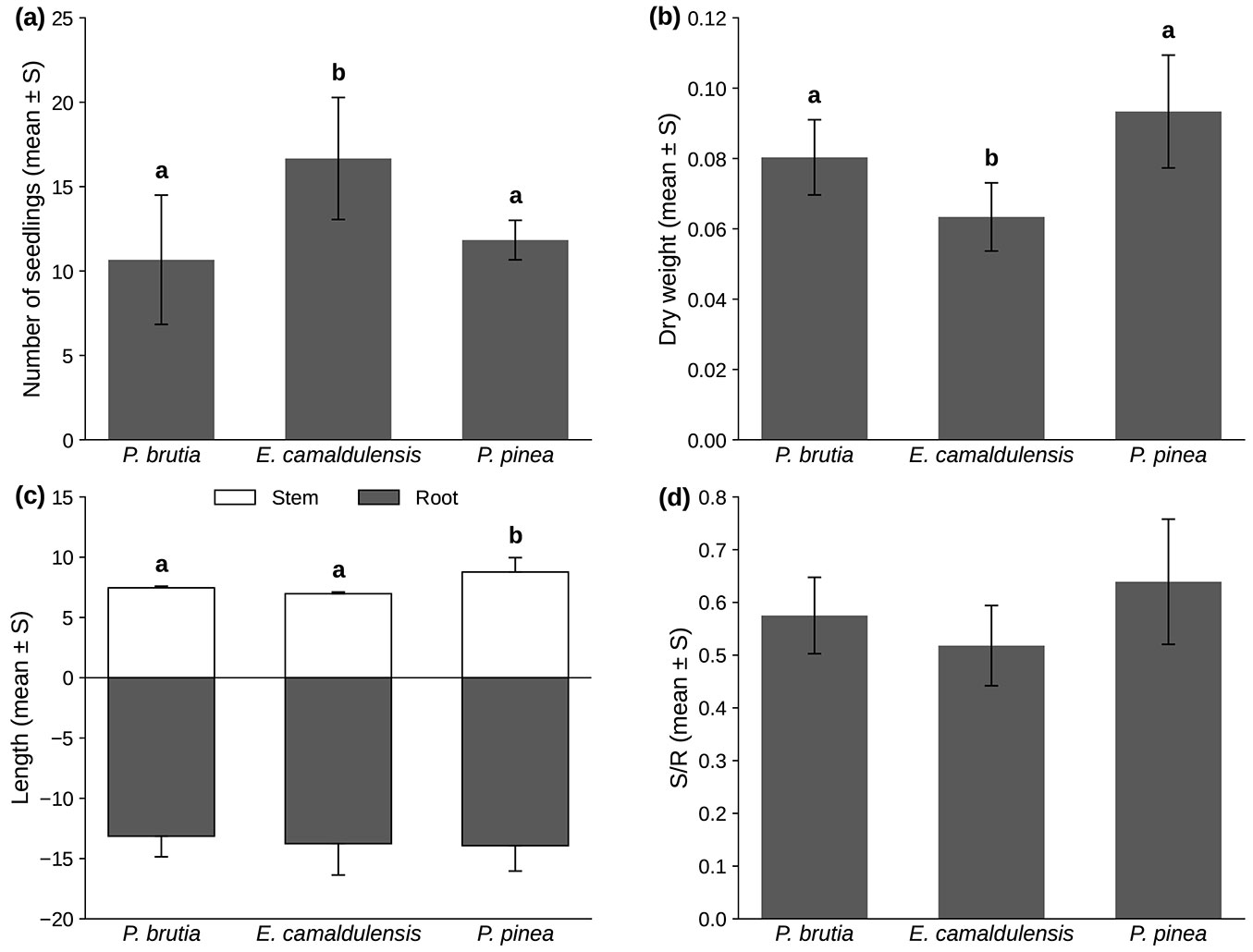
Seed germination and seedling development of P. brutia were assessed in soil experiments conducted using soil samples collected from areas surrounding trees of different species (Fig. 1). The number of P. brutia seedlings growing in soil samples from E. camaldulensis was higher compared to soils from other species (Fig. 1). A statistically significant difference was observed in the number of seedlings grown in soil samples from E. camaldulensis compared to the other two species (F = 6.26, p = 0.01). However, dry weights (F = 18.86, p < 0.001) and stem lengths (F = 8.336, p = 0.003), which are indicators of seedling development, were highest in soil samples of P. pinea and lowest in those of E. camaldulensis (Fig. 1).
Fig. 1 - Number of seedlings, dry weights, stem and root lengths, and stem length/root length ratio (S/R) of P. brutia seedlings grown in soils collected from P. brutia, E. camaldulensis, and P. pinea plantation sites. Different letters indicate significant differences (p<0.05) between the means.
Soil properties
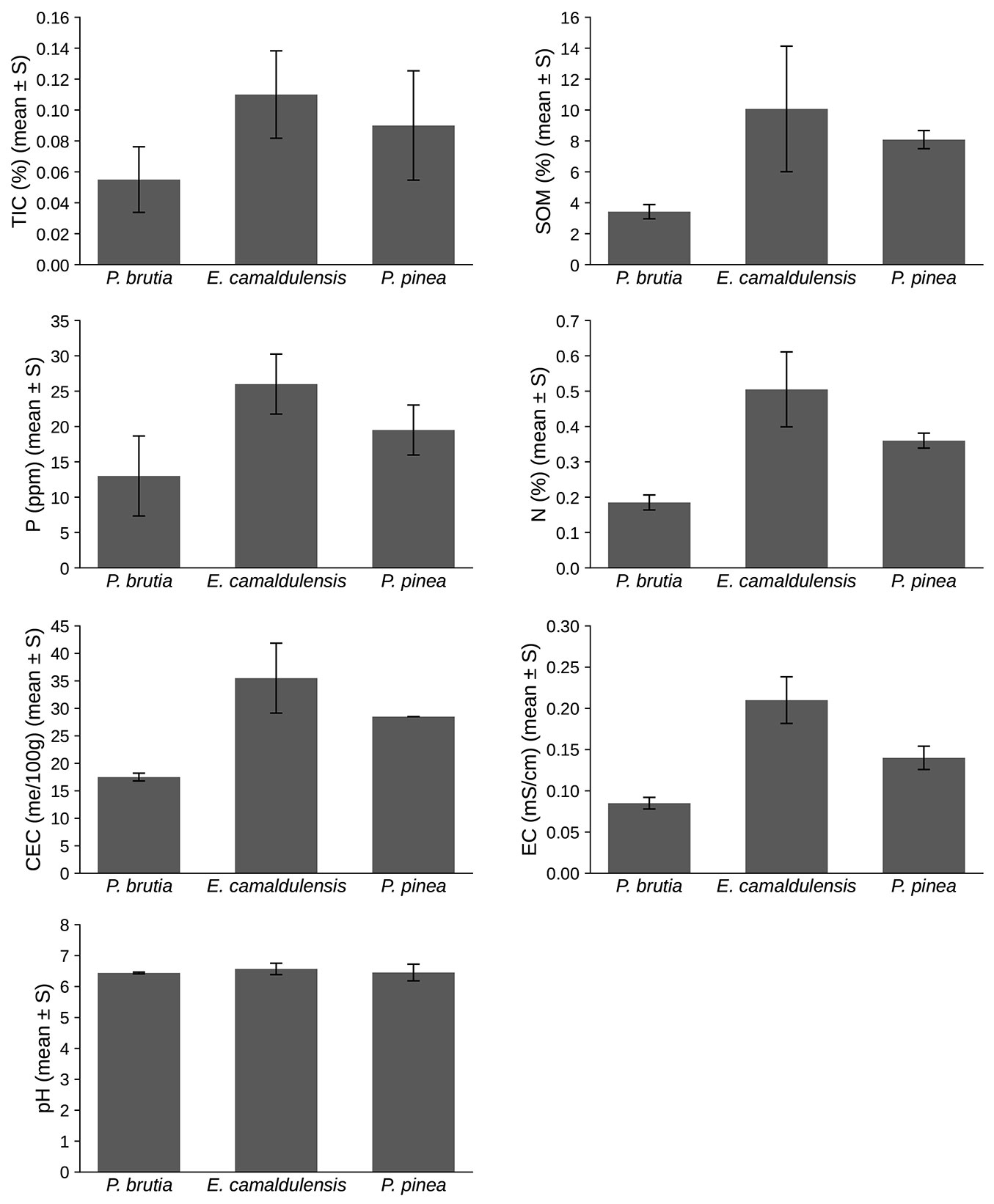
Physical and chemical properties of soil samples collected from plantation sites were analyzed. The study sites had two soil textures: sandy loam and sandy-clay loam. There was no significant variation in soil texture among the sites (Fig. 2). All soil parameters - including total inorganic carbonate, total soil organic matter, phosphorus, total nitrogen levels, cation exchange capacity, and electrical conductivity - were highest in E. camaldulensis soil and lowest in P. brutia soil. Soil acidity was similar across the stands, with pH ranging from 6.42 to 6.85 (Fig. 3).
Fig. 2 - The texture structure of soils collected from P. brutia, E. camaldulensis, and P. pinea plantation sites.
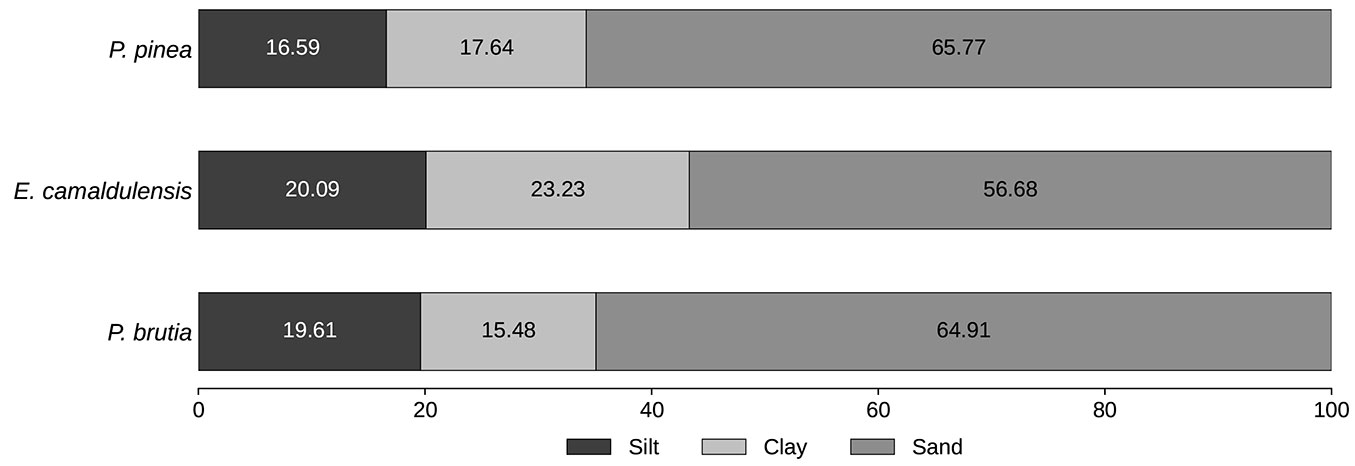
Fig. 3 - Total inorganic carbonate (TIC), total soil organic matter (SOM), phosphorus (P), total nitrogen levels (N), cation exchange capacity (CEC), electrical conductivity (EC), and pH values of soils collected from P. brutia, E. camaldulensis, and P. pinea plantation sites.
Discussion
This study aimed to compare plantation stands established with different species (E. camaldulensis, P. brutia, and P. pinea) in terms of understorey plant communities and soil structure, and to investigate the recolonization potential of P. brutia in plantation sites.
Plantations dominated by species such as Eucalyptus spp. have been identified as a cause of biodiversity reduction in the understorey, posing a significant challenge to the long-term sustainability of native ecosystems ([7], [28]). In this study, the understorey plant composition at the plantation sites was compared to determine whether changes in dominant tree species caused significant changes in the structure of the whole plant community. The results showed that this change did not substantially affect the composition of understorey woody plant species; no significant differences were detected among the plantation sites. Some plant species, such as Callicotome villosa, Cytisopsis dorycniifolia, Genista acanthoclada, Pistacia lentiscus, Pistacia terebinthus, Quercus coccifera and Smilax aspera, were found to be specific to a certain stand. However, these species are very common in eastern Mediterranean ecosystems.
The canopy cover of species used in plantations was estimated to assess temporal dominance across three sampling periods. The most notable finding was the significant increase in P. brutia canopy cover within the E. camaldulensis stand between the first and second sampling periods. P. brutia canopy cover increased from 2% to 52% over 6 years in the E. camaldulensis stand, a rate significantly higher than that observed even in P. brutia stand. However, in the third sampling period, canopy cover remained stable with no further change. The results highlight a high recruitment rate of native species in E. camaldulensis plantation stand 22 years after fire. Ecological conditions and abiotic factors in this area allowed P. brutia seeds from nearby native fragments to colonize the site, even in the presence of eucalypt trees. The successful establishment of a species depends not only on its inherent traits but also on the pre-existing community and the interactions between them ([41]). Recruitment is largely influenced by the species’ capacity to adapt to the site, recruitment abilities (seed germination and seedling development), and factors that either positively or negatively affect these processes, such as the presence of allelopathic chemicals and nutrient availability ([27]). While pine species are generally considered strong colonizers and better invaders than Eucalyptus ([12]), forests often provide less suitable environments for pine establishment than open habitats ([19]). Despite the heliophilous nature of P. brutia, which typically confines its establishment to open, well-illuminated areas ([45]), the species established well within E. camaldulensis stands. By comparison, eucalypt canopy cover increased more slowly than P. brutia. Water availability is a critical factor affecting seedling recruitment and survival of E. camaldulensis ([36]), and water scarcity can limit its growth in plantation stands ([47]). This aligns with expectations, as drought-resistant P. brutia ([43]) tends to outcompete the water-sensitive Eucalyptus species in low-altitude Mediterranean ecosystems characterized by a hot, dry summer period.
Favorable physical and chemical soil characteristics may have played a crucial role in the successful establishment of P. brutia within E. camaldulensis plantations. All evaluated parameters - total inorganic carbonate, total soil organic matter, phosphorus and total nitrogen levels of soil, cation exchange capacity, and electrical conductivity - were higher in E. camaldulensis plantation stands in comparison with other sites. Higher soil nutrient contents and exchangeable capacity enhance seed recruitment. Nutrient availability in the eucalypt stand soil likely influenced the recruitment of native species. Eucalypt has been shown to be more efficient than many other tree species, especially evergreens such as pines, at returning nutrients to the soil through litterfall and nutrients to the surface from deep in the soil (Anonymous 1992 in [33]). Consistent with this study, positive effects of soil nutrients provided by abundant decayed litter on native species recruitment have been reported in other eucalypt stands ([6]). Even in tropical ecosystems, eucalypt trees can act as nurse plants, effectively promoting natural regeneration and recovery of native species ([14]). These findings contrast with numerous studies highlighting the inhibitory effects of eucalypt litter on seedlings of other species ([16]). Studies performed in tropical forests have reported relatively poor organic carbon and total nitrogen levels in eucalypt plantation sites ([8]). Nevertheless, our findings support the hypothesis that eucalypt plantations can positively affect soil properties, enhancing the potential for native species recruitment and ecosystem restoration.
One of the primary objectives of this study was to examine the effects of allelopathic chemicals in the leaves of species used in plantations on seed germination of P. brutia. It is well established that eucalypt species contain allelochemicals with high biological activity ([31]). Previous research showed that eucalypt species possess allelopathic chemicals ([38]) that negatively affect critical plant growth parameters, including seed vigor, seedling length, water content, chlorophyll content, and cell survival ([26]). However, this study found no negative effect of E. camaldulensis on seed germination success of native species, consistent with findings from certain studies ([47]). Even in experiments using ethanol extracts, germination rates remained high, similar to those observed in soil experiments. In the soil experiments, P. brutia seedlings were more numerous in E. camaldulensis soil than in P. pinea soil. Nevertheless, contradictory results were observed regarding the dry weights of P. brutia. A study investigating the effects of eucalypt leaf extracts on cell division during seed germination and seedling development in P. brutia showed increased mitotic activity in seeds treated with eucalypt extracts. However, cytotoxic and genotoxic effects were also reported in the same experimental groups ([24]) and in other related studies ([5]). These findings suggest that the effects of eucalypt on seed germination remain inconclusive, consistent with previous studies that reported mixed results.
In contrast to the positive impacts of E. camaldulensis on P. brutia recruitment, experiments involving P. pinea and P. brutia showed negative results for the seed germination of P. brutia. Both leaf extract and soil experiments showed inhibitory effects on seed germination. The delayed colonization of P. brutia in the P. pinea plantation stand supported the findings regarding inhibitory allelopathic effects of P. pinea. Valera-Burgos et al. ([46]) previously highlighted the allelopathic influence of P. pinea needles on seed germination and seedling performance of Mediterranean shrubs, consistent with the results of this study. Similarly, Nakhoul et al. ([30]) emphasized the autotoxic allelopathic effect of aqueous extract from green needles on seed germination and seedling growth, potentially linked to quinic acid. However, despite the negative effects observed for P. pinea, seedlings grown in P. pinea soils had longer stems and higher dry weights. This finding may be attributed to the lower number of seedlings developing in P. pinea soils compared with other soils. A small number of seedlings in the same-size pot and within the same soil volume may benefit from a less competitive growth environment, allowing improved development compared with environments with high seedling densities. The inhibitory effects observed in treatments derived from P. brutia extracts may indicate auto-allelopathy, whereby compounds released from plant tissues suppress the germination or early establishment of conspecific individuals. Such auto-allelopathic effects have been reported in several conifer species and may help regulate recruitment patterns and stand density, particularly in systems with high litter accumulation ([19]). However, more comprehensive studies are needed to clarify the extent and ecological significance of potential autotoxic effects of P. brutia on conspecific seed germination and regeneration dynamics.
Conclusion
The results indicate that afforestation with different tree species, or changes in dominant tree species following fire, do not significantly shift the understorey woody plant community in post-fire P. brutia forests. Plant species adapted to Mediterranean climatic conditions and recurrent fire regimes can recolonize these areas regardless of changes in canopy dominance.
Canopy cover analyses showed that P. brutia successfully re-established and expanded its canopy within areas dominated by Eucalyptus camaldulensis. In contrast, its establishment was delayed in Pinus pinea plantations, most likely due to allelopathic effects associated with P. pinea. The relatively rapid recovery of P. brutia within E. camaldulensis stands may reflect improved soil conditions that facilitate seed germination and seedling establishment.
Current findings suggest that E. camaldulensis does not exhibit invasive behavior within post-fire P. brutia ecosystems in Southwestern Turkey, in contrast to invasive patterns documented in other ecological contexts. P. brutia demonstrated significant ecological resilience and robust recolonization potential, even in areas where it was initially replaced by other species following fire disturbance. Furthermore, the results indicate that small-scale eucalypt plantations may actually enhance soil organic matter and nutrient status. Consequently, in sites with severely degraded soils, these plantations could work as a strategic, temporary management tool to facilitate ecosystem recovery. However, the efficacy of recolonization appears heavily contingent on the landscape context, specifically plantation size and proximity to established P. brutia stands. In this study, the relatively small size of plantation patches and the surrounding forest matrix likely played a pivotal role in favoring recolonization. Despite these positive indicators, comprehensive long-term research is still required to fully optimize post-fire restoration and management strategies.
Acknowledgements
This study was supported by Burdur Mehmet Akif Ersoy University Scientific Research Projects Commission, Project No. 0293-NAP-16.
References
Gscholar
Gscholar
Gscholar
Gscholar
Gscholar
Gscholar
CrossRef | Gscholar
Gscholar
Gscholar
CrossRef | Gscholar
CrossRef | Gscholar
Gscholar
Gscholar
Gscholar
Authors’ Info
Authors’ Affiliation
Burdur Mehmet Akif Ersoy University, Faculty of Arts and Science, Department of Biology, Burdur (Turkey)
Corresponding author
Paper Info
Citation
Kaynas BY (2026). The impact of afforestation on vegetation, soil properties, and Pinus brutia Ten. recruitment in post-fire P. brutia forests. iForest 19: 421-428. - doi: 10.3832/ifor4833-019
Academic Editor
Davide Ascoli
Paper history
Received: Feb 18, 2025
Accepted: Jun 05, 2026
First online: Nov 12, 2026
Publication Date: Dec 31, 2026
Publication Time: 5.33 months
Copyright Information
© SISEF - The Italian Society of Silviculture and Forest Ecology 2026
Open Access
This article is distributed under the terms of the Creative Commons Attribution-Non Commercial 4.0 International (https://creativecommons.org/licenses/by-nc/4.0/), which permits unrestricted use, distribution, and reproduction in any medium, provided you give appropriate credit to the original author(s) and the source, provide a link to the Creative Commons license, and indicate if changes were made.

Web Metrics
Breakdown by View Type
Article Usage
Total Article Views: 61
(from publication date up to now)
Breakdown by View Type
HTML Page Views: 14
Abstract Page Views: 16
PDF Downloads: 29
Citation/Reference Downloads: 0
XML Downloads: 2
Web Metrics
Days since publication: 1
Overall contacts: 61
Avg. contacts per week: 427.00
Article Citations
Article citations are based on data periodically collected from the Clarivate Web of Science web site
(last update: Jul 2026)
(No citations were found up to date. Please come back later)
Publication Metrics
by Dimensions ©
Articles citing this article
List of the papers citing this article based on CrossRef Cited-by.
Related Contents
iForest Similar Articles
Research Articles
Post-fire recovery of the plant community in Pinus brutia forests: active vs. indirect restoration techniques after salvage logging
vol. 11, pp. 635-642 (online: 04 October 2018)
Review Papers
Climate change impacts on spatial distribution, tree-ring growth, and water use of stone pine (Pinus pinea L.) forests in the Mediterranean region and silvicultural practices to limit those impacts
vol. 14, pp. 104-112 (online: 01 March 2021)
Technical Reports
Post-fire forest management in southern Europe: a COST action for gathering and disseminating scientific knowledge
vol. 3, pp. 5-7 (online: 22 January 2010)
Review Papers
Impacts of climate change on the establishment, distribution, growth and mortality of Swiss stone pine (Pinus cembra L.)
vol. 3, pp. 82-85 (online: 15 July 2010)
Review Papers
Post-fire soil hydrology, water erosion and restoration strategies in Andosols: a review of evidence from the Canary Islands (Spain)
vol. 9, pp. 583-592 (online: 17 March 2016)
Short Communications
Growth of Stone pine (Pinus pinea L.) European provenances in central Chile
vol. 10, pp. 64-69 (online: 29 August 2016)
Research Articles
Amount and distribution of coarse woody debris in pine ecosystems of north-western Spain, Russia and the United States
vol. 7, pp. 53-60 (online: 28 October 2013)
Research Articles
Allometric equations to assess biomass, carbon and nitrogen content of black pine and red pine trees in southern Korea
vol. 10, pp. 483-490 (online: 12 April 2017)
Research Articles
Addressing post-transplant summer water stress in Pinus pinea and Quercus ilex seedlings
vol. 8, pp. 348-358 (online: 16 September 2014)
Short Communications
Upscaling the estimation of surface-fire rate of spread in maritime pine (Pinus pinaster Ait.) forest
vol. 7, pp. 123-125 (online: 13 January 2014)
iForest Database Search
Search By Author
Search By Keyword
Google Scholar Search
Citing Articles
Search By Author
Search By Keywords
PubMed Search
Search By Author
Search By Keyword