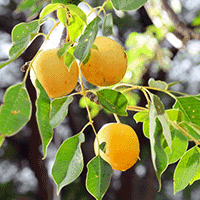
The potential of the marula tree, Sclerocarya birrea, (A. Rich.) Horchst subspecies litterfall in enhancing soil fertility and carbon storage in drylands
Abubakari H Munna (1) , Nyambilila A Amuri (1), Dino A Woiso (2), Proches Hieronimo (3)
iForest - Biogeosciences and Forestry, Volume 18, Issue 6, Pages 366-374 (2025)
doi: https://doi.org/10.3832/ifor4478-018
Published: Dec 07, 2025 - Copyright © 2025 SISEF
Research Articles
Abstract
The potential of Sclerocarya birrea subspecies as native trees to improve agricultural productivity and combat global warming through carbon storage has not been fully explored, despite their extensive distribution across global drylands. The objective of this study was to determine the potential of litterfall from Sclerocarya birrea subspecies to improve soil organic carbon (OC) and fertility, and carbon storage in drylands. Leaf and fruit litterfall samples, comprising 18 samples for each subspecies, from nine trees of subspecies birrea, caffra, and multifoliata were collected in Tanzania. Soil samples were collected under and away from the canopies of the selected trees. The soil pH and the concentrations of organic carbon (OC) and nutrients (total Nitrogen - TN, P, K, Ca, Mg, Na, Cu, Zn, Fe, Mn, S) in the soil, fruit, and leaf litterfall were determined using standard laboratory methods of analysis. The results showed that leaf OC in S. birrea subspecies ranged from 41.16% to 43.49%, and TN from 1.01% to 1.19%. The C:N ratio ranged from 34.58% to 41.66% in leaf, and from 52.73% to 75.12% in fruit litterfall. Phosphorus was significantly higher in fruit (0.17-0.20%) than in leaf (0.02-0.04%) for all subspecies. Ca and Mg were higher in leaf litterfall (0.54-0.89% Ca and 0.19-0.27% Mg), than in fruit litterfall (0.08-0.11% Ca and 0.10% Mg). Cu, Fe, and Mn concentrations were significantly higher in fruit, ranging from 11.71 to 31.42 mg kg-1, 214.13 to 400.59 mg kg-1, and 31.42 to 54.77 mg kg-1, respectively, than in leaf with 3.32 to 4.39 mg kg-1, 64.10 to 107.70 mg kg-1, and 16.08 to 18.97 mg kg-1, respectively. Contrastingly, Zn in leaf ranged from 412.97 in multifoliata to 499.78 mg kg-1 in caffra, which was 33 to 46 times higher than in fruit litterfall. Soils under the canopies of subsp. birrea, caffra, and multifoliata had significantly higher OC and K, Na, and S (p < 0.05), and numerically higher concentrations of most nutrients than soils away from the canopies. We concluded that leaf and fruit litterfall of the Sclerocarya birrea subspecies can improve soil fertility and carbon storage in drylands if managed properly.
Keywords
Climate Change, C:N Ratio, Carbon Sequestration, Food Security, Agroforestry, Litterfall Quality, Soil Amendment
Authors’ Info
Authors’ address
Nyambilila A Amuri 0000-0003-3092-3458
Department of Soil and Geological Sciences, Sokoine University of Agriculture, P.O. Box 3008, Chuo Kikuu, Morogoro (Tanzania)
Department of Biosciences, Sokoine University of Agriculture, P.O. Box 3038, Chuo Kikuu, Morogoro (Tanzania)
Department of Agricultural Engineering, Sokoine University of Agriculture, P.O. Box 3003, Chuo Kikuu, Morogoro (Tanzania)
Corresponding author
Paper Info
Citation
Munna AH, Amuri NA, Woiso DA, Hieronimo P (2025). The potential of the marula tree, Sclerocarya birrea, (A. Rich.) Horchst subspecies litterfall in enhancing soil fertility and carbon storage in drylands. iForest 18: 366-374. - doi: 10.3832/ifor4478-018
Academic Editor
Emilia Allevato
Paper history
Received: Sep 28, 2023
Accepted: Jun 05, 2025
First online: Dec 07, 2025
Publication Date: Dec 31, 2025
Publication Time: 6.17 months
Copyright Information
© SISEF - The Italian Society of Silviculture and Forest Ecology 2025
Open Access
This article is distributed under the terms of the Creative Commons Attribution-Non Commercial 4.0 International (https://creativecommons.org/licenses/by-nc/4.0/), which permits unrestricted use, distribution, and reproduction in any medium, provided you give appropriate credit to the original author(s) and the source, provide a link to the Creative Commons license, and indicate if changes were made.

Web Metrics
Breakdown by View Type
Article Usage
Total Article Views: 3972
(from publication date up to now)
Breakdown by View Type
HTML Page Views: 890
Abstract Page Views: 1830
PDF Downloads: 1102
Citation/Reference Downloads: 1
XML Downloads: 149
Web Metrics
Days since publication: 292
Overall contacts: 3972
Avg. contacts per week: 95.22
Citation Metrics
Article Citations
Article citations are based on data periodically collected from the Clarivate Web of Science web site
(last update: Jul 2026)
Total number of cites (since 2025): 1
Average cites per year: 0.50
Publication Metrics
by Dimensions ©
Articles citing this article
List of the papers citing this article based on CrossRef Cited-by.
References
Nitrogen-total. In: “Methods of Soil Analysis. Part 2. Chemical and Microbiological Properties” (Page AL, Miller RH, Keeney DR eds). American Society of Agronomy, Soil Science Society of America, Madison, WI, USA, pp. 595-624.
Gscholar
Sclerocarya birrea: a monograph. Publication no. 19, School of Agriculture and Forest Science, University of Wales, Bangor, UK, pp. 157.
Gscholar
Mineral nutrition of high plants. Academic Press, San Diego, CA, USA, pp. 330-355.
Gscholar
Soil pH and lime requirement. In: “Methods of Soil Analysis, Part 2. Chemical and Mineralogical Properties” (Page AL, Miller RH, Keeny DR eds). Agronomy Monograph no. 9, American Society of Agronomy and Soil Science Society of America, USA, pp. 199-224.
Gscholar
The use of the DRASTIC-LU/LC model for assessing groundwater vulnerability to nitrate contamination in Morogoro Municipality, Tanzania. Earth 3 (4): 1161-1184.
Gscholar
SOil and plant analysis manual (Revised Edition). The Royal Veterinary and Agricultural University, Chemistry Department, Copenhagen, Denmark. pp. 133.
Gscholar
The right tree in the right place: predicting and mapping global-scale suitable areas for marula tree, Sclerocarya birrea (A. Rich.) Horchst. subspecies cultivation, conservation, and use in restoring global drylands. Frontiers of Biogeography 15 (4): e60181.
CrossRef | Gscholar
Total carbon, organic carbon, and organic. In: “Methods of Soil Analysis, Part 2. Chemical and Microbiological Properties” (Page AL, Miller RH, Keeny DR eds). American Society of Agronomy, Madison, WI, USA, pp. 539- 579.
Gscholar
Laboratory methods of soil and plant analysis: a working manual (2nd edn). Sacred Africa 21: 25-26.
Gscholar
The effects of canopy cover on throughfall and soil chemistry in two forest sites in the México City air basin. Atmósfera 21 (1): 83-100.
Gscholar
Trees on farms for livelihoods, conservation of biodiversity and carbon storage: evidence from Nicaragua on this “invisible” resource. In: “Integrating Landscapes: Agroforestry for Biodiversity Conservation and Food Sovereignty”. Springer International Publishing, Cham, Switzerland, pp. 369-393.
Gscholar
Exchangeable cations. Methods of soil analysis, Part 2. Chemical and microbiological properties (2nd edn) (Page AL ed). American Society of Agronomy, Soil Science Society of America, Madison, WI, USA, pp. 159-165.
Gscholar
Litterfall production, decomposition, and litter nutrient contents in a mined area revegetated with different forest species. Revista Brasileira de Ciência do Solo 47: e0220 122.
CrossRef | Gscholar
Related Content
Crous-Duran J, Graves AR, Garcia-de-Jalón S, Paulo JA, Tomé M, Palma JH
Vol. 12, pp. 85-91 (online: Feb 2019)
Andivia E, Bou J, Fernández M, Caritat A, Alejano R, Vilar L, Vázquez-Piqué J
Vol. 11, pp. 786-793 (online: Dec 2018)
Zhen L, Deng X, Wei Y, Jiang Q, Lin Y, Helming K, Wang C, König HJ, Hu J
Vol. 7, pp. 372-384 (online: Dec 2014)
Alberti G, Vicca S, Inglima I, Belelli-Marchesini L, Genesio L, Miglietta F, Marjanovic H, Martinez C, Matteucci G, D’Andrea E, Peressotti A, Petrella F, Rodeghiero M, Cotrufo MF
Vol. 8, pp. 195-206 (online: Apr 2015)
Tognetti R, Cherubini P
Vol. 2, pp. 56-58 (online: Mar 2009)
Sariyildiz T, Savaci G, Kravkaz IS
Vol. 9, pp. 165-170 (online: Feb 2016)
Horváth M, Bečvárová PH, Šarapatka B, Vencálek O, Zouhar V
Vol. 14, pp. 320-328 (online: Aug 2021)
Da Silva AM, Braga Alves C, Alves SH
Vol. 3, pp. 124-129 (online: Sep 2010)
Becvárová P, Horváth M, Sarapatka B, Zouhar V
Vol. 11, pp. 734-742 (online: Dec 2018)

Ramírez-Martínez A, González-Guillén MDJ, De Los Santos-Posadas HM, Ángeles-Pérez G, Santiago-García W
Vol. 14, pp. 413-420 (online: Oct 2021)