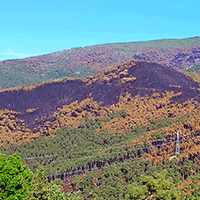
Wildfire incidence in Spanish Natura 2000 sites is largely explained by forest land cover
Álvaro Enríquez-de-Salamanca (1-2)
iForest - Biogeosciences and Forestry, Volume 19, Issue 3, Pages 195-200 (2026)
doi: https://doi.org/10.3832/ifor5146-019
Published: Jun 04, 2026 - Copyright © 2026 SISEF
Research Articles
Abstract
The relationship between wildfires and protected areas remains controversial in Mediterranean regions, where several studies have reported a disproportionate incidence of fires within protected sites. Using data from the European Forest Fire Information System, 8.241 wildfires recorded in Spain between 2008 and 2025 were analyzed to assess whether wildfire incidence in Natura 2000 sites is primarily associated with protection status or with land-use structure, particularly forest land cover. Indicators of burnt area for total land and forest land at the national level and within the Natura 2000 network were calculated by aggregating wildfire perimeters and their distribution across forest land and Natura 2000 areas, and expressed as proportional indicators to enable direct comparison between spatial units. Additionally, correlation analyses between burnt area variables and Mann-Kendall tests to assess temporal trends in burnt area were applied. Natura 2000 sites accounted for 38.6% of the burnt area in Spain and 40.6% of the burnt forest land. Although the proportion of burnt area relative to total territory was higher within Natura 2000 than nationally (4.9% vs. 3.5%), this difference was largely explained by the higher share of forest land in protected sites (80.9% vs. 54.4%). When considering forest land only, the proportion of burnt area in Natura 2000 was slightly lower than the national average (5.4% vs. 5.9%). Significantly increasing trends in burnt area were detected in both protected and non-protected areas using the Mann-Kendall test. These results suggest that apparent differences in wildfire incidence between protected and non-protected areas are largely attributable to land-use composition rather than to protection status itself, highlighting the importance of explicitly accounting for landscape structure when interpreting wildfire statistics.
Keywords
Wildfires, Natura 2000, Forest Land, Land-use Structure, Protected Areas, Spain
Authors’ Info
Authors’ address
Department of Biodiversity, Ecology and Evolution, Faculty of Biological Sciences, Complutense University of Madrid, c/ José Antonio Novais, 12, 28040 Madrid (Spain)
Draba Ingeniería y Consultoría Medioambiental, c/ Cañada Nueva 29, 28200 San Lorenzo de El Escorial (Spain)
Corresponding author
Paper Info
Citation
Enríquez-de-Salamanca Á (2026). Wildfire incidence in Spanish Natura 2000 sites is largely explained by forest land cover. iForest 19: 195-200. - doi: 10.3832/ifor5146-019
Academic Editor
Rafael Da Silveira Bueno
Paper history
Received: Jan 30, 2026
Accepted: May 08, 2026
First online: Jun 04, 2026
Publication Date: Jun 30, 2026
Publication Time: 0.90 months
Copyright Information
© SISEF - The Italian Society of Silviculture and Forest Ecology 2026
Open Access
This article is distributed under the terms of the Creative Commons Attribution-Non Commercial 4.0 International (https://creativecommons.org/licenses/by-nc/4.0/), which permits unrestricted use, distribution, and reproduction in any medium, provided you give appropriate credit to the original author(s) and the source, provide a link to the Creative Commons license, and indicate if changes were made.

Web Metrics
Breakdown by View Type
Article Usage
Total Article Views: 1409
(from publication date up to now)
Breakdown by View Type
HTML Page Views: 285
Abstract Page Views: 493
PDF Downloads: 595
Citation/Reference Downloads: 0
XML Downloads: 36
Web Metrics
Days since publication: 52
Overall contacts: 1409
Avg. contacts per week: 189.67
Citation Metrics
Article Citations
Article citations are based on data periodically collected from the Clarivate Web of Science web site
(last update: Mar 2025)
(No citations were found up to date. Please come back later)
Publication Metrics
by Dimensions ©
Articles citing this article
List of the papers citing this article based on CrossRef Cited-by.
References
Por qué se queman nuestros bosques? Decálogo para entender la problemática de los incendios forestales en España [Why are our forests burning? Ten commandments to understand the problem of forest fires in Spain]. Artemisan Fundación, Ciudad Real, Spain, pp. 20. [in Spanish]
Online | Gscholar
Advance report on forest fires in Europe, Middle East and North Africa 2023. JRC Technical Report, European Union, Luxembourg, pp. 36.
CrossRef | Gscholar
Related Content
Corona P, Barbati A, Tomao A, Bertani R, Valentini R, Marchetti M, Fattorini L, Perugini L
Vol. 5, pp. 204-209 (online: Aug 2012)
Cantarello E, Newton A
Vol. 1, pp. 75-80 (online: Feb 2008)
Zhen L, Deng X, Wei Y, Jiang Q, Lin Y, Helming K, Wang C, König HJ, Hu J
Vol. 7, pp. 372-384 (online: Dec 2014)
Mairota P, Buckley P, Suchomel C, Heinsoo K, Verheyen K, Hédl R, Terzuolo PG, Sindaco R, Carpanelli A
Vol. 9, pp. 560-568 (online: Aug 2016)
Jablonski M, Korhonen KT, Budniak P, Mionskowski M, Zajaczkowski G, Sućko K
Vol. 10, pp. 315-321 (online: Feb 2017)
Coskuner KA
Vol. 15, pp. 85-94 (online: Apr 2022)
Neris J, Santamarta JC, Doerr SH, Prieto F, Agulló-Pérez J, García-Villegas P
Vol. 9, pp. 583-592 (online: Aug 2016)
Kutnar L, Eler K, Marinšek A
Vol. 9, pp. 318-324 (online: Apr 2016)
Lukić S, Baumgertel A, Obradović S, Kadović R, Beloica J, Pantić D, Miljković P, Belanović Simić S
Vol. 15, pp. 163-170 (online: Jun 2022)
Ponce-Calderón LP, Rodríguez-Trejo DA, Villanueva-Díaz J, Bilbao BA, Álvarez-Gordillo GDC, Vera-Cortés G
Vol. 14, pp. 548-559 (online: Dec 2021)