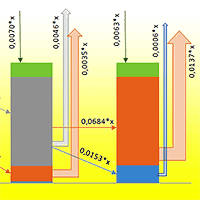
Impact of the four-eyed fir bark beetle (Polygraphus proximus Blandf.) on coarse woody debris stock and carbon budget of fir forests in Central Siberia
Liudmila Mukhortova (1) , Oxana Sergeeva (2), Denis Demidko (1), Leonid Krivobokov (1), Yury Baranchikov (1)
iForest - Biogeosciences and Forestry, Volume 19, Issue 3, Pages 209-218 (2026)
doi: https://doi.org/10.3832/ifor4882-018
Published: Jun 08, 2026 - Copyright © 2026 SISEF
Research Articles
Abstract
In the boreal forests of Central Siberia, a marked increase in tree mortality caused by the invasive four-eyed fir bark beetle (Polygraphus proximus Blandf.) has raised concerns about its impact on forest carbon dynamics. This study aims to quantify changes in coarse woody debris (CWD) stocks and their associated carbon fluxes under different levels of beetle infestation. Using systematic field surveys across infestation gradients, we measured CWD accumulation and decomposition by component (snags, logs, and stumps). Our results show that CWD stocks varied significantly, ranging from 68.1 to 179.9 Mg ha-1, with the highest amounts observed in the most heavily infested areas. In particular, the proportion of carbon stored in snags increased with infestation severity. Furthermore, our analysis of decomposition rates based on empirical data indicates accelerated carbon dioxide emissions from CWD in severely damaged stands. These findings underline the substantial impact of bark beetle outbreaks on the carbon storage capacity of fir forests and highlight the need for management strategies that account for pest effects on forest carbon budgets. This study contributes to a better understanding of pest-induced changes in forest ecosystems and supports the refinement of carbon dynamics models for boreal forests.
Keywords
Forest Carbon Dynamics, Bark Beetle Impact, Boreal Forest Ecology, Coarse Woody Debris Dynamics, Decomposition Rate, Siberian Fir Ecosystems
Authors’ Info
Authors’ address
Denis Demidko 0000-0001-6538-9828
Leonid Krivobokov 0000-0003-4105-6281
Yury Baranchikov 0000-0002-2472-7242
V.N. Sukachev Institute of Forest SB RAS, Federal Research Center “Krasnoyarsk Science Center SB RAS”, Krasnoyarsk, 660036 (Russian Federation)
Siberian Federal University, Krasnoyarsk, 660041 (Russian Federation)
Corresponding author
Paper Info
Citation
Mukhortova L, Sergeeva O, Demidko D, Krivobokov L, Baranchikov Y (2026). Impact of the four-eyed fir bark beetle (Polygraphus proximus Blandf.) on coarse woody debris stock and carbon budget of fir forests in Central Siberia. iForest 19: 209-218. - doi: 10.3832/ifor4882-018
Academic Editor
Matteo Marchioro
Paper history
Received: Apr 15, 2025
Accepted: Dec 06, 2025
First online: Jun 08, 2026
Publication Date: Jun 30, 2026
Publication Time: 6.13 months
Copyright Information
© SISEF - The Italian Society of Silviculture and Forest Ecology 2026
Open Access
This article is distributed under the terms of the Creative Commons Attribution-Non Commercial 4.0 International (https://creativecommons.org/licenses/by-nc/4.0/), which permits unrestricted use, distribution, and reproduction in any medium, provided you give appropriate credit to the original author(s) and the source, provide a link to the Creative Commons license, and indicate if changes were made.

Web Metrics
Breakdown by View Type
Article Usage
Total Article Views: 1544
(from publication date up to now)
Breakdown by View Type
HTML Page Views: 409
Abstract Page Views: 572
PDF Downloads: 491
Citation/Reference Downloads: 1
XML Downloads: 71
Web Metrics
Days since publication: 101
Overall contacts: 1544
Avg. contacts per week: 107.01
Citation Metrics
Article Citations
Article citations are based on data periodically collected from the Clarivate Web of Science web site
(last update: Jul 2026)
(No citations were found up to date. Please come back later)
Publication Metrics
by Dimensions ©
Articles citing this article
List of the papers citing this article based on CrossRef Cited-by.
References
Carbon storage in forests and peatlands of Russia. General Technical Report NE-244, USDA Forest Service, Northeastern Research Station, Radnor, PA, USA, vol. 137, pp. 244.
Gscholar
Woody plants of Russian forests: list of species and state accounting of biodiversity of forest resources. V. N. Sukachev Institute of Forest SB RAS, Krasnoyarsk, Russia, pp. 181.
Gscholar
Landscape-based farming system of the Krasnoyarsk Territory: scientific and practical recommendations. Polikor Publishing House, Krasnoyarsk, Russia, pp. 591.
Gscholar
In pursuit of the four-eyed fir bark beetle Polygraphus proximus Blandf. Ecology of Southern Siberia and adjacent territories 15 (1): 52-54.
Gscholar
The four-eyed fir bark beetle is a new aggressive pest of fir in Siberia. Lesnoj Vestnik/ Forestry Bulletin 4: 78-81.
Gscholar
Dynamics of Siberian fir dieback in the outbreak area of the four-eyed fir bark beetle. Lesnoj Vestnik / Forestry Bulletin 18: 132-138.
Gscholar
Results of monitoring studies of the condition of fir forests in chronic foci of mass reproduction of the four-eyed fir bark beetle (on the example of the Tomsk Region). Interexpo Geo-Siberia 3: 230-234.
Gscholar
First record of Polygraphus proximus (Coleoptera, Scolytidae) in Moscow Province. Bulletin of the Moscow Society of Naturalists 113: 39-42.
Gscholar
Peculiarities of forest regeneration processes in fir forest caused by transformation of their micro mosaic organization by Polygraphus proximus Bland. Vestnik of Volga State University of Technology, Series “Forest, Ecology, Nature Management”, vol. 1, pp. 5-16. [in Russian]
CrossRef | Gscholar
Decay of Siberian fir trees at the initial stages of development of foci of mass reproduction of the four-eyed fir bark beetle. In: Proceedings of the “Ecology: Facts, Hypotheses, Models”. IERIZh Ural Branch of the Russian Academy of Sciences, 10-13 Apr 2018. Reaction, Ekaterinburg, Russia, pp. 34.
Gscholar
Four-eyed fir bark beetle on the territory of Russia. Plant Protection and Quarantine 11: 32-34.
Gscholar
The fate of dead spruce on the Kenai Peninsula: a preliminary report. Technical Paper R10-TP-134, USDA Forest Service, Anchorage, AK, USA, pp. 23.
Gscholar
Carbon accumulation in dead wood of larch forests of Northern Taiga and Central Siberia. Lesnoe Khoziaystvo 5: 33-34.
Gscholar
Carbon budget in the dark coniferous forests of the southern taiga. PhD thesis, Krasnoyarsk, Russia, pp. 20.
Gscholar
Overview of the current secondary range of the four-eyed fir bark beetle (Polygraphus proximus Blandford) in the Russian Federation. Russian Journal of Biological Invasions 15: 180-197.
CrossRef | Gscholar
The potential threats posed by the invasive bark beetle Polygraphus proximus (Coleoptera, Curculionidae: Scolytinae) to a natural park in the Middle Urals (Russia). Acta Biologica Sibirica 10: 661-675.
CrossRef | Gscholar
Simultaneous determination of total C and N content in peat soils using the anstet method, modification Ponomareva and Nikolaeva. In: “Methods of Determination of Humus Content and Composition in Soils (Mineral and Peat)”. Nauka, Leningrad, Russia, pp. 79-83.
Gscholar
Can outbreaks of dendrophagous insects make a considerable impact on the biosphere? Biosphere 1 (1): 71-81.
Gscholar
Changes of phytocenosis understories of fir forests in the breeding grounds of four-eyed fir bark beetle (Polygraphus proximus Blandf.) in the Krasnoyarsk Territory. Bulletin of Higher Educational Institutions, Lesnoj Zhurnal / Russian Forestry Journal 2: 67-84. [in Russian]
CrossRef | Gscholar
Polygraphus proximus in the Krasnoyarsk territory. In: “Invasive Dendrophilous Organisms: Challenges and Protection Operations”. All-Russian Research Institute of Silviculture and Mechanization of Forestry, Pushkino, Russia, pp. 104-109.
Gscholar
Estimation of detritus decomposition rate in forests of the Leningrad Region. Proceedings of the Saint Petersburg Forestry Research Institute 1: 31-45.
Gscholar
Methods of dendrochronology. Part I. Fundamentals of dendrochronology. Collecting and receiving tree-ring information: educational and methodological allowance. Publishing House of Krasnoyarsk State University, Krasnoyarsk, Russia, pp. 80.
Gscholar
The assessment of the carbon pool in coarse woody debris in Russian forests, with account of the influence of fires and felling operations. Lesovedenie 4: 3-15.
Gscholar
Related Content
Petrillo M, Cherubini P, Sartori G, Abiven S, Ascher J, Bertoldi D, Camin F, Barbero A, Larcher R, Egli M
Vol. 9, pp. 154-164 (online: Feb 2016)
Tavankar F, Nikooy M, Picchio R, Venanzi R, Lo Monaco A
Vol. 10, pp. 652-658 (online: Jun 2017)
Duračiová R, Muňko M, Barka I, Koreň M, Resnerová K, Holuša J, Blaženec M, Potterf M, Jakuš R
Vol. 13, pp. 215-223 (online: Jun 2020)
Marzano R, Lingua E, Garbarino M
Vol. 5, pp. 93-100 (online: Jun 2012)
Fidej G, Mikoš M, Rugani T, Jež J, Kumelj Š, Diaci J
Vol. 8, pp. 73-81 (online: Feb 2015)
Majdák A, Jakuš R, Blaženec M
Vol. 14, pp. 203-211 (online: Jun 2021)
Ponce-Calderón LP, Rodríguez-Trejo DA, Villanueva-Díaz J, Bilbao BA, Álvarez-Gordillo GDC, Vera-Cortés G
Vol. 14, pp. 548-559 (online: Dec 2021)
Kermavnar J, Kutnar L, Pintar AM
Vol. 16, pp. 105-115 (online: Apr 2023)
Herrero C, Krankina O, Monleon VJ, Bravo F
Vol. 7, pp. 53-60 (online: Feb 2014)
Neves NM, Paula RR, Araujo EA, Gorsani RG, Abreu KMPD, Kunz SH
Vol. 15, pp. 8-15 (online: Feb 2022)